
Your AI chatbot just told a customer with a burst pipe to "schedule an appointment for next week." Meanwhile, you can't afford a receptionist to answer phones around the clock, so 74.1% of calls go to voicemail anyway.
Sound familiar?
Pure AI frustrates customers who need real help right now. Pure human staffing is financially impossible for most small businesses. But here's the thing: you don't have to choose between them.
This guide explains AI-human hybrid customer service and why it's becoming the dominant approach for businesses of all sizes. You'll see real data on what percentage of calls AI can handle versus what needs human judgment, how smart escalation works, and how to implement hybrid service without enterprise budgets.
What Is AI-Human Hybrid Customer Service?
AI-human hybrid customer service means AI handles routine interactions while humans manage complex, emotional, or emergency situations. This isn't AI with occasional smart forwarding as an afterthought. It's a designed system where each handles what they do best.
The Middle Ground Between AI and Human
Think of hybrid service as a smart front door. AI answers every call, assesses what the customer needs, and either resolves it immediately or routes to a human. The customer gets instant response for simple questions and real human help for serious issues.
How Hybrid Differs from AI-Only
AI-only systems try to handle everything, and they fail predictably. They can't detect the difference between "my faucet drips" and "water is flooding my basement right now." They frustrate customers stuck in loops with no escape to a real person.
According to Accenture research, 64% of customers say companies have lost the human element of customer service. That's what happens when AI-only becomes the only option.
How Hybrid Differs from Human-Only
Human-only means staffing costs, limited hours, and capacity constraints. The math doesn't work for most small businesses. A full-time customer service representative costs $36,920 per year according to the Bureau of Labor Statistics. Even then, one person can only answer one call at a time, and they're not available at 2 AM when a customer's basement floods.
Why the Industry Is Moving to Hybrid
Gartner predicts 80% of customer service organizations will apply generative AI technology by 2025. By 2028, 30% of Fortune 500 will offer service through only a single AI-enabled channel.
The business process automation market is growing from $13.7B to $41.8B by 2033. AI-related tasks on Zapier have grown 760% in just 2 years. Industry research shows high-performing service teams already use AI to assist human agents.
The industry learned the hard way that "replace humans with AI" was the wrong approach. Hybrid is the correction.
Why Pure AI or Pure Human Doesn't Work Alone
Let's look at why either extreme fails, and why small businesses end up stuck between them.
The AI-Only Failure Point
AI-only systems can't detect true emergencies versus routine requests. Here's an actual example from our call analysis:
"This is an emergency, I have water flooding my basement right now."
An AI-only system might respond with "I can help you schedule an appointment. What day works for you?" That customer is furious, calling competitors, and telling everyone about their experience.
AI also can't handle angry or frustrated customers who need empathy. It can't discuss complex projects that require back-and-forth conversation. It can't make judgment calls about unusual requests.
The Human-Only Cost Problem
Human-only means hiring staff. At the median customer service salary of $36,920, that's over $3,000 per month for one person who works 40 hours per week. They're not there at 7 PM Friday when a customer calls about a Monday emergency.
The result? In our analysis of 130,175 calls from 45 contractors over 7 months, we found 74.1% of calls go completely unanswered. That translates to $189,068 lost per contractor annually from missed opportunities.
You can't afford full-time staff, but you also can't afford to miss 74% of calls.
The 74% Missed Call Crisis
Let me put this in perspective. If your business gets 42 calls per month (the industry average), and 74.1% go unanswered, that's 31 missed calls monthly. Some are spam. Some are price shoppers. But some are customers ready to book, emergencies that need immediate help, and high-value projects you'll never know about.
Each missed call is a customer who called you first, got voicemail, and moved on.
What Customers Actually Want
Zendesk's 2024 research found 73% of customers want the option to speak with a human, even when AI is available. PwC research shows 82% of consumers want more human interaction in customer service.
But they also want instant response. They don't want to leave a voicemail and wait three hours. They want fast answers for simple questions AND human help when they need it.
That's exactly what hybrid delivers.
What AI Should Handle vs. What Humans Should Handle
The key to effective hybrid service is knowing exactly which calls AI can resolve and which need human judgment. Here's what the data shows.
The 80/20 Rule of Hybrid Service
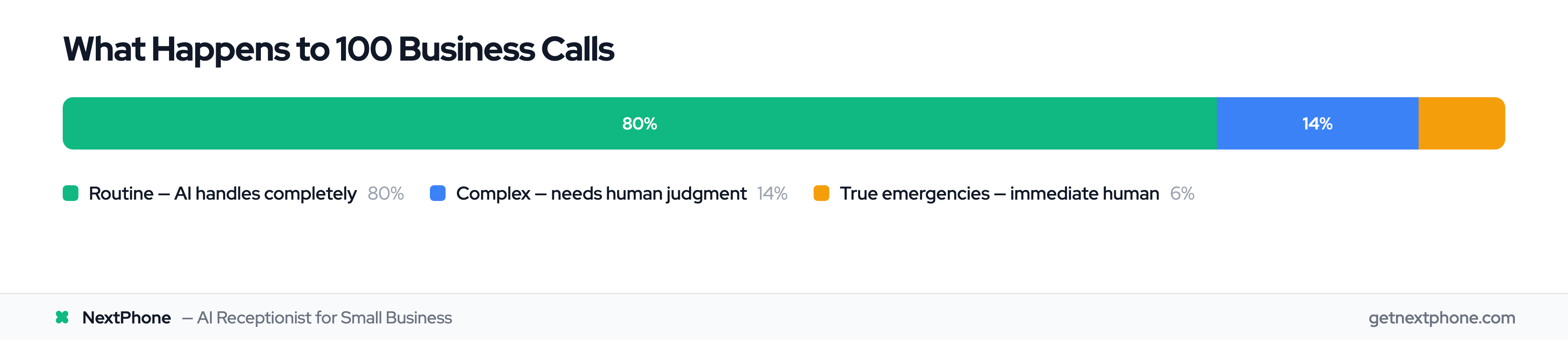
Harvard Business Review research found AI handles 80% of routine inquiries effectively, but complex issues require human judgment.
Our own analysis of 130,175 calls supports this breakdown:
- Approximately 80% were routine inquiries AI can handle completely
- About 14% involved complexity requiring human conversation
- 6.2% were true emergencies requiring immediate human intervention
Tasks AI Handles Best
AI excels at predictable, information-based interactions:
-
Routine Information Requests
-
"What are your hours?"
-
"Do you service my area?"
-
"What's your pricing for basic AC repair?"
-
Simple Scheduling
-
"I need to schedule an appointment for next week"
-
"Can you come out Tuesday afternoon?"
-
"I need to reschedule my Thursday appointment"
-
Administrative Tasks
-
Appointment confirmations and reminders
-
Checking appointment status
-
Basic FAQ responses
-
After-hours information requests
Spam Filtering Our data shows 7% of incoming calls are spam or robocalls. AI filters these automatically so humans never waste time on them.
Tasks That Require Human Judgment
Humans excel at situations requiring empathy, expertise, or authority:
-
Emergencies (6.2% of calls)
-
"Water is flooding my basement right now"
-
"No heat in my house and it's 15 degrees outside"
-
"I smell gas"
-
Emotional Situations
-
"I'm extremely frustrated with the service I received"
-
"This is the third time I've called about this issue"
-
Customers who are clearly upset or angry
-
Complex Discussions
-
"I want to discuss a complete kitchen renovation"
-
"I have questions about a complicated project"
-
Multiple-phase jobs requiring consultation
-
High-Stakes Decisions
-
Complaints requiring resolution authority
-
Large projects where customers expect personal attention
-
VIP customers who should always reach a human
How to Filter Spam and Save Human Time
Here's an underappreciated benefit of hybrid service: AI handles the 7% of calls that are spam, robocalls, and solicitations. Your human time goes to real customers, not to pressing "2 to be removed from our list."
That's 7% of call volume that never reaches a human, freeing them for the calls that actually matter.
How Escalation from AI to Human Works
The magic of hybrid service is seamless escalation. When AI recognizes a call needs human attention, the handoff should feel natural, not jarring.
Trigger-Based Escalation
AI monitors conversations for signals that indicate human intervention is needed:
Keyword Triggers Words and phrases that immediately indicate escalation: "emergency," "urgent," "flooding," "manager," "speak to someone," "this is serious"
Sentiment Triggers AI can detect frustration, anger, and confusion through tone, word choice, and conversation patterns
Complexity Triggers Multiple questions in one call, unusual requests AI wasn't configured for, or topics outside AI's knowledge base
Direct Requests Customer simply says "Let me talk to a human" or "I need to speak with a real person"
Configured Rules VIP customers, high-value inquiry types, or specific topics you've designated for human handling
The Handoff Process
A smooth escalation looks like this:
- AI announces transfer: "Let me connect you with a team member who can help with this."
- Warm transfer (when possible): AI briefly introduces the situation to the human
- If human unavailable: AI takes detailed message with guaranteed callback timeframe
- Emergency override: Designated emergency contact receives call regardless of time
The customer should never feel abandoned or stuck. There's always a path forward.
Context Transfer (What Human Receives)
When AI escalates, the human shouldn't start from scratch. They receive:
- Summary of conversation so far
- Customer name and phone number
- Reason for escalation (emergency, complaint, complexity, request)
- Any relevant history if the customer has called before
- AI-generated urgency rating
The customer doesn't repeat themselves. The human is prepared before they even say hello.
Tracking Callback Requests (25.4% of Calls)
In our analysis, 25.4% of callers explicitly request callbacks. "Have them call me back" or "I'll call back later" are common phrases.
Without a system, these fall through cracks. Sticky notes get lost. Messages pile up. Customers wait and eventually give up.
Hybrid AI tracks every callback request:
- Logs customer info, timestamp, and reason
- Creates task or notification for human follow-up
- Can send customer a text confirming when to expect a call
- Ensures nothing falls through the cracks
Why Emergency Detection Is Critical
For service businesses especially, the ability to detect true emergencies and route them instantly is what makes hybrid service work.
The 6.2% That Can't Wait
In our analysis of 130,175 calls, 6.2% were true emergencies requiring immediate response. For home services, these include:
- Burst pipes with active flooding
- No heat during freezing weather
- No air conditioning during extreme heat, especially with elderly or infants
- Gas leaks or electrical hazards
- Security concerns
These customers cannot wait for a callback tomorrow. They need help now, and they'll call contractors until someone answers. Miss this call and you've lost the customer forever.
Emergency jobs also tend to be highest-margin work. A routine service call might be $300-400. An emergency call is often $500-1,500 with urgency premiums.
How AI Detects Emergencies
AI uses multiple signals to identify true emergencies:
Keyword Matching Words like "emergency," "urgent," "flooding," "leak," "no heat," "no cooling," "immediately," "right now"
Context Analysis "Water everywhere" + "happening now" = high urgency. The combination of keywords matters.
Urgency Language Patterns Our data shows 15.9% of calls contain some urgency language. AI distinguishes between:
- True emergency (6.2%): "Flooding basement right now"
- High urgency (9.7%): "Need this done this week, it's important"
- Routine (84.1%): "Looking to schedule something for next month"
Immediate Routing vs. Scheduled Callback
Based on urgency level, AI routes differently:
True Emergency: Route to designated phone immediately. No voicemail. No "we'll call you back." Direct connection to available human.
High Urgency: Offer immediate callback within 15-30 minutes. Prioritize in queue.
Routine with Urgency Words: Normal scheduling. Customer saying "can you come this week?" isn't an emergency.
Real Emergency Examples from Service Calls
From our call data:
"This is an emergency, I have water flooding my basement right now." → Detection: "emergency" + "flooding" + "right now" = Immediate route
"Our AC isn't working and it's 95 degrees. We have elderly parents staying with us." → Detection: "no cooling" + "95 degrees" + vulnerable population mention = High priority route
"The toilet is leaking a little bit, wondering if you could come out this week." → Detection: "leaking" but "a little bit" + "this week" = Not emergency, AI handles scheduling
Benefits of AI-Human Hybrid Customer Service
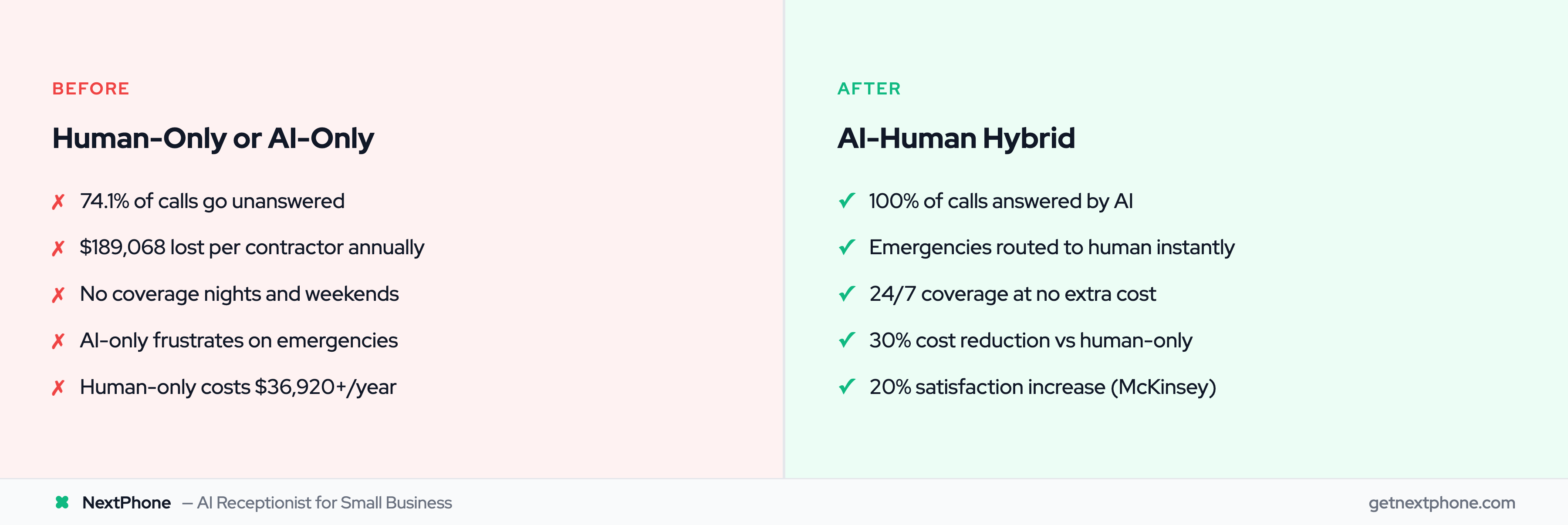
Beyond solving the AI-vs-human dilemma, hybrid service delivers measurable business benefits.
24/7 Coverage Without 24/7 Staffing
AI answers every call regardless of time. That means:
- After-hours routine requests handled automatically ("What are your hours tomorrow?")
- After-hours emergencies routed to on-call human
- Weekend inquiries captured and resolved or queued
- Holiday calls don't go to voicemail
You're available 24/7 without paying for 24/7 staff. The 80% of routine calls get instant resolution at 11 PM. The 6.2% of emergencies reach you immediately.
30% Cost Reduction, 20% Satisfaction Increase
McKinsey research found hybrid AI-human models reduce customer service costs by 30% while improving satisfaction by 20%.
Cost reduction comes from:
- AI handling high-volume routine calls
- Humans only spend time on calls requiring judgment
- Spam filtered automatically
- Callback tracking prevents wasted follow-up
Satisfaction increases because:
- Simple questions get instant answers
- Complex issues get human attention
- Emergencies reach humans immediately
- Customers aren't stuck in AI loops with no escape
No More Missed Calls (Capture 100%)
Currently, 74.1% of calls go unanswered for the average contractor. With hybrid:
- AI answers 100% of calls
- Routine calls resolved immediately
- Complex calls routed appropriately
- Emergency calls reach humans fast
- Callback requests tracked and queued
That $189,068 annual loss from missed calls? Hybrid eliminates it.
Faster Resolution for Routine, Better Care for Complex
Hybrid means appropriate response for each situation:
Simple question? Answered in 30 seconds by AI. Customer doesn't wait on hold.
Complex project? Human discusses thoroughly. Customer gets expertise.
Emergency? Human responds immediately. Customer gets urgent help.
Everyone gets what they actually need, not a one-size-fits-all response.
Measuring Hybrid Success
Track these metrics to optimize your hybrid system:
- AI resolution rate: What percentage of calls AI handles completely (target: 75-85%)
- Escalation rate: What percentage route to humans (target: 15-25%)
- Escalation accuracy: Were escalated calls actually complex/urgent? (target: 90%+)
- Customer satisfaction: Separate scores for AI-resolved and human-resolved
- Response time: Time to resolution by category
- Callback completion rate: What percentage of requested callbacks happen?
Start measuring from day one. Adjust escalation criteria based on results.