
Why Phoenix Businesses Need an Answering Service (The Numbers Don't Lie)
It's 2:47 PM on a Tuesday in July. The thermostat reads 115 degrees. Your customer's AC just died. Their kids are sweating through their shirts. They grab their phone and call the first HVAC company they find on Google.
You're on a roof in Tempe, installing a new unit. Your phone buzzes in your pocket. You can't answer. The call goes to voicemail. The customer hangs up and calls the next name on the list.
That scenario plays out hundreds of times daily across the Phoenix metro area. And it's costing local businesses a fortune.
Industry research shows 74.1% of calls to home services businesses go completely unanswered. That's three out of every four potential customers dialing your competitor instead.
For Phoenix businesses specifically, the stakes are even higher. The city's explosive growth means more competition for every customer, while extreme heat creates genuine emergencies that can't wait for a callback.
The Phoenix Economy Is Booming (But Your Phone Isn't Keeping Up)
Arizona now has 592,485 small and medium-sized businesses, representing 99.4% of all businesses in the state. The Phoenix metro alone saw over $34 billion in new investment during 2025, with nearly 28,000 projected new jobs.
That's great news for the local economy. But it also means more businesses are fighting for the same pool of customers. When someone needs an HVAC repair, a plumber, a roofer, or a real estate agent, they're choosing between a dozen options on their phone screen.
The business that answers first wins. Research shows conversion rates are 8x greater when you respond within the first 5 minutes. Wait longer than that, and your chances of converting that lead drop off a cliff.
What Missed Calls Actually Cost You
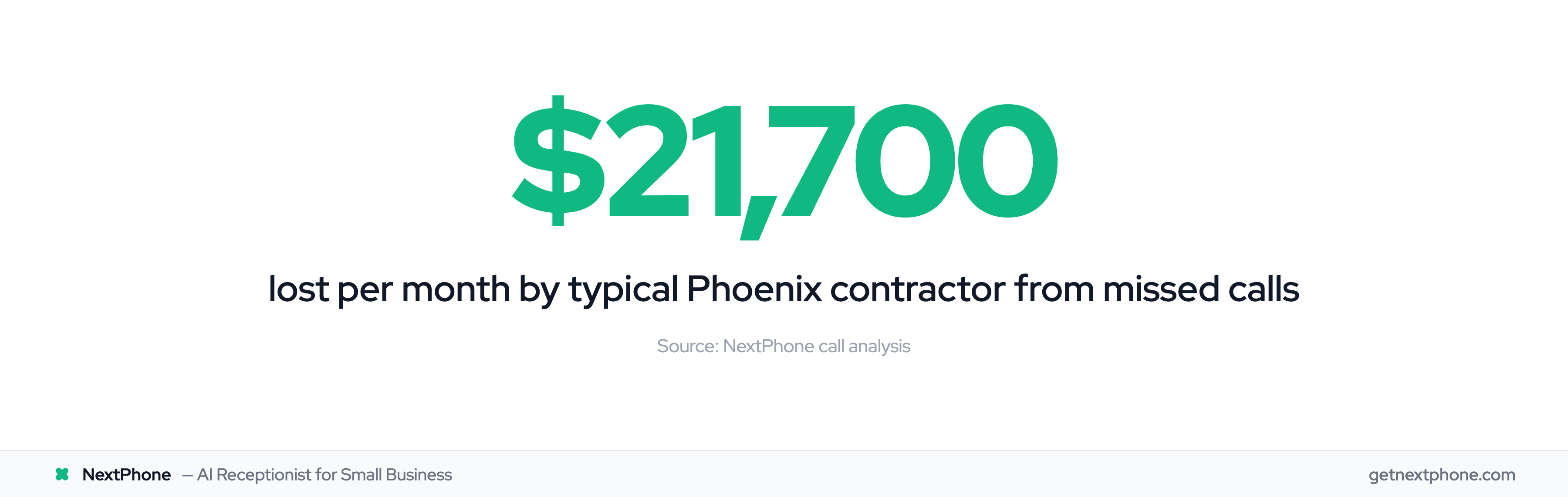
Let's do the math for a typical Phoenix contractor receiving 42 calls per month:
- 74.1% go unanswered = 31 missed calls per month
- If just 20% would have converted at an average $3,500 project value
- That's $21,700 per month in lost revenue = $260,400 per year
And here's what makes it brutal: 85% of callers who don't reach someone won't call back. They don't leave a voicemail. They don't try again later. They call your competitor.
For emergency calls in Phoenix - and there are plenty during monsoon season and 115-degree summers - the numbers are even worse. Our data shows calls containing urgency language like "emergency," "urgent," or "ASAP" rank among the top reasons people call. Emergency jobs average $4,200 in revenue, significantly more than routine work. Missing just one emergency call per week costs $16,800 per month.
The 602 Advantage: Why Your Area Code Matters in Phoenix
Most Phoenix business owners don't think twice about their phone number. But your area code might be the difference between a customer answering your return call or sending it to voicemail.
Phoenix Area Codes Explained
Phoenix and the surrounding Valley of the Sun uses three main area codes:
- 602 - The original. Established in 1947 as one of the first 86 area codes in the country. Covers central Phoenix and is the most recognized.
- 480 - Assigned in 1999. Covers the East Valley: Mesa, Chandler, Tempe, Scottsdale, Gilbert.
- 623 - Also created in 1999. Covers the West Valley: Glendale, Peoria, Surprise, Goodyear.
In 2023, the Arizona Corporation Commission eliminated geographic boundaries between these three codes. That means a 602 number now works across the entire metro area. You don't need to match your area code to your exact neighborhood anymore.
Why Local Numbers Get Answered More
Here's something most businesses overlook: your phone number type directly affects whether customers pick up.
According to Hiya's State of the Call report, local phone numbers see 60-70% answer rates with just 2-5% spam perception. Compare that to toll-free numbers (800, 888, etc.) which get only 40-50% answer rates and carry a 20-30% spam perception.
That's a 20-30 percentage point gap. If you're returning calls from a toll-free number, nearly one in three customers thinks you're a telemarketer and ignores you completely.
A 602 number tells Phoenix customers: "I'm local. I'm a real business in your community." That trust signal matters, especially when you're calling back a potential customer who reached your voicemail.
Getting a 602 Business Number
You have several options for getting a local Phoenix number:
- Port your existing number - If you already have a 602 number, you can transfer it to any new service. Check out our phone number porting guide for the step-by-step process.
- Get a new number through your answering service - Most services (both traditional and AI) will provision a new 602, 480, or 623 number when you sign up.
- VoIP providers - Services like Dialpad, Ringover, and LinkedPhone offer 602 numbers with instant activation.
The key point: whether you choose a traditional answering service or an AI receptionist, make sure you're using a local Phoenix area code. The trust difference is measurable.
Types of Answering Services Available in Phoenix
Phoenix has no shortage of answering service options. But they aren't all the same - and the differences matter more than you might think (for a deeper look at one common choice, see our comparison of answering service vs voicemail). Here's how the main options break down.
Traditional Live Answering Services
These are the companies that have been serving Phoenix for decades. Operators sit in a call center (sometimes locally, sometimes not) and answer your calls following a script you provide.
Phoenix-based options include: AnswerConnect, MAP Communications, Signius (Tempe office), AnswerFirst, and Specialty Answering Service.
How they work:
- You forward calls to their number (or they give you a local number)
- Human operators answer using your business name
- They take messages, schedule appointments, or transfer urgent calls
- Most bill per-minute or per-call
The catch: Per-minute billing means costs climb fast during busy seasons. A Phoenix HVAC company during a July heat wave could burn through a monthly call allotment in a week.
Virtual Receptionist Services
A step up from traditional answering services. Virtual receptionists act more like dedicated staff - they learn your business, manage your calendar, and handle more complex conversations.
Smith.ai is the most recognized name in this space, starting at $300/month. You get more personalized service, but you're still paying per-call and dealing with human limitations (breaks, shift changes, training inconsistencies).
AI-Powered Answering Services
The newest option - and increasingly the go-to choice for Phoenix small businesses. AI receptionists use conversational AI to have real discussions with callers, not just follow rigid scripts.
How AI differs:
- Answers in under 5 seconds (every call, every time)
- Available 24/7/365 with zero downtime
- Handles unlimited calls simultaneously (no busy signals during peak season)
- Learns your specific business (services, pricing, availability, FAQs)
- Routes emergencies to your phone immediately
- Costs a flat monthly fee regardless of volume
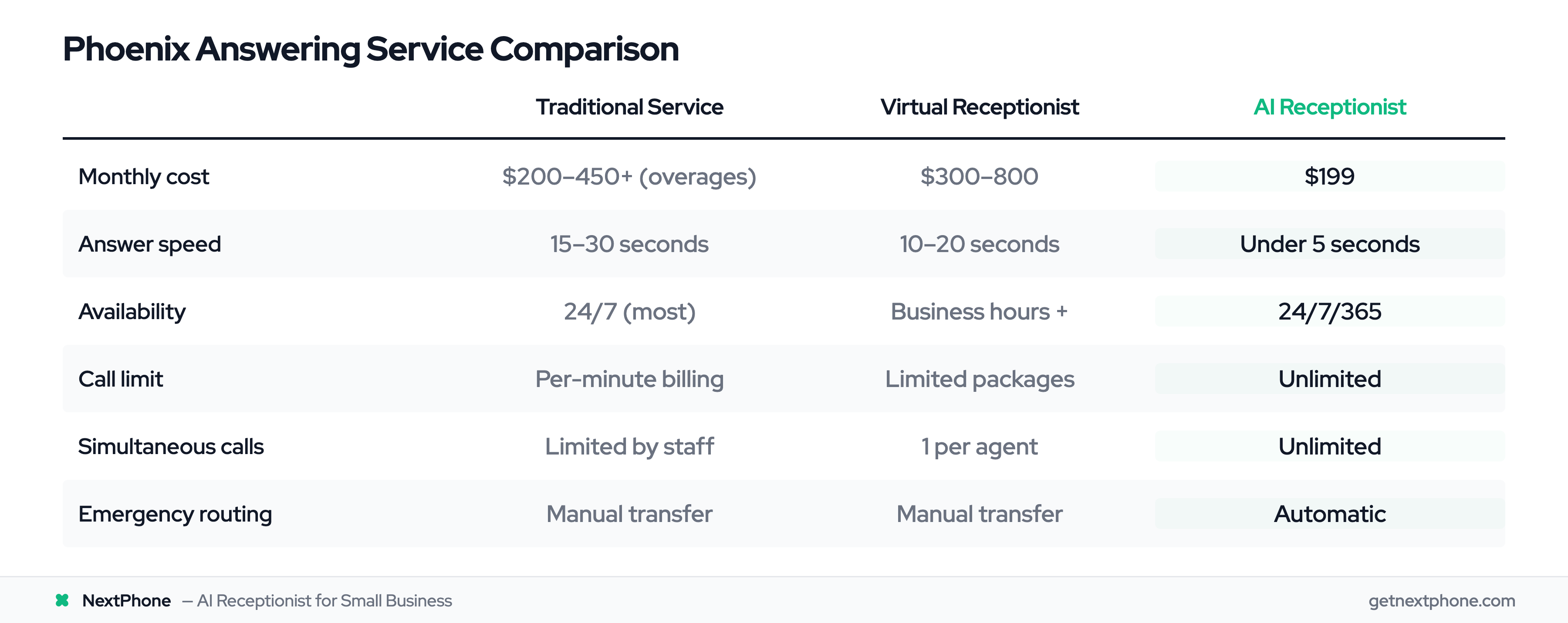
How They Compare
| Feature | Traditional Service | Virtual Receptionist | AI Receptionist |
|---|---|---|---|
| Monthly Cost | $200-450+ (with overages) | $300-800 | $199 |
| Answer Speed | 15-30 seconds | 10-20 seconds | Under 5 seconds |
| Availability | 24/7 (most) | Business hours + some after-hours | 24/7/365 |
| Call Limit | Per-minute billing | Limited call packages | Unlimited |
| Simultaneous Calls | Limited by staff | 1 per agent | Unlimited |
| Bilingual | Some providers | Some providers | Built-in |
| CRM Integration | Basic or none | Some | Full (HubSpot, Salesforce, etc.) |
| Emergency Routing | Manual transfer | Manual transfer | Automatic detection + routing |
| Consistency | Varies by agent | Varies by agent | Same quality every call |
For most Phoenix small businesses - especially those dealing with seasonal call spikes (HVAC in summer, roofers after monsoons) - the unlimited call model makes the most financial sense.
Phoenix Industries That Need Answering Services Most
Not every business has the same call patterns. Here's how Phoenix's unique market creates specific answering needs.
HVAC and Home Services (The Heat Factor)
Phoenix is one of the hottest cities in the world. When summer temperatures hit 115°F, an AC failure isn't an inconvenience - it's a genuine health emergency, especially for elderly residents and families with young children.
HVAC companies in the Valley see massive call volume spikes from June through September. Our data shows true emergencies are a recurring reason people call home services contractors - pipes bursting, power outages, AC systems dying in dangerous heat.
These emergency calls average $4,200 in revenue. But here's the problem: contractors are on job sites, in attics, on roofs. They physically can't answer their phones during the workday.
An after-hours answering service that handles calls 24/7 isn't a luxury for Phoenix HVAC companies. It's the difference between capturing a $4,200 emergency job and watching it go to your competitor down the street.
Medical and Healthcare Practices
Healthcare is one of Arizona's largest employment sectors, with 167,165 SMB employees in the space. Phoenix medical practices face constant phone pressure: appointment scheduling, prescription refills, insurance questions, and after-hours patient calls.
Compliance and data security are non-negotiable for medical answering services. Both traditional services (like AnswerFirst) and AI receptionists can meet these requirements.
Real Estate and Property Management
Phoenix is geographically massive - the fifth-largest city in the US by area. Real estate agents spend their days driving between properties across the sprawling metro, from Surprise in the west to Gilbert in the east.
When a buyer calls about a listing, they're not waiting around. The first agent to respond gets the showing. A 602 number answering service keeps local real estate professionals competitive without requiring them to pull over on the I-10 every time their phone rings.
Legal and Professional Services
Client intake calls for law firms are high-value and time-sensitive. A potential client who can't reach an attorney will call the next firm on their list. For Phoenix's growing legal market, answering every call means capturing every potential case.