
Introduction
When a customer calls and reaches your voicemail, there's a 60-80% chance they'll hang up without leaving a message.
They're not waiting for you to call back. They're calling your competitor.
This is the dilemma small business owners face every day. Voicemail is free, but it might be costing you customers. An answering service captures every call, but adds $200-500 to your monthly expenses. How do you know which option is right for your business?
Here's what most comparison guides won't tell you: sometimes voicemail is actually fine. We're not going to push you toward an expensive solution you don't need.
This guide provides an honest comparison of voicemail vs. answering services, including real data on customer behavior and conversion rates. We'll show you when voicemail is genuinely sufficient, when you definitely need more, and introduce a modern third option that changes the math entirely.
Let's start by understanding what voicemail actually costs you.
What Voicemail Really Costs Your Business

Voicemail seems simple. Customer calls, leaves a message, you call them back. What could go wrong?
A lot, actually.
What Happens When Customers Reach Voicemail
Picture this: A potential customer needs a plumber. They find your business online and call. Your phone goes to voicemail.
Now they face a decision: leave a message and hope you call back, or hang up and try the next plumber on Google.
Industry research shows 60-80% of callers choose to hang up. 80% of calls to voicemail don't result in messages being left (Ring Eden). They don't wait. They don't try again later. They call someone who answers.
For callers with urgent needs, this happens even faster. Customer service data reveals urgent calls with language like "ASAP," "emergency," or "need someone today" rank among the top reasons people call. These callers aren't leaving voicemails. They're calling the next business immediately.
The Conversion Rate Problem
Even when customers DO leave voicemails, problems persist.
Consider what a typical voicemail sounds like: "Hi, this is John. Call me back when you get a chance."
No details about what they need. No indication of urgency. No project specifics. You're left guessing whether this is a $200 service call or a $15,000 project.
Now consider what a proper call capture looks like: "Customer needs roof estimate for 2,400 square foot home. Composition shingle replacement needed due to storm damage. Insurance claim involved. Best callback time is after 3pm. Caller indicated ongoing water damage, so high urgency."
Same customer, completely different ability to serve them.
The Callback That Never Happens
Here's where voicemail really fails: callback requests routinely fall through the cracks and never get returned. Voicemail statistics show an average response rate of just 4.8%, meaning most voicemails simply don't lead to business.
Voicemails pile up. They get lost in the shuffle. You forget. By the time you call back, they've already hired someone else.
Research from Invoca shows 85% of customers whose calls go unanswered will not call back. That first missed call is often your only chance.
The hidden cost of voicemail isn't the messages you miss. It's the customers you never even knew you lost. And for the 20-40% who do leave messages, the quality of your voicemail transcription service determines whether you actually capture their details accurately.
What Is an Answering Service?
An answering service means someone, whether human or AI, answers your phone when you can't. Instead of reaching voicemail, callers get a live response.
How Answering Services Work
When a call comes in and you can't answer, the call forwards to the answering service. They answer with your business name, assist the caller, and handle the call according to your preferences.
This might mean taking a detailed message, scheduling an appointment, answering common questions, or transferring urgent calls to your cell phone. You receive the information via text, email, or direct integration with your CRM.
The key difference from voicemail: the caller's needs are addressed immediately instead of sitting in a queue hoping you'll call back.
Types of Answering Services
Traditional/Live Answering Service: Human operators at a call center answer with your business name and follow scripts you provide. They take messages and handle basic inquiries. Cost: $200-500/month, often with per-minute charges.
Virtual Receptionist: A dedicated remote receptionist assigned to your business specifically. More personalized than call center operators because they learn your business. Cost: $300-600/month.
AI Answering Service: Artificial intelligence trained on your specific business answers calls naturally. Can handle FAQs, schedule appointments, and detect urgency. Cost: flat monthly plans from $199.
Key Capabilities
What answering services provide that voicemail can't:
- 24/7 live response: Someone always answers
- Immediate assistance: Callers get help in seconds, not hours
- Detailed capture: Full information about caller needs
- Appointment scheduling: Book directly into your calendar
- Urgency detection: Emergency calls get flagged and routed immediately
- Unlimited simultaneous calls: Never a busy signal
Answering Service vs Voicemail: The Complete Comparison
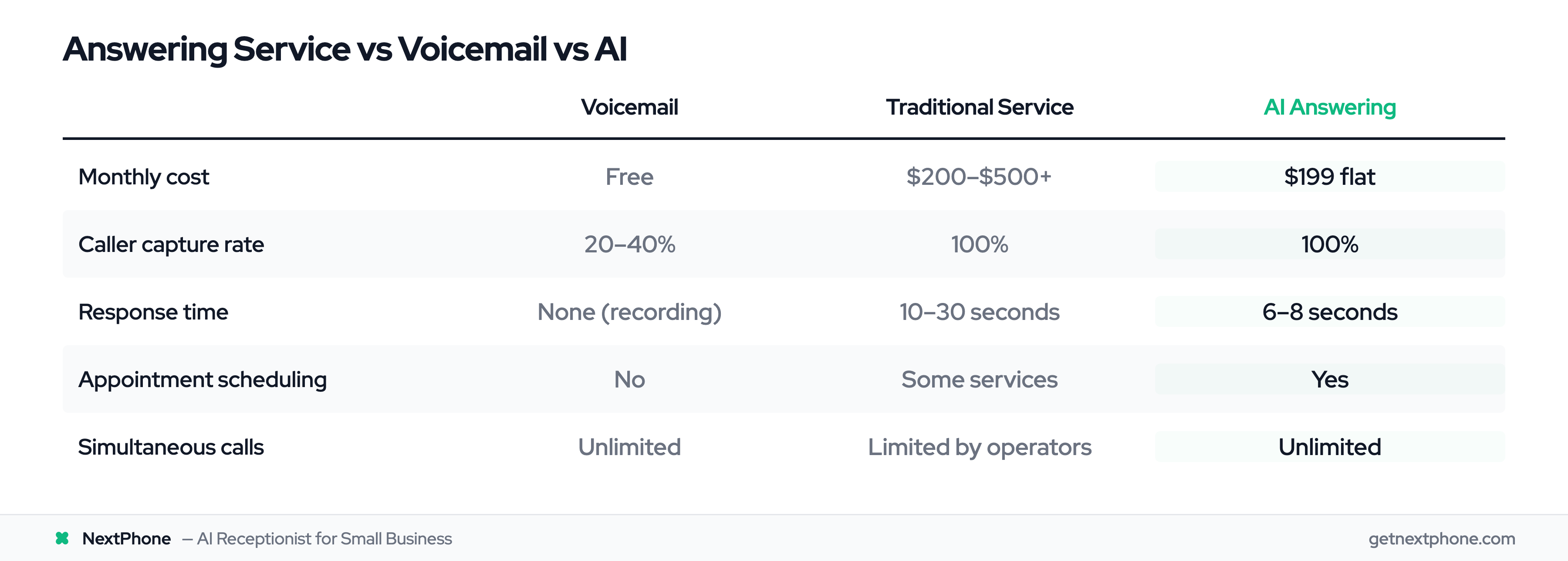
Let's put these options side by side.
Feature Comparison
| Feature | Voicemail | Traditional Answering | AI Answering |
|---|---|---|---|
| Monthly Cost | Free | $200-500+ | $199 |
| Availability | 24/7 | 24/7 | 24/7 |
| Response Time | None (recording) | 10-30 seconds | 6-8 seconds |
| Caller Capture Rate | 20-40% | 100% | 100% |
| Appointment Scheduling | No | Some services | Yes |
| Urgency Detection | No | Limited | Yes |
| Simultaneous Calls | Unlimited | Limited by operators | Unlimited |
| Business Knowledge | None | Script-based | Trained on your business |
| Consistency | N/A | Variable | Perfect |
Customer Experience Comparison
When callers reach voicemail, they feel ignored. There's no help, no immediate answer, no human connection. For many, it signals that your business doesn't prioritize customer service.
When callers reach an answering service, they feel valued. Someone is there to help. Their questions get answered. Their needs get captured accurately.
Industry research consistently shows customers prefer live answering and are more likely to do business with companies that answer their phones.
First impressions matter. If a potential customer's first experience with your business is a voicemail box, that shapes how they see you.
Cost Comparison
Voicemail: Free in dollar terms. But calculate the opportunity cost: if you lose just one $500 job per month because a caller hung up instead of leaving a message, voicemail "costs" $6,000 per year.
Traditional Answering: $200-500/month base, often with per-minute overages that can add another $50-100/month. Annual cost: $3,000-7,200.
AI Answering: flat monthly plans from $199. Annual cost: $2,388 on the entry plan. No per-minute charges, no overages.
The Revenue Impact
Let's do the math for a contractor receiving 40 calls per month:
With voicemail:
- 40 calls come in
- 60% hang up without leaving message = 24 lost contacts
- Remaining 16 leave voicemails, and a large share of those callbacks never happen
- Total potentially lost contacts: 30+ per month
With answering service:
- 40 calls come in
- 100% captured with full details
- All 40 contacts logged and actionable
If just 20% of those calls were quote requests, and you close 20% of quotes on $3,500 average projects, voicemail costs you roughly $4,200/month in missed opportunities.
The answering service costs $199-300/month.
The math isn't close.
When Voicemail Is Actually Enough
Here's something most answering service companies won't tell you: voicemail works fine for some businesses. We're not going to push you toward a service you don't need.
Low Call Volume Businesses
If you receive fewer than 15-20 calls per month, voicemail may be sufficient.
At low volume, you can realistically return every call same-day. The cost of an answering service ($200/month for 15 calls = $13 per call) may not make sense.
Signs this is you: You rarely have more than one or two voicemails waiting. You return calls within hours, not days. Missing a call is unusual, not the norm.
Non-Urgent Services
If your service doesn't require immediate response, voicemail causes less damage.
Consulting with long lead times. Seasonal businesses in the off-season. Services where customers expect to wait 24-48 hours for a response.
If "call me back tomorrow" is acceptable to your customers, voicemail works.
Existing Customer Base
Established customers who already know and trust you are more likely to leave messages and wait for callbacks.
They've done business with you before. They know you're reliable. They won't immediately call your competitor.
If your business is primarily serving existing customers (not acquiring new ones), voicemail is less risky.
Supplemental Use
Even businesses with answering services use voicemail for specific purposes:
- Backup during rare overflow periods
- Specific "leave a detailed message" situations
- Overnight hours if your answering service has limits
Voicemail as backup = fine. Voicemail as primary strategy = risky.
When You Definitely Need an Answering Service
Some situations make it clear: voicemail is costing you business.
High Call Volume
If you receive more than 30 calls per month, voicemail becomes a liability.
You can't return 30+ calls same-day while also doing your actual work. Voicemails pile up faster than you can handle them. By the time you call back, opportunities have gone cold.
Signs this is you: You regularly have 5+ voicemails waiting. Callbacks take 24-48+ hours. You're constantly playing catch-up.
Time-Sensitive Services
Emergency services need answering services. Period.
Plumbing emergencies. HVAC failures. Electrical issues. Medical needs. Legal situations.
Customer service data shows emergencies are a recurring reason people call. These callers won't leave voicemail and wait. They'll call the next business on the list.
Emergency jobs average $1,200 versus $400 for regular service calls. Missing one emergency call costs you three times a normal job.
Customer Acquisition Phase
If you're actively growing and acquiring new customers, voicemail kills your momentum.
You're spending money on marketing to make the phone ring. When those calls go to voicemail, you're wasting your advertising investment.
New prospects don't know you. They have no reason to leave a message and wait. They'll call whoever answers first.
Industry research suggests the first business to answer captures 35-50% of shopping callers.
Competitive Markets
If your competitors answer their phones and you have voicemail, they win.
When customers are comparing 3-5 businesses, response time is a differentiator. The business that answers, helps immediately, and schedules an appointment gets the job.
Your voicemail greeting doesn't compete with a live conversation.