Why This Decision Matters More Than You Think

Your phone rings. A homeowner needs their AC fixed before the weekend. You're on a job site. The call goes to voicemail. They call the next contractor on Google.
According to industry research, 85% of callers who don't reach someone won't call back. They're gone. And industry research puts the missed-call rate for home services at 74.1%, so most of those callers never reach anyone in the first place.
So the question of "local vs national answering service" isn't academic. It's about whether your business has a safety net or a revenue leak. Let's break down both options honestly, look at what each actually costs, and explore a third option that most comparison guides conveniently leave out.
What Are Local Answering Services?
A local answering service operates in your geographic area. The operators live in your city or region. They pick up calls using your business name, take messages, and sometimes handle basic scheduling.
The appeal is straightforward: these folks know your area. They recognize street names, understand local references, and speak with the same regional accent as your customers. When a caller says "I'm over by the old mill on Route 7," a local operator knows exactly where that is.
Most local answering services are smaller operations - typically 5-30 operators serving businesses in a specific metro area or region. They position themselves as an extension of your team, and in many cases, they genuinely feel like one.
What Are National Answering Services?
National answering services operate across the country with multiple call centers, often in different states or time zones. Companies like Ruby, AnswerConnect, and PATLive fall into this category.
These services handle thousands of clients across dozens of industries. Their operators work from scripts customized to each business, routing calls based on protocols you set up during onboarding.
The infrastructure difference is significant. Where a local service might have one office with 20 operators, a national service has hundreds of operators across multiple locations. This affects everything from capacity to disaster recovery.
For businesses weighing their options, understanding these structural differences helps clarify which tradeoffs you're comfortable making. If you're exploring all available options, our answering service comparison guide covers the broader landscape.
The Case for Local Answering Services
Regional Knowledge and Familiarity
This is the strongest selling point for local services. Operators who live in your community bring genuine local knowledge to every call.
For a plumber in Denver, a local operator can tell a caller, "Yes, we service the Highlands and Wash Park areas." For a law firm in Charleston, the operator understands local court references. This familiarity builds trust with callers who expect to reach someone connected to the business.
Accent and communication style matter too. Research on spam call perception shows that callers are more likely to stay on the line when the voice on the other end sounds familiar and local. A caller in rural Texas might hang up faster on someone who sounds like they're in a call center overseas.
Personal Relationships and Accountability
With a smaller client roster, local services can genuinely learn your business. The same operator might answer your calls for months or years, building familiarity with your regular customers and common scenarios.
You can often visit the office, meet the team, and give in-person training. When something goes wrong, you call the owner directly. That accountability is real and valuable.
The Downsides You Should Know About
Here's where local services struggle:
- Limited capacity: A 15-person operation can't handle sudden call spikes. Storm season for a roofing company? Your calls might go to voicemail anyway.
- Disaster vulnerability: If a hurricane or ice storm hits your area, your local answering service loses power too. You're both down simultaneously.
- Restricted hours: Many local services only operate during business hours. A large share of home services calls arrive outside traditional 9-5 hours, and every one of those goes unanswered.
- Limited technology: Smaller operations often can't afford modern CRM integrations, SMS capabilities, or advanced call routing.
- Business risk: Small companies close, get acquired, or lose key staff. If your local service shuts down, you're scrambling for a replacement with zero transition time.
The Case for National Answering Services
Scale, Redundancy, and Reliability
National services solve the reliability problem. With call centers in multiple locations, a storm in one city doesn't affect your coverage. Operators in Arizona pick up the slack when the Texas center goes down.
This redundancy extends to staffing. Flu season doesn't cripple a professional answering service with 500 operators the way it does a local shop with 15. You're less likely to experience dropped calls or extended hold times during peak periods.
Diverse Industry Expertise
Because national services work with thousands of clients across different industries, they've developed protocols for nearly every scenario. Medical practices, law firms, HVAC companies, real estate agents - they've handled calls for all of them.
This cross-industry experience means better training programs, more refined scripts, and operators who've encountered unusual situations before. They're less likely to be thrown off by an unexpected question.
The Downsides You Should Know About
National services have their own problems:
- Impersonal service: Your account is one of thousands. Operators read from scripts and move on to the next call. Callers can tell the difference.
- Script-driven responses: Complex questions get deflected to voicemail or callback requests. The operator can't think on their feet about YOUR business.
- Per-minute pricing traps: Most national services charge $0.75-$1.50 per minute after your plan limit. During busy months, your $400/month plan can balloon to $800+.
- Operator turnover: National call centers have notoriously high turnover. The operator who learned your business last month is gone.
- Hold times: Despite more staff, national services often put callers on hold during peak hours. Research shows 30% of callers abandon after just one minute on hold.
Head-to-Head Comparison
| Factor | Local Service | National Service |
|---|---|---|
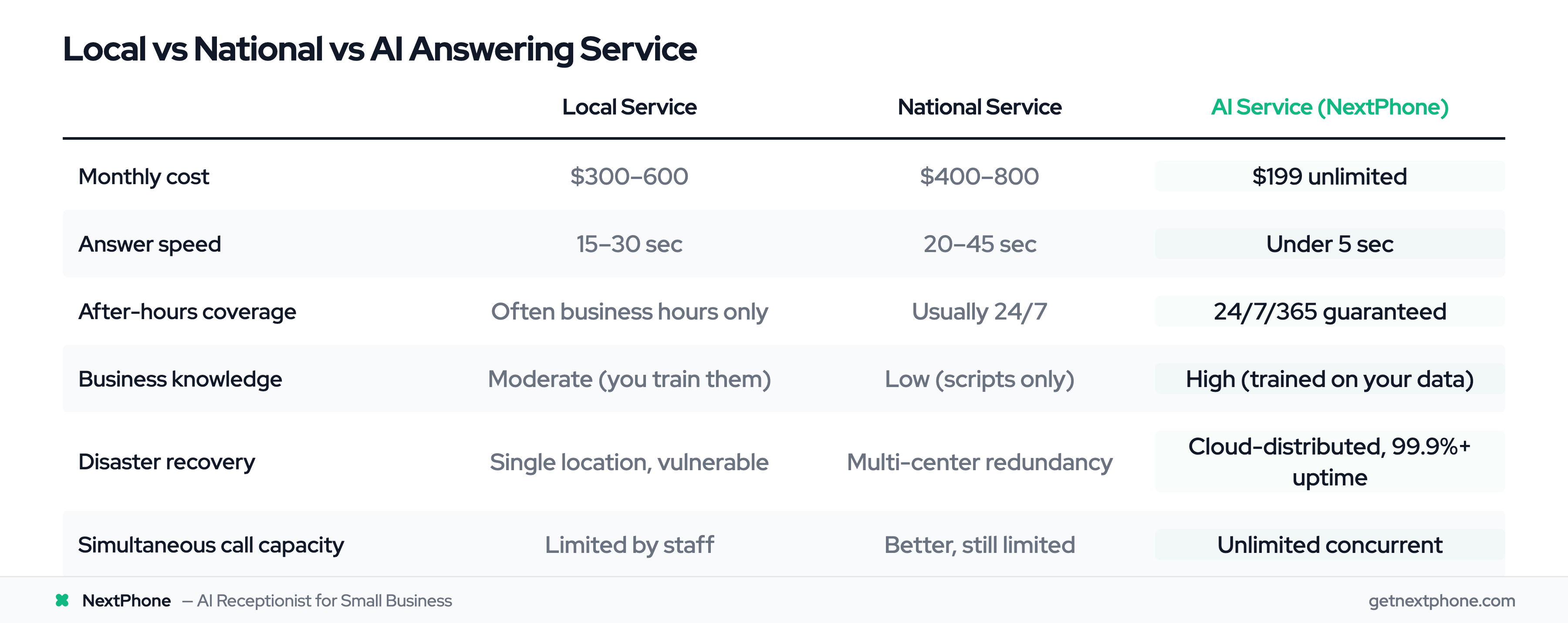
| Monthly Cost | $300-600 (limited minutes) | $400-800 (with overages) |
| Local Knowledge | Strong - operators know your area | Minimal - rely on scripts |
| Scalability | Limited by staff size | High - hundreds of operators |
| Disaster Recovery | Vulnerable (single location) | Redundant (multiple centers) |
| After-Hours Coverage | Often limited to business hours | Usually 24/7 available |
| Personalization | High - small client roster | Low - thousands of clients |
| Technology/Integrations | Basic (phone + message) | Moderate (some CRM, some SMS) |
| Contract Flexibility | Often month-to-month | Frequently annual contracts |
| Industry Expertise | Limited to local market | Broad cross-industry |
| Answer Speed | 15-30 seconds typical | 20-45 seconds typical |
The honest assessment? Neither option is clearly superior across the board. Local wins on personalization and knowledge. National wins on reliability and scale. Both charge significantly more than what most solo operators and small businesses can comfortably afford.
The Real Cost Breakdown
Local Answering Service Pricing
Most local services charge $300-600 per month for basic plans, which typically include:
- 50-100 minutes of talk time
- Business hours coverage (8am-6pm)
- Basic message taking and delivery
- Setup fees of $50-200
After-hours or weekend coverage? That's extra. Holiday coverage? Extra. More than 100 minutes? $1.00-$1.50 per additional minute.
National Answering Service Pricing
National providers typically price between $400-800 per month for comparable plans:
- 75-200 minutes of talk time
- 24/7 coverage included
- Script customization
- Setup fees of $100-500
The trap here is overage pricing. During your busy season - when you need the service most - per-minute charges can double your monthly bill.
The Math That Should Concern You
Here's what most answering service comparison guides won't show you. According to the Bureau of Labor Statistics, a full-time receptionist costs about $35,000/year ($2,900/month). Traditional answering services cost $400-800/month.
But look at what you're actually paying per call. If you receive 42 calls per month (a typical month for a home services contractor) and pay $600/month for a traditional service, that's $14.28 per answered call.
Meanwhile, at that 74.1% miss rate, 31 of those calls go unanswered. At a 20% close rate and a $3,500 average job, that's roughly $21,700 per month in missed revenue. Even an expensive answering service pays for itself many times over - if it actually answers every call.
The real question isn't "local vs national." It's "what's the cost per answered call, and is every call getting answered?"
Check our AI receptionist pricing guide for a detailed comparison of all options including AI alternatives.