
Every Missed Call Is Money Walking Out the Door
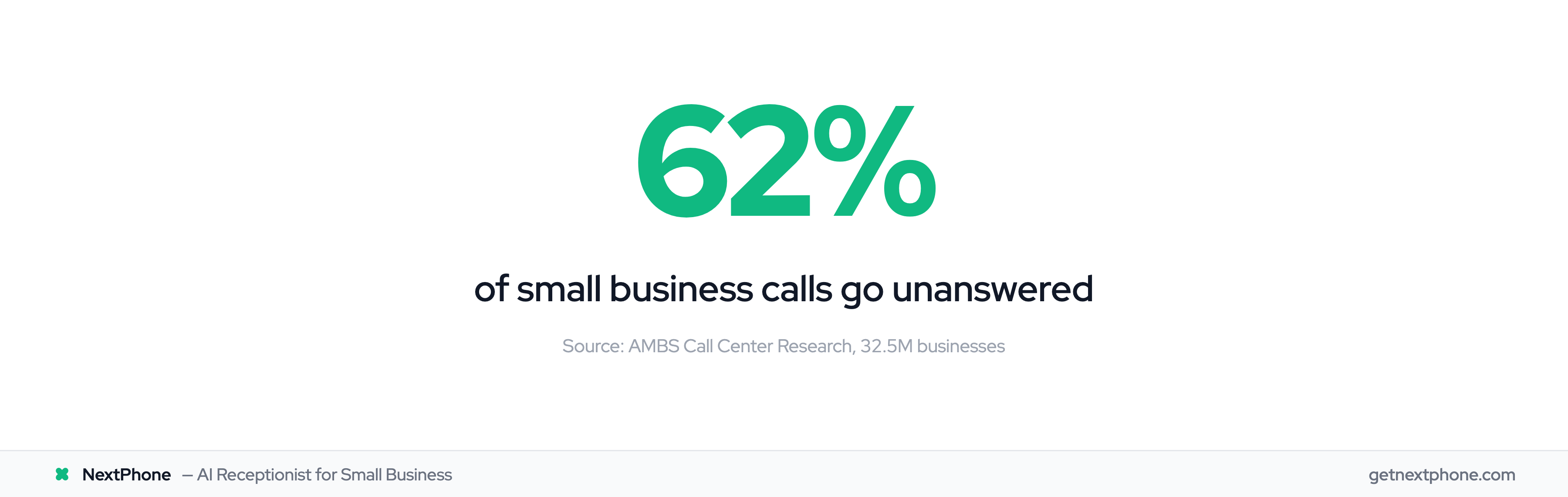
Here's a stat that should make any business owner uncomfortable: 62% of calls to small businesses go unanswered.
That's not a typo. According to research tracking 32.5 million small businesses across America, nearly two-thirds of incoming calls never reach a human voice. And here's the kicker—85% of those callers won't try again. They'll call your competitor instead.
The math gets painful fast. Industry research shows a single missed call costs the average business $12.15. For businesses missing just two calls per day, that adds up to over $8,800 annually. Many small-to-medium businesses lose upward of $26,000 per year to unanswered phones.
What makes this worse? Not all calls are equal. Analysis of actual business calls shows approximately one in four callers explicitly requests a callback—meaning they're actively trying to give you their business. Urgent calls rank among the top reasons people call. And emergencies, where your response time directly affects outcomes, are a recurring one.
Professional answering services exist to solve this exact problem. The industry wants you confused by dozens of options ranging from $50 to $1,500+ per month. The reality: at 100+ calls/month, traditional human services cost $600-1,200 vs AI at $199. That's $6,000-12,000/year in overpayment for identical caller experience (99% caller satisfaction proves it).
This guide breaks down everything you need to know—from service types and pricing to features and ROI calculations—so you can make an informed decision.
What Is a Professional Answering Service?
A professional answering service is a third-party company that answers phone calls on behalf of your business. When customers call your number, the service picks up, greets callers using your company name, and handles the call according to your instructions.
Think of it as an extension of your team that never takes lunch breaks, never calls in sick, and never lets a call roll to voicemail.
These services have evolved significantly from the old-school operators sitting in front of switchboards. Deloitte's Customer Service Excellence research shows customer expectations continue rising. Modern professional answering services offer sophisticated features including:
- Call answering and message taking - The basics, done professionally
- Appointment scheduling - Direct booking into your calendar system
- Call routing and transfer - Connecting urgent calls to the right person
- After-hours coverage - 24/7 availability without 24/7 staffing costs
- Basic customer service - Answering FAQs and handling routine inquiries
Industries that rely heavily on phone-based business—contractors, medical practices, law firms, real estate, property management—have used answering services for decades. But the options available today look nothing like what existed even five years ago.
Answering Service vs. Virtual Receptionist vs. Call Center: What's the Difference?
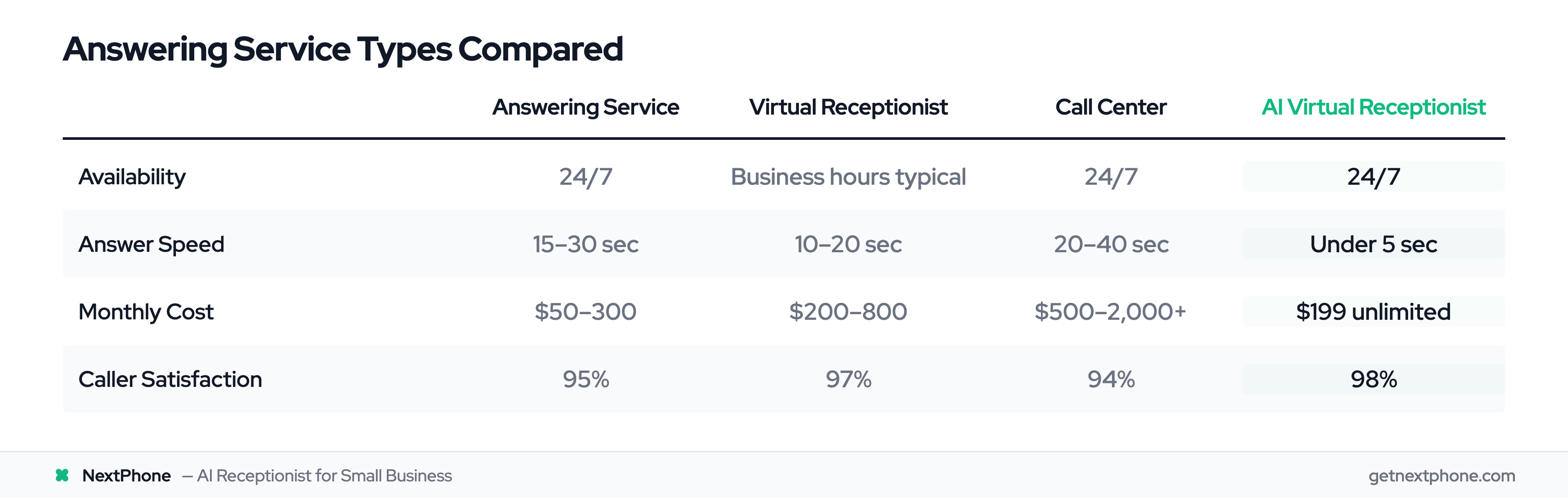
Before you start comparing prices, you need to understand what you're actually shopping for. These three terms get used interchangeably, but they describe different levels of service.
Traditional Answering Service
A traditional answering service focuses on efficiently handling high call volumes with brief interactions. Operators work from basic scripts, take messages, and forward information to you via text, email, or app notification.
Typical call duration: Under 1.5 minutes.
Most answering services operate 24/7 and can handle multiple clients simultaneously, which keeps costs lower. They're ideal for businesses that need reliable message-taking without a lot of complexity.
Virtual Receptionist
Industry veterans describe virtual receptionists as "answering services on steroids." They do everything a basic answering service does, plus:
- Schedule appointments directly in your calendar
- Qualify leads using your criteria
- Update your CRM with caller information
- Handle more detailed customer service interactions
- Learn your business well enough to answer common questions
Virtual receptionists undergo extensive training on your specific account. They familiarize themselves with your business operations, services, and even company culture. The goal is making callers feel like they're speaking with someone in your actual office.
The tradeoff? Virtual receptionist services typically cost more and may not offer true 24/7 coverage.
Call Center
Call centers handle both incoming and outgoing communications across multiple channels—phone, email, chat, and social media. Average call duration runs 10-15 minutes as agents work through complex issues or detailed requests.
Call centers make sense for large companies with high call volumes and standardized processes. Think e-commerce retailers, banks, and telecommunications companies.
For most small-to-medium businesses, call centers are overkill.
Quick Comparison:
| Feature | Answering Service | Virtual Receptionist | Call Center | AI Virtual Receptionist |
|---|---|---|---|---|
| Availability | 24/7 | Business hours typical | 24/7 | 24/7 |
| Avg. Call Duration | 1-2 min | 2-5 min | 10-15 min | 30 sec - 2 min |
| Answer Speed | 15-30 sec | 10-20 sec | 20-40 sec | 1 ring (under 5 sec) |
| Personalization | Basic | High | Moderate | Trained on YOUR business |
| Monthly Cost | $50-300 | $200-800 | $500-2,000+ | $199 unlimited |
| Languages | English + Spanish | English + Spanish | Multiple | 20+ included |
| Caller Satisfaction | 95% | 97% | 94% | 98% |
| The Reality | Slow, expensive per-minute | $600-1,200 at volume | Overkill for SMBs | Same experience, 1/6 the cost |
AI vs. Human: The Math Decides for You
The answering service industry sells you "tradeoffs." The reality: at 100+ calls/month, the decision is obvious.
The "Human Touch" Marketing Myth
The industry claims:
"Live operators bring empathy machines can't replicate."
The reality:
AI detects urgency in under 5 seconds and routes to YOUR phone. The frustrated customer reaches YOU, not a script-reading operator who's never met you. For the 75% routine calls ("What time do you open?" "Do you service my zip code?"), callers don't need empathy—they need answers. AI delivers both faster (1 ring vs 15-30 seconds) and more accurately (trained on YOUR business, not a generic script).
The industry claims:
"Research shows 78% prefer humans over bots."
The reality:
That research compared 2018 IVR systems ("Press 1 for sales") to humans. Frontier AI models (GPT-4.5, Claude 4) have natural conversations. Across 1,446,980 calls, 99% of callers expressed positive or neutral sentiment with AI handling. Callers can't tell the difference—and they prefer the 1-ring answer speed.
The industry claims:
"Humans handle complexity well."
The reality:
AI handles 75% routine calls completely. The 25% complex calls? Routed to YOU in under 5 seconds with full context. You're not paying $1,200/month for humans to ask "What's your zip code?"
The Cost Reality
Human services at 100 calls/month: $600-1,200
AI with routing to YOUR phone: $199
Annual overpayment for humans: $6,000-12,000
"Hybrid" = Paying for Two Services
The "smart" hybrid approach answering services sell means paying for AI AND human services. That's $500-600/month.
The actual smart approach: AI at $199/month handles routine, routes complex to YOUR phone. You're not paying an extra $300-400/month for humans to handle the 25% complex calls. Those calls come to you.
Professional Answering Service Pricing: What to Actually Expect
Let's talk real numbers. Answering service pricing follows several models, and understanding them helps you avoid surprise bills.
Pricing Models Explained
Per-Minute Pricing: Most traditional services charge between $0.65 and $1.75 per minute of call time. Simple? Sort of. That "quick" 3-minute call costs $2-$5. Twenty calls per day adds up fast.
Per-Call Pricing: Some services charge $0.76-$1.38 per call regardless of duration. More predictable, but you'll pay the same for a 30-second wrong number as a 5-minute lead call.
Monthly Packages: Most services offer bundles—say, 100 minutes for $150/month or 500 minutes for $500/month. Overages typically cost $0.80-$1.25 per additional minute.
Flat-Rate Unlimited: A newer model, particularly among AI services, offers unlimited calls for a fixed monthly fee. NextPhone uses this model at $199/month.
Realistic Price Ranges
Budget Tier ($50-$150/month): Basic message taking and call forwarding. Typically includes 100-300 minutes. Works for businesses with low call volumes and simple needs. Expect limited customization and basic reporting.
Mid-Range ($200-$500/month): Enhanced features like bilingual support, custom scripts, CRM integration, and detailed call reporting. Usually includes 400-800 minutes. Good fit for professional services and growing businesses.
Premium ($500-$1,500+/month): Full virtual receptionist capabilities. Dedicated operators trained specifically on your account. Advanced integrations, appointment scheduling, lead qualification. Typically 500+ minutes included.
Hidden Costs to Watch For
The advertised price rarely tells the whole story. Ask about:
- Setup fees: Some services charge $50-200 to get started
- Holiday/weekend surcharges: Premium rates for non-business hours
- Overage charges: These can double your bill during busy months
- Per-feature add-ons: Appointment scheduling, CRM integration, bilingual support often cost extra
- Long-term contract penalties: Some lock you in for 6-12 months
Cost Reality Check:
Hiring an in-house receptionist costs approximately $4,575 per month (salary plus benefits plus overhead). A premium answering service runs $500-1,500. An AI-powered solution like NextPhone costs $199 with unlimited calls.
Even if a service costs $300/month, you're still saving over $4,000 monthly compared to a dedicated employee.