
Every Missed Call Is a Missed Order
It's Friday at 5:15 PM. Your phone rings. A customer wants to place a $200 order, but you're already driving home. The call goes to voicemail. They hang up without leaving a message and order from your competitor's website instead.
This happens more than you think. Research shows that 85% of callers who can't reach a business won't call back. They move on. For businesses that take orders by phone, every unanswered call is revenue walking out the door.
An order taking answering service solves this by ensuring someone -- or something -- always picks up. NextPhone answers every order call in under 5 seconds, captures order details at 99%+ accuracy, and pushes structured data to your systems instantly. No hold times, no human error, no missed sales.
But not all order taking services are equal. Some use human operators. Some use AI. Some blend both. And the cost difference between them can be staggering.
This guide covers how order taking services work, what they cost, and how to pick one that actually captures the sales calls you're currently missing.
How NextPhone's Order Taking Service Works
- Forward your calls -- Set up call forwarding from your existing business number. Takes minutes, no hardware needed.
- AI takes the order -- NextPhone answers in under 5 seconds, greets the caller by your business name, and collects every order detail: items, quantities, preferences, contact info, and payment.
- Data hits your systems -- Completed orders push to your POS, CRM, or e-commerce platform via HTTP webhooks within seconds. You get SMS and email confirmations automatically.
What Is an Order Taking Answering Service?
An order taking answering service goes beyond standard call answering. Instead of just collecting messages, it processes actual purchase transactions, bookings, or service requests during the call.
How Order Taking Services Work
When a customer calls to place an order, the service:
- Answers the call (immediately, no hold time)
- Greets the caller using your business name and script
- Collects order details: items, quantities, sizes, preferences
- Captures customer information: name, address, phone, email
- Handles payment information (if configured)
- Confirms the order back to the caller
- Pushes all data to your systems
The caller gets a professional ordering experience. You get a complete order record without lifting a finger.
What Information Gets Captured
Modern order taking services collect whatever you configure them to gather:
- Customer name, phone, email, shipping address
- Product selections, quantities, variations
- Special instructions or customizations
- Preferred delivery/pickup times
- Payment method (card details handled via PCI-compliant systems)
- How they heard about you (attribution tracking)
Everything gets logged, timestamped, and sent to your ordering system.
Order Taking vs General Answering Services
A general answering service takes messages. Someone calls, the service writes down their name and number, and passes it along for you to call back.
An order taking answering service completes the transaction. The customer calls, places their order, and hangs up knowing it's done. No callback needed. No friction. No chance for them to change their mind.
The difference in revenue capture is massive. Message-taking means the customer still has to wait for your return call. By then, 85% have already moved on.
What Missing Sales Calls Costs Without an Order Taking Service

Most business owners dramatically underestimate how many sales calls they're losing. The data tells a different story than gut feeling.
What the Data Shows
We analyzed thousands of calls from home services businesses over 7 months. The findings:
- 74.1% of calls went completely unanswered - not diverted to voicemail, just missed entirely
- 25.4% of callers explicitly requested callbacks - callbacks that mostly never happen
- 6.9% were quote or order requests - direct revenue opportunities ringing into silence
- 7.7% were scheduling requests - bookings that went to competitors instead
For a business receiving 42 calls per month, that's 31 calls going unanswered. If even a third of those were purchase-intent calls, that's 10 lost orders per month.
The Missed Order Math
Let's run the numbers for different business types:
E-commerce/Retail:
- 10 missed order calls/month at $75 average order = $750/month lost
- Factor in phone orders' 40% higher average value = $1,050/month lost
- Annual impact: $12,600
- Industry data shows restaurants lose 23% of potential phone orders to busy signals and hold times
- 150 missed calls/month, 60% would have ordered at $25 average = $2,250/month lost
- Annual impact: $27,000
Service Businesses:
- 31 missed calls/month (our 74.1% data), 20% conversion at $3,500 = $21,700/month lost
- Annual impact: $260,400
The math changes depending on your average order value. But the pattern holds: missed calls cost far more than any answering service subscription.
Why Callers Don't Call Back
Here's what seals the deal: 85% of callers who reach voicemail won't try again. They don't leave messages. They don't bookmark your site for later. They find someone who picks up.
For order-intent callers, this makes perfect sense. They want to buy something right now. If you can't help them right now, someone else can. The purchase intent doesn't wait for your callback.
Phone calls also convert at 30-50% higher rates than form fills, according to Invoca's research. Callers have already decided they want to buy. They just need someone to take their money.
Key Features of an Effective Order Taking Service
Not every order taking answering service delivers the same results. Here's what separates the ones that capture revenue from the ones that frustrate customers.
24/7 Availability
30-35% of calls come outside standard business hours. For restaurants, it's even higher during dinner rush. For e-commerce, evening and weekend shoppers drive significant order volume.
An order taking service that only works 9-5 misses the calls that matter most. After-hours callers often have higher purchase intent. They've researched, they've decided, and they're ready to buy. An after-hours answering service ensures those high-intent calls don't go to waste.
Accurate Data Capture
Order accuracy isn't optional. Wrong items, misspelled names, incorrect addresses, and transposed phone numbers all create downstream problems that cost more to fix than the original order was worth.
AI-powered order taking captures data at 99%+ accuracy. No mishearing "Smith" as "Smyth." No transposing digits in a phone number. No forgetting to ask about allergies or delivery preferences. Every data point gets captured exactly as stated.
Human operators average 90-95% accuracy. Not bad, but at volume, that 5-10% error rate adds up. A hundred orders with 5% errors means five customers getting the wrong thing.
System Integration
Captured order data is only useful if it reaches your business systems automatically. The best order taking services integrate with:
- POS systems - Orders appear in your queue instantly
- E-commerce platforms - Shopify, WooCommerce, BigCommerce
- CRM software - HubSpot, Salesforce, Zoho
- Inventory management - Stock levels update in real time
- Kitchen display systems - Restaurant orders go straight to the kitchen
Manual re-entry defeats the purpose. If someone has to type the order into your system after the call, you've added delay, cost, and error risk.
Payment Processing
For businesses that take payment at order time, PCI-compliant payment processing is non-negotiable. The service must handle card details securely, process the transaction, and confirm payment, all during the call.
Some services capture payment details and pass them to your processor. Others integrate directly with Stripe, Square, or your existing payment gateway.
Upselling and Cross-Selling
Trained order taking, whether human or AI, can suggest complementary products or upgrades during the call. "Would you like to add a drink to that?" or "We have a bundle deal that saves 15% on those items together."
This capability alone can boost average order value by 15-25%. The key is making suggestions feel helpful rather than pushy.
AI vs Human Order Taking: An Honest Comparison
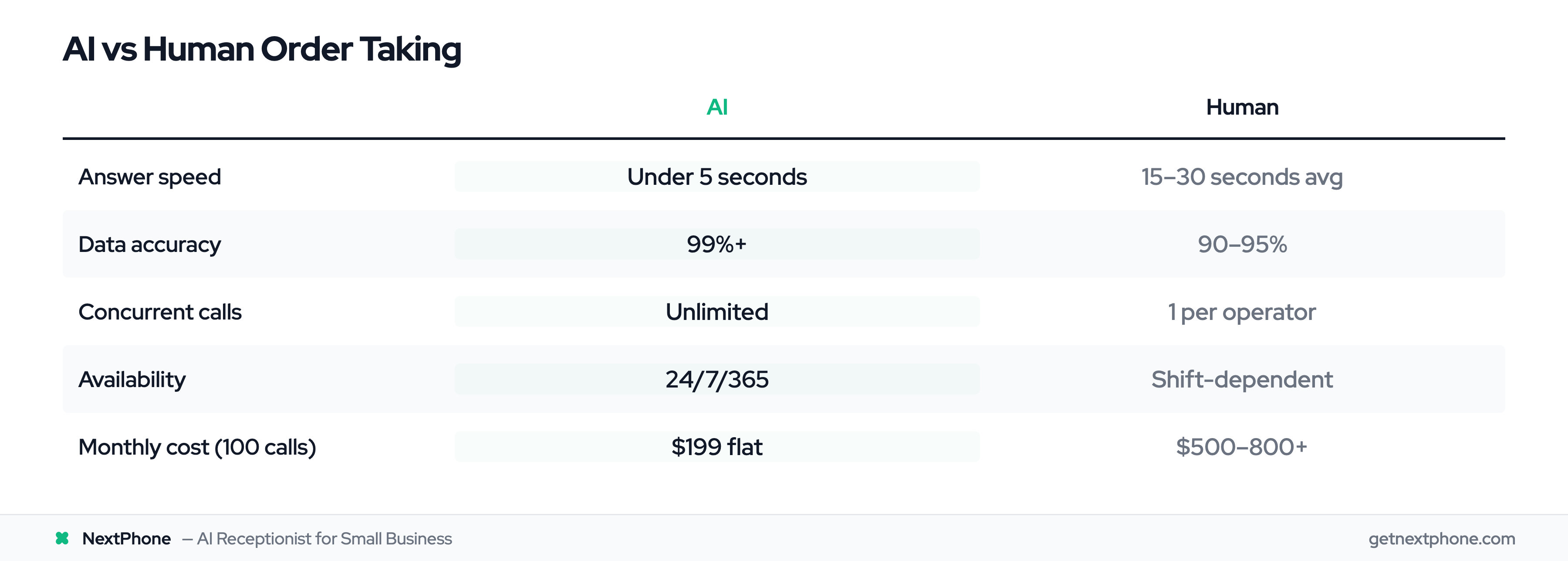
The order taking answering service market has split into two camps: traditional human-operated services and modern AI-powered platforms. Both work. Neither is perfect for every situation.
Where AI Excels
| Capability | AI Performance | Human Performance |
|---|---|---|
| Answer speed | Under 5 seconds | 15-30 seconds average |
| Data accuracy | 99%+ | 90-95% |
| Concurrent calls | Unlimited | 1 per operator |
| Availability | 24/7/365 | Shift-dependent |
| Consistency | Identical every call | Varies by mood/fatigue |
| Monthly cost | $199 flat | $500-800+ (100 calls) |
| Scalability | Instant | Hiring/training lag |
AI handles the routine orders that make up 80% of calls. Standard menu items, catalog products, service bookings with predictable details. These calls follow patterns that AI handles flawlessly.
Speed matters here. When a caller reaches AI, they get an immediate response. No hold music. No "please hold, all operators are busy." The AI phone answering picks up before the second ring.
Where Humans Still Win
Complex orders with nuance still favor human operators:
- Custom configurations with multiple decision points
- Emotional high-value purchases needing reassurance
- Orders requiring creative problem-solving ("I need something like X but different")
- Situations where reading tone of voice matters
- Complaints bundled with reorder requests
Humans read between the lines. A caller saying "I guess that works" sounds different from "perfect, that's exactly what I need." Trained operators catch hesitation and address it. AI doesn't yet match that emotional intelligence.
The Hybrid Approach
The best order taking answering service setup combines both:
- AI handles routine orders (80% of calls): menu items, standard products, simple bookings
- Complex calls transfer to humans: custom orders, complaints, high-value sales
- AI captures data even during transfers: caller info, order history, and context pass to the human operator
This gives you AI's cost efficiency and speed for the bulk of calls, with human nuance for the calls that need it. NextPhone's intelligent call routing makes this transfer invisible to the caller.
Why "Live Agents Only" Order Taking Falls Short
Some traditional order taking answering services position "no AI, live agents only" as a selling point. It sounds reassuring, but the operational reality works against you:
- Shift-dependent coverage. Live agent services staff to average volume. During peak hours, callers wait on hold. After hours, you pay premium rates or get no coverage at all.
- No cost control. Per-minute billing means your bill spikes during busy months. A restaurant running a holiday promotion can see answering service costs double overnight.
- Human error compounds at scale. A 5-10% error rate on order details means wrong items, incorrect addresses, and transposed phone numbers. At 100 orders per month, that's 5-10 customers receiving the wrong thing.
- No scalability. When 3 customers call simultaneously, 2 wait. An AI order taking service handles unlimited concurrent calls with zero hold time.
- Inconsistency. Agent A follows the script perfectly. Agent B skips the upsell prompt and forgets to ask about allergies. You can't control who picks up your calls.
AI-powered order taking isn't a concession -- it's a structural advantage. Every call gets answered identically, every data point gets captured at 99%+ accuracy, and your costs stay flat regardless of volume. The businesses still paying per-minute for live-agent-only order taking are overpaying for lower accuracy and worse coverage.
How Order Data Reaches Your Systems
The magic isn't in answering the call. It's in what happens to the order data after the call ends.
Real-Time Data Flow
Modern order taking services push data to your systems the moment it's captured. Here's what that looks like:
- During the call: AI collects order details, confirms with caller
- Call ends: Structured data fires via webhook to your systems
- Within seconds: Order appears in your POS, CRM, or order management queue
- Simultaneously: Customer gets SMS confirmation with order details
- You get notified: Push notification or email with order summary
No manual entry. No delay. No lost sticky notes.
Common Integration Points
NextPhone connects with any system that accepts HTTP webhooks, which covers virtually every modern business tool:
- CRM platforms: Lead and order records created automatically
- E-commerce: Orders placed in your online store's queue
- Scheduling tools: Appointments booked directly to your calendar
- Custom APIs: Send data anywhere your developer can build an endpoint
The AI collects whatever fields you configure: name, email, phone, order items, quantities, special instructions, delivery preferences, payment method. All structured, all searchable, all pushed instantly.
SMS and Email Confirmations
After every order, the system can automatically:
- Send the customer an SMS confirmation with order details
- Email you a summary with caller number (tap-to-call) and order specifics
- Push a notification to your phone with the key details
- Log the full transcript for reference
This closes the loop. The customer knows their order went through. You know what was ordered. Nobody has to wonder if the message got lost.
How NextPhone Handles Order Taking
NextPhone takes the AI receptionist for small business concept and applies it specifically to order capture. Here's how it works for businesses that take phone orders:
Setup: Tell the AI what information to collect. Product names, sizes, quantities, delivery addresses, special requests. Whatever your order form requires, the AI asks for it conversationally.
Answering: Every call gets picked up in under 5 seconds. The AI greets callers by your business name, asks what they'd like to order, and walks through the details naturally.
Processing: Order information gets captured with 99%+ accuracy. No mishearing, no typos, no forgotten fields. The AI confirms details back to the caller before ending the call.
Integration: Completed orders push to your systems immediately via HTTP webhooks. CRM, POS, email, SMS, whatever you use. The data arrives structured and ready to process.
Routing: Complex or unusual orders trigger transfer to your phone. The AI passes along everything it's already collected so the customer doesn't repeat themselves.
All of this runs at $199/month with unlimited calls. Compare that to traditional order taking services at $500-800/month for just 100 calls, or an in-house order taker at $35,000/year who only works 40 hours a week.
Frequently Asked Questions
How much does an order taking answering service cost?
Pricing varies widely. Traditional human-operated services run $500-800/month for around 100 calls, with per-call or per-minute overages during busy periods. AI-powered services like NextPhone charge $199/month for unlimited calls with no overage fees. An in-house employee dedicated to order taking costs $35,000+/year in salary alone. For most small businesses, AI delivers the best cost-to-coverage ratio.
Can an answering service process credit card payments?
Yes. Many order taking services handle payment processing with PCI-compliant systems. Some capture card details and pass them to your payment processor. Others integrate directly with Stripe, Square, or your existing gateway. AI services typically collect payment information during the call and route it securely to your processing system.
What industries use order taking services most?
Restaurants lead the pack (takeout and delivery orders), followed by e-commerce retailers (catalog and phone orders), healthcare suppliers (medical supply orders), professional services (booking and consultation scheduling), and home services (estimate requests and job bookings). Any business that receives purchase-intent phone calls benefits from dedicated order taking.
How accurate is AI order taking compared to humans?
AI captures data at 99%+ accuracy with no typos, transposed numbers, or forgotten fields. Human operators average 90-95% accuracy, which means 5-10 errors per hundred orders. AI also logs every interaction automatically, creating a searchable record. For high-volume order processing, AI's consistency advantage compounds over time.
Can order taking services handle returns and exchanges?
Yes. Both AI and human services can process return requests, capture reason codes, issue RMA numbers, and provide return shipping instructions. Complex situations, like partial refunds or exchanges for unavailable items, can be routed to your team with full context from the initial interaction already captured.
Do I need special equipment for an order taking service?
No. Modern order taking answering services work with your existing phone number through simple call forwarding. No new hardware, no software installation, no IT department needed. Setup typically takes minutes. You configure what information to collect, test the flow, and go live.
How long does it take to set up an order taking answering service?
Most AI-powered order taking services go live in under an hour. With NextPhone, setup involves three steps: configure what order information to collect (items, quantities, contact details, payment), set up call forwarding from your existing phone number, and test the flow with a few practice calls. No IT department, no hardware, no contracts. You can be capturing orders the same day you sign up.
Can I keep my existing phone number with an order taking service?
Yes. An order taking answering service works through call forwarding from your current business number. Your customers keep calling the same number they always have. The only difference is that every call gets answered, even at 2 AM on a Sunday. No number changes, no customer confusion, no reprinting business cards.
What happens if the AI can't handle a call?
The AI transfers the call to you or your team with full context already captured -- caller name, phone number, what they've ordered so far, and what they need help with. The customer doesn't repeat themselves. For NextPhone, you set the rules: transfer on custom orders over a certain value, on specific product questions, or whenever the caller requests a human. The AI handles the routine 80%; humans handle the exceptions.
Stop Leaving Money on the Table
Every sales call your business misses is revenue you'll never recover. The data is clear: 74.1% of calls go unanswered, and 85% of those callers won't try again. For businesses that take phone orders, that translates directly to lost sales.
An order taking answering service ensures every caller reaches someone ready to process their purchase. AI-powered options give you 24/7 coverage, 99%+ accuracy, and instant system integration at a fraction of what human services charge.
The question isn't whether you can afford an order taking service. It's whether you can afford to keep missing the calls.