Quick answer: The best MightyCall alternative depends on whether your problem is the phone number or the unanswered calls. MightyCall is a virtual phone system: it routes and forwards calls, but someone still has to answer them. If your real issue is calls going to voicemail while you're on a job or after hours, the better switch is flat-rate AI answering (NextPhone, $199/month, unlimited inbound) that actually picks up, books, and qualifies. This guide ranks 8 MightyCall alternatives on real pricing and what they actually do when the phone rings.
Last updated: June 2026. Confirm current pricing on each vendor's site.
Disclosure: NextPhone is our product. We built it as an AI receptionist for small businesses. We've put it alongside virtual phone systems and live answering services so you can compare on the same terms: what happens when a customer actually calls.
What MightyCall Actually Is (and Isn't)
MightyCall is a virtual phone system. For a per-user monthly fee, you get a business number, a multi-level IVR ("press 1 for sales"), call routing, voicemail-to-email, call recording, and a softphone app for your team. It's a solid, no-frills VoIP product for a small team that wants to look professional and keep business calls off personal cells.
Here's the part the marketing glosses over: MightyCall routes calls. It doesn't answer them. When a customer dials in, MightyCall rings the people you've configured. If nobody's free (you're under a sink, on a roof, driving, or asleep), the call lands in voicemail like it always did. The IVR just moves the caller around a menu until a human is available. No human, no answer.
That's the exact friction we hear from owners shopping around. The most common MightyCall complaint we get on sales calls is blunt:
"It's pricey for what it actually does — it just forwards calls."
That's a fair read. A virtual phone system is plumbing. It carries the call. Whether the call gets handled still depends on a person being available, and for most small businesses, a person usually isn't.
Routing vs. answering: why the distinction decides everything
Most "MightyCall alternatives" lists compare virtual phone systems against each other: this one's cheaper per seat, that one has a nicer app, this one bundles more minutes. All true, all beside the point if your calls go unanswered.
There are two different problems hiding under "I need a better phone setup":
You need a phone system: a number, outbound calling, team extensions, an IVR, voicemail. MightyCall and the other VoIP tools below solve this.
You need calls answered: someone (or something) that picks up every time, captures the lead, books the job, and routes the urgent ones to you. A phone system can't do this. A receptionist or an AI receptionist can.
Across the 2,000,000+ inbound calls our AI receptionist has answered, the pattern is unambiguous: small businesses routinely miss 60–80% of incoming customer calls (Invoca data corroborates). Every missed call is a customer choosing your competitor. They don't leave a voicemail and wait; they call the next business on Google. Switching from MightyCall to a cheaper virtual phone system saves a few dollars per seat. It does nothing about the missed calls. That's the trap.
Keep that split in mind as we go through the alternatives.
Best MightyCall Alternatives: Quick Comparison
If you're scanning, here's the overview. The first row is the one most MightyCall shoppers actually need and the one comparison guides skip.
Prices checked against each provider's own pricing page on October 5, 2026.
Alternative
Type
Starting Price
Answers calls for you?
Best for
NextPhone AI
AI receptionist
From $199/mo, flat monthly, unlimited
Yes: picks up, books, qualifies
Service businesses tired of missed calls
Grasshopper
Virtual phone
From $14/mo (billed annually)
No, routes to you
Solopreneurs who just want a business number
Quo (formerly OpenPhone)
Virtual phone
$15/user/mo
No, routes to you
Remote, text-heavy small teams
Google Voice
Virtual phone
$10–30/user/mo
No, routes to you
Solo on a budget, already on Google
Dialpad
VoIP + AI assist
$15/user/mo
Partial: transcribes, you answer
Sales teams wanting AI call notes
Ooma Office
Virtual phone
$24.95/user/mo
No, routes to you
Simple needs, no contracts
Ruby Receptionists
Live humans
$250/month for 50 minutes
Yes, live agents
Premium brands, sensitive intake
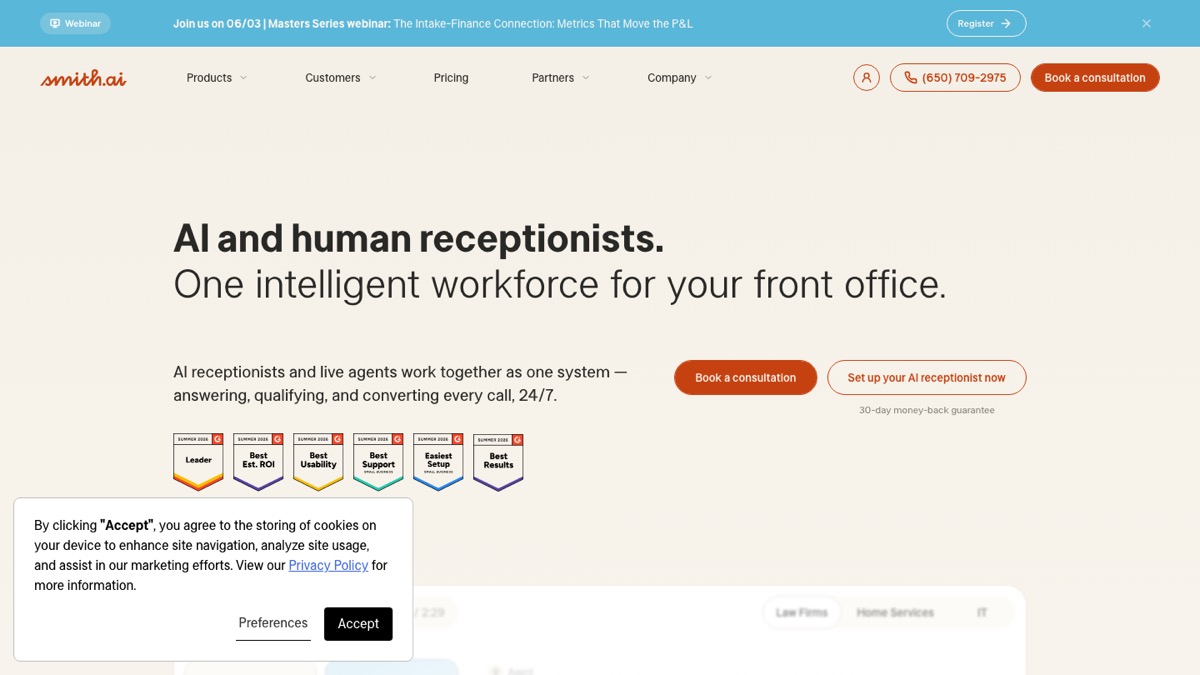
Smith.ai
AI + human
Free for 25 AI calls; human from $300/month for 30 calls
Yes, AI or agents
Legal, high-stakes intake
MightyCall, Grasshopper, Quo, Google Voice, Dialpad and Ooma read on their own pricing pages in October 2026; plans change often; confirm current rates before deciding.
Notice the "answers calls for you?" column. Most of this list is virtual phone systems just like MightyCall. They'll route your calls a little cheaper or with a nicer app, but they leave the answering to you. Only the AI and live-human options actually pick up. Let's rank them.
1. NextPhone AI: Best Overall (Answers, Books, and Qualifies)
Pricing: flat monthly plans from $199. Unlimited inbound calls. No per-minute, per-call, or overage fees. No per-user pricing.
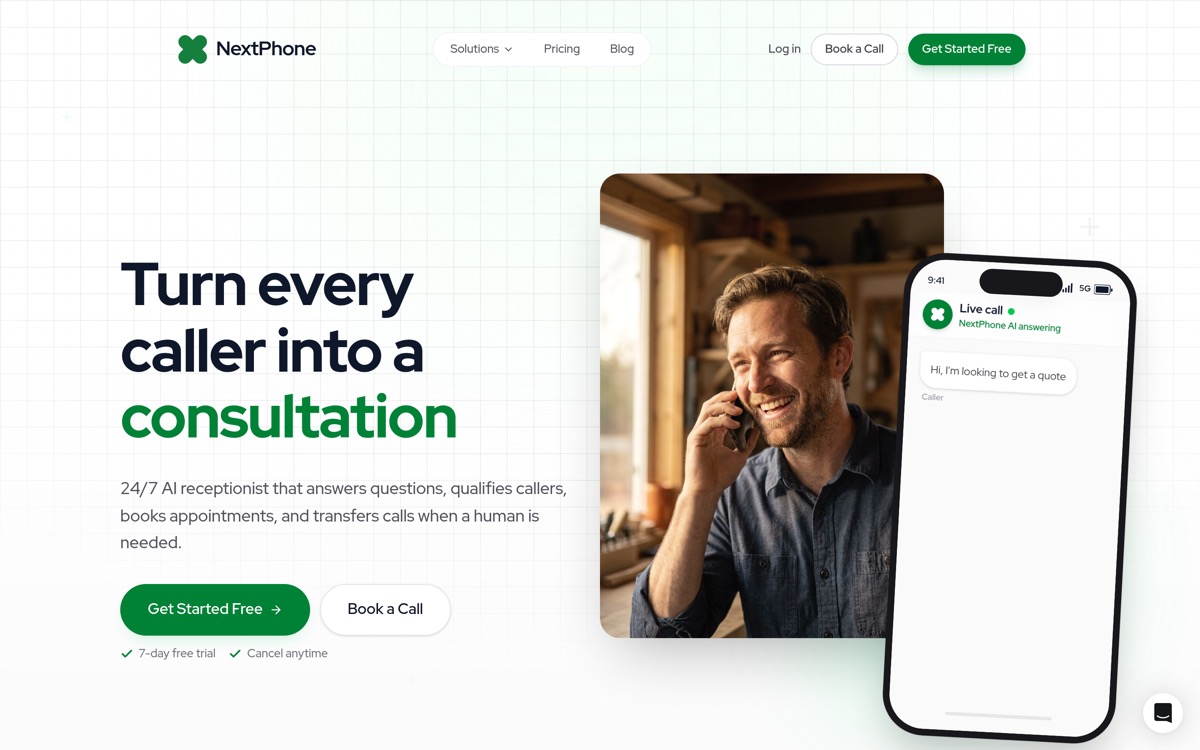
This is the category MightyCall shoppers usually didn't know existed. NextPhone is an AI receptionist that answers the phone for you. It picks up in under 2 seconds, has a real conversation with the caller, and completes the actual task: answers the question, books the appointment, captures the lead with the details you care about, or routes an urgent call straight to your cell with full context.
Where MightyCall's IVR sends a caller through a menu hoping a human is free, NextPhone's AI handles the call itself. Across 2,000,000+ real business calls answered, it resolves 90–95% of calls without human escalation, maintains 99% positive caller sentiment, and filters spam and robocalls separately so you're never paged for an extended-warranty pitch.
What it does on a live call:
Answers your real questions. Hours, service area, pricing ballparks, "do you work on X?": handled instantly, trained on your business.
Books appointments. Checks availability and gets the caller on the calendar during the call, then confirms by text.
Qualifies leads. Captures name, number, job type, budget, timeline, new-vs-existing (any field you define) as structured data, not a guess scribbled on a sticky note.
Routes the calls that need you. "My pipe burst" gets flagged as urgent and forwarded to your phone within seconds, with the context already gathered.
Speaks 14 languages. Each call is handled in the language the caller speaks.
Before you trust an AI on your main line, you should hear it work. This is the difference between an IVR forwarding a call and an AI actually handling one:
Hear it: an AI receptionist qualifying a sample inbound lead
0:00
0:59
A sample call: the AI greets, asks the right qualifying questions, and captures structured details. MightyCall's IVR can move this caller through a menu; it can't have this conversation.
And here's the after-hours scenario where a virtual phone system always loses: the call MightyCall would have dropped into voicemail:
Hear it: an AI receptionist handling a sample after-hours call
0:00
0:43
The AI greets, takes the caller's name and matter, confirms the callback number, and flags it for a morning callback. With a routing-only system, this caller hits voicemail at 9 PM and calls your competitor.
On integrations, NextPhone is natively integrated with Clio (legal practice management: Clio Manage gets the caller as a contact and the consult on your calendar, Clio Grow gets a lead with the call summary and every intake answer; no matters are created) and HubSpot (CRM): calls become contact records with the call details sent after the call. Jobber connects natively too, and ServiceTitan, Salesforce, and 8,000+ other tools connect via Zapier, so leads land wherever you already work.
Best for: Any service business losing calls to voicemail: contractors, trades, law firms, real estate, auto shops.
Limitation: It's an inbound answering solution. If your main job is high-volume outbound dialing, pair it with a cheap virtual line (see Grasshopper below).
Feature
NextPhone AI
MightyCall
Pricing
From $199/mo, flat monthly, unlimited
Per-user + minute bundles + overage
Answers calls for you
Yes, AI picks up in under 2 sec
No, routes to a human who must be free
Books appointments
Yes, during the call
No
Qualifies leads
Yes, structured capture
No
After-hours coverage
24/7/365
Voicemail when nobody's available
Try NextPhone free for 7 days
AI answering service that answers, qualifies, and books, 24/7.
Pricing: From $14/month (True Solo) billed annually, or $168/year (read October 2026). Flat, no per-user fees.
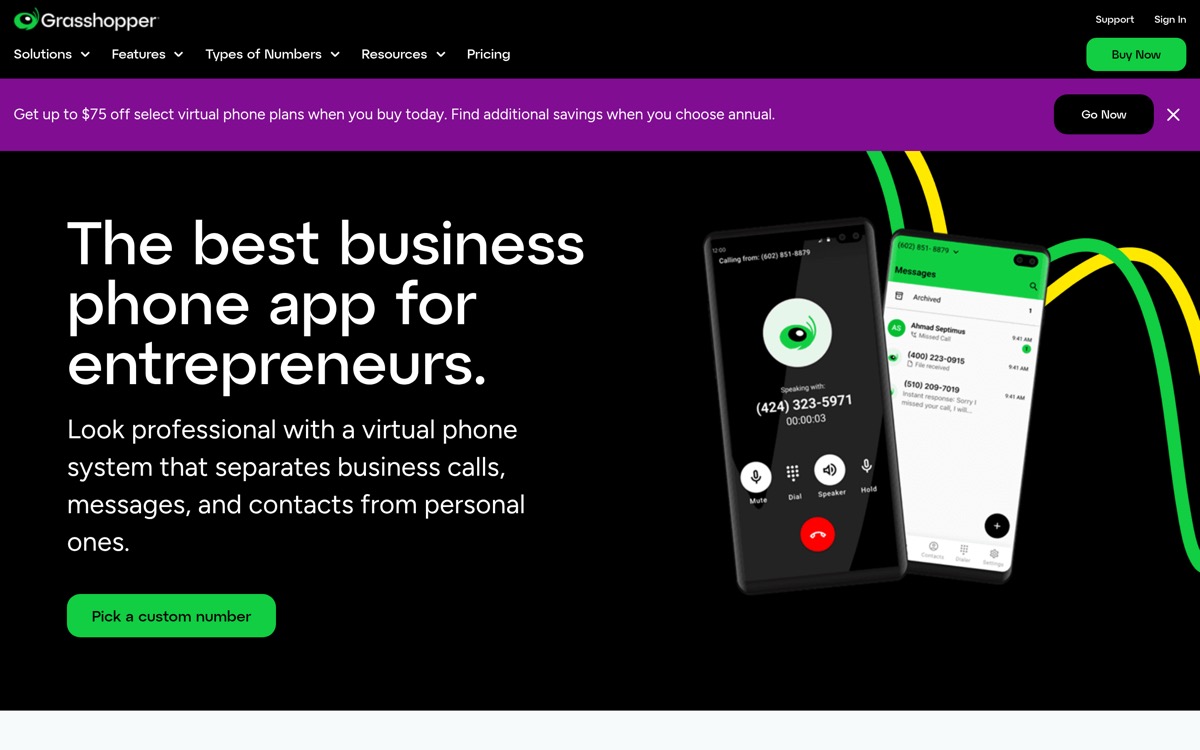
If you genuinely just want what MightyCall's base plan gives you (a business number, voicemail, basic routing) but cheaper and without per-seat math, Grasshopper is the cleanest swap. The True Solo plan is one number for $14/month billed annually; the Small Business plan covers unlimited users at a higher flat rate.
It's a virtual phone system, full stop. It separates business from personal calls and looks professional on caller ID. But like MightyCall, it routes calls to you; it doesn't answer them. Compare it head-to-head with AI in our Grasshopper AI receptionist breakdown.
Best for: Solopreneurs and 1–3 person teams who answer their own phones and just want a clean business line.
Limitation: No AI, no live answering: every call still needs you to pick up.
3. Quo (formerly OpenPhone): Best for Remote, Text-Heavy Teams
Pricing: $15 per user per month (annual; $28 monthly, read October 2026).
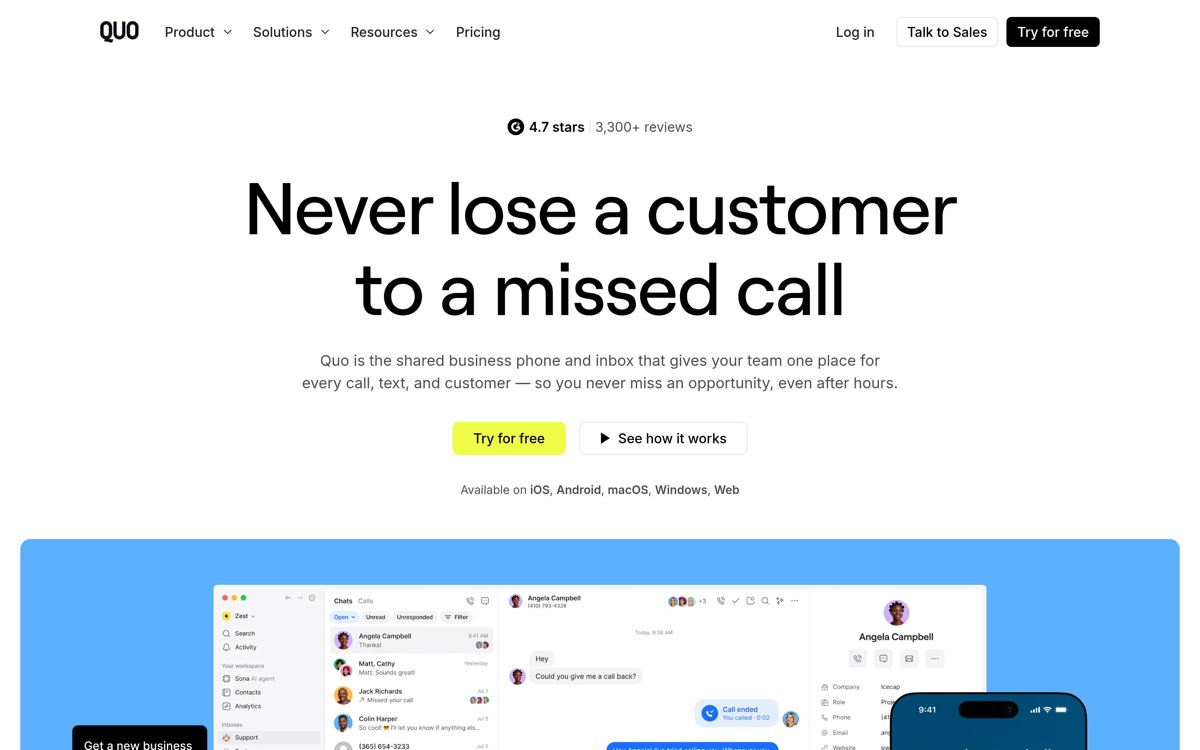
Quo (formerly OpenPhone) is built around how modern small teams actually communicate: shared numbers, shared inboxes, lots of texting, and a clean app that feels more like a messaging tool than a phone system. For teams collaborating on the same customer conversations, it's a noticeably nicer experience than MightyCall's older interface.
It's still per-user VoIP, though, so cost scales with headcount, and it's still a routing tool: calls ring your team and go to voicemail when nobody answers. See setup specifics in our Quo (formerly OpenPhone) integration guide.
Best for: Remote teams where texting matters as much as calling.
Limitation: Per-user pricing scales up; no AI answering or live agents.
4. Google Voice: Best Budget Option
Pricing: $10–30 per user per month (business tiers: Starter $10, Standard $20, Premier $30). A separate consumer Google Voice tier is free, but it isn't a business plan.
The simplest, cheapest way to get a separate business number. Consumer Google Voice gives an individual a US number, voicemail, and call forwarding for nothing, but it's a personal-use product, not a business plan. Business Starter at $10/user adds Google Workspace integration if you already live in Gmail and Calendar.
The trade-offs are real: no toll-free numbers, US-only, bare-bones routing, and (same as every tool in this tier) it doesn't answer calls, it forwards them. Full comparison in our Google Voice alternative guide.
Best for: Solo operators who want a cheap, Google-native business number.
Limitation: Minimal features, US-only, no answering layer.
Pricing: $15 per user per month (annual; $27 monthly).
Dialpad is the closest thing on this list to "VoIP with AI baked in." Every call gets real-time transcription, automated post-call summaries, and sentiment analysis, and the sales tiers add coaching that flags objection moments and talk-to-listen ratios. At $15/user it undercuts a lot of UCaaS platforms while including AI features they charge extra for.
But its AI assists the human on the call: it transcribes and summarizes; it doesn't answer the phone when your reps are unavailable. The upper tiers also get expensive fast. See our Dialpad AI alternative comparison for the full picture.
Best for: Sales teams that want AI call notes and coaching for reps who are already answering.
Limitation: AI helps the human; it doesn't replace the missed-call problem. Upper tiers get pricey.
6. Ooma Office: Best for Simplicity
Pricing: $24.95–34.95 per user per month (read October 2026).
Ooma does the basics well: call, text, voicemail, simple routing, no contracts, 15-minute setup. If you found MightyCall fiddly and just want a phone system that works without surprises, Ooma is the low-drama pick.
It's still per-user, and still a routing tool: predictable pricing, but the same "someone has to answer" limitation as MightyCall.
Best for: Small teams wanting dead-simple VoIP with no contracts.
Limitation: Fewer features; no answering layer.
7. Ruby Receptionists: Best Live Humans (Premium)
Pricing: Starts at $250/month for 50 minutes.
If you want actual humans answering (not an IVR, not AI), Ruby is the premium standard. US-based receptionists answer in your business name, take messages, and route calls warmly. For brands where every first impression has to feel high-touch, that polish is worth paying for.
The catch is the meter. Ruby bills on included minutes plus overage, so a busy month or a few long calls pushes your bill up fast: the same per-minute anxiety, just with live agents instead of routing. We break down the tradeoffs in our Ruby Receptionists vs AI comparison.
Best for: Premium brands and low-volume, high-stakes calls where a human voice justifies the cost.
Limitation: Per-minute pricing; gets expensive at volume.
8. Smith.ai: Best for High-Stakes Intake
Pricing: AI Receptionist free for 25 calls, or $150/month for 75 calls, with overage of $2.17 to $3.00 a call; Human Virtual Receptionist Starter $300/month for 30 calls, with overage of $8.50 to $11.50 a call.
Smith.ai offers both a live-agent service and an AI option, which makes it flexible for firms that want humans on sensitive intake (think legal) but a cheaper AI fallback for overflow. The live agents are well-trained and handle nuanced conversations gracefully.
Both tiers bill per call with monthly caps, so a high-volume month gets costly and unpredictable. For sensitive intake where caller experience is everything, that may be worth it; for general small-business call volume, flat-rate AI usually wins on cost. Compare directly in our Smith.ai alternative breakdown.
Best for: Law firms and high-stakes intake that want live humans with an AI safety net.
Limitation: Per-call pricing with caps; pricey at volume.
The Cost Math MightyCall Doesn't Show You
Here's why "pricey for what it does" stings. MightyCall is per-user ($20/user/mo annual, $25 monthly on the Core plan, read October 2026) with a 3-user minimum, and each plan pools a set number of minutes, then charges overage. So the advertised per-seat price isn't the floor; three seats is.
Take a typical 3-person service business on the entry tier:
Base: $20–25/user × 3 (the 3-user minimum) = $60–75/month before you add anything
A busy month blows past the pooled minutes → overage on inbound and outbound
Effective cost climbs toward $90–120/month, and higher tiers ($38/$54 per user) push the floor up further
And after all that, the calls still go to voicemail when your crew is on jobs, at lunch, or off the clock. You're paying to carry the call, not to win it.
Now the missed-call side of the ledger. For a typical contractor receiving 42 calls per month, if 74.1% go unanswered (31 missed calls, NextPhone call data), and just 20% would have converted at an average $3,500 project value, that's $21,700 per month in lost revenue, or $260,400 per year.
A virtual phone system, no matter how cheap the seats, doesn't touch that number. Something that answers does:
Solution
Monthly Cost
What happens when a customer calls
MightyCall (3-user minimum)
$60–120
Rings your team; voicemail if nobody's free
Cheaper VoIP (Grasshopper)
From $14 (billed annually)
Same: routes to you, voicemail otherwise
Full-time receptionist
$3,500+
Answered, but only 40 hours/week
NextPhone AI
From $199/mo, flat monthly
Answered in under 2 sec, 24/7, books and qualifies
On flat monthly plans from $199, AI answering provides coverage that would cost $35,000+/year with a human receptionist, and unlike a human (or a per-minute live service), it doesn't take lunch, sick days, or overage fees. For a deeper breakdown, see our AI receptionist pricing guide.
The Hybrid Setup: Keep a Cheap Line, Add an AI That Answers
You don't have to choose between a phone system and answered calls. The smartest setup for a lot of small businesses is both:
Cheap virtual line for outbound + AI answering for inbound.
Grasshopper or Google Voice for your outbound business number: from $10-$14/month
NextPhone to answer every inbound call: $199/month
Total: ~$215–280/month
Compare that to MightyCall at $60–120/month where inbound calls still hit voicemail, or MightyCall plus a receptionist ($3,500+/month) to actually answer them. The hybrid gives you outbound calling and every inbound call answered, booked, or routed, for less than the cost of one human's monthly paycheck.
The real comparison was never AI vs. human. It's AI vs. voicemail. Without something that answers, missed calls go unanswered. With AI, 90–95% of calls get resolved immediately, and the rest get smart-routed to your phone with full context. Either way, the caller gets helped instead of hitting voicemail and calling your competitor. For the full side-by-side on this category split, see our AI receptionist vs answering service comparison.
How to Choose the Right MightyCall Alternative
Pick a cheaper virtual phone system if:
You (or your team) reliably answer your own calls
Your real complaint is just price-per-seat or a clunky app
Outbound calling is your main use case
Recommendations: Grasshopper (solo, flat rate), Quo (formerly OpenPhone) (remote teams), Google Voice (cheap, Google-native), Ooma (simple, no contracts)
Pick AI answering if:
Calls currently go to voicemail while you're working
You're a service business with booking and qualifying needs
You don't have a dedicated receptionist
Recommendation: NextPhone AI: flat monthly plans from $199, answers every call 24/7
Pick live humans if:
Every first impression has to feel high-touch
Your intake is sensitive (legal, high-stakes)
Call volume is low enough that per-minute pricing stays sane
Recommendations: Ruby (premium), Smith.ai (legal/intake, with AI fallback)
Ask yourself five questions:
What percentage of my calls currently go to voicemail?
Do I need to make outbound calls, or just catch inbound ones?
How many people actually need a phone-system login?
What's a single missed lead worth in my business?
Is the phone number the problem, or the empty desk behind it?
If most calls go unanswered and a missed lead is worth real money, no virtual phone system fixes that. Something that answers does.
Frequently Asked Questions
What is the best alternative to MightyCall for small business?
It depends on your problem. If you just want a cheaper business number, Grasshopper ($14/mo billed annually) or Google Voice ($10/user/mo for Business Starter) are the simplest swaps. If your real issue is calls going unanswered, NextPhone AI (flat monthly plans from $199, unlimited) is the best pick because it actually answers, books appointments, and qualifies leads instead of just routing them, something no virtual phone system, MightyCall included, does on its own.
Why do people say MightyCall is overpriced?
The common complaint is "pricey for what it does — it just forwards calls." MightyCall is a virtual phone system: per-user pricing plus minute bundles and overage, for a number, an IVR, and routing. The value gap shows up when owners realize routing isn't answering: calls still hit voicemail when nobody's free, so they're paying to carry calls they still miss.
Does MightyCall answer calls automatically?
No. MightyCall routes and forwards calls and runs an IVR menu, but a human still has to pick up. There's no AI or agent answering on your behalf. If nobody's available, the caller lands in voicemail. That's the core difference between a virtual phone system like MightyCall and an AI receptionist like NextPhone, which answers the call itself.
Is there a flat-rate alternative to MightyCall?
Yes. Grasshopper offers flat-rate virtual phone plans (from $14/mo billed annually) with no per-user fees. For answering rather than just routing, NextPhone's flat monthly plans start at $199 for unlimited inbound calls (no per-minute, per-call, or overage fees), which makes the bill predictable even in a busy month, unlike MightyCall's minute bundles plus overage.
Can I keep my number if I switch from MightyCall?
Yes. Number porting is standard across virtual phone systems, AI answering services, and live answering services. The process usually takes 1–2 weeks, the new provider handles most of the paperwork, and your customers won't notice: same number, different system answering. See our phone number porting guide for the full process.
MightyCall vs an AI receptionist: what's the real difference?
MightyCall is infrastructure: it gives you a number and moves calls around to people who still have to answer. An AI receptionist is the answer itself: it picks up in seconds (NextPhone: under 2 seconds), handles the conversation, books appointments, qualifies leads, and routes only the calls that need a human. One carries the call; the other wins it. Many businesses pair a cheap virtual line for outbound with AI answering for inbound.
The Bottom Line
MightyCall is a fine virtual phone system. It gives you a professional number, an IVR, and call routing for a per-user fee. But it does exactly what owners complain about: it forwards calls. It doesn't answer them, book them, or qualify them, and when your crew is busy or off the clock, callers still hit voicemail.
So the right MightyCall alternative comes down to one question:
Is your problem the phone number, or the calls you're missing behind it?
If it's the number, Grasshopper, Quo (formerly OpenPhone), Google Voice, or Ooma give you a cleaner, cheaper virtual line. If it's the missed calls (and for most small businesses, it is), no virtual phone system fixes that. AI answering does: every call picked up in seconds (under 2 seconds on NextPhone), questions answered, appointments booked, leads qualified, urgent calls routed to you, on flat monthly plans from $199 with no per-user fees and no overage.
Before you switch to another virtual phone system, ask whether routing was ever really the problem. The empty desk was.
Try NextPhone AI answering service
AI answering service that answers, qualifies, and books, 24/7.