
It's 9:47 PM on a July Tuesday. The temperature in Houston just dropped to 94 degrees - the coolest it's been all day. A homeowner in Sugar Land realizes their AC hasn't kicked on in two hours. The thermostat reads 87 degrees inside. Their elderly mother is visiting from out of state.
They grab their phone and start calling HVAC contractors.
First call: voicemail. Second call: rings six times, voicemail. Third call: someone answers on the second ring.
Guess who gets the $4,200 emergency repair job?
This scenario plays out dozens of times every night across the Houston metro area. In a city where summer temperatures regularly exceed 100 degrees and AC failure can become a medical emergency within hours, being available when customers call isn't just good business. It's the difference between winning work and watching it go to your competitors.
This guide covers everything Houston business owners need to know about answering services: why local numbers matter, what options exist, how pricing works, and how to capture the calls you're currently missing.
NextPhone: Houston answering service -- $199/mo flat rate, local 713 number, 24/7 AI, bilingual English/Spanish included. Start your free trial
Why Answering Services Matter More in Houston
Houston isn't like other cities. The combination of extreme weather, a booming economy, and a massive service-based workforce creates unique challenges - and opportunities - for business owners who understand how to respond.
Houston's Climate Creates Emergencies Others Don't Have
Summer in Houston means temperatures that regularly exceed 100°F. When an air conditioning system fails, it's not an inconvenience - it's a health emergency, particularly for children, elderly residents, and people with medical conditions.
Consider what Houston businesses face:
- Hurricane season runs from May through November, creating surge demand for contractors, electricians, and restoration services
- Houston residents are 2.7 times more likely to experience power outages than the average American, according to The Washington Post's analysis of utility data
- Hurricane Beryl in July 2024 left more than 500,000 Houston residents without power for days during extreme heat conditions
- The May 2024 derecho knocked out power to 900,000+ customers in Harris County alone
When customers call a Houston HVAC contractor, plumber, or electrician during these events, they need help immediately. They're not going to wait for a callback. They're calling the next name on the list.
The Houston Economy is Booming
Houston's business environment makes the competition even fiercer. According to Houston.org's economic data:
- 97% of Houston businesses are small businesses (fewer than 500 employees)
- These small businesses employ 44% of the region's workforce - 1.2 million people
- Houston is ranked the 7th-best U.S. city for starting a business (CommercialCafe, December 2025)
- The region added 57,800 jobs in 2024 and forecasts 71,800 new jobs in 2025
- 130,000+ business establishments operate in the Houston metro area
With 130,000 businesses competing for customers, the one who answers the phone first has a massive advantage. A Lead Connect survey found that 78% of customers hire whichever business responds first. Not the cheapest. Not the best-reviewed. The first one to pick up.
Bilingual Answering for Houston's Spanish-Speaking Customers
Houston's population is over 44% Hispanic, making bilingual answering capability essential -- not optional. If your answering service can't handle Spanish-speaking callers, you're turning away nearly half of Houston's potential customers. Any Houston answering service worth considering should include bilingual English/Spanish support as standard, not a premium add-on.
The Real Cost of Missed Calls

Here's what the data shows about missed calls in home services businesses:
Across the 1,446,980+ business calls NextPhone has answered for home services businesses and others, plus published industry research:
- Industry research shows 74.1% of calls go completely unanswered - three out of four potential customers reach voicemail
- Approximately one in four callers asks for a callback
- Urgent calls rank among the top reasons people call - language like "emergency," "urgent," or "ASAP"
- Emergencies are a recurring reason people call - pipe burst, no power, AC out in extreme heat
For a typical Houston contractor receiving 42 calls per month, that 74.1% missed rate means 31 missed calls. If just 20% of those would have converted at an average project value of $3,500, that's $21,700 per month in lost revenue - or $260,400 per year.
And here's what makes it worse: industry research shows that 85% of callers who don't reach someone won't call back. They don't leave voicemails. They call your competitor instead.
Why a Local Houston Number Matters
If you're going to invest in an answering service, make sure you get a local Houston area code. The difference in how customers respond is significant.
The Story of the 713 Area Code
Area code 713 was one of the original 86 area codes established in 1947 when AT&T and the Bell System created the North American Numbering Plan. It originally served all of southeastern Texas, including Houston and the surrounding region.
Today, 713 covers Harris County, Fort Bend County, Montgomery County, and Brazoria County - the heart of the Houston metro. Cities like Houston proper, Pasadena, Pearland, League City, Sugar Land, and The Woodlands all fall within the 713 coverage area.
As Houston grew, the area needed more numbers:
- 281 (1996): Added for the suburbs, roughly following Beltway 8
- 832 (1999): First overlay to 713
- 346 (2014): Fourth area code for the region
- 621 (January 2025): The newest overlay, just added this year
All five area codes now serve the Houston metro area. Houston residents recognize all of them as "local."
Local Numbers Get Answered
The data on local versus toll-free numbers is clear:
| Number Type | Answer Rate | Spam Perception |
|---|---|---|
| Local (713/281/832) | 60-70%+ | 2-5% |
| Toll-Free (800/888) | 40-50% | 20-30% |
According to Hiya's State of the Call report, 48% of consumers never answer calls from unidentified numbers. But when they see a local area code - especially a recognized one like 713 - they're significantly more likely to pick up.
A local Houston number creates immediate familiarity. Customers assume you're a local business, not a national call center or telemarketer. For industries like HVAC, plumbing, electrical, healthcare, and legal services, that trust translates directly into higher connection rates and more business.
Houston Answering Service Options for Your Business
Houston business owners have several options when it comes to answering services. Here's how they compare.
Traditional Live Answering Services
How they work: Human operators answer calls on your behalf, take messages, and forward urgent matters according to your instructions.
Typical pricing: $0.75-$1.25 per minute in the Houston market, with monthly minimums starting around $100-300.
Houston providers include:
- Apollo Answering Service: A Houston-based, multi-generational business serving over 400 clients
- Signius: Operating since 1929, with a local office at 8915 Knight Road
- MAP Communications: Serves various industries including medical practices
- Specialty Answering Service: Per-minute billing with various plan tiers
- Responsive Answering: Per-minute billing plans
Pros: Human touch, ability to handle complex conversations, established reputation.
Cons:
- Per-minute costs can add up quickly during busy seasons
- Quality varies by individual operator
- May not provide true 24/7 coverage
AI-Powered Answering Services
How they work: AI answers calls instantly, handles frequently asked questions, books appointments, captures lead information, and routes emergencies to your cell phone. Think of it as a virtual receptionist that never sleeps.
Typical pricing: Flat monthly fee. NextPhone charges $199/month for unlimited calls.
Pros: Consistent quality on every call, truly 24/7/365 availability, answers in under 5 seconds, integrates with your existing tools (CRM, calendar, SMS), typically 40-60% less expensive than traditional services.
Cons:
- Complex emotional situations may benefit from smart forwarding to you (good AI services detect these and transfer calls automatically)
AI + Smart Forwarding
How they work: AI handles routine calls (which make up 60-80% of most businesses' call volume), while smart forwarding routes complex situations, VIP clients, or escalations to you.
Best for: Businesses that want efficiency but need direct access for certain situations.
Quick Comparison
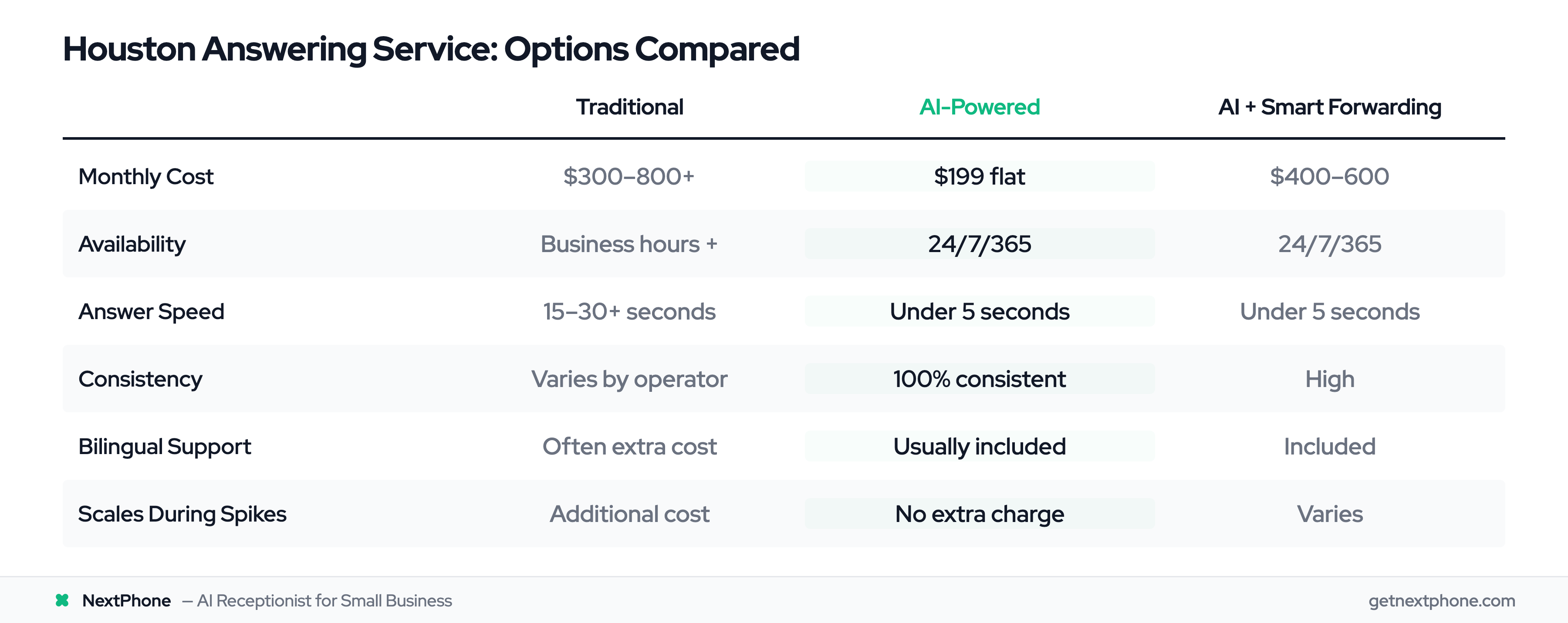
| Feature | Traditional | AI-Powered | AI + Smart Forwarding |
|---|---|---|---|
| Monthly Cost | $300-800+ | $199 flat | $400-600 |
| Availability | Business hours + | 24/7/365 | 24/7/365 |
| Answer Speed | 15-30+ seconds | Under 5 seconds | Under 5 seconds |
| Consistency | Varies by operator | 100% consistent | High |
| CRM Integration | Limited | Full | Full |
| Bilingual Support | Often extra cost | Usually included | Included |
| Scales During Spikes | Additional cost | No extra charge | Varies |
For Houston businesses dealing with unpredictable call volumes (hurricane season, summer AC emergencies), the flat-rate pricing of AI services can provide significant peace of mind.
Answering Services by Houston Industry
Different Houston industries have different answering service needs. Here's what matters most for each.
HVAC and Plumbing Contractors
For Houston HVAC and plumbing businesses, 24/7 emergency coverage isn't optional - it's the core requirement.
When someone's AC fails at 10 PM in August, or a pipe bursts at 3 AM, they're not going to wait until morning. They're calling until someone answers. Emergency calls in Houston's climate are often life-safety situations, especially for elderly residents.
Key features needed:
- Emergency detection (AI identifies words like "emergency," "flooding," "no AC," "burst pipe")
- Instant routing to owner's cell for true emergencies
- After-hours coverage that actually works
- Spanish bilingual capability
The numbers: Emergency service calls average $4,200 - significantly higher than routine work. Missing just one emergency call per week means losing $16,800 per month in revenue.
Electricians and General Contractors
Houston's construction sector is booming - it grew 7% year-over-year in 2024, adding 16,357 jobs. That growth means more competition and more customer calls.
The problem? You can't answer your phone when you're on a ladder, in a crawl space, or working with live wires.
Key features needed:
- Appointment scheduling capability
- Quote request capture with project details
- Works while you're on job sites
- Handles "do you service my area?" and basic pricing questions
Medical and Dental Practices
Houston's Texas Medical Center sets a high bar for healthcare standards in the region. Medical practices need answering services that meet privacy requirements and handle the high volume of appointment-related calls.
Key features needed:
- Secure, compliant call handling
- Appointment scheduling and confirmation
- Appointment reminder capabilities (reduces no-shows)
- Insurance verification basics
- Urgent care triage (routing emergencies appropriately)
Legal and Professional Services
Law firms face a particular challenge: research shows 35% of law firm calls go unanswered, costing the industry an estimated $109 billion annually.
Key features needed:
- Lead qualification and intake information collection
- Matter urgency classification
- Professional demeanor appropriate for legal clients
- Detailed message capture
Real Estate Agents
Real estate agents can't answer calls during showings, but every missed call could be a lost buyer or seller. Studies show the average real estate agent takes over 15 hours to respond to inquiries - and 78% of buyers work with the first agent to respond.
Key features needed:
- Lead capture for property inquiries
- Showing scheduling
- Property information responses
- Integration with real estate CRMs like Follow Up Boss