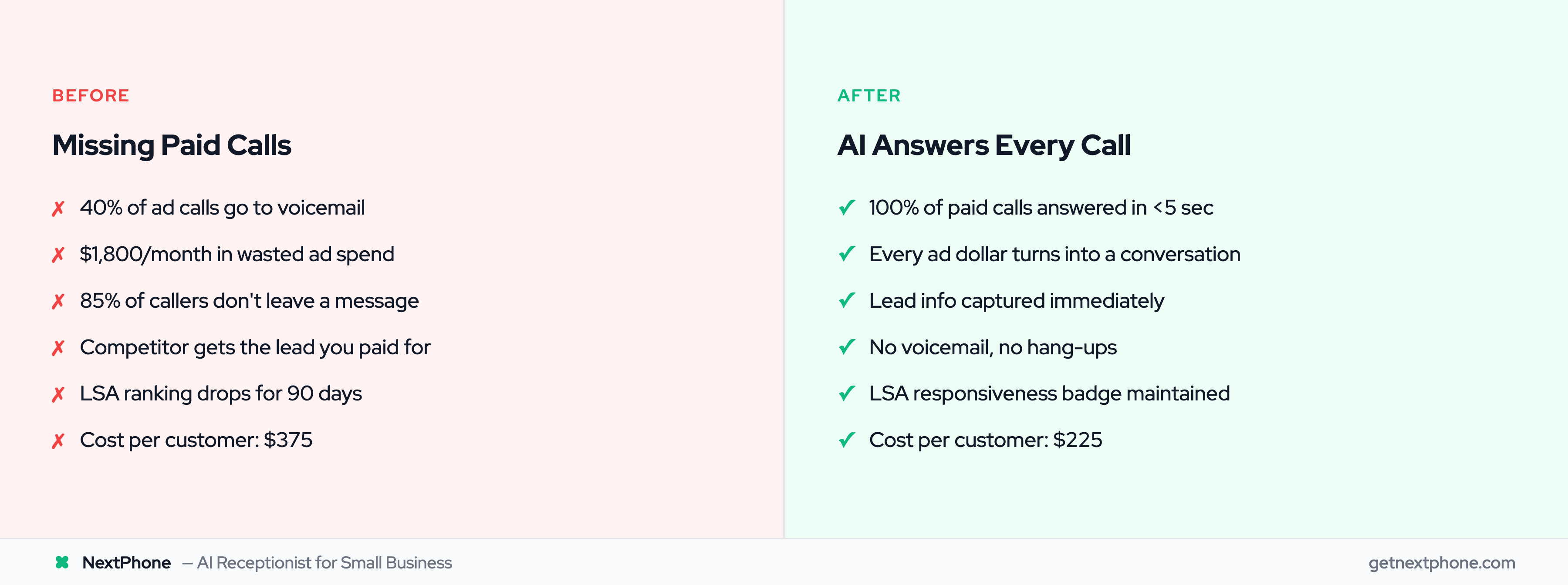
Tired of wasting ad spend on missed calls? See how NextPhone answers every paid call instantly.
What Are Click-to-Call Ads?
Click-to-call ads are paid advertisements that let a potential customer tap a phone number and dial your business directly from the ad. They appear across Google Search, Google Maps, Facebook, and Instagram. When someone taps the number, their phone dials you immediately and you are charged for the click — whether you answer or not.
The mechanic is simple: a user searches for something like "emergency plumber near me," sees your ad with a phone number, taps it, and their phone starts ringing yours. Google or Meta charges you for that tap. If you pick up, you have a high-intent lead on the line. If you don't, you have a charge on your account and nothing to show for it.
Click-to-call is one of the highest-converting ad formats available. Google's own data shows that 70% of mobile searchers have used the click-to-call feature, and phone call leads convert at 30-50% higher rates than form fills. But that conversion advantage only exists if someone answers the phone. When nobody picks up, click-to-call becomes the most expensive way to send a lead to voicemail.
The Real Cost of Missing a Click-to-Call Ad Call
Your Google Ads bill hits $3,000 this month. Somewhere in that spend, a homeowner clicked your call extension. Your phone rang. The charge was $50.
You were with a client. The phone went to voicemail.
That $50 is gone. Not "invested." Not "spent wisely." Gone. Thrown in the trash. The homeowner who clicked your ad? They already called the next result on the page.
This is different from a missed call off your website or a Google Maps listing. Those are free opportunities you didn't capitalize on. Click-to-call missed calls are opportunities you paid cash money for and then ignored.
Every day, small businesses across the country burn thousands of dollars on click-to-call ads that ring into empty offices, busy phones, and voicemail boxes nobody checks. This post shows you exactly how much that's costing you, which ad types are bleeding money, and how to make sure every paid ring turns into an actual conversation.
The Basic Math
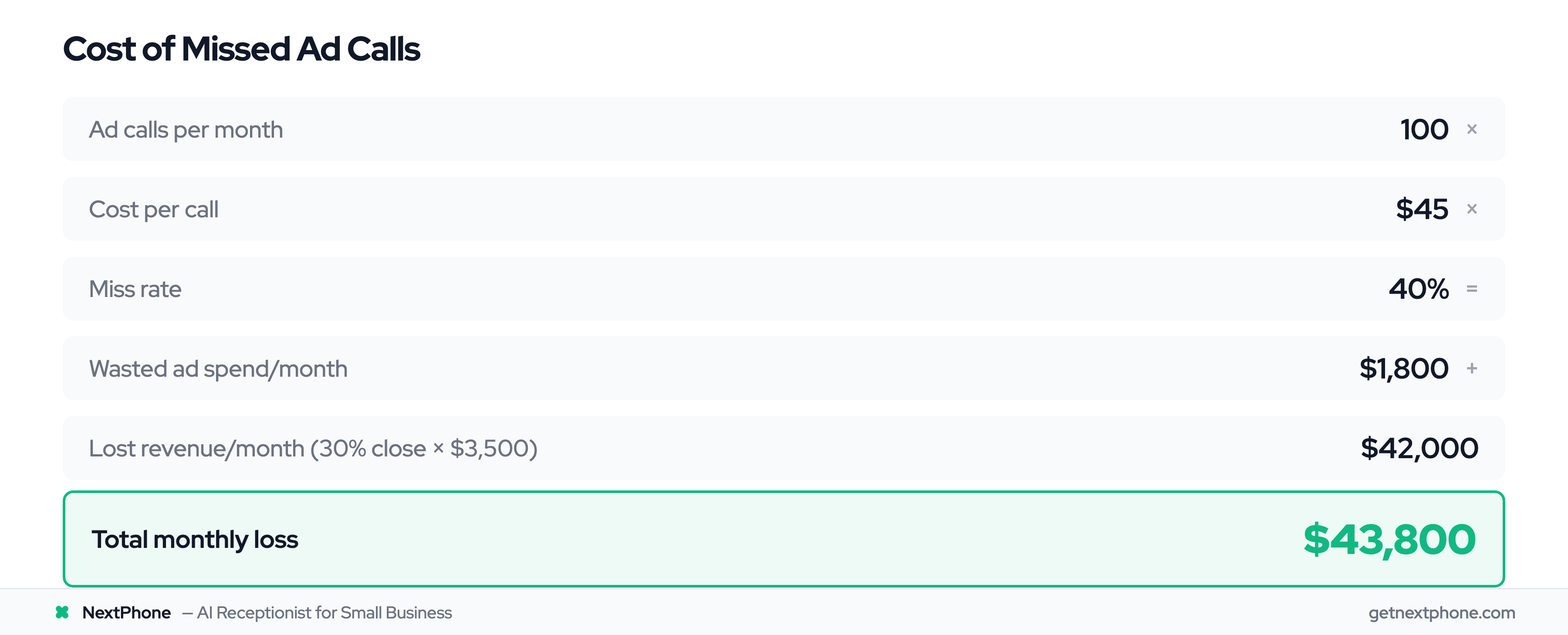
Let's start simple. You're running Google Ads with call extensions for your plumbing business. Your average cost per call: $45. You receive about 25 ad-driven calls per week - roughly 100 per month.
How many do you actually answer? If you're like most small businesses, the answer is painful. Research from Invoca shows that 62% of calls to small businesses go unanswered. Even being generous and assuming you answer more than average - say you miss "only" 40% - the math is brutal:
- 100 calls per month at $45 each = $4,500 in ad spend
- 40% missed = 40 unanswered calls
- 40 missed calls × $45 = $1,800/month wasted
- Annual waste: $21,600 in ad spend that generated zero conversations
The Double Hit: Wasted Spend PLUS Lost Revenue
But it gets worse. Those 40 missed calls weren't just wasted ad dollars. They were potential customers.
Phone call leads convert at 30-50% higher rates than form fills. Forrester research found that phone calls convert to revenue 10-15x more frequently than web leads. Someone who clicks a call button is high-intent - they want to talk right now. They're ready to hire.
If even 30% of those 40 missed callers would have converted at a $3,500 average job value:
- 40 missed calls × 30% conversion = 12 lost customers per month
- 12 × $3,500 = $42,000/month in lost revenue
- Annual: $504,000 in revenue that called you, paid to call you, and you didn't pick up
Even at a more conservative 20% conversion and $2,000 average job, you're still looking at $192,000 in annual lost revenue from missed ad calls alone.
The Number That Should Keep You Up at Night
Add the wasted ad spend ($21,600) to even a conservative lost revenue estimate ($192,000) and you're looking at over $200,000 per year walking out the door because nobody answered the phone.
You paid for that phone to ring. The money left your account. And then nothing happened.
Click-to-Call Ad Types Where Missed Calls Cost You Most
Google Ads Call Extensions and Call Assets
As of late 2025, Google transitioned call-only ads to call assets (also called call extensions). These show your phone number alongside your search ads, and when someone taps it on mobile, their phone dials you directly.
What you're paying: The click-to-call costs the same as any other click on your ad. For home services, that's $4-$11+ per click depending on your trade. But since phone callers convert at higher rates, the effective cost per customer acquisition is often lower than regular clicks - IF you answer.
What you waste when you miss: Every unanswered call extension click is the full CPC gone. At $8 average CPC and 50 call clicks per month, missing 40% means $160/month in pure waste. For high-competition keywords (roofing, HVAC emergency), where CPCs hit $15-25, the waste compounds fast.
The kicker: Google's own research shows 70% of mobile searchers use the click-to-call feature. Nearly half of searchers say if a business doesn't have a phone number in search results, they'll explore other brands. You're paying to have that number there. Pick it up.
Google Local Service Ads (LSA)
LSAs are the gold-standard pay-per-lead model for local businesses. You only pay when someone actually calls or messages through the ad. Costs range from $15-$100 per lead depending on your trade and market.
What makes LSA different: Google tracks your responsiveness. Down to the minute. Businesses that respond within 2-3 minutes convert 40-60% more leads than those who wait 10-15 minutes.
The 90-day penalty: Here's what most contractors don't know - missed calls on LSA don't just waste that individual lead. They tank your ranking for the next 90 days. Google's algorithm interprets missed calls as "this business doesn't have capacity" and reduces your ad placement. Miss calls today, pay for it for three months.
The responsiveness badge: Maintain fast response times and Google displays "Typically responds in a few minutes" on your LSA listing. This badge alone increases click-through rates significantly. Miss too many calls and you lose it.
Facebook and Meta Call Ads
Facebook call ads let users tap a button that dials your business directly from the ad. While Facebook's average CPC is lower than Google ($0.70-$1.67 in the US according to WordStream's 2025 benchmarks), the lead generation CPCs for service businesses run $2.50-$5.50.
What makes these tricky: Facebook call ads generate calls from people scrolling their feed. They're interested enough to tap "Call Now," but their attention span is short. If you don't answer within 3-4 rings, they're back to scrolling. You got charged for the click. They're gone.
Instagram too: The same call ad format runs on Instagram. Same cost structure, same problem when you don't answer.
Google Business Profile (Maps) Call Button
Technically, GMB calls are free - you don't pay per click. But the homeowner searching "plumber near me" on Google Maps and tapping your call button is one of the highest-intent leads you'll ever get.
Why this matters here: If you're investing time and money in your Google Business Profile (photos, reviews, posts), those efforts drive calls. When those calls go unanswered, your review-building efforts are wasted, your map ranking drops (Google tracks engagement), and a competitor captures the customer you spent months earning.
Why 40% of Your Paid Calls Go Unanswered
You're not ignoring these calls on purpose. The problem is structural.
You're Already on a Call
Your phone rings with an ad lead. But you're already talking to another customer. You can't put them on hold to grab a new call. The new one goes to voicemail — which 85% of callers won't leave a message on anyway. ServiceTitan's data shows that the average home services business misses 27% of calls during peak hours alone, precisely when ad-driven call volume is highest.
You're With a Client in Person
You're doing an estimate at someone's house. Your phone buzzes. Are you going to interrupt a face-to-face meeting to take a call? Of course not. That's rude and unprofessional. So the paid call goes unanswered.
Calls Come During Lunch, After Hours, and Weekends
Your ads might run 24/7 (or close to it), but you don't work 24/7. That lead who searches "emergency electrician" at 9 PM on a Saturday and clicks your call extension? You're at your kid's soccer game. A large share of calls to home services businesses come outside standard 9-5 hours. If your ads run during those hours, your phone needs to be answered during those hours.
You're a One-Person Show
Many contractors running click-to-call ads are solo operators. There's no office staff. No receptionist. Just one person doing the actual work and trying to run a business. Industry research puts the missed-call rate for home services businesses at 74.1%. These aren't careless business owners - they're busy professionals who can't be in two places at once.
Your Click-to-Call Button Is Broken (and You Don't Know It)
Not every missed click-to-call is a human-availability problem. Some are technical failures you never see. A broken tel: link on your website sends desktop users to a dead end because their computer can't dial a phone number. Your click-to-call button might be hidden behind other elements on mobile, so users tap it but nothing fires. Some businesses route ad calls to a tracking number that was disconnected months ago. Others have landing pages where the call button simply doesn't render on certain browsers or screen sizes. These technical failures are invisible in your ad dashboard — the click registers, you get charged, but the call never connects. Run your own ads on every device you can find and actually tap every call button. You'll be surprised how often the experience is broken.