A customer just got rear-ended at the intersection three blocks from your shop. Her airbags deployed. She's shaken up but okay. The tow truck driver hands her your card and says you do good work.
She calls your number. The phone rings. And rings. You're in the back lot, measuring panel gaps on a 2023 Accord that came in this morning. By the time you get to the office, she's already dialed the shop down the street. They answered on the second ring.
That was a $4,500 repair you just lost. And according to research from Numa analyzing 600 dealership service departments, service departments risk losing an average of $853,000 annually by failing to answer customer calls.
Here's the thing: 78% of customers work with the first shop that responds. Not the cheapest. Not the one with the best reviews. The first one to pick up the phone.
This guide breaks down how auto body shop answering services work, what they cost, and how the right solution can help you convert more estimate calls into booked repairs.
The Hidden Cost of Missed Calls at Your Body Shop
How Many Calls Your Shop Is Actually Missing
Most body shop owners think they're answering most of their calls. The data tells a different story.
In our analysis of thousands of customer service calls from small businesses over 7 months, 74.1% of calls went completely unanswered. That's three out of every four potential customers hearing voicemail or endless ringing.
Auto shops specifically miss 30-40% of incoming calls during normal hours. During peak times when you're juggling walk-ins, insurance adjusters, and vehicles in the lot, that number climbs even higher.
Why? Because collision repair creates a perfect storm for missed calls:
- You're in the parking lot writing an estimate when the phone rings inside
- Your service advisor is explaining a supplement to a frustrated customer
- The parts counter is on hold with the OEM dealer
- Everyone assumes someone else will grab it
The Math: What Each Missed Estimate Costs
Let's run the numbers for a typical independent body shop.
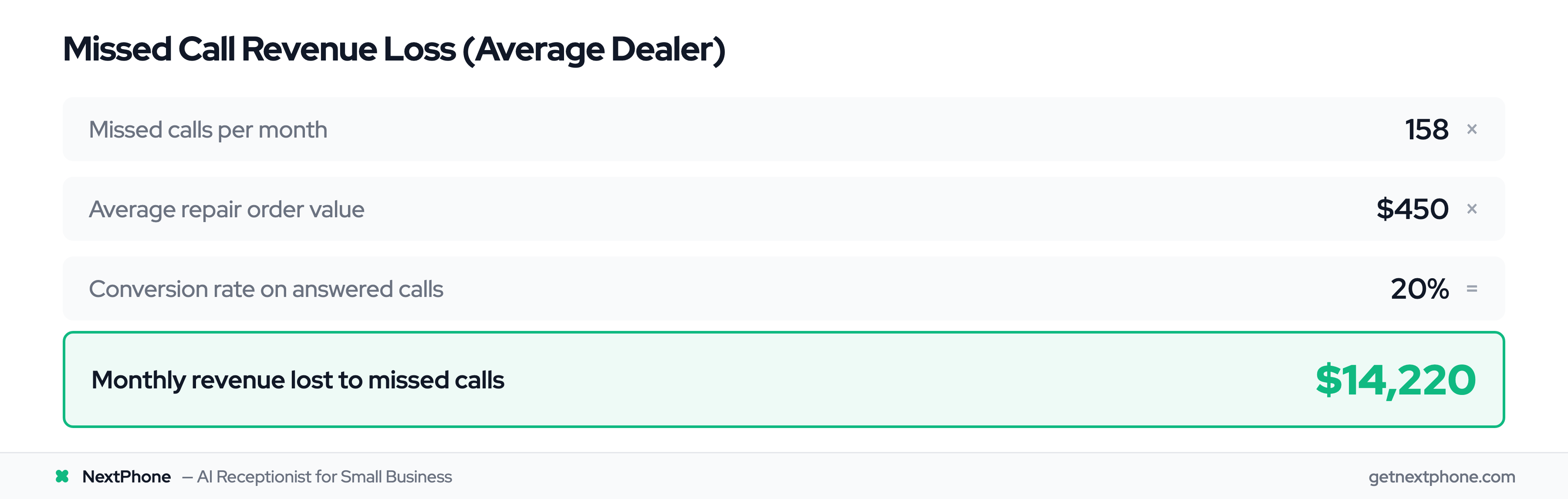
Say you receive 50 estimate-related calls per month. If you're missing 74% of them (like many shops we studied), that's 37 missed calls. At a 25% conversion rate for estimate calls that actually connect, and an average repair value of $4,000, here's what that looks like:
- 37 missed calls per month
- 9 of those would have converted to jobs (25%)
- 9 jobs x $4,000 average repair = $36,000/month in lost revenue
- Annual impact: $432,000/year
Even if your miss rate is lower, even if your conversion rate is different, the math is brutal. One missed estimate call per day costs you $1,000+ in potential revenue.
And there's a compounding effect. According to BodyShop Business research, unhappy customers tell 16 people about their bad experience. Those potential customers who couldn't reach you? They're telling friends and family to skip your shop.
Why Body Shops Miss More Calls Than Other Businesses
Collision repair has unique challenges that make phone coverage harder than most industries:
The estimate process takes you away from the phone. You can't write accurate repair orders from your desk. You need to be hands-on with the vehicle, measuring, photographing, sometimes doing a partial teardown to see hidden damage. That takes 20-45 minutes per vehicle.
Insurance calls are unpredictable. DRP adjusters, claim representatives, and supplement reviewers call at random times. Missing their call can delay the entire repair timeline.
Customers are already stressed. Someone calling for a collision repair estimate just had their car damaged. They're anxious, dealing with insurance, maybe missing work. They don't want to leave a voicemail and wait.
Peak hours hit hard. According to industry data, peak booking hours for automotive services are 8-11:30 AM, with Monday and Tuesday being the busiest days. That's exactly when your shop is at maximum chaos.
Types of Calls Your Body Shop Receives
Not all body shop calls are equal. Understanding the different call types helps explain why generic answering services fail, and what you actually need.
Estimate and Quote Requests (The Money Calls)
These are your highest-value incoming calls. Someone has vehicle damage and is ready to schedule an estimate. They typically have questions like:
- "Do you work with State Farm/GEICO/Progressive?"
- "How soon can I bring my car in for an estimate?"
- "Do you do paintless dent repair?"
- "Can you work with my insurance on the claim?"
The person answering needs to collect specific information: vehicle year/make/model, type of damage, insurance company and claim number if they have one, and their availability for an appointment.
Miss this call, and they move to the next shop on their list. The first shop to respond wins 78% of the time.
Insurance and DRP Program Calls
If you're part of any Direct Repair Programs, you know these calls matter. According to industry data, 82% of insured customers went with a DRP shop in recent years. DRP work makes up a massive portion of collision repair revenue.
These calls include:
- Insurance adjusters discussing claim details
- DRP coordinators checking on repair status
- Supplement approval discussions
- Total loss inquiries
Whoever answers needs to understand terms like "supplement," "betterment," "OEM certification," and "R&I labor." A generic answering service reading scripts will fumble these calls.
Status Updates and Parts Questions
"Is my car ready?" "Did the parts come in yet?" "When can I pick it up?"
These calls aren't new revenue, but they impact customer satisfaction. According to an AudaExplore study, 62% of collision repair customers said timely status updates would be very or somewhat valuable. The same study found 48% of consumers believe repair shops provide poor customer service.
Answering status calls quickly and accurately builds the reputation that brings future referrals.
Emergency Tow and Accident Calls
These are the 2 AM calls. Someone's daughter just crashed on the highway. A drunk driver hit a parked car in someone's driveway. A delivery truck sideswiped a row of vehicles.
In our analysis of thousands of calls, 15.9% contained urgency language like "emergency," "urgent," or "ASAP." For collision repair, after-hours emergency calls often become same-week repairs at premium rates.
The question is: who answers at 11 PM on a Saturday?
Your Options for Handling Body Shop Calls
You have three main approaches for handling phone coverage at your collision center. Each has tradeoffs.
Hiring a Full-Time Receptionist
The traditional solution: put a person at the front desk.
Costs:
- Salary: $28,000-$35,000/year depending on your market
- Benefits: Add 25-30% for insurance, taxes, PTO
- Total: $35,000-$45,000/year minimum
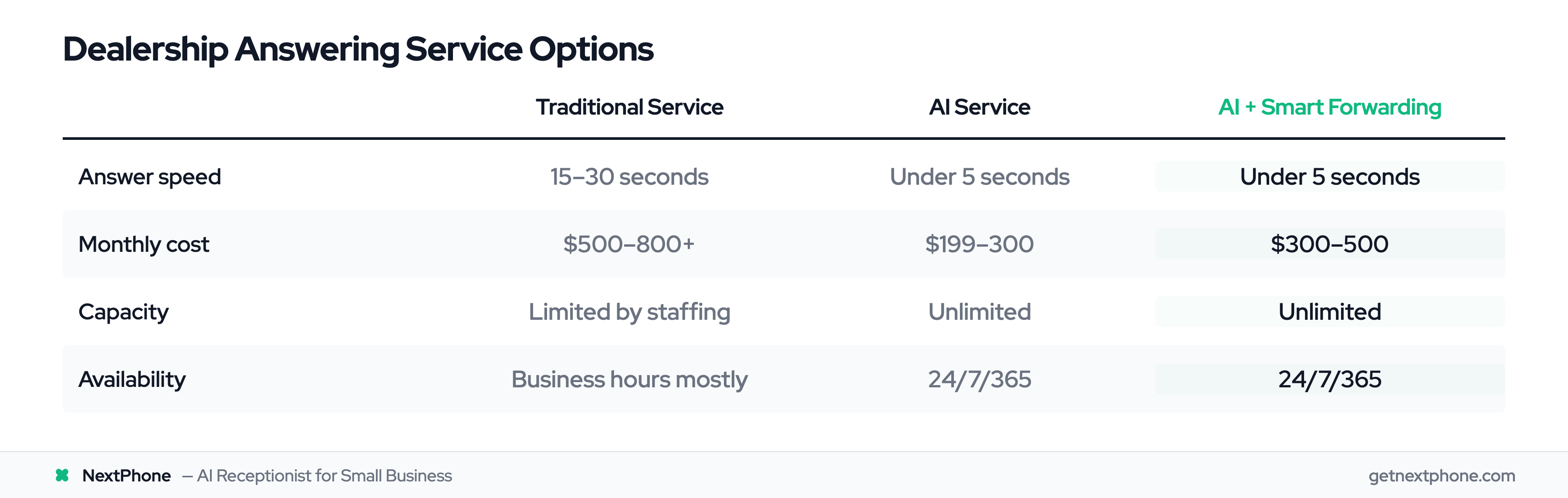
Reality check: Even a great receptionist only covers 40 hours per week. They take lunch breaks. They call in sick. They go on vacation. Meanwhile, 30-35% of calls to service businesses come outside traditional 9-5 hours.
You're paying $3,500+/month for coverage that disappears at 5 PM and on weekends.
Traditional Live Answering Services
Companies like AnswerConnect and Ruby provide live operators who answer calls on your behalf.
Costs:
- Base plans: $200-400/month
- Per-minute or per-call fees after included minutes
- Typical total: $400-800/month for moderate volume
The catch: These operators work from scripts. They handle calls for law offices, HVAC companies, dental practices, and your body shop all in the same shift. They don't understand DRP programs, supplement processes, or the difference between a blend and a refinish.
When an insurance adjuster calls about the "P-pages discrepancy on the Johnson claim," a generic operator is lost.
AI-Powered Answering Services
Modern conversational AI has changed the game for small businesses. AI answering services like NextPhone use natural language processing to have real conversations with callers.
Costs:
- Entry-level: $99-199/month
- Full-featured: $199-500/month
- Typically includes unlimited calls (no per-minute fees)
What's different: AI can be trained on your specific business. It learns your DRP relationships, your service offerings, your typical repair timeline. It answers consistently, 24/7, without overtime or sick days.
Real-world results back this up. According to Autobody News coverage of Body by Cochran, a $75M collision center MSO, their stores were "below 70% for responses to assignments and most were missing nearly half." After implementing AI, they now contact 95% of leads.
That's a 25+ percentage point improvement in capture rate.
AI-First with Smart Forwarding
AI-first services handle routine calls like estimate scheduling, hours questions, and basic status updates. When a caller asks for something complex or specifically requests a person, smart forwarding transfers to you directly.
This approach gives you 24/7 AI coverage for routine calls with the safety net of reaching you for unusual situations.
Features That Matter for Collision Repair Shops
When evaluating an answering service for your body shop, generic "small business" features aren't enough. Look for capabilities specific to collision repair.
Insurance and DRP Call Handling
Your answering service needs to understand how insurance claims work. That means:
- Recognizing claim numbers and policy information
- Knowing the difference between a DRP referral and a customer-pay repair
- Understanding supplement requests and approval processes
- Properly routing adjuster calls vs. customer calls
Generic services read scripts. Body shop-trained services collect the right information and route calls appropriately.
An effective greeting might sound like: "Thanks for calling ABC Collision. I can help you schedule an estimate appointment. Are you filing an insurance claim, or is this a cash-pay repair? If you have your claim number handy, I can pull up your information."
Estimate Appointment Scheduling
The whole point of answering calls is converting them to booked appointments. Your answering service should:
- Access your actual calendar availability
- Book estimate appointments directly (not just take messages)
- Collect vehicle information, damage description, and insurance details
- Send confirmation texts or emails automatically
- Update your shop management system in real-time
If callers have to wait for a callback to schedule, you've already lost the speed advantage.
After-Hours and Emergency Routing
Body shops get legitimate emergencies outside business hours. Accident calls. Tow situations. Someone whose car was broken into overnight.
Your answering service should distinguish between:
- True emergencies that need immediate owner notification (call forwarding, text alert)
- Urgent but not immediate that warrant a next-morning callback
- Standard inquiries that can wait for business hours
You decide the criteria. The system executes consistently.
Integration with Shop Management Systems
Modern body shops run on software. CCC ONE, Mitchell, Audatex for estimating. Shop management systems for workflow. Calendar tools for scheduling.
The best answering services connect with your existing stack. When someone books an estimate, it should appear in your calendar without manual entry. When an insurance company calls, caller ID information should match to existing claims.
According to AudaExplore research, 74% of collision repair customers want to better understand the work their repair shop is doing. Integration means faster, more accurate communication.
Cost Breakdown and ROI for Body Shops
Let's get specific about what each option actually costs and what return you can expect.
What You're Currently Losing
Using the math from earlier:
- 50 estimate calls per month
- 37 missed (74% miss rate during busy periods)
- 9 would have converted (25% close rate)
- $4,000 average repair value
- Monthly loss: $36,000
- Annual loss: $432,000
Even with a more conservative 40% miss rate, you're looking at $150,000+ in annual lost revenue.
What Each Option Actually Costs
Full-Time Receptionist:
- Salary: $32,000/year
- Benefits and taxes: $8,000
- Total: $40,000/year ($3,333/month)
- Coverage: 40 hours/week only
Traditional Answering Service:
- Base plan: $300/month
- Overage fees (100+ calls): $200/month average
- Total: $500/month typical
- Coverage: 24/7 but script-based
AI Answering (NextPhone):
- Flat rate: $199/month
- No per-call fees
- Total: $199/month
- Coverage: 24/7 with business-trained AI
Calculating Your Real ROI
Here's the simple version:
If an AI answering service captures just 5 extra estimate appointments per month that you would have missed, and 25% of those convert to jobs at $4,000 average:
- 5 appointments x 25% close rate = 1.25 additional repairs
- 1.25 repairs x $4,000 = $5,000 in monthly revenue
- Cost: $199
- Net gain: $4,801/month
- ROI: 2,400%
The service pays for itself if it captures just ONE additional estimate that converts. Everything beyond that is profit.
How NextPhone Helps Body Shops Convert More Estimates
NextPhone was built for service businesses that miss calls because they're actually doing the work. Here's how it applies to collision repair.
AI That Understands Collision Repair
Unlike generic answering services, NextPhone's AI can be trained on your specific business. That means:
- Understanding DRP terminology and your specific insurance relationships
- Knowing your service offerings (PDR, frame straightening, glass replacement)
- Recognizing the difference between an estimate request and a status check
- Collecting the right information for each call type
The AI answers in under 5 seconds, every time. No hold music. No "please wait while I transfer you." Just immediate, competent response.
Insurance and DRP Call Handling
When an adjuster calls about a supplement, NextPhone captures the claim number, the specific question, and routes it appropriately. When a DRP coordinator needs a status update, the AI can pull from your system and provide accurate information.
The 95% contact rate that Body by Cochran achieved? That's the kind of improvement body shops see when every call gets answered professionally.
Seamless Estimate Scheduling
NextPhone connects to your calendar and booking systems. When someone calls for an estimate:
- AI greets them professionally using your business name
- Collects vehicle information and damage description
- Asks about insurance or cash pay
- Checks your real-time availability
- Books the appointment
- Sends confirmation via text and email
- Updates your shop management system
The caller gets immediate service. You get a booked appointment without lifting the phone.
At $199/month with unlimited calls, NextPhone costs less than most body shops spend on coffee. The question isn't whether you can afford it. It's whether you can afford to keep missing calls.
Frequently Asked Questions
Can an AI answering service really handle insurance and DRP calls?
Yes, but the AI must be trained on collision repair terminology. Modern conversational AI understands industry-specific language when properly configured. It can handle claim numbers, adjuster names, and supplement discussions. For complex insurance negotiations that require human judgment, the AI routes calls to you or your staff. The key is choosing a service that allows customization for your specific DRP relationships and processes.
How quickly can I set up an answering service for my body shop?
It depends on the service type. Traditional live answering services typically require 1-2 weeks for script development and operator training. AI solutions like NextPhone can often be set up same-day. NextPhone's website import feature analyzes your site and configures the AI with your business information, services, and common questions in under an hour.
Will customers know they're talking to AI?
Transparency works better than deception. Research shows 60-70% of customers are comfortable interacting with AI for simple tasks like scheduling. The key is being upfront ("Hi, I'm the AI assistant for ABC Collision") and ensuring seamless transfer to a human when needed. Most callers care more about getting their question answered quickly than whether they're talking to a person.
What happens if a customer has an emergency after hours?
You configure the rules. NextPhone can route emergency calls (accident scenes, tow requests, urgent situations) directly to your cell phone via call forwarding or immediate text alert. Non-urgent after-hours calls get logged with full details for next-business-day callback. You decide what qualifies as "emergency" based on keywords or caller request.
How does the answering service handle estimate scheduling?
Effective services integrate with your calendar system. NextPhone collects vehicle year/make/model, damage description, insurance information if applicable, and customer contact details. It then checks your actual availability and books the appointment, sending automatic confirmations. No message-taking and callback required. The estimate is booked before the caller hangs up.
What's the difference between a body shop answering service and a general answering service?
Specialization matters. Body shop answering services understand collision repair terminology, DRP processes, and what information matters for estimates. They know to ask about insurance claims, collect vehicle VINs, and route adjuster calls differently than customer calls. General answering services use one-size-fits-all scripts that frustrate insurance professionals and miss critical details.
Stop Losing Estimates to Missed Calls
The math on missed calls is simple and brutal. Every unanswered phone is a potential $4,000+ repair walking to your competitor. Body shops that win aren't always the best equipped or the cheapest. They're the ones who answer the phone.
AI answering services have made 24/7 professional call coverage affordable for independent shops. For less than $200/month, you can capture calls while you're in the lot, after hours, or overwhelmed with walk-ins.
Body by Cochran went from below 70% contact rate to 95% with AI. That's thousands of additional customer touches per month across their locations. For an independent shop, even capturing a handful of extra estimates monthly transforms your bottom line.
The first shop to respond wins 78% of the time. Make sure that shop is yours.