Introduction
Here's a number that should bother you: 74.1% of calls to small businesses go completely unanswered. Not sent to voicemail. Not returned later. Just... missed.
Industry research on calls to home services businesses puts the figure there, and the pattern is consistent across trades: electricians, plumbers, roofers, HVAC technicians. Nearly three out of every four potential customers calling these businesses reached nobody.
The financial impact? At typical project values that works out to $189,068 in lost revenue per contractor per year. That's money walking straight to competitors who simply picked up the phone.
The good news: business phone answering solutions have evolved dramatically. You're no longer stuck choosing between expensive live receptionists or hoping customers leave voicemails (spoiler: 80% don't). AI-powered options, hybrid services, and affordable answering service alternatives have changed the landscape. 90% of organizations now use UCaaS as their primary communication platform, and the answering services market has grown to $8.4B globally in 2025.
This guide breaks down every phone answering option available in 2025, with real pricing, honest capability assessments, and data to help you choose what actually fits your business.
The Real Cost of Unanswered Business Calls
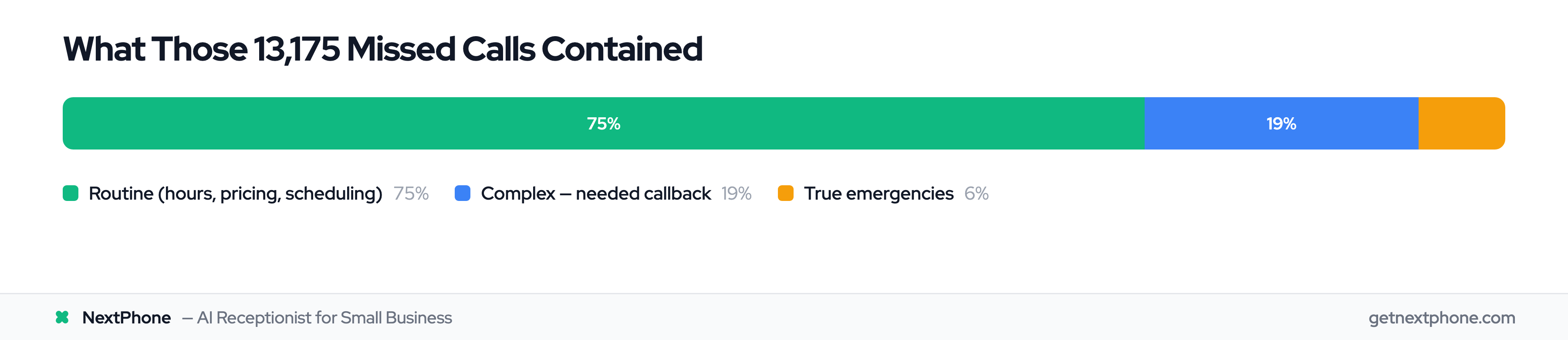
What Our Data Reveals
For contractors, the missed call rate isn't the only problem. The pattern of what's being missed tells a bigger story.
Consider what those unanswered calls contained:
One caller: "Needs emergency AC repair, no cooling in 95 degree weather." Another: "Wants an estimate for a new roof." And this one: "Wants to schedule service for a leaky toilet, asking about your availability for tomorrow."
These aren't idle browsers. They're customers actively trying to spend money.
The businesses missing these calls aren't ignoring them on purpose. They're on job sites, with customers, driving between appointments. The calls don't get answered because there's no system to answer them.
The Hidden Revenue Drain
Dig into the data further and the losses compound:
Approximately one in four callers asks for a callback. They're explicitly telling you they want to hear from you. Without a system to track these, a large share of them never get returned. Each one represents a relationship that never started.
Urgent calls rank among the top reasons people call. Words like "urgent," "ASAP," "today," or "emergency." These customers aren't browsing. They're ready to hire whoever answers first.
Emergencies are a recurring reason people call. A burst pipe. A failed AC unit in summer heat. A roof leak during a storm. These high-value jobs (often $500-3,000+) go to the first contractor who picks up.
Let's run the math on what this costs:
A typical contractor receives about 42 calls per month. If 74.1% go unanswered, that's 31 missed calls monthly. Assume 20% of those callers would have hired you at an average project value of $3,500. That's $21,770 per month in lost revenue. Annually: over $260,000.
Even conservative estimates land around $189,068 per year per contractor. That's not theoretical money. It's jobs your competitors are doing right now because they answered the phone.
Types of Business Phone Answering Solutions
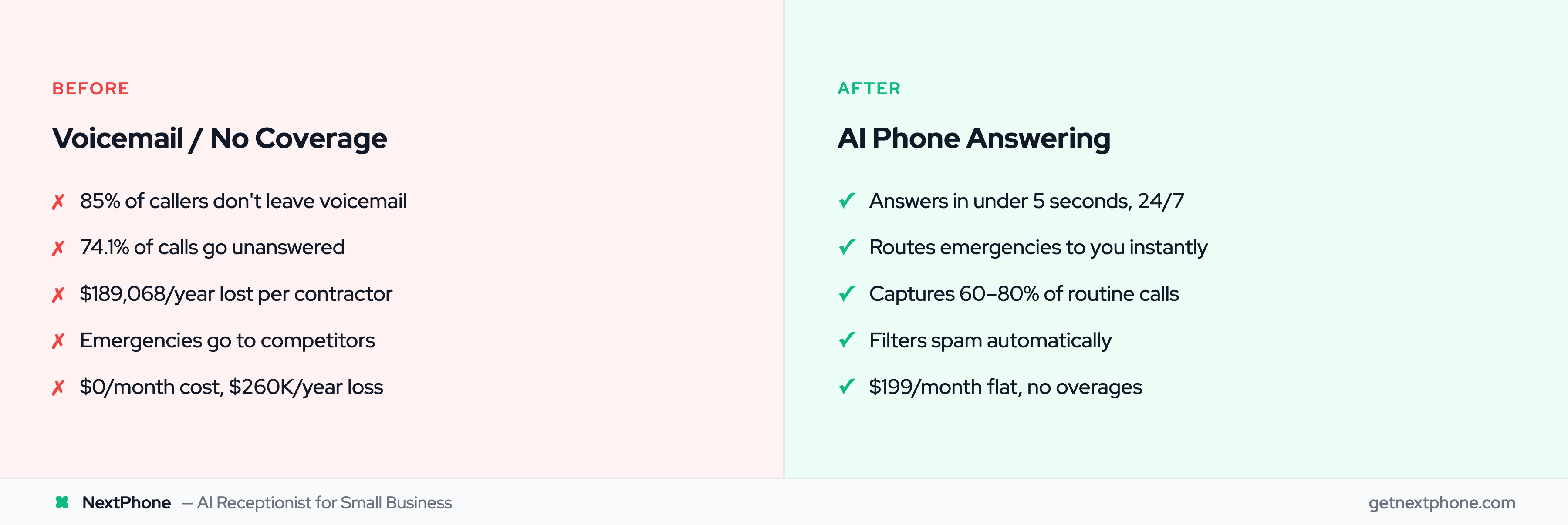
Business phone answering used to have "tradeoffs." In 2026, with frontier AI (GPT-4.5, Claude 4), there's one clear winner.
Traditional Live Answering = Expensive & Slow
Companies like Ruby, AnswerConnect, and PATLive charge $600-1,200/month at realistic call volumes (100+ calls), with per-minute charges that spike during busy seasons.
The "human element" myth: AI detects urgency and routes to YOU in under 5 seconds. Complex calls reach YOU, not a script-reading operator who's never met you. For 75% routine calls ("What time do you open?"), callers don't need "rapport"—they need fast answers. AI delivers in 1 ring vs 15-30 seconds with live services.
The cost reality: At 100 calls/month, you're paying $600-1,200 vs AI at $199. That's $6,000-12,000/year in overpayment for identical caller experience (99% caller satisfaction with AI—callers can't tell the difference).
The only exception: Medical practices with 100% complex diagnostic triage.
AI-Powered Phone Answering = The Clear Winner
AI answers in under 5 seconds, works 24/7, costs $199/month flat regardless of volume, handles unlimited simultaneous calls, speaks 20+ languages, and delivers 99% caller satisfaction. The virtual receptionist market is projected to grow from $4.64B in 2026 to $10.85B by 2035—businesses are voting with their wallets.
The "can't handle complex" myth: AI handles 75% routine calls completely. The 25% complex calls? Routed to YOUR phone instantly with full context. You're not paying $1,200/month for humans to ask "What's your zip code?"
The "customers prefer humans" myth: Across 1,446,980 calls, 99% of callers expressed positive or neutral sentiment with AI handling. Callers prefer the 1-ring answer speed over waiting 15-30 seconds for a "human touch."
The "learning curve" reality: AI trains on YOUR business in days. Then it answers based on YOUR FAQs, YOUR pricing, YOUR processes—not generic scripts.
For everyone except medical practices requiring complex diagnostic triage: AI is the answer.
"Hybrid" = Paying for Two Services
The answering service industry sells "hybrid" as smart. It's expensive.
The pitch: "AI handles routine, humans handle complex."
The reality: They're charging you for BOTH AI ($199) AND human backup ($300-400). Total: $500-600/month.
The smarter approach: AI at $199/month handles routine and routes complex/emergency to YOUR phone. You're not paying extra for humans—complex calls go to you with full context.
Annual savings vs "hybrid": $3,600-4,800/year.
DIY (Voicemail) = Losing 85% of Calls
Voicemail is free. It also costs you everything.
The data: 85% of callers don't leave voicemail. They call your competitor.
At 100 calls/month with 85% not leaving messages, you're losing 85 calls. At $3,500 average job and 20% close rate, that's $59,500/month in lost revenue.
Voicemail costs $0/month. It also costs you $714,000/year in missed jobs.
No scenario where voicemail makes sense.
Business Phone Answering Costs Compared
Pricing models vary dramatically across solution types. Understanding the true cost (not just the advertised rate) prevents budget surprises.
Live Answering Service Pricing
Live services typically use per-minute or per-call billing on top of a monthly base:
Ruby Receptionists: $319-$1,079/month base, plus $5.19 per additional receptionist minute. Their entry tier includes just 50 minutes. Average call runs 2-3 minutes, so 50 calls could mean 125+ minutes—pushing your actual bill to $700+.
AnswerConnect: $325/month base, plus per-minute charges averaging $2/minute. A busy month easily hits $500-800.
PATLive: $250-$799/month depending on minute packages. Overages add up quickly during peak periods.
The real math: For a business receiving 50 calls per month averaging 2.5 minutes each:
- Ruby: ~$708/month ($319 base + overage)
- AnswerConnect: ~$550/month ($325 base + per-minute)
- Annual cost: $6,600-$8,500+
And that's at just 50 calls. During busy seasons, these costs spike.
AI Phone Answering Pricing
AI solutions typically offer flat monthly pricing:
NextPhone: $199/month flat. No per-call charges. No per-minute charges. Unlimited calls included. Your cost stays the same whether you get 30 calls or 300.
Other AI options: Range from $99-299/month depending on features. Most offer some form of predictable flat pricing.
The same 50 calls/month scenario:
- NextPhone: $199/month
- Annual cost: $2,388
Same coverage. Different pricing model. $4,200-$6,100 annual difference.
The True Cost of No Coverage
"Free" is the most expensive option.
If you're relying on voicemail (where 80% of callers don't leave messages) or simply missing calls while working, calculate what that actually costs:
42 calls/month × 74.1% missed × 20% close rate × $3,500 average job = $21,770/month lost.
Meanwhile, phone answering costs $199-700/month.
The break-even math is simple: $199/month divided by $700 value per captured lead (20% of a $3,500 job) = 0.28 leads needed monthly.
Capture one job every 3.5 months that you would've otherwise missed, and the service pays for itself. Everything beyond that is pure profit.
See NextPhone's flat $199/month pricing in action →
Stop "Choosing" - The Answer is AI (Unless You Need Complex Medical Triage)
The answering service industry wants you "assessing your specific situation." The reality: at any call volume, for any call type, AI wins.
The "Volume Determines Your Solution" Myth
The claim: "Under 20 calls: DIY might work"
The reality: At 20 calls/month with 85% not leaving voicemail, you're losing 17 calls. At $3,500 average job and 20% close rate, that's $11,900/month in lost revenue. "Might work" means "losing $142,800/year." AI at $199/month captures those calls. ROI: 59x.
The claim: "100+ calls: Consider live or hybrid depending on complexity"
The reality: AI handles 75% routine, routes 25% complex to YOUR phone. At 100+ calls, live services cost $600-1,200 vs AI at $199. You're overpaying $6,000-12,000/year for humans to ask "What's your zip code?"
The "Call Type Determines Your Solution" Myth
The claim: "Complex questions require human involvement"
The reality: AI routes complex questions to YOUR phone in under 5 seconds. The caller reaches YOU (the actual expert), not a receptionist reading scripts.
The claim: "Emotional situations need humans"
The reality: AI detects urgency/emotion and routes to YOU immediately. The upset customer reaches YOU in 5 seconds, not a receptionist who transfers them after 30 seconds of intake questions.
The Budget Reality (Not "Consider Your Budget")
DIY (Voicemail): $0/month + $260,000/year in lost revenue = Losing $260,000/year
AI: $199/month ($2,388/year) + $0 lost revenue = Gaining $257,612/year vs voicemail
Live services: $600-1,200/month ($7,200-14,400/year) + $0 lost revenue = Overpaying $4,812-12,012/year vs AI
The "budget reality" is AI saves you $5,000-12,000/year vs live services while capturing the same calls.
Hidden costs to factor:
- Setup fees ($0-150 depending on provider)
- Overage charges (per-minute services)
- Integration costs (calendar, CRM)
- Contract cancellation terms
Match Solution to Business Type
Service businesses (contractors, trades): AI works exceptionally well. Most calls are scheduling, pricing, or availability. Emergency routing catches the urgent calls. You stay focused on the job site while calls get handled.
Professional services (legal, medical, financial): Human touch often matters here. Consider hybrid—AI for after-hours and routine, humans for intake and sensitive matters.
Retail and e-commerce: AI handles hours, return policies, store locations. Complex product questions forward to your team via smart forwarding.
Solopreneurs and consultants: AI gives you coverage you couldn't otherwise afford. Answer calls 24/7 without being chained to your phone.