Key Takeaways
- Phone answering services handle your business calls professionally when you can't, with options ranging from traditional live agents to modern AI solutions
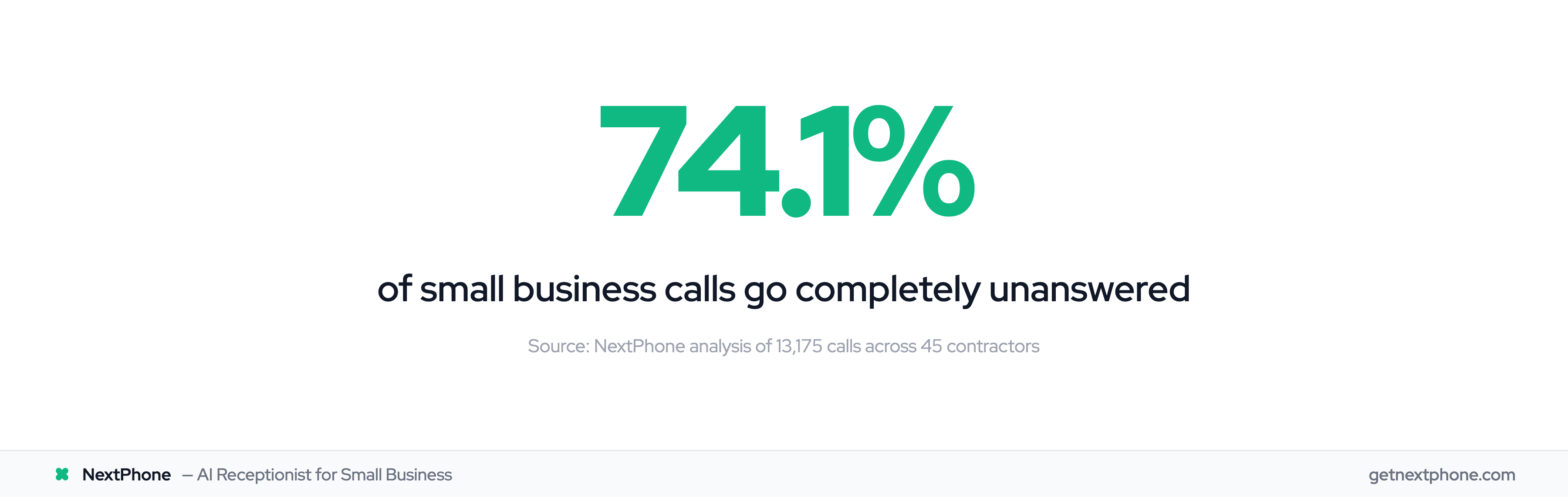
- 74.1% of small business calls go unanswered, costing the average contractor $189,068 per year in lost revenue
- Traditional live services typically cost $300-$1,000+/month; AI-powered services run $99-$300/month flat
- Both types handle 24/7 coverage, message taking, appointment scheduling, and call transfers
- Traditional services excel at complex conversations requiring human judgment; AI excels at consistency, availability, and cost
- At 50+ calls/month, AI services typically save 60-80% compared to traditional live answering
What Is a Phone Answering Service?
A phone answering service answers your business calls on your behalf when you can't get to the phone yourself. Think of it as a professional receptionist who works remotely, handling your incoming calls so customers never hit voicemail.
This isn't passive voicemail recording. It's active call handling in real-time.
Core functions typically include:
- Answering calls with your business name and custom greeting
- Taking detailed messages and delivering them to you
- Routing urgent calls directly to your cell
- Scheduling appointments
- Providing basic business information to callers
Phone answering services differ from call centers, which typically handle sales or customer support at scale. Answering services focus on reception, that first point of contact when someone calls your business.
They also differ from virtual assistants, who handle various administrative tasks. Phone answering services specialize specifically in real-time call handling.
Today, two main categories exist: traditional live-agent services (human receptionists) and modern AI-powered services (conversational AI that handles calls automatically). The virtual receptionist market is now worth $6.26B, and 85% of customer service leaders will explore or pilot conversational generative AI in 2025. Both solve the same core problem, but they work differently and cost very differently.
How Phone Answering Services Work
The Basic Process
Whether you choose traditional or AI-powered service, the fundamental flow is similar:
- You forward your business calls to the service (or use a dedicated number)
- The service answers in your business name with your custom greeting
- The caller's need is identified through conversation
- Appropriate action is taken (message, transfer, scheduling, or information)
- You receive notification of the call (text, email, or app notification)
From the caller's perspective, they've reached your business and someone helped them. 82% of customers expect an immediate response, and they don't know (or usually care) whether they spoke with your employee, a remote receptionist, or an AI.
Call Routing Options
You control when calls go to the answering service:
- All calls: Every incoming call goes to the service
- Overflow only: Calls forward after a set number of rings
- After-hours only: Service handles calls outside your specified hours
- Custom rules: Different routing for different days, times, or numbers
Most businesses start with after-hours or overflow routing and expand from there.
How You Stay Connected
You're never out of the loop. Services keep you informed through:
- Real-time SMS or app notifications for every call
- Email summaries with caller details and messages
- Call recordings or transcripts for review
- Emergency transfer protocols for urgent situations
- Online dashboard to review call history and analytics
The caller gets immediate help. You get instant notification. Everyone wins.
Traditional Phone Answering Services
Traditional phone answering services employ teams of trained human receptionists who answer calls on behalf of multiple businesses. These agents work from call centers or remotely, following customized scripts for each client.
How Traditional Services Operate
When a call comes in, it routes to an available agent who sees your business name and custom script on their screen. They answer professionally, handle the caller's needs according to your instructions, and log the interaction.
Agents typically handle calls for multiple businesses, switching between scripts as calls come in. Quality varies by service, but reputable providers invest heavily in training and quality monitoring. McKinsey research shows AI can improve productivity 30-50% in customer service settings—a key reason businesses are shifting.
What Traditional Services Include
Most traditional services offer:
- Live person answering every call
- Custom greeting using your business name
- Message taking with accurate delivery
- Basic appointment scheduling (often with calendar integration)
- Call transfers to you or designated team members
- After-hours and weekend coverage (usually at premium rates)
- Bilingual options (Spanish most common, often extra cost)
Major Traditional Providers
Ruby Receptionists: Premium positioning with emphasis on receptionist quality. Starting at $319/month for 50 receptionist minutes, with $5.19 per additional minute. Higher tiers run $599/month (100 minutes), $999/month (200 minutes), and up.
AnswerConnect: 24/7 focus with appointment scheduling capabilities. Starting around $325/month with per-minute charges after included allocation.
Smith.ai: Targets legal and professional services with lead qualification focus. Starting at $255/month for 30 calls, with $8.50 per additional call.
PATLive: More budget-friendly entry point. Starting at $199/month for 75 minutes with per-minute overages.
Traditional Service Strengths
Human receptionists bring genuine advantages:
- Human judgment: Can handle unexpected situations, make reasonable decisions on the fly
- Empathy and rapport: Build relationships, calm frustrated callers, navigate emotional conversations
- Complex handling: Manage nuanced requests that require interpretation
- Caller preference: Some customers specifically want human interaction
- De-escalation: Skilled agents can defuse difficult situations
Traditional Service Limitations
The drawbacks are significant, especially for small businesses:
- Expensive at volume: Per-minute billing adds up fast. A 50-call month can easily cost $700+
- Unpredictable costs: You don't know your bill until month-end
- Hold times: During peak periods, callers may wait
- Quality variance: Some agents are better than others
- Premium for 24/7: After-hours and weekends often cost extra
- Staffing limitations: Holidays and unusual hours may have reduced coverage
Modern AI Phone Answering Services
AI-powered phone answering has matured significantly. Modern services use conversational AI that can hold natural, helpful phone conversations, not the robotic "press 1 for sales" systems of the past.
How AI Answering Services Work
When a call comes in, AI-powered services use natural language processing to understand what the caller says and respond appropriately in real-time. The AI can ask clarifying questions, provide information, schedule appointments, take messages, and route urgent calls.
Modern AI doesn't follow rigid phone trees. It holds actual conversations, understanding intent even when callers don't use expected phrases. The technology has reached the point where many callers can't tell they're not speaking with a human.
What AI Services Can Do
Today's AI answering services handle:
- Answering with custom greetings and business information
- Understanding caller questions and responding helpfully
- Scheduling appointments directly in your calendar
- Taking detailed messages with accurate contact information
- Routing urgent calls to you immediately
- Handling multiple calls simultaneously (no hold times)
- Providing consistent experience on every single call
- Working 24/7/365 without staffing concerns
What AI Handles Well
AI excels at:
- Standard inquiries (hours, location, services, pricing)
- Appointment scheduling and rescheduling
- Message taking with caller details
- Call screening (qualifying leads, filtering spam)
- After-hours coverage
- High call volumes (no capacity limits)
AI Service Strengths
The advantages are compelling:
- Flat-rate pricing: No per-minute anxiety or surprise bills
- True 24/7: Always available at no premium
- Unlimited capacity: Handles 5 simultaneous calls as easily as 1
- Perfect consistency: Every call handled the same way
- No hold times: Instant answer, every time
- Significantly lower cost: Often 60-80% less than equivalent live coverage
AI Service Limitations
AI isn't perfect for every situation:
- Complex requests: May struggle with highly unusual or nuanced situations
- Caller preference: Some callers want a human specifically
- Sensitive conversations: Less suited for highly emotional interactions
- Setup matters: Quality depends on proper configuration
NextPhone as an Example
NextPhone represents the AI approach with:
- $199/month flat rate
- Unlimited calls included
- 24/7 coverage at no extra cost
- Appointment scheduling with calendar integration
- Message taking and call transfers
- No per-call or per-minute charges
- No long-term contract
At 50 calls per month, that's $3.98 per call. At 100 calls, it's $1.99 per call. At 200 calls, it's under $1 per call. The math favors high volume.
Try NextPhone free for 7 days
AI answering service that answers, qualifies, and books — 24/7.
Traditional vs. AI: The Head-to-Head Comparison
Let's put both approaches side by side.
Feature Comparison
| Feature | Traditional Live | AI-Powered |
|---|---|---|
| 24/7 availability | Available (often extra cost) | Included standard |
| Unlimited calls | Very expensive | Often included |
| Call transfers | Yes | Yes |
| Appointment scheduling | Yes | Yes |
| Message taking | Yes | Yes |
| Custom greeting | Yes | Yes |
| Conversation type | Human | AI (natural language) |
| Hold times | Possible during peaks | None |
| Complex judgment calls | Excellent | Limited |
| Consistency | Varies by agent | 100% consistent |
| Capacity | Limited by staffing | Unlimited |
| Typical monthly cost | $400-$1,000+ | $99-$300 |
Cost Comparison at Different Volumes
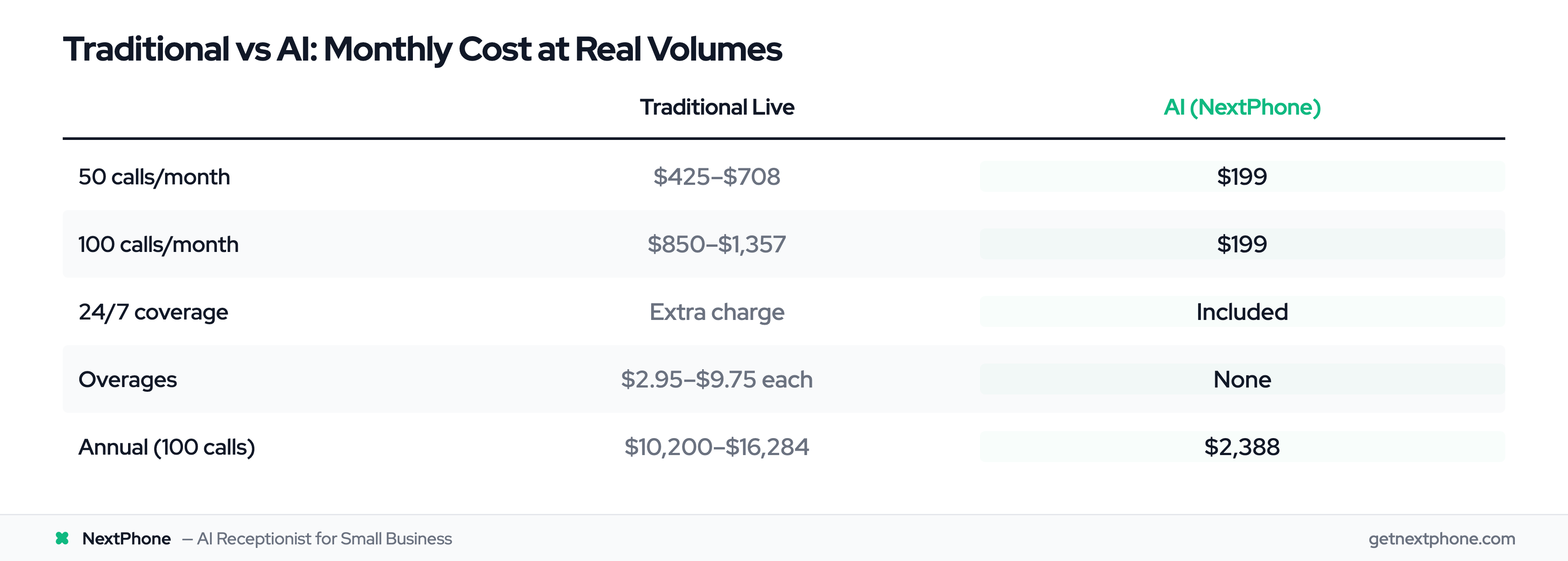
The cost difference becomes dramatic as call volume increases.
At 50 calls per month (assuming 2.5 minute average):
| Service | Calculation | Monthly Cost |
|---|---|---|
| NextPhone (AI) | $199 flat | $199 |
| Smith.ai | $255 base + 20 overage calls x $8.50 | ~$425 |
| AnswerConnect | $325 base + overages | ~$450 |
| Ruby (traditional) | $319 base + 75 overage minutes x $5.19 | ~$708 |
At 100 calls per month:
| Service | Calculation | Monthly Cost |
|---|---|---|
| NextPhone (AI) | $199 flat | $199 |
| Smith.ai | $255 base + 70 overage calls x $8.50 | ~$850 |
| AnswerConnect | $325 base + overages | ~$875 |
| Ruby (traditional) | $319 base + 200 overage minutes x $5.19 | ~$1,357 |
Annual cost comparison at 100 calls/month:
| Service | Monthly | Annual |
|---|---|---|
| NextPhone | $199 | $2,388 |
| Smith.ai | ~$850 | $10,200 |
| AnswerConnect | ~$875 | $10,500 |
| Ruby | ~$1,357 | $16,284 |
Annual savings with AI: $7,812 to $13,896 depending on which traditional service you'd otherwise use.
Quality and Experience
Both approaches can deliver professional, effective call handling:
Traditional: Offers human warmth, judgment, and the ability to handle truly unusual situations. Quality varies by individual agent. Some calls may have brief hold times.
AI: Provides perfect consistency on every call, instant response, and no capacity limitations. Handles standard calls excellently. May struggle with edge cases requiring human judgment.
For most standard business calls, either approach works well. The question becomes: what do you need, and what's it worth?