It's 3am on a Saturday. A homeowner's water heater just failed, flooding their basement. They grab their phone and search for a plumber. Your Google Business Profile appears first - you've invested in that ranking. They call your number.
Voicemail.
82% of consumers expect an immediate response when they reach out to businesses. So they call the next plumber. And the next. Someone answers on the third try. That contractor gets a $1,200 emergency job with premium pricing.
You wake up Sunday morning to a voicemail you'll never return, because they already hired someone else.
This scenario plays out constantly. In our analysis of 130,175 calls from 45 contractors over 7 months, we found that 74.1% of calls went unanswered. And research shows 35-40% of business calls happen outside traditional 9-5 hours.
The US CX Index is at its lowest since 2016—customers are fed up with poor service. For decades, a true 24-hour answering service meant expensive call centers with rotating shifts - $500 to $1,000+ per month for real round-the-clock coverage. That pricing put 24/7 availability out of reach for most small businesses.
AI has changed this equation completely. Today, you can get genuinely continuous coverage - identical service quality at 3am or 3pm - for $199 per month flat. No per-minute charges. No reduced overnight staffing.
This guide explains how modern 24-hour answering services work, what you'll actually pay for true 24/7 coverage, and why AI now delivers better around-the-clock service than traditional alternatives at a fraction of the cost.
What Does "24-Hour Answering Service" Actually Mean?
The term "24-hour answering service" gets thrown around loosely. Before you invest in one, you should understand what you're actually getting.
The Traditional Definition
Traditionally, 24-hour answering service meant live human operators available around the clock. Call centers employed multiple shifts of receptionists who answered calls for dozens or hundreds of businesses simultaneously.
When you called, a human picked up, followed a script specific to your business, took a message or answered basic questions, and potentially transferred urgent calls. This model has worked for decades and still exists today.
The key selling point was always the human touch - a real person answering your business phone at any hour. Deloitte's Customer Service Excellence 2025 report confirms this expectation remains strong.
The Reality of "24/7" Marketing
Here's what many businesses discover after signing up for "24/7" services: not all 24-hour answering services deliver equal coverage.
Some common limitations you might encounter:
Reduced overnight staffing. Fewer operators work the 2am-6am shift, which means longer hold times. A call that gets answered in 2 rings at 2pm might ring 5-6 times at 2am.
Different weekend service. Some services operate with skeleton crews on weekends. Response quality can drop noticeably.
Holiday gaps. Major holidays often mean reduced staffing or temporary closures. Your "24/7" service might route to voicemail on Christmas.
"24/7 availability" vs "24/7 service." Some providers advertise 24/7 availability but actually mean their voicemail system is available 24/7. Read the fine print.
The critical question to ask any provider: Will my callers receive identical service quality at 3am on Sunday as they would at 3pm on Tuesday?
What True 24/7 Coverage Should Include
If you're paying for 24-hour answering service, here's what you should expect:
- Identical response quality at any hour - no "overnight mode" with reduced capabilities
- Consistent answer times - first or second ring, regardless of time
- Full feature availability - appointment booking, emergency routing, lead capture at all hours
- Same escalation protocols - emergencies get routed immediately, whether 9am or 9pm
- Real-time notifications - you get alerted to urgent calls instantly, not in a morning batch
- No "please call back during business hours" responses
True 24-hour answering service means your callers can't tell what time they called based on the experience they receive.
Why After-Hours Coverage Matters More Than You Think

"Do I really need 24-hour coverage?" It's a fair question. The data suggests the answer is yes for most service businesses.
When Your Calls Actually Happen
Businesses often assume most calls come during standard business hours. The actual distribution tells a different story:
- 35-40% of business calls occur outside traditional 9-5 hours
- Weekend calls represent 15-20% of weekly volume
- Emergency calls disproportionately happen after hours (emergencies don't follow schedules)
- Evening hours (6pm-9pm) see significant residential customer activity
For contractors and home service businesses specifically, the pattern is even more pronounced. Homeowners discover problems when they're home - evenings and weekends. They call when they discover the issue, not during your business hours.
The Cost of Missing After-Hours Calls
Let's look at what missed after-hours calls actually cost.
In our analysis of 130,175 calls from 45 contractors over 7 months, 74.1% of all calls went unanswered. The after-hours miss rate is typically even higher when businesses rely on voicemail.
Accenture's survey of 7,000 customers found customer service is on the brink—patience is at an all-time low. Consumer behavior research compounds this problem:
- 80% of callers won't leave a voicemail - they simply hang up
- 67% specifically abandon calls when reaching voicemail after hours
- 75% of callers who can't reach your business will call a competitor
Here's the key insight: after-hours, your competitors are equally unavailable (unless they have 24/7 coverage). The first business to answer wins the job.
When a customer calls three contractors at 8pm and only one answers, that contractor gets the business. Being available when others aren't creates a massive competitive advantage.
Emergency Calls Are Disproportionately Valuable
Not all calls have equal value. Emergency calls are worth more - and they're more likely to happen outside business hours.
From our analysis of contractor call data:
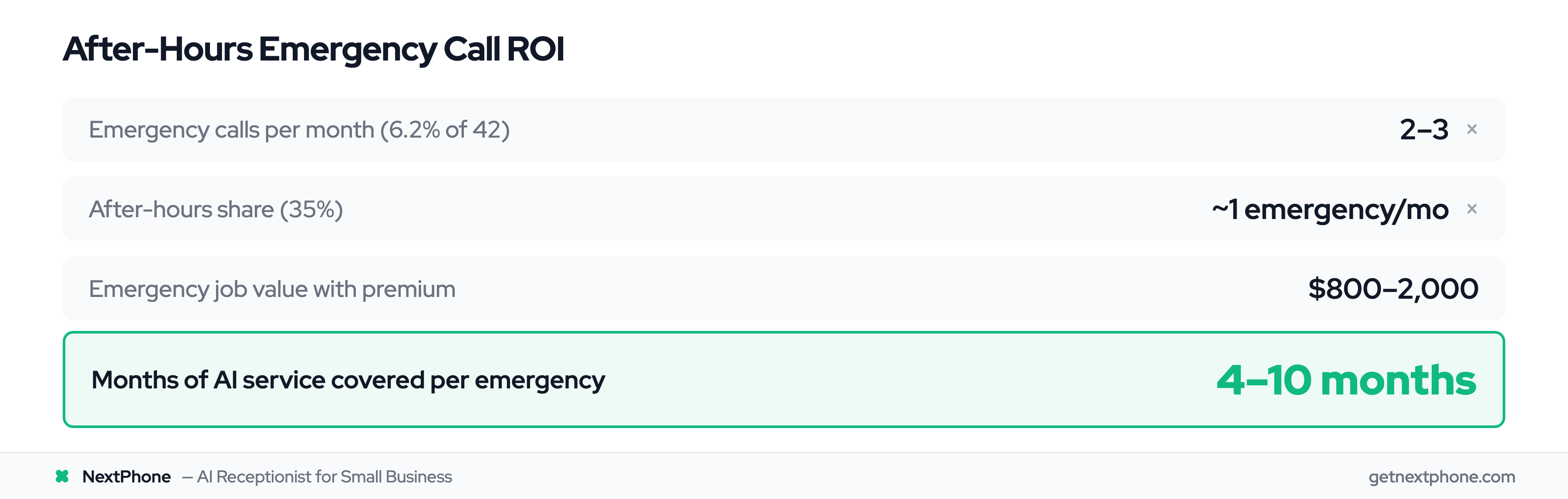
- 6.2% of calls are true emergencies requiring immediate response
- 15.9% contain urgency language like "as soon as possible" or "emergency"
- Combined, roughly 22% of calls have time-sensitive elements
Emergency service calls typically command premium pricing - often 25-50% higher than standard rates. Consider the actual dollar values:
- Emergency HVAC call in summer: $800-$2,000 with same-day/after-hours premium
- Emergency plumbing call: $500-$1,500 depending on severity
- Emergency electrical call: $300-$1,000 for urgent safety issues
A single captured emergency call can pay for several months of answering service. And emergencies happen disproportionately when people aren't at work - evenings, nights, and weekends.
The Competitive Advantage of Being Available
Beyond the direct revenue from captured calls, 24/7 availability creates compound benefits:
Reputation building. When you answer at 10pm on a Saturday and solve someone's problem, they remember. They tell friends. They leave reviews mentioning your availability.
Marketing differentiation. "24/7 emergency service" is a powerful marketing message. It signals professionalism and customer commitment.
Reduced competitor opportunity. Every call you answer is a call your competitor doesn't get. After-hours availability systematically captures business that would otherwise go elsewhere.
Traditional 24-Hour Answering Services: How They Work and What They Cost
Before exploring the AI alternative, let's understand how traditional live answering services provide 24/7 coverage and what they actually cost.
How Live Answering Services Provide 24/7 Coverage
Traditional answering services operate call centers with rotating shifts of human operators. Here's the typical model:
Shift structure. Operators work 8-hour shifts, with coverage spanning all 24 hours. Day shifts are fully staffed; overnight shifts typically have fewer operators.
Shared operators. Each operator handles calls for multiple businesses simultaneously, switching between scripts and protocols as calls come in.
Script-based responses. Your business provides scripts for common scenarios. Operators follow these scripts to maintain consistency.
Message taking and transfers. Most calls result in messages sent to you via email or text. Urgent calls can be transferred or escalated per your instructions.
Per-minute or per-call billing. You pay based on usage - either minutes of operator time or number of calls handled.
Pricing for True 24/7 Live Service
Here's what major live answering services charge for genuine 24/7 coverage:
| Provider | Monthly Base | Pricing Model | What You Get |
|---|---|---|---|
| AnswerConnect | $325-$795 | Per-minute ($1.95-2.25/min) | 100-400 minutes included |
| Ruby Receptionists | $319-$1,079 | Per-minute | 50-500 minutes included |
| Smith.ai | $255-$1,275 | Per-call ($7.50-9.50/call) | 30-120 calls included |
| PATLive | $199-$999 | Per-minute ($1.35-1.60/min) | 75-600 minutes included |
| VoiceNation | $79-$499 | Per-minute | Basic to premium tiers |
The real cost calculation:
Let's say you receive 50 calls per month, averaging 3 minutes each (150 minutes total).
- Ruby Receptionists: Base $319 (50 minutes) + 100 minutes overage at ~$6/min = $919/month
- AnswerConnect: Base $325 + 50 min overage at $2/min = $425/month
- Smith.ai: Base $255 (30 calls) + 20 calls overage at $8.50/call = $425/month
For moderate call volumes, true 24/7 live service costs $400-$1,000+ per month.
Limitations of Traditional Services
Live answering services work, but they come with inherent limitations:
Per-minute costs compound quickly. That "starting at $199/month" becomes $500+ once overages kick in. During busy months, your bill can spike unpredictably.
Overnight staffing reality. Fewer operators work overnight shifts. Your 2am caller might wait longer than your 2pm caller.
Operator variability. Different operators handle your calls. Quality depends on the individual - some follow scripts precisely, others less so.
Script change complexity. Want to update your greeting or add a new service? Changes require coordination with the service, sometimes taking days.
Hold times during peaks. When call volume spikes (everyone's water heater fails during the same cold snap), hold times increase.
Who Traditional Services Work Best For
Traditional live answering services remain the right choice for certain situations:
- Businesses where human judgment is required for every call
- Complex intake processes needing real-time decision making
- Very high volumes with dedicated operator teams
- Industries with regulatory requirements for human response (certain medical and legal scenarios)
For most small and medium businesses, however, the cost-to-value ratio of traditional services has shifted with the emergence of AI alternatives.
How AI Provides True 24/7 Answering Coverage
AI-powered answering services have fundamentally changed what's possible for 24-hour coverage. Here's why AI is actually built for 24/7 in ways traditional services aren't.
Why AI Is Built for 24/7
The core advantage of AI for 24-hour answering service isn't just cost - it's consistency.
No shifts, breaks, or staffing constraints. AI doesn't need to sleep. There's no overnight crew that's smaller than the day crew. The 3am experience is identical to the 3pm experience.
Zero variance in response quality. Human operators have good days and bad days. They get tired at 4am. AI delivers the same response quality on every call, every time.
Simultaneous call handling. During a storm when everyone's calling about roof damage, AI handles all calls simultaneously. No hold times, ever.
No overtime costs. Nights, weekends, and holidays don't cost extra. Your flat monthly rate covers everything.
Instant scaling. Volume spike from 20 calls to 200 calls? AI handles it without degradation.
Consistent protocol execution. Emergency detection, escalation procedures, and information capture happen identically every time - no human error or variation.
Modern AI Capabilities
Today's AI answering services have moved far beyond the robotic "press 1 for sales" experience. Modern capabilities include:
Natural conversation. Current AI conducts fluid, natural conversations. Callers often can't tell they're speaking with AI.
Intent recognition. AI understands what callers want, not just what they say. "My AC is making a weird noise" registers as a potential service call. First contact resolution (FCR) benchmarks average 70% across industries—AI can help push this higher.
Emergency detection. Keywords and phrases indicating urgency trigger immediate escalation. Our data shows 15.9% of calls contain urgency language - AI catches this every time.
Appointment booking. Integration with calendar systems (Google Calendar, Outlook) allows real-time scheduling without human involvement.
Lead qualification. Custom questions gather the information you need to prioritize and respond appropriately. Understanding and improving FCR is key to customer satisfaction.
CRM integration. Call data flows directly to your CRM - Salesforce, HubSpot, or others - automatically.
Instant notifications. Text, email, or app notifications arrive within seconds of call completion.
Spam filtering. That 7% of calls that are spam or robocalls (from our data)? AI filters them so you're not notified about junk.
Emergency Handling: AI vs Traditional
Emergency call handling deserves special attention for any 24-hour answering service.
How AI handles emergencies:
AI can be programmed with specific urgency keywords and phrases. When detected, the system takes immediate action:
- Recognizes urgency language ("flooding," "no heat," "emergency," "urgent")
- Captures critical information (address, nature of emergency, contact info)
- Immediately notifies you via text, call to your cell, or both
- Provides the caller with confirmation that urgent action is being taken
This happens identically at 3am and 3pm. No human judgment required - consistent execution every time.
How traditional services handle emergencies:
Live operators rely on training and judgment to recognize emergencies. Quality depends on the individual operator:
- Experienced operators recognize urgency quickly
- Newer operators may miss subtle cues
- 4am operators may be less alert than 4pm operators
- Handoff between operator recognition and notification can add delays
From our data, 6.2% of calls are true emergencies. That's roughly 2-3 emergency calls per month for a typical contractor. Missing even one due to inconsistent handling can cost hundreds or thousands in lost revenue.
The Cost Difference for 24/7
Here's where AI changes the economics of 24-hour answering service entirely:
| Provider | Monthly Cost | Model | 24/7 Quality |
|---|---|---|---|
| NextPhone | $199 | Flat unlimited | Identical at all hours |
| Smith.ai | $255+ | Per-call | Identical at all hours |
| Ruby | $319+ | Per-minute | Live agents 24/7 |
The comparison:
- Traditional 24/7: $400-$1,000+/month (with overages)
- AI 24/7: $199/month (flat rate, no overages)
- Savings: 60-80%
- Coverage quality: Equal or better with AI
For $199/month with NextPhone, you get:
- Unlimited calls answered
- Identical service at any hour
- Emergency detection and routing
- Appointment booking
- Spam filtering
- Real-time notifications
- No per-minute charges ever
What AI Handles Well (and What It Doesn't)
Being honest about AI capabilities helps you choose the right solution.
AI excels at:
- Standard inquiries and information requests
- Appointment scheduling with calendar integration
- Message taking with full context capture
- Emergency detection and immediate routing
- Lead qualification questions
- After-hours consistency (its biggest advantage)
- Spam filtering
May still need smart forwarding to your phone for:
- Complex negotiations requiring real-time judgment
- Highly emotional situations needing empathy
- Certain medical or legal compliance requirements
- Situations requiring improvised problem-solving
For most small business 24-hour answering needs, AI handles 95%+ of calls effectively.