
What Are Virtual Receptionist Services?
Virtual receptionist services provide professional call answering for your business, handled remotely by live agents, AI technology, or a combination of both. Unlike your cousin's kid checking voicemails once a day, virtual receptionists actively manage incoming calls—answering questions, scheduling appointments, routing emergencies, and qualifying leads.
The market is booming—the virtual receptionist service market is projected to grow from $3.85B to $9B by 2033, with another estimate projecting growth from $4.64B in 2026 to $10.85B by 2035. More businesses are realizing they can't afford to miss calls.
Think of it as having a full-time receptionist without the desk, the salary, or the benefits package.
How Virtual Receptionists Differ from Answering Services
People confuse these two constantly, but the difference matters for your bottom line.
Answering services are passive. Someone picks up, scribbles a message, and hangs up. You get "Joe called about a leak" three hours later. Maybe you call back. Maybe Joe already hired someone else. For more on this distinction, see answering service vs receptionist.
Virtual receptionists are active. They follow your business rules to actually handle the call:
- Schedule appointments directly into your calendar
- Route emergency calls to your mobile immediately
- Answer FAQs from your knowledge base ("Yes, we service that area")
- Qualify leads with budget and timeline questions
- Filter spam automatically (robocalls get blocked before they ever ring you)
Booking or rescheduling an appointment is the single most common reason people call. You want those booked while the customer is on the phone—not sitting in a voicemail queue while they call your competitor.
Three Service Models: Human, AI, and Hybrid
Human virtual receptionists are real people in call centers answering your line. They're empathetic, flexible, and great with nuanced conversations. They also cost $300-$2,000 per month depending on volume. For a detailed breakdown, see our AI vs human receptionist comparison.
AI-powered virtual receptionists use conversational technology to understand and respond to callers. An AI virtual receptionist answers instantly, works 24/7/365, and handles unlimited calls simultaneously. Cost: $50-$300 per month. See our full virtual receptionist comparison for provider-by-provider details.
AI with smart forwarding is where the industry is headed. AI resolves 90-95% of calls entirely on its own—scheduling, answering questions, capturing leads. For the 5-10% that are genuinely complex or urgent, it forwards directly to you or your team with full context. No paid humans in the middle.
See how to set up AI answering in 15 minutes →
The True Cost of Missed Calls
Here's the uncomfortable truth most business owners don't want to face: you're probably missing the majority of your incoming calls.
Industry data shows contractors miss 60-80% of incoming calls. Not 10%. Not 20%. Up to 80%.
You're on a job site. You're on a ladder. You're under a sink. You're with another customer. You're eating lunch. You're asleep. The phone rings four times and dumps to voicemail.
For a contractor getting 42 calls per month (industry average), missing 74% means 31 calls go completely unanswered. Thirty-one potential customers you never spoke to.
What Those Missed Calls Actually Represent

Let's break down what you're losing:
Quote requests are among the top reasons people call. Those callers are actively asking for estimates. For 31 missed calls, that's about 2.1 quote requests going straight to voicemail every month. At a $3,500 average project value and 20% close rate, you're leaving $1,470 on the table monthly—from quote requests alone.
Approximately one in four callers explicitly requests a callback. They say "please call me back." A large share of those requests never get returned. They fall through the cracks—lost on sticky notes, buried in voicemails, forgotten during busy days.
True emergencies are a recurring reason people call. "Pipe burst," "no heat," "electrical sparking"—these calls can't wait. Emergency jobs average $1,200 because of urgency premiums and after-hours rates. When someone's basement is flooding at 9 PM, they're calling contractors until one answers. If you're not that one, you lose.
Urgent calls rank among the top reasons people call. Phrases like "ASAP," "urgent," "today," or "emergency" show up constantly. These customers need help now and will hire whoever responds first.
Why "I'll Call Them Back" Falls Apart
You check voicemail religiously? Great. But by the time you return calls:
The emergency is handled. Someone with flooding doesn't wait 4 hours. They called the next plumber, who answered, who's already fixing the problem.
The quote request moved on. Homeowners shopping for roof repairs called five companies. Three answered immediately and scheduled estimates. You called back 2 hours later—after they already have three appointments booked.
The callback forgot about you. "Hi, this is Mike returning your call" only works if they're still interested. If they booked someone else, your callback is wasted time.
Research from MIT and InsideSales.com shows following up within the first minute of contact increases lead conversion by almost 400%. Additionally, 85% of callers won't call back if their first call goes unanswered. Every minute delay reduces your odds by 4%.
The businesses winning aren't necessarily the best at their trade. They're the ones answering the phone.
How Virtual Receptionist Services Work
If you're not answering the phone yourself, how does a virtual receptionist actually handle your business calls? Let me walk you through it.
The Call Flow
Step 1: Customer calls your business number. Instead of ringing your phone (which you can't answer from a roof), it forwards to the virtual receptionist service.
Step 2: The receptionist answers within 2-3 rings—typically under 10 seconds. AI systems answer even faster, often instantly.
Step 3: Caller hears your customized greeting: "Thank you for calling ABC Plumbing, this is Sarah. How can I help you today?"
Step 4: The receptionist handles the call based on what the customer needs—answering questions, booking appointments, taking messages, or routing emergencies.
From the customer's perspective, they called your number, someone professional answered, and their issue got addressed. They don't know (or care) that it's not someone sitting in your office.
Call Screening and Intelligent Routing
Not every call deserves the same treatment.
Spam filtering: Spam and robocalls get filtered out before they ever ring you. Electricians get hit hardest—their numbers end up on spam lists more than other trades. Virtual receptionists detect these automatically (caller ID patterns, known spam numbers, robotic voices) and block them before they waste your time.
Urgency detection: When someone says "emergency," "flooding," "urgent," or "ASAP," the system flags it. Urgent calls rank among the top reasons people call. These get routed differently—often immediately transferred to your mobile with a text alert.
Time-based routing: Different rules apply during business hours versus nights and weekends. Routine calls might go to your office during the day, while only emergencies get transferred at 2 AM.
Appointment Scheduling and Calendar Integration
Here's where virtual receptionists earn their keep.
Scheduling is the single most common reason people call. The receptionist integrates with Google Calendar, Outlook, ServiceTitan, or Housecall Pro. When someone wants an appointment:
Receptionist: "I can check availability. Are you free Tuesday between 2-4 PM?"
Caller: "Yes, 2 PM works."
Receptionist: "Perfect. I've scheduled you for Tuesday at 2 PM. You'll get a confirmation text."
The appointment lands in your calendar. The customer has confirmation. You didn't stop working to make it happen.
Lead Capture and CRM Integration
Modern virtual receptionist services don't just answer—they capture leads in your CRM automatically.
When a quote request comes in, the receptionist asks qualifying questions: What service do you need? What's your timeline? What's your budget range?
This creates a lead record in your system. By the time you follow up, you already know it's a $15,000 roof replacement they want done in two weeks. You're not calling blind—you're calling with context to close.
Types of Virtual Receptionist Services
Three models exist, each with different strengths and price points.
Live Human Virtual Receptionists
Real people working remotely from call centers, answering your phone under your business name.
Pros:
- High personalization and empathy
- Handle nuanced, complex conversations well
- Think on their feet for unusual situations
- Build relationships with repeat callers
Cons:
- Expensive ($300-$2,000/month)
- Limited to staffed hours unless you pay premium for 24/7
- Capacity constraints during peak volume
- Quality varies by agent
Best for: Businesses needing high-touch customer service where every caller expects personal attention—legal practices, medical offices, high-end service providers.
AI-Powered Virtual Receptionists
Conversational AI that understands natural language and responds intelligently.
Pros:
- True 24/7/365 availability (never sleeps)
- Instant answer (under 5 seconds)
- Handles unlimited simultaneous calls
- Affordable ($50-$300/month)
- Consistent quality—never has a bad day
Cons:
- Can struggle with highly complex situations
- May feel robotic if poorly designed
- Requires good setup and training
- Not ideal for deeply technical conversations
Best for: High call volume businesses with routine inquiries, anyone needing 24/7 virtual receptionist coverage or after-hours answering, budget-conscious operations where most calls are standard questions or scheduling.
Hybrid Models: The Industry Standard
AI handles 60-70% of routine calls while humans back up complex situations.
How it works:
- "What are your hours?" → AI answers instantly
- "I need to schedule service" → AI books it
- Spam call → AI blocks it
- Frustrated customer venting → Transfers to human
- Complex technical question → Transfers to human
Pros:
- Cost efficiency of AI for most calls
- Human judgment when it matters
- Scalability without quality sacrifice
- Best customer experience overall
Cons:
- Requires smooth handoff protocols
- More complex initial setup
Best for: Almost everyone. Research shows the industry standard is 70% of routine calls handled by AI while humans manage the other 30%. You get significant cost savings without sacrificing quality on the calls that need a human touch.
Virtual Receptionist Pricing: What You'll Actually Pay
Let's get specific about costs—including the hidden fees providers don't advertise.
Pricing Models Explained
Per-minute billing charges you for every minute on the phone. Rates run $1.50-$6.00 per minute.
Sounds cheap until you do the math. Average call length is 3-5 minutes. At $3.50/minute and 4 minutes per call, that's $14 per call. Forty-two calls monthly = $588.
Worse, many per-minute plans round up. A 30-second call gets billed as 2 minutes. It adds up fast.
Monthly flat rate charges a fixed fee for a set number of calls or unlimited calls:
- $199/month unlimited calls
- $350/month for up to 100 calls
- $500/month for 150-300 calls
More predictable. You know your cost upfront without watching the meter.
Hybrid pricing combines base fee plus per-call charges. Example: $100 base + $3 per call.
Works for very low volume. But if calls increase, so does your bill—proportionally.
Real Provider Pricing Examples
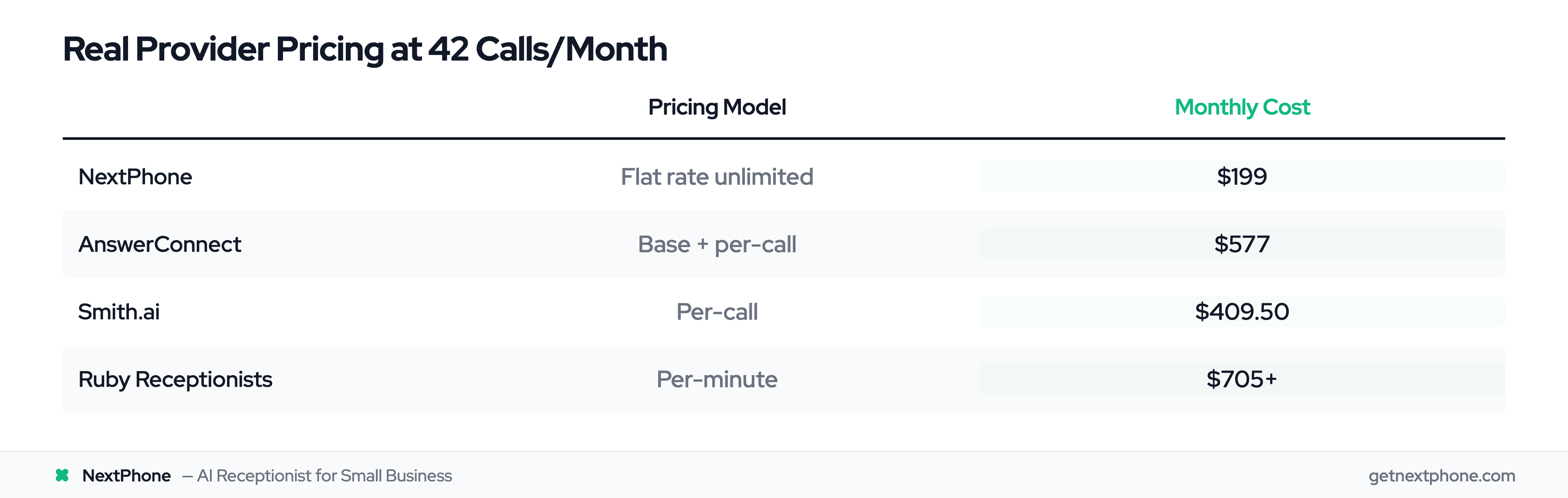
Ruby Receptionists: $720/month for 200 minutes (about 40-50 calls). Overages charged at $6/minute. High volume months can hit $1,000+.
AnswerConnect: $325/month base + $6 per call. For 42 calls: $325 + $252 = $577/month.
Smith.ai: $300 for 30 calls. Additional calls at $11.50 each. For 42 calls: $409.50/month.
NextPhone: $199/month unlimited calls. No per-minute fees. No call limits. Flat rate.
Industry data shows AI-powered services range $50-$300/month while human-powered services run $300-$2,000/month.
Hidden Fees That Blow Budgets
Watch for these surprises before signing:
- Setup fees: $50-$150 to onboard your business
- Overage charges: Rate spikes when you exceed your plan
- Holiday surcharges: Extra cost for weekend and holiday coverage
- Integration fees: $50-$200 to connect your CRM or calendar
- Cancellation penalties: Early termination fees on annual contracts
- Minimum requirements: Pay for 100 minutes even if you use 50
The most transparent providers offer simple flat-rate pricing with no surprises. For more on pricing models, see our flat rate vs per-minute answering service breakdown and cost of a virtual receptionist guide.
Cost vs. In-House Receptionist
Bureau of Labor Statistics reports median receptionist wage at $17.90/hour.
Full-time (40 hours/week, 52 weeks): $37,232/year.
Add benefits, payroll taxes, and overhead: closer to $45,000-$50,000 annually.
And that receptionist works 9-5 Monday through Friday. No nights. No weekends. No holidays. When they're sick or on vacation, calls go unanswered.
Virtual receptionist at $199-$500/month with 24/7 coverage = 5-10% of the cost of a full-time employee.
For solo contractors and small teams, the math isn't close. See our virtual receptionist cost vs hiring staff analysis for the full comparison.