
Last updated: July 2026. Pricing verified at time of writing. Confirm current pricing on each vendor's site.
Short answer: NextPhone. For most service businesses, NextPhone is the AI-native answer to Smith.ai's per-call model — $199/month flat, unlimited calls, no per-call fees, no overage charges, no per-minute anxiety. The AI answers every call in under 5 seconds (no queue, no hold), runs 24/7 in 9 languages, handles intake with custom workflows you configure, and transfers calls that need you immediately with full context. Across 1,446,980+ business calls answered, it resolves 90–95% without human escalation and maintains 99% positive caller sentiment.
Smith.ai's human receptionist plans start at $292.50/month for 30 calls, with $11/call overage on the base tier. At 100 calls per month, you're looking at roughly $1,060. At 180 calls — a normal month for a busy contractor or multi-attorney firm — costs climb past $1,900. Storm season, a marketing campaign that works, a busy week of referrals — your answering bill climbs with every ring.
For law firms that specifically need live human receptionists for conflict checking and run very low call volumes, Smith.ai fits that narrow profile. For contractors, solo professionals, and service businesses where the core problem is calls going unanswered, the math points clearly toward flat-rate AI.
This guide covers 8 alternatives with real pricing and honest trade-offs.
Disclosure: NextPhone is our product.
NextPhone vs. Smith.ai — the short version:
| NextPhone | Smith.ai AI | Smith.ai Human | |
|---|---|---|---|
| Monthly cost | $199/mo flat | $97.50/mo (30 calls) | $292.50/mo (30 calls) |
| At 100 calls/mo | $199 | ~$270 | ~$1,060 |
| At 200 calls/mo | $199 | ~$500+ | $1,900+ |
| Pricing model | Unlimited calls, flat | Per-call + overages | Per-call + overages |
| Trial | 7-day free | — | 30-day money-back |
Even against Smith.ai's cheaper AI product, NextPhone wins at any real call volume. At 100 calls/month, their AI tier runs ~$270 — still 35% more than NextPhone's flat $199. Their human tier runs ~$1,060, more than 5× as much. One busy referral month, a storm season, a marketing push that works — every ring adds to the bill.
→ Try NextPhone free — no per-call fees →
Try NextPhone free for 7 days
AI answering service that answers, qualifies, and books — 24/7.
Get Started FreeSmith.ai Pricing Breakdown: What You're Actually Paying
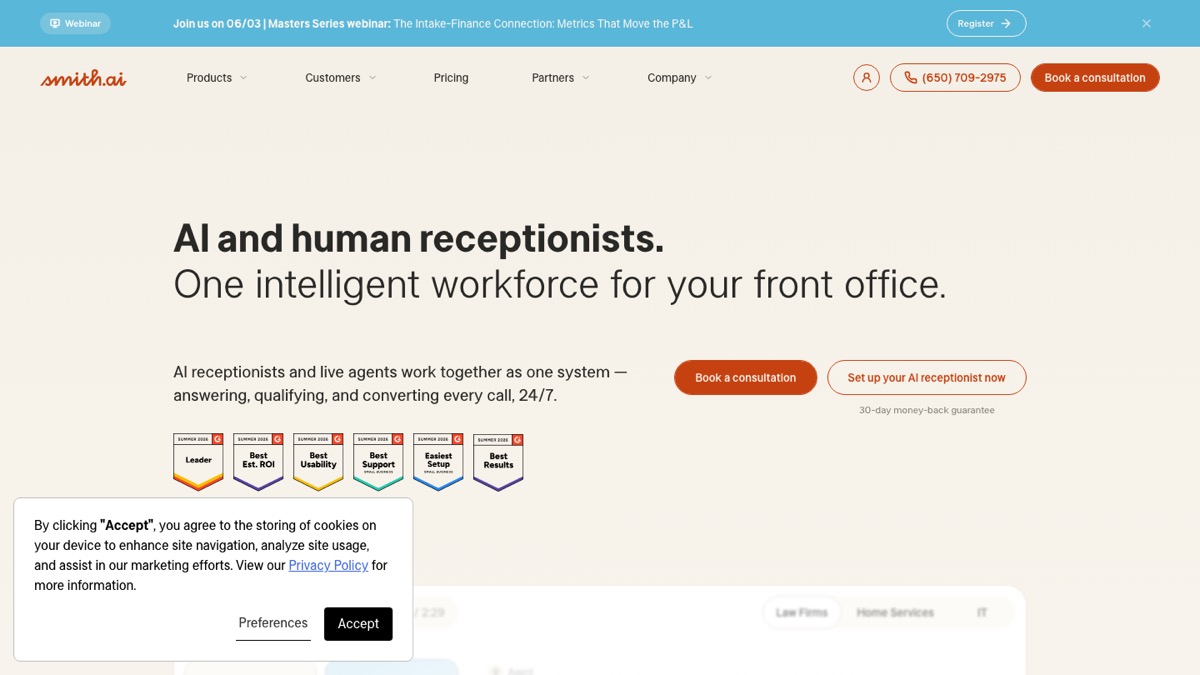
Before comparing alternatives, it helps to understand what Smith.ai costs at different volumes. This is where most comparison articles get vague. Here are the real numbers.
Human Receptionist Plans
| Plan | Monthly Cost | Calls Included | Overage Rate | Cost at 100 Calls/Mo |
|---|---|---|---|---|
| Starter | $292.50/mo | 30 calls | $11.00/call | ~$1,060 |
| Basic | $600/mo | 60 calls | $10.00/call | ~$1,000 |
| Pro | $900/mo | 90 calls | $9.50/call | ~$995 |
| Custom | $1,500+/mo | 150+ calls | Negotiated | Varies |
AI Receptionist Plans (Separate Product)
Smith.ai also offers an AI-only product, starting at $97.50/month for 30 calls. Overage rates run $2-3/call depending on volume tier.
What Happens at Scale
Here's the math that matters:
| Monthly Call Volume | Smith.ai Human Cost | Smith.ai AI Cost |
|---|---|---|
| 30 calls | $292.50 | $97.50 |
| 50 calls | ~$520 | ~$140 |
| 100 calls | ~$1,000 | ~$270 |
| 150 calls | ~$1,470 | ~$390 |
| 200 calls | ~$1,900+ | ~$500+ |
For a law firm consistently at 30 calls per month, $300 is manageable. For a contractor fielding 100-200 calls during peak season, the bill becomes painful fast.
Smith.ai doesn't charge for spam calls (a real plus), offers a 30-day money-back guarantee, and requires no contracts. But the per-call model means your cost is fundamentally unpredictable month to month.
Quick Comparison: All 8 Smith.ai Alternatives
| Provider | Type | Starting Price | Pricing Model | Best For | G2 Rating |
|---|---|---|---|---|---|
| NextPhone | AI | $199/mo | Flat rate, unlimited | Service businesses missing calls | N/A (newer) |
| Ruby | Human | ~$245/mo (50 min) | Per minute | Premium brand experience | 4.4/5 |
| AnswerConnect | Human | ~$350/mo (200 min) | Per minute | 24/7 live human coverage | 4.3/5 |
| Moneypenny | Human + AI | ~$395/mo | Per call/minute | UK/US professional services | 4.0/5 |
| PATLive | Human | $235/mo (75 min) | Per minute | Custom scripted intake | 4.1/5 |
| Dialzara | AI | ~$29-99/mo | Per-minute tiers | Budget AI testing | N/A |
| ConvoCore | AI | $99-199/mo | Flat rate | Simple AI answering | N/A |
| Abby Connect | Human | $329/mo (100 min) | Per minute (30-sec increments) | Personalized dedicated teams | 4.8/5 |
1. NextPhone — Best Flat-Rate AI for Service Businesses
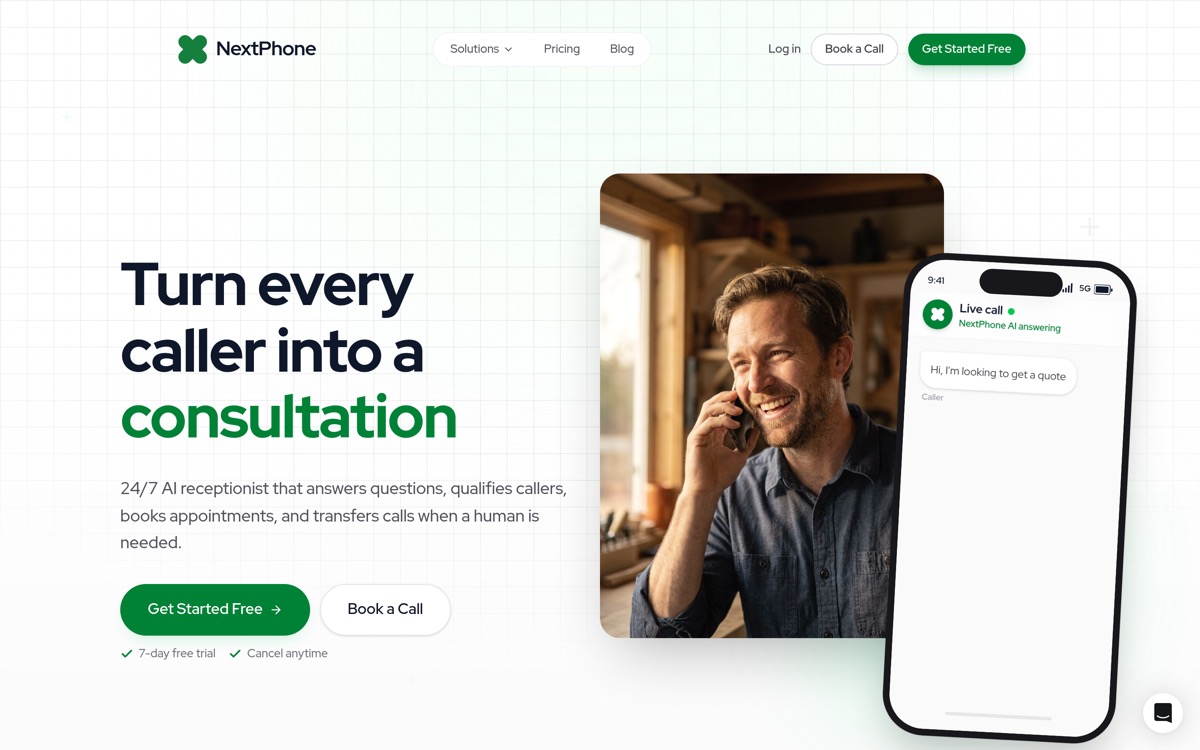
Pricing: $199/month flat. Unlimited calls. No per-call fees. No overage charges. No setup fees. 7-day free trial.
NextPhone is an AI answering service. It doesn't replace your phone system — it answers your phone when you can't. AI picks up in 2-3 rings, handles routine questions, books appointments, captures lead details, and routes emergencies to your cell within seconds.
In our analysis of 1,446,980+ calls across 2,074 businesses, 28.5% arrived outside business hours, and 34.8% of those after-hours callers expressed buying intent. Those are calls going to voicemail if nobody answers.
Disclosure: NextPhone is our product. We built it because we saw the data — small businesses miss most of their calls regardless of phone system. We've included it alongside every other option so you can compare on the same terms.
Best for: Contractors, law firms, professional services firms, and any service business where calls go unanswered because you're physically doing your work.
Key advantage: Flat-rate pricing means the busiest month costs the same as the slowest. Handles unlimited simultaneous calls. Emergency routing detects urgency keywords and transfers to your phone immediately. Integrates natively with Clio and HubSpot; connects to ServiceTitan, Jobber, and 6,000+ other apps via Zapier. 9 languages. 99% positive caller sentiment across 1,446,980+ calls.
Limitation: Not a phone system replacement. No video conferencing, no team messaging, no desk phones. AI resolves 90–95% of calls without human escalation; complex conversations get transferred to you with full context. Newer platform — doesn't have the review history of established services.
How it compares to Smith.ai: Fundamentally different pricing model. At 100 calls/month, NextPhone costs $199 flat vs. Smith.ai's AI tier ($270) or human tier ($1,060). The trade-off: Smith.ai has human receptionists on every call. NextPhone uses AI with smart forwarding to your phone for the calls that need you. For routine intake — scheduling, FAQ, lead capture — AI handles it identically. For sensitive calls, you're the human backup, not a stranger reading scripts.
Try NextPhone free for 7 days
AI answering service that answers, qualifies, and books — 24/7.
Get Started Free2. Ruby — Best Premium Human Receptionist
Pricing: Plans start at approximately $245/month for 50 receptionist minutes. Higher tiers scale to $1,399+ for 500 minutes. Per-minute billing, no rollover.
Ruby is the gold standard in live virtual receptionist services. Over 20 years in business, 15,000+ customers, 100% US-based human receptionists. If you want the highest-quality human answering experience available, Ruby is it.
Best for: Businesses where caller experience is the brand — luxury services, high-end law firms, boutique consulting.
Key advantage: Every caller speaks with a warm, trained professional. Ruby's receptionists are consistently praised for sounding like in-house staff, not an outsourced call center. Bilingual English/Spanish, 24/7/365, compliance available.
Limitation: Expensive at volume. Per-minute pricing with no rollover means busy months hurt. Users report $650/month for 200 minutes. At typical call lengths, that covers roughly 50-65 calls. Ruby is 4.4/5 on G2, but reviewers note annual price increases. For a deeper comparison, see our Ruby alternative breakdown.
How it compares to Smith.ai: Ruby is 100% human (no AI in the call). Smith.ai uses a hybrid model. Ruby's per-minute pricing is more granular but can get expensive faster on long calls. Both have strong legal industry presence. Ruby is the better choice if human voice quality is your top priority.
3. AnswerConnect — Best for 24/7 Live Human Coverage
Pricing: Plans start around $350/month for 200 minutes. Per-minute billing. $49.99 setup fee. Pricing requires registration to view.
AnswerConnect emphasizes "no bots, no AI, just real people." Voted Best Answering Service for 2026 by Forbes, they provide round-the-clock human answering with customizable scripts and returning-caller recognition.
Best for: Professional services firms where every single caller must speak with a live person, no exceptions.
Key advantage: True 24/7 human coverage including holidays. Forbes-recognized reliability. Flexible plans that scale monthly.
Limitation: Per-minute billing rounds up to the nearest minute — a 61-second call costs 2 minutes. Pricing is opaque (not publicly listed without registration). No outbound calling. Limited customization compared to AI alternatives. For a full comparison, see our AnswerConnect alternative analysis.
How it compares to Smith.ai: AnswerConnect is pure human, no AI component. Smith.ai has deeper legal integrations (Clio, MyCase). AnswerConnect's minute-based pricing is simpler than Smith.ai's per-call model but similarly unpredictable at volume.
4. Moneypenny — Best for UK/US Professional Services
Pricing: Custom pricing starting around $395/month. Combines dedicated receptionists with technology. Contact for quote.
Moneypenny operates on both sides of the Atlantic, handling over 20 million calls per year. They assign a dedicated team of receptionists to your account — not a rotating pool — so callers hear familiar voices.
Best for: Professional services firms (legal, accounting, financial advisory) that need a consistent, dedicated receptionist team with a polished UK/US presence.
Key advantage: Dedicated receptionists who learn your business, clients, and preferences over time. Strong in legal and financial services. Also offers live chat and outsourced switchboard services.
Limitation: Pricing requires a consultation — not transparent online. Premium positioning means it's not the budget option. Primary focus on professional services means contractors and trades aren't the target market.
How it compares to Smith.ai: Both serve professional services, but Moneypenny's dedicated-team model offers more personal consistency than Smith.ai's agent pool. Smith.ai has deeper legal CRM integrations. Moneypenny is stronger for firms wanting a "feels like in-house" receptionist experience.
5. PATLive — Best for Custom Scripted Intake
Pricing: Starter at $235/month for 75 minutes ($2.25/min overage). Pro at $1,050/month for 600 minutes ($1.85/min overage). No setup fees, no contracts.
PATLive has been providing live answering since 1990. Their edge is fully customizable call scripts built with proprietary scripting software and a team of US-based receptionists who follow them precisely.
Best for: Businesses that need complex, multi-step intake processes — event registration, detailed qualification, appointment scheduling with specific protocols.
Key advantage: 35+ years of experience, highly customizable call handling flows, emergency dispatch capability. 14-day free trial. PATLive scores 4.1/5 on G2.
Limitation: Per-minute pricing scales with volume. Bilingual support costs extra ($20/month add-on). No AI component for handling routine calls at lower cost. Integration depth is limited compared to Smith.ai's 7,000+ Zapier connections.
How it compares to Smith.ai: PATLive is more customizable on scripting but lacks Smith.ai's legal-specific workflows and CRM integrations. Smith.ai's per-call pricing is more predictable than PATLive's per-minute billing for shorter calls. PATLive is better for complex, non-legal intake flows.
6. Dialzara — Best Budget AI Entry Point
Pricing: Plans start at approximately $29/month. Per-minute tiers with 60-500 included minutes depending on plan. Overage charges apply.
Dialzara is a lightweight AI answering service built for businesses testing AI reception for the first time. Quick setup (15-30 minutes), 40+ voice options, and Zapier integrations for connecting to other tools.
Best for: Solo operators or very small businesses with under 50 monthly calls who want to test AI answering without a big commitment.
Key advantage: Lowest entry price in AI answering. Simple setup — answer questions about your business, pick a voice, go live. Month-to-month billing with no contracts.
Limitation: Minute-capped pricing means overage charges during busy months. Entry tier doesn't include call transfers or integrations. Spam calls and robocalls count toward your minutes. No emergency routing intelligence. Limited industry-specific training. For a detailed comparison, see our Dialzara alternative breakdown.
How it compares to Smith.ai: Both use usage-based pricing, but Dialzara is all-AI while Smith.ai is human-powered. Dialzara is dramatically cheaper at low volumes but lacks the legal specialization, human judgment, and deep CRM integrations that make Smith.ai valuable for professional services.