
A San Jose contractor is installing solar panels on a Cupertino rooftop. His phone buzzes in his pocket. A homeowner across town has a leaking water heater and needs help today. The contractor can't reach his phone while handling equipment on the roof. The call goes to voicemail. The homeowner hangs up and calls the next name on Google. That's a $3,500 job gone in 30 seconds.
This scenario plays out thousands of times every day across San Jose and Silicon Valley. The region is home to more than 66,000 businesses and over 2,500 high-tech companies. It's the 10th largest city in the United States, with a population exceeding one million. Yet despite all that economic activity and tech sophistication, small business owners still struggle with the same problem that's plagued contractors for decades: they can't answer the phone while they're working.
The solution? A local 408 business number paired with an answering service that never misses a call. Here's how to set it up and what it'll cost you.
Understanding the 408 Area Code: Silicon Valley's Original Number
History of the 408 Area Code
The 408 area code has been synonymous with Silicon Valley since 1959. Originally, it covered a much larger portion of California, but as the region's population exploded with the tech boom, the territory shrank to focus exclusively on the heart of Silicon Valley.
Today, the 408 area code is practically a badge of honor for local businesses. When someone sees a 408 number on their caller ID, they immediately associate it with San Jose, Cupertino, and the innovation hub that's shaped the modern world.
Cities and Areas Covered
The 408 area code serves the core of Silicon Valley, including:
- San Jose
- Sunnyvale
- Santa Clara
- Cupertino
- Campbell
- Los Gatos
- Saratoga
- Milpitas
- Morgan Hill
- Gilroy
These cities represent some of the most affluent communities in the country, with a median household income of $141,565 in San Jose alone. That's a customer base with money to spend on quality home services.
The 669 Area Code Overlay
In 2012, the 669 area code was introduced as an overlay for the same geographic region. Why? The tech boom brought so many new businesses and residents that the 408 area code simply ran out of available numbers.
Both 408 and 669 serve the exact same territory. Neither is more "local" than the other. However, the 408 area code carries more recognition and history, which some business owners prefer for branding purposes.
Why San Jose Customers Trust a 408 Number
Local Numbers Build Customer Trust
Here's a fact that surprises many business owners: customers are significantly more likely to answer and trust calls from local numbers.
According to research on phone number perception, local numbers see answer rates of 60-70% or higher, with spam perception of just 2-5%. Compare that to toll-free numbers (800, 888, etc.), which see answer rates of only 40-50% and spam perception of 20-30%.
A 2024 study found that 83% of consumers prefer to support local businesses over corporate chains. When your caller ID shows a 408 area code, you're signaling that you're part of the San Jose community, not some out-of-state call center.
The Silicon Valley Business Environment
San Jose presents unique challenges and opportunities for small businesses. The cost of living is among the highest in the nation. Commercial rents are expensive. Permits take longer than in other cities. The San Jose Chamber of Commerce has noted that while the region offers "a dynamic customer base and highly skilled employees," businesses struggle with "high costs of goods and services" and "slower permitting times."
What does this mean for your phone strategy? You can't afford to hire a full-time receptionist at Bay Area wages. At the same time, you can't afford to miss calls from customers who have the income to pay premium prices for quality work.
A professional answering service with a local 408 number gives you the presence without the overhead.
Standing Out in a Competitive Market
With 66,000 businesses competing for attention in San Jose, every detail matters. When a homeowner searches for a plumber and sees five options, the one with the local number and instant response will often win the job.
Your competitors are investing in marketing, SEO, and Google Ads. But if they're missing 70%+ of the calls those investments generate, they're burning money. The business that actually answers becomes the business that books the job.
What Missed Calls Actually Cost San Jose Businesses
The Shocking Miss Rate for Small Businesses
Most business owners dramatically underestimate how many calls they're missing.
The industry research is brutal: 74.1% of calls to home services businesses go completely unanswered. That's nearly three out of every four potential customers reaching voicemail.
And here's what makes it worse: according to industry research, 85% of customers who reach voicemail will never call back. They don't leave a message. They just call your competitor.
One plumber running a two-truck shop captured this perfectly: "I didn't even know I was missing that many calls until I saw the data. I just thought business was slow." He had 76 missed calls in a single month.
San Jose Contractor Example: The Math
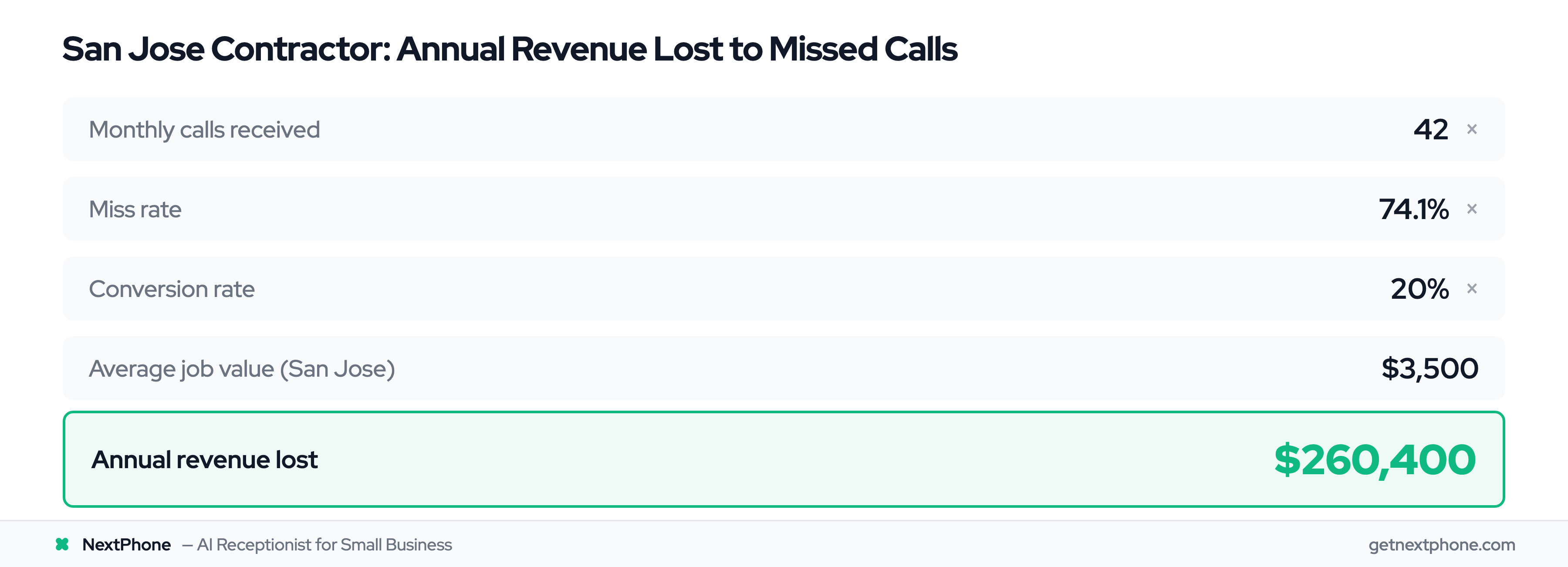
Let's run the numbers for a typical San Jose contractor:
Monthly Call Volume: 42 calls (average for home services businesses)
Missed Calls: 42 × 74.1% = 31 missed calls per month
Conversion Rate: 20% of calls typically convert to jobs
Average Job Value: $3,500 (San Jose area)
Monthly Lost Revenue: 31 missed × 20% conversion × $3,500 = $21,700/month
Annual Lost Revenue: $21,700 × 12 = $260,400/year
Even if we cut those numbers in half to be conservative, you're still looking at over $130,000 in annual lost revenue from missed calls.
Research from Ambs Call Center puts the average cost of a single missed call at $12.15 for small businesses, with annual losses often exceeding $26,000.
Why Voicemail Doesn't Work
"I have voicemail, so I'm covered." This is the most expensive misconception in small business.
Our data shows approximately one in four callers explicitly asks for a callback when they reach voicemail. That sounds encouraging until you realize: without a systematic tracking system, 80% of those callback requests never happen. The contractor gets busy, the note gets lost, and the customer moves on.
For emergency situations, voicemail is even worse. In our data, urgent calls using language like "emergency," "urgent," or "ASAP" rank among the top reasons people call. These callers won't wait. An HVAC customer whose AC died in 100-degree San Jose heat isn't leaving a voicemail and hoping you call back tomorrow.
Emergency calls also represent your highest-value work. The average emergency job in home services is $4,200, significantly higher than routine appointments. Missing one emergency call per week adds up to $16,800 per month in lost revenue.
Your Options: AI vs Traditional Answering Services
When it comes to answering your San Jose business calls, you have three main options. Each comes with different costs, capabilities, and tradeoffs.
Traditional Live Answering Services
Traditional answering services employ human operators who answer calls on your behalf, take messages, and forward urgent calls. Several companies serve the San Jose area, including Map Communications, AnswerConnect, and Smith.ai.
Typical Costs:
- $300-800 per month for 100-200 calls
- Per-call pricing: $0.70-$1.62 per call
- Per-minute pricing: $0.75-$2.50 per minute
- Overage fees for exceeding plan limits
Pros:
- Human touch for complex conversations
- Can handle unusual situations
- Some customers prefer human interaction
Cons:
- Expensive, especially with overages
- Quality varies by operator
- 24/7 coverage costs extra (often 30-50% more)
- Wait times during busy periods
- Setup fees can reach $500
AI-Powered Answering Services
AI answering services use conversational AI to handle incoming calls. The technology has improved dramatically in recent years, with modern systems achieving near-human understanding for routine business calls.
Typical Costs:
- $99-299 per month
- Usually flat-rate with unlimited calls
- No setup fees with most providers
- No overage charges
Pros:
- Answers every call in under 5 seconds
- 24/7/365 coverage included
- Consistent quality on every call
- Scales infinitely (handles 1 call or 100 simultaneous)
- No sick days, vacations, or training issues
Cons:
- May not handle every complex scenario perfectly
- Some customers prefer human interaction
- Requires clear configuration for your business
Which Is Right for Your Business?
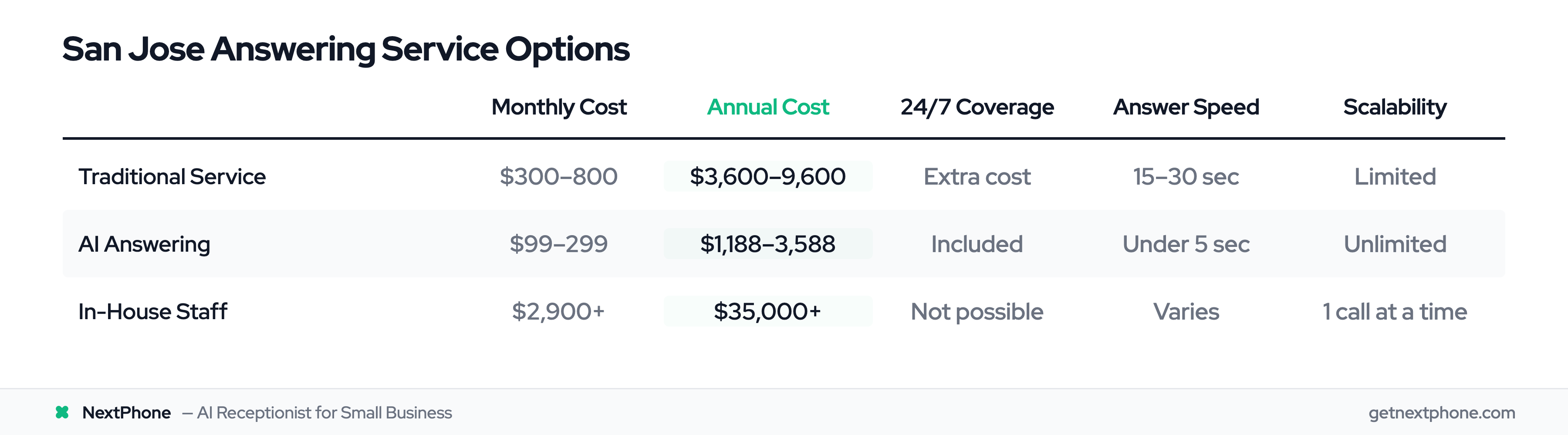
Here's a comparison to help you decide:
| Factor | Traditional Service | AI Answering | In-House Staff |
|---|---|---|---|
| Monthly Cost | $300-800 | $99-299 | $2,900+ |
| Annual Cost | $3,600-9,600 | $1,188-3,588 | $35,000+ |
| 24/7 Coverage | Extra cost | Included | Not possible |
| Answer Speed | 15-30 seconds | Under 5 seconds | Varies |
| Scalability | Limited | Unlimited | 1 call at a time |
| Consistency | Varies by operator | 100% consistent | Varies by mood |
For most San Jose small businesses, AI answering offers the best combination of coverage, consistency, and cost. You get 24/7 professional presence for less than the cost of traditional service during business hours only.
AI-first with smart forwarding works well: AI handles routine calls (hours, pricing, scheduling, basic questions) while immediately forwarding urgent or complex calls to you. This captures the 60-80% of calls that are routine while ensuring you personally handle the ones that need your judgment.