Last updated: September 2026
Introduction
If missed calls are the real reason you're leaving Nextiva — not a missing feature — NextPhone is the answer most comparison articles skip. Law firms, CPA practices, and professional services businesses pay $45–225/month for Nextiva and still send calls to voicemail. NextPhone AI answering picks up every call in under 2 seconds, 24/7, at a flat $199/month — no per-user fees, no per-minute billing, no separate answering service bill.
Try NextPhone free for 7 days
AI answering service that answers, qualifies, and books — 24/7.
If you need a full VoIP platform — video conferencing, team messaging, call center features — the alternatives below cover RingCentral, Dialpad, Vonage, Ooma, and OpenPhone with pricing and trade-offs for each.
You're paying Nextiva $15 to $75 per user per month. You have three people in your business. That's $45 to $225 monthly for a phone system. And you're still missing calls while you're with customers, on job sites, or after hours.
You're not alone. Thousands of small business owners search for "Nextiva alternative" every month, frustrated by the same issues: pricing that adds up fast, features they never touch, mobile apps that don't work reliably, and the nagging feeling they're overpaying for complexity they don't need.
This guide covers what you'd expect: the VoIP alternatives like RingCentral, Dialpad, and Vonage. But most "Nextiva alternative" articles skip a question that matters more than feature comparisons: Do you actually need another full VoIP system at all?
For many small businesses, the real problem isn't the phone system. It's that calls go unanswered. Industry research on home services businesses found 74.1% of calls go completely unanswered, regardless of what phone system those businesses use. Swapping Nextiva for RingCentral doesn't fix that. If your actual issue is missed calls, not missing features, a different category of solution might be the better move.
Disclosure: NextPhone is our product. We built it to solve the missed-calls problem we observed in that data. We've included it alongside traditional VoIP alternatives so you can evaluate it on the same terms.
How We Evaluated These Alternatives
We assessed each Nextiva alternative against five criteria relevant to small businesses with 1-5 people:
- Pricing transparency for small teams -- Does the per-user math make sense at 1-3 seats, or does the platform assume 10+?
- Setup complexity -- Can you self-serve the setup in a day, or do you need IT help and a week of configuration?
- Mobile app reliability -- For service businesses working from phones, a broken mobile app is a dealbreaker.
- Feature-to-need fit -- Are you paying for call center analytics and video conferencing you'll never open?
- Real user review scores -- G2 and TrustRadius ratings from actual small business users, not enterprise deployments.
For a broader look at VoIP options and how they compare, see our VoIP small business guide.
Why Businesses Look for Nextiva Alternatives
Before diving into alternatives, it helps to understand why so many businesses consider switching. Nextiva isn't a bad product—it's actually one of the top cloud VoIP providers serving 100,000+ businesses with 99.999% uptime. But for many small businesses, the fit just isn't right.
The Pricing Problem
Nextiva's pricing starts at $15 per user per month for the Core plan and climbs to $75 for Power Suite CX. For enterprise plans, it reaches $199 per user monthly.
For a single user, that's manageable. But small businesses rarely have just one person. A three-person team on the Core plan pays $45/month. On the Engage plan, that's $75/month. Annually, you're spending $540 to $900—before adding any extras.
Compare that to competitors starting at $15-20 per user, and the pricing gap has narrowed—but Nextiva's higher tiers still add up fast.
| Nextiva Plan | Price/User/Month | 3-Person Team/Month | Annual Cost |
|---|---|---|---|
| Core | $15 | $45 | $540 |
| Engage | $25 | $75 | $900 |
| Power Suite CX | $75 | $225 | $2,700 |
Complexity Overkill for Small Teams
Nextiva is built for businesses that need unified communications: voice, video, team messaging, call center features, CRM integrations, analytics dashboards, advanced IVR systems.
That's impressive for a 50-person company with dedicated IT staff.
But if you're a plumber, an attorney, or a solo consultant, you probably don't need:
- Video conferencing (you meet customers in person)
- Team messaging (you can just text your one employee)
- 20+ CRM integrations (you use a spreadsheet or basic CRM)
- Call center features (you're not running a call center)
You're paying enterprise prices for enterprise features you'll never use.
Technical Issues and Complaints
Customer reviews reveal recurring frustrations:
Mobile app problems: The Nextiva mobile app averages 2.3/5 on iOS and 1.5/5 on Android according to user feedback. Complaints include dropped calls, echo issues, and general unreliability. For businesses that work from phones (most small businesses), this is a dealbreaker.
SMS/texting delays: Multiple reviews cite waiting weeks or months for text messaging to be approved and activated. In an era when customers expect texting, this creates real business impact.
Contract and cancellation issues: Users report auto-renewals with no notification, difficulty canceling, and unexpected charges. One business discovered they'd been overcharged for three years for services they weren't using.
Setup complexity: Business.com's review notes that Nextiva takes longer to set up than competitors, with a steeper learning curve for the full platform.
These aren't universal experiences—many users are satisfied. But for small businesses without IT support, these issues compound quickly.
Nextiva Pricing 2026
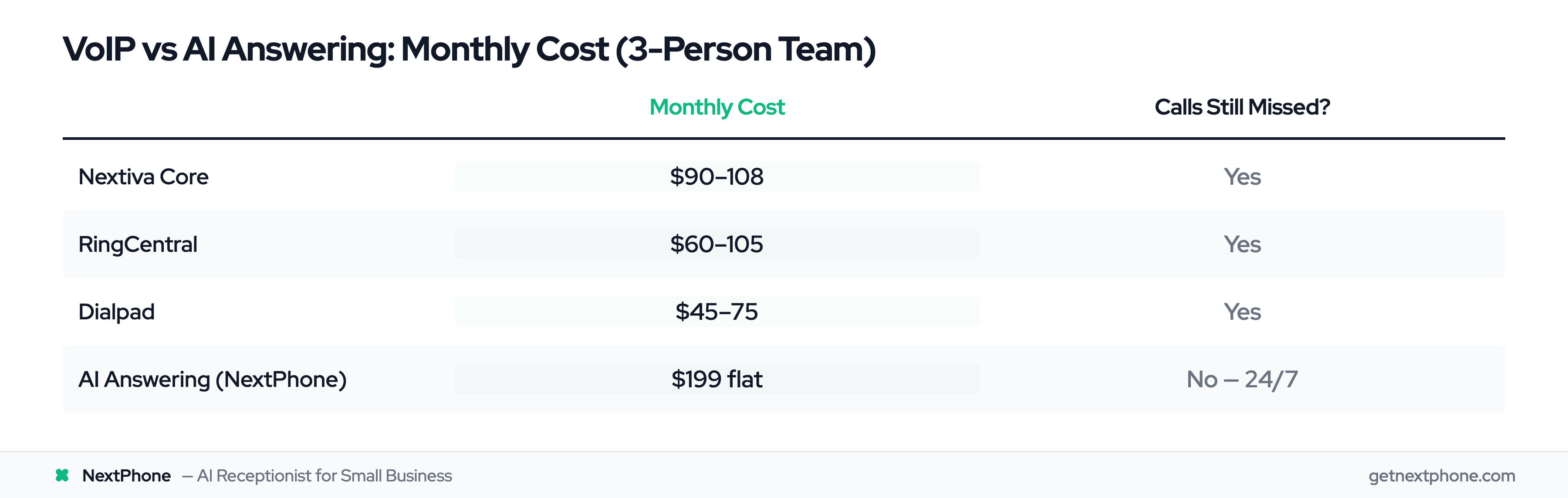
Nextiva's pricing structure is the most common reason businesses start searching for alternatives. Here's the full cost picture — and how the two main solution categories compare.
| Solution | Price | 3-Person Team/Month | What You're Paying For |
|---|---|---|---|
| Nextiva Core | $15/user/mo | $45 | Voice + SMS + team messaging |
| Nextiva Engage | $25/user/mo | $75 | Core + digital channels + analytics |
| Nextiva Power Suite CX | $75/user/mo | $225 | Full UCaaS + contact center features |
| NextPhone | $199/mo flat | $199 | AI answering, unlimited calls, 24/7 |
The per-user math works against small teams. A three-person shop on Nextiva's Engage plan pays $900/year for a phone system. Scale to five people and that's $1,500/year — before adding any extras.
NextPhone doesn't scale with headcount. At $199/month flat, it covers unlimited inbound calls answered 24/7 by AI — whether you have one person or ten. NextPhone resolves 90–95% of calls without human escalation, picks up in under 2 seconds, and maintains 99% positive caller sentiment.
The Hidden Cost: Nextiva + a Separate Answering Service
Most Nextiva pricing tables stop at the VoIP bill. For law firms, CPA practices, and professional services businesses, the real comparison includes the answering service you still need on top:
| Setup | Monthly Cost | What You Get |
|---|---|---|
| Nextiva Core, 3-person team | $45 | VoIP features — calls still go to voicemail |
| Nextiva Core + traditional human answering service | $345–$845 | VoIP + per-minute operator coverage, often limited hours |
| NextPhone | $199 flat | AI answering 24/7 — no per-user or per-minute bill |
Professional services businesses that need both a phone system and 24/7 coverage for every incoming call routinely pay $400–800/month split across two vendors. NextPhone replaces the answering service entirely at a predictable flat rate — with no per-minute billing that spikes when call volume surges.
The right comparison isn't just price — it's what problem each option solves. Nextiva is a full VoIP platform (voice, video, team messaging). NextPhone is an AI answering service. If your issue is missed calls, not missing features, they address different problems at similar monthly costs for small teams.
Nextiva Competitors: 8 Alternatives Compared
The VoIP market has consolidated around a handful of major Nextiva competitors — each with distinct trade-offs on price, complexity, and feature depth. The global VoIP market hit $176 billion in 2025 and is projected to reach $389 billion by 2034. Here's how the main options stack up.
| Provider | Starting Price | Best For | Key Advantage |
|---|---|---|---|
| RingCentral | $20/user/mo | Integration-heavy teams | 300+ app integrations |
| Dialpad | $15/user/mo | AI-focused teams | Built-in transcription & insights |
| Vonage | $19.99/user/mo | Custom routing needs | APIs and smart numbers |
| Ooma | $19.95/user/mo | Budget-conscious | Simple, reliable, affordable |
| OpenPhone | $15/user/mo | Simplicity seekers | Clean, mobile-first design |
| Aircall | $30/user/mo | Support teams | Zendesk/Intercom integrations |
| 8x8 | Contact for pricing | Mid-market scaling | UCaaS + CCaaS combined |
| Grasshopper | $14/mo | Solopreneurs | Virtual phone system, no per-user fees |
| NextPhone | $199/mo flat | Service businesses missing calls | AI answering with emergency routing, unlimited simultaneous calls |
NextPhone: Best for Service Businesses Missing Calls
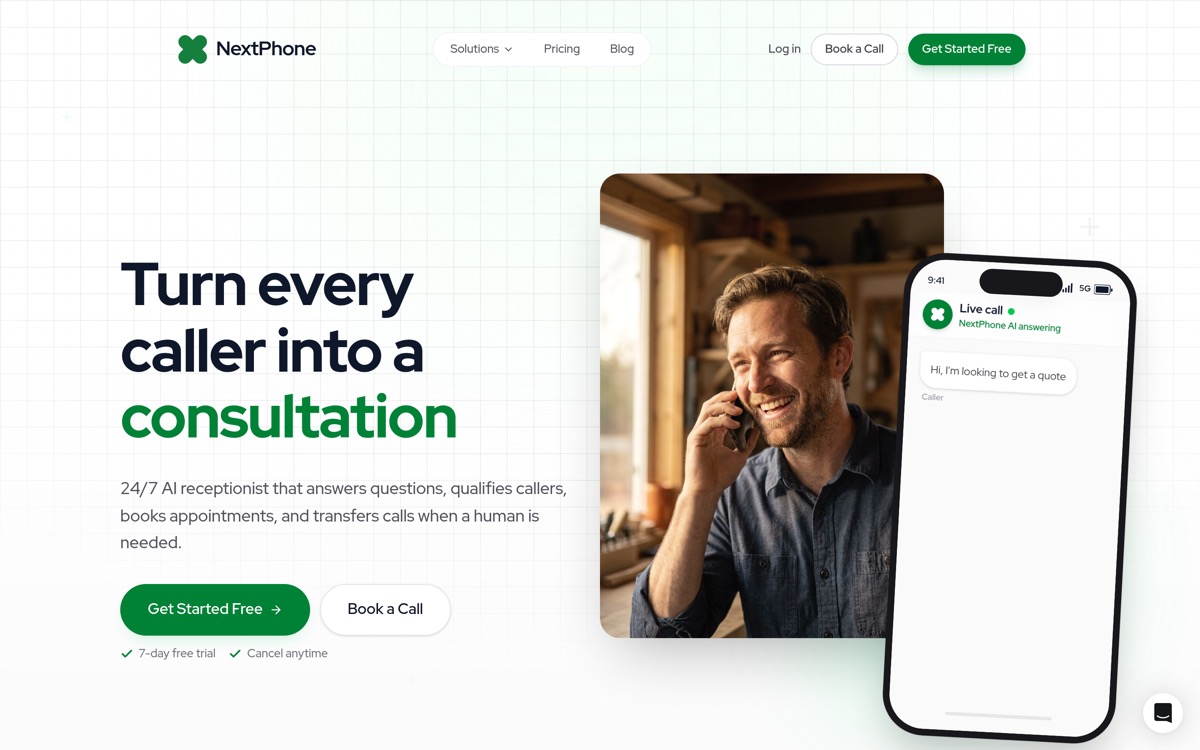
Pricing: $199/month flat (no per-user fees)
Best for: Law firms, consultants, professional services, and contractors where the phone goes unanswered because you're physically doing your work.
NextPhone isn't a VoIP platform. It's a different category entirely. Instead of replacing your phone system, it answers your phone when you can't. AI picks up in under 2 seconds, handles routine questions, books appointments, captures lead details, and routes emergencies to your cell within seconds.
We built it after answering more than 2,000,000 real business calls, in a market where industry research puts 74.1% of calls unanswered. The phone system worked fine. Nobody was there to pick it up.
Key advantage: Every call answered 24/7 at a flat rate. Handles unlimited simultaneous calls. Integrates with ServiceTitan, Jobber, Clio, and HubSpot. No per-user math, no per-minute billing.
Limitation: Not a phone system replacement. No video conferencing, no team messaging, no desk phones. If you need unified communications, look at the VoIP options below.
Try NextPhone free for 7 days
AI answering service that answers, qualifies, and books — 24/7.
RingCentral: Best for Integrations
Pricing: $20-35/user/month (annual billing)
RingCentral integrates with over 300 third-party apps, compared to Nextiva's roughly 20 native integrations. If your business lives in Salesforce, HubSpot, Slack, or Microsoft Teams, RingCentral connects seamlessly. For a deeper look, see our RingCentral alternative breakdown.
Best for: Teams that need their phone system talking to their CRM, project management, and collaboration tools.
Key advantage: The deepest third-party integration ecosystem of any VoIP provider.
Limitation: Can be equally complex. You're trading one enterprise platform for another. RingCentral holds a 4.3/5 on G2, but reviewers frequently cite a steep learning curve for small teams.
Dialpad: Best for AI Features
Pricing: $15-25/user/month (annual billing)
Dialpad builds AI into every tier. You get real-time call transcription, AI-generated summaries, voicemail transcription, and call coaching insights automatically. If you want the AI features Nextiva charges extra for, Dialpad includes them standard. See our Dialpad integration and AI alternative analysis.
Best for: Sales teams and support centers that want insights from every conversation.
Key advantage: AI transcription and coaching included at every price tier. Dialpad scores 4.4/5 on G2, with users praising the built-in AI.
Limitation: If you just need a phone that rings, the AI focus may be overkill. Small businesses report paying for intelligence features they never open.
Vonage: Best for Custom Routing
Pricing: $19.99+/user/month
Vonage excels at call routing customization. Their APIs and smart number features let you build complex workflows—routing by area code, time of day, caller history, or custom conditions.
Best for: Businesses with specific routing needs or those building custom communication workflows.
Key advantage: Developer-friendly APIs for building exactly the call flow you want.
Limitation: The customization requires setup time and possibly developer resources. Not plug-and-play for non-technical owners.
Ooma: Best Budget Option
Pricing: $19.95-24.95/user/month
Ooma offers straightforward business phone service without the bells and whistles. It's particularly good for businesses transitioning from traditional landlines—familiar features, simpler interface, lower price. More details in our Ooma integration review.
Best for: Small businesses with basic phone needs who want reliability without complexity.
Key advantage: Lowest learning curve of any full VoIP platform. Works out of the box.
Limitation: Fewer advanced features if you scale past 10 users. Ooma scores 4.6/5 on G2, but reviewers note the platform doesn't grow well into mid-market needs.
OpenPhone: Best for Simplicity
Pricing: $15-25/user/month
OpenPhone is built mobile-first for founders and small teams. Clean interface, easy setup, straightforward pricing. If Nextiva felt overwhelming, OpenPhone feels like a breath of fresh air. See our OpenPhone integration overview.
Best for: Startups, solopreneurs, and remote teams that work primarily from phones and laptops.
Key advantage: The cleanest UI in the VoIP space. Setup in minutes, not days.
Limitation: No call center capabilities if you grow into needing them — no queue management, monitoring, or agent analytics.
Aircall: Best for Support Teams
Pricing: $30-50/user/month (3-seat minimum, annual billing)
Aircall is purpose-built for customer support and sales teams that live inside helpdesk software. Native integrations with Zendesk, Intercom, HubSpot, and Freshdesk mean call data flows directly into your support tickets.
Best for: Teams of 3+ running structured support operations with ticketing workflows.
Key advantage: The tightest helpdesk integrations of any VoIP provider. Call context appears inside your existing support tickets automatically.
Limitation: The 3-seat minimum and $30+/user starting price makes it expensive for solo operators or two-person teams. At $90-150/month minimum, you're paying enterprise support pricing for a small business.
8x8: Best for Mid-Market Scaling
Pricing: Contact for pricing (enterprise-grade, not publicly listed)
8x8 combines UCaaS (unified communications) and CCaaS (contact center) into a single platform. If you're growing from 5 to 50 employees and need a system that handles both internal collaboration and customer-facing calls, 8x8 scales without forcing a platform switch. See our 8x8 integration analysis.
Best for: Businesses planning to scale into mid-market territory who want one platform for voice, video, messaging, and contact center.
Key advantage: Single platform covers both UC and contact center needs — no integrating two separate systems.
Limitation: Pricing isn't transparent. You have to talk to sales, which typically means the plan costs more than publicly-priced alternatives. 8x8 scores 4.2/5 on G2, but it's overkill for businesses under 10 people.
Grasshopper: Best for Solopreneurs
Pricing: $14-55/month per line (not per user)
Grasshopper is a virtual phone system — not a full VoIP platform. It adds a business number on top of your existing phone. No desk phones, no PBX, no complex setup. Per-line pricing (not per-user) makes it the cheapest option for solo operators. More in our Grasshopper AI receptionist comparison.
Best for: Freelancers, solopreneurs, and side businesses that need a professional business number without replacing their phone system.
Key advantage: Simplest setup of any option. Download the app, pick a number, start receiving calls. Per-line pricing means no per-user multiplication.
Limitation: Very basic feature set. No video, no team messaging, no CRM integrations, no call center features. If you need anything beyond a business number with voicemail and forwarding, you'll outgrow it quickly.
Any of these can replace Nextiva as a VoIP platform. They each have trade-offs, but they're all legitimate options with satisfied customers.
Now back to the question we raised in the intro: do you actually need any of them?