The Phone Call That Got Away
It's 97 degrees in the San Fernando Valley. Someone's AC unit just quit. They grab their phone, search "HVAC repair near me," and tap the first number that comes up—yours. You're on a roof in Torrance, hands full of tools, phone buzzing in your pocket where you can't reach it.
The call goes to voicemail. They don't leave a message. Thirty seconds later, they're calling your competitor.
This happens constantly across Los Angeles. With over 244,000 businesses competing in LA County and operating costs that run 20% above the national average, every missed call stings a little harder here. Industry research shows 74.1% of calls to home services businesses go completely unanswered. That's three out of every four potential customers hearing voicemail instead of a human voice.
The good news? You can fix this with a Los Angeles answering service that gives you a professional 310 presence and 24/7 coverage—without hiring anyone.
Why Los Angeles Businesses Need Better Phone Coverage
LA's High-Cost, High-Competition Market
Running a business in Los Angeles isn't like running one anywhere else. According to the LAEDC Economic Forecast, the cost of doing business in LA is approximately 20% higher than the national average. That means your rent is higher. Your labor costs are higher. And when a potential customer slips away because nobody answered the phone, you're losing more money than a business owner in Kansas City would lose.
LA County is home to more than 244,000 businesses and boasts the highest proportion of minority- and women-owned businesses in the country. Competition is fierce across every industry—HVAC contractors, law firms, real estate agents, medical practices, and the entertainment industry that defines this city.
The $297,600 Problem
Here's what missed calls actually cost a typical Los Angeles small business owner:
- The average home services contractor receives about 42 calls per month
- At a 74.1% miss rate, that's 31 missed calls every month
- LA project values run higher than the national average—about $4,000 for a typical job
- If just 20% of those missed callers would have converted, that's $24,800 per month walking out the door
- Multiply that by 12 months: $297,600 per year in lost revenue
That number isn't theoretical. It's what happens when three out of four callers hear voicemail and call someone else.
Why Traditional Solutions Fall Short
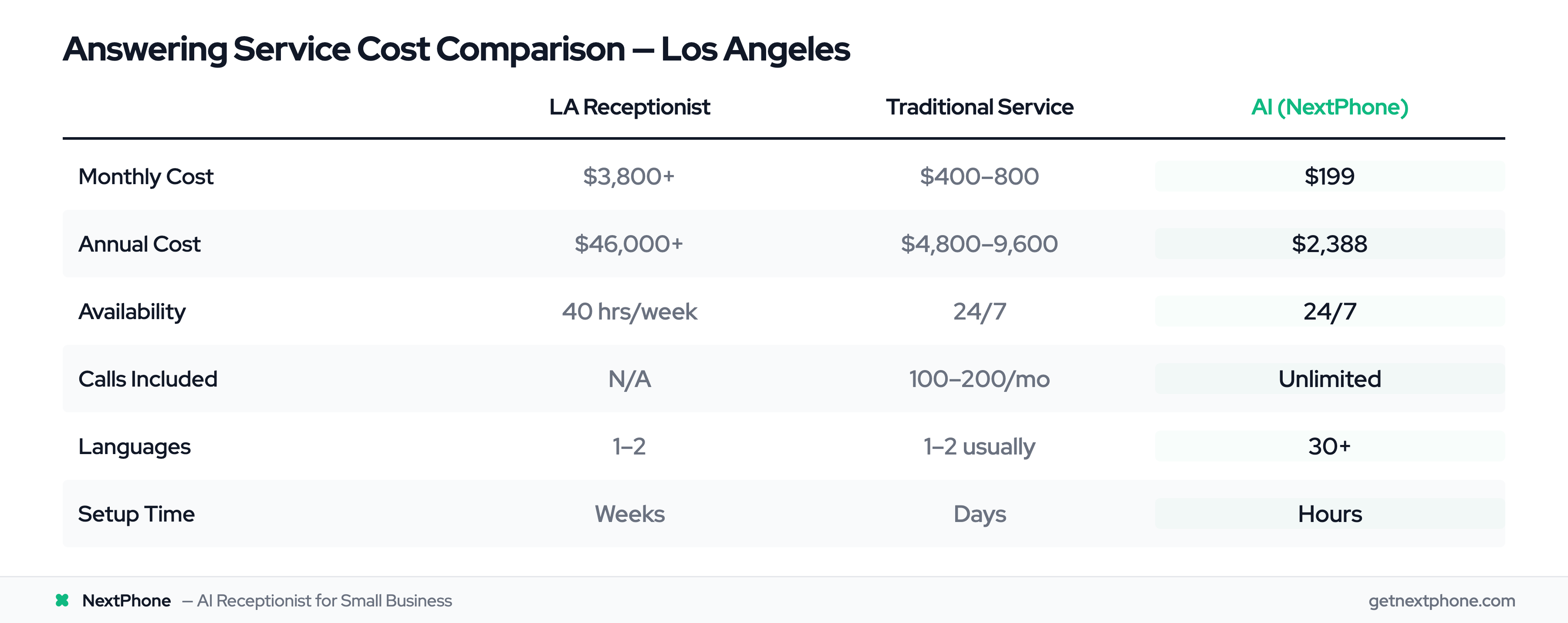
Hiring a receptionist in Los Angeles means paying $37,000 to $46,000 per year—well above the national median of $35,000 that the Bureau of Labor Statistics reports. Add benefits, training, sick days, and the simple fact that nobody works 24/7, and you're looking at a significant expense that still doesn't cover evenings, weekends, or holidays.
Traditional answering services charge $400 to $800 per month and typically limit you to 100-200 calls before overage fees kick in. During busy seasons—like when California had 863 new HVAC business openings in a single year—that call volume cap disappears fast.
Understanding LA Area Codes: 310, 424, and Local Presence
What Areas Do 310 and 424 Cover?
The 310 area code is one of the most recognizable in the country. Created in 1991 when it split from the original 213, it covers West Los Angeles and the South Bay—some of the most desirable real estate and business territory in Southern California.
Cities and neighborhoods in the 310/424 coverage area include:
- Westside: Beverly Hills, Brentwood, Westwood, Pacific Palisades
- Beach Cities: Santa Monica, Venice, Malibu
- South Bay: Manhattan Beach, Hermosa Beach, Redondo Beach, Torrance
- Other Areas: Culver City, Inglewood, Hawthorne, Palos Verdes, Santa Catalina Island
If your customers are in these areas, having a 310 or 424 number signals that you're local, established, and part of their community.
The 310 vs 424 Perception Question
You might hear that "310 sounds more established" than 424. Here's the reality: the 424 overlay was added in 2006 simply because the region ran out of 310 numbers. Both area codes cover the exact same geographic territory. A business with a 424 number is just as local as one with 310.
That said, if having a 310 number matters to your brand, many services let you choose your area code when you sign up.
Why Local Numbers Build Trust
This isn't just perception—it's backed by data. Local phone numbers see answer rates of 60-70% or higher when calling out to customers. Toll-free numbers? They get answered 40-50% of the time and carry a 20-30% spam perception. People screen unfamiliar toll-free calls. They answer local ones.
When someone in Santa Monica sees a 310 number on their caller ID, they assume it's a neighbor, a local business, someone relevant to their life. That assumption gets your call answered.
The Real Cost of Missed Calls in Los Angeles
The Numbers Don't Lie: 74.1% of Calls Go Unanswered

We didn't guess at these statistics. Here's what the data on calls to home services businesses shows:
- Industry research shows 74.1% of calls go completely unanswered
- Approximately one in four callers explicitly asks for a callback—and without a tracking system, most of those callbacks never happen
- Urgent calls rank among the top reasons people call, using language like "emergency," "urgent," or "ASAP"
- Emergencies are a recurring reason people call—pipe bursts, power outages, AC failures during heat waves
When three out of four calls reach voicemail, you're not running a business—you're running a message machine that mostly gets ignored.
What Happens When Callers Hit Voicemail
According to industry research, 85% of callers who don't reach a live person won't call back. They don't leave messages. They don't try again later. They simply move on to the next search result and call your competitor.
"I didn't even know I was missing that many calls until I saw the data," one plumber told us. "I just thought business was slow."
It wasn't slow. He was missing calls while working under houses and losing thousands of dollars every month without realizing it.
Emergency Calls: The Highest-Stakes Missed Opportunities
Not all calls are equal. Emergency calls—AC failures during triple-digit heat, burst pipes flooding kitchens, electrical problems leaving families in the dark—represent your highest-value opportunities. These customers aren't price shopping. They're desperate for someone who answers.
Emergency jobs in LA average $4,500 or more, significantly higher than routine work. Miss one emergency call per week and you're leaving $18,000 per month on the table. That's $216,000 per year from emergency work alone.
LA-Adjusted Revenue Impact
The Math at LA Project Values
Let's run the numbers with realistic Los Angeles figures:
Monthly calculation:
- 42 calls per month (contractor average)
- 74.1% miss rate = 31 missed calls
- $4,000 average LA project value
- 20% conversion rate = 6.2 would-be customers
- 31 missed calls x $4,000 x 20% = $24,800/month lost
Annual impact:
- $24,800 x 12 months = $297,600/year
That's not a typo. A quarter-million dollars per year, gone because nobody answered the phone.
Emergency Call Economics During Heat Waves
Los Angeles summers regularly hit 100+ degrees, especially inland. When someone's AC dies at 3 PM on a July afternoon, they're not comparison shopping. They're calling the first number they find and praying someone picks up.
Urgent calls rank among the top reasons people call, and genuine emergencies are a recurring reason too. For a business getting 42 calls per month:
- Several urgent calls every month
- Missing just a fraction of them without proper coverage = 2 missed emergency calls
- At $4,500 per emergency job = $9,000/month in missed emergency revenue
The Callback Failure Cascade
Here's what makes this worse: approximately one in four callers who reach voicemail does ask for a callback. They're giving you a second chance. But without a systematic tracking system, research suggests 80% of those callback requests never happen. The message gets lost, forgotten, or deprioritized.
So even your "save" opportunities slip away.
How AI Answering Services Work
Beyond Voicemail: Actual Conversations
An AI phone answering service isn't a fancy voicemail. It's an actual conversation that happens in real time. When a customer calls your 310 number, the AI:
- Answers in under 5 seconds (faster than most humans reach the phone)
- Greets them professionally with your business name
- Asks how it can help
- Understands their response using natural language processing
- Provides information, answers questions, or collects their details
- Routes urgent calls to your phone immediately
The caller gets their questions answered. You get notified about the call. Nobody hears voicemail.
What AI Can Handle (And When Humans Take Over)
Modern AI handles 70-85% of typical business calls without any human involvement:
- Hours and location: "What time do you open Saturday?"
- Services offered: "Do you repair Samsung refrigerators?"
- Pricing ballparks: "About how much is a water heater replacement?"
- Scheduling: "Can I book an appointment for Thursday?"
- Lead collection: Name, phone, email, reason for calling
When calls require human judgment—complex negotiations, upset customers, unusual situations—the AI can transfer directly to your cell phone. You handle what needs your expertise. Everything else runs automatically.
24/7 Coverage Without 24/7 Staff
The statistic that matters: over 30% of calls to businesses happen outside traditional 9-5 hours. For home services, that number climbs even higher—most calls to contractors come after hours or on weekends.
AI doesn't take breaks. It doesn't call in sick. It doesn't go home at 5 PM. When someone's pipe bursts at midnight or their AC dies at 6 AM before a brutal LA heatwave, your answering service picks up.
Multilingual Support for LA's Diverse Population
The Numbers: 50%+ Non-English Speakers at Home
Los Angeles isn't just diverse—it's one of the most linguistically varied cities on Earth. According to language research, over 50% of LA residents speak a language other than English at home. If your answering service only handles English, you're potentially missing half your market.
Spanish, Korean, and Mandarin: LA's Major Languages
The language breakdown in Los Angeles:
- Spanish: Spoken in approximately 36% of LA households
- Korean: Koreatown is one of the largest Korean communities outside Korea, with over 500,000 speakers in the broader LA area
- Chinese (Mandarin/Cantonese): Growing presence, especially as San Gabriel Valley communities expand
- Other significant languages: Tagalog, Armenian, Persian, Russian
Traditional answering services often offer Spanish support, but rarely more. That leaves the Korean grandmother calling about a plumbing emergency, or the Mandarin-speaking business owner needing HVAC service, talking to someone who can't understand them.
How AI Handles Multilingual Calls
Modern AI answering services support 30+ languages, including Spanish, Korean, and Mandarin. The AI detects the caller's language and responds appropriately, providing the same professional experience regardless of which language the customer speaks.
One West Los Angeles luxury real estate brokerage reported a 35% increase in inquiries from Spanish- and Mandarin-speaking buyers within three months of implementing trilingual bilingual answering support. When you can serve customers in their preferred language, you capture business your competitors miss.