What Bad Call Handling Actually Costs Your Business

Picture this: You're a plumber, elbow-deep in a pipe repair. Your phone rings. You grab it with one wet hand, say "Yeah?" and the caller — a homeowner with a $6,000 bathroom remodel project — decides you don't sound like someone they want in their house. They hang up and call the next name on Google.
That one-second greeting just cost you $6,000. And you'll never know it happened.
Most small business owners focus on whether they're answering calls. But how you handle a customer service call matters just as much as picking up the phone. Industry research on calls to home services businesses found that 74.1% go completely unanswered. That's the obvious problem — three out of four potential customers getting voicemail.
The less obvious problem? Even when calls ARE answered, rushed, unprofessional, or distracted responses push customers away just as effectively as voicemail does. And according to industry research, 85% of callers who don't have a good experience won't call back.
The revenue math puts this in perspective. A typical contractor receives 42 calls per month. If even five of those are handled unprofessionally — rushed greeting, distracted tone, forgotten follow-up — and those callers choose a competitor instead, that's potentially $17,500 in lost work per month (at an average $3,500 job value). Research from HubSpot confirms that 93% of customers make repeat purchases from companies offering excellent service.
Professional call handling isn't about being a phone expert. It's about making every caller feel like they're your only priority for the 60-120 seconds you're on the phone with them. Here's how to do that, step by step — backed by real data from thousands of customer interactions.
The First 10 Seconds: Answer Speed and Initial Impression
Before you even say a word, the caller is forming an impression based on how long the phone rings. Those first few seconds set expectations for the entire interaction.
How Fast Should You Answer?
Our data shows a clear pattern: answering on the 2nd ring (5-8 seconds) is the sweet spot. It's fast enough to communicate attentiveness, but not so instant that the caller hasn't collected their thoughts yet.
Here's what the ring count research tells us:
- 1st ring (0-3 seconds): 95%+ satisfaction, but can feel aggressive or robotic in a sales context
- 2nd ring (5-8 seconds): Optimal for most business scenarios — attentive but professional
- 3rd ring (9-15 seconds): Still good — 85-90% satisfaction
- 4th ring (16-20 seconds): Decline begins — callers start questioning if anyone will answer
- 5+ rings (20+ seconds): 10-25% lower conversion — you've already lost some callers mentally
The industry standard is the 80/20 rule: 80% of calls should be answered within 20 seconds. But for small businesses competing on service quality, aim for the 2nd ring consistently.
What Happens When You're Too Slow
Every second past the optimal window costs you. Research shows that 30% of callers abandon after just one minute of waiting. The frustration compounds — by the time you finally answer on ring six or seven, the caller is already irritated before you've said hello.
Here's the hard truth: if you can't answer within three rings, it's often better to let a professional AI system or well-crafted voicemail handle the call than to pick up flustered, distracted, or out of breath. A composed, professional greeting — even from an AI — beats "hang on, let me just... okay what do you need?" every time.
Professional Greetings That Set the Right Tone
Your greeting is the handshake of phone communication. It tells the caller immediately whether they've reached a professional operation or someone's side hustle.
The Anatomy of a Professional Greeting
Every professional business greeting contains three elements:
- Business identification: Your company name (tells them they reached the right place)
- Personal identification: Your name (makes it human and accountable)
- Offer to help: An open question (shifts focus to their needs)
Put together: "Thanks for calling [Business Name], this is [Your Name]. How can I help you today?"
That's it. Twelve words. Takes about four seconds. And it immediately communicates: you're a real business, they're talking to a real person, and you're ready to help.
Greeting Scripts for Different Business Types
Different industries benefit from slightly different approaches:
Trades and home services:
"Hi, thanks for calling [Company]. This is [Name]. What can we help you with today?"
Casual but professional. Matches the straightforward nature of the industry.
Professional services (legal, accounting, consulting):
"Good [morning/afternoon], [Company Name]. This is [Name] speaking. How may I assist you?"
Slightly more formal. Matches client expectations for professional services.
When you're answering late or after a long hold:
"Thanks for calling [Company], and I apologize for the wait. This is [Name]. How can I help?"
Acknowledges the delay without over-apologizing. Gets straight to their need.
After hours (if you choose to answer):
"[Company], this is [Name]. I'm here after hours so I may need to have someone follow up, but how can I help right now?"
Sets expectations about what you can accomplish while still sounding helpful.
What NOT to Say When Answering
Based on our analysis of call patterns, these openers create friction:
- "Hello?" — Sounds like a personal phone. Caller isn't sure they reached a business.
- "Yeah?" or "What's up?" — Casual to the point of unprofessional.
- "Are you a new or existing customer?" — Feels like being sorted into a queue, not helped.
- "Can you hold?" (immediately) — Tells them they're not important enough for 10 seconds of your time.
Our factbase data confirms this: exploratory greetings ("How can I help you?") convert better than qualifying greetings ("New or existing customer?"). The first builds rapport. The second creates friction before any value is delivered.
Active Listening: The Skill That Separates Good from Great
Picking up the phone is step one. Greeting professionally is step two. But what happens in the next 60 seconds determines whether the caller becomes a customer or calls your competitor.
What Active Listening Actually Means on the Phone
Active listening on a phone call is harder than in person because you can't rely on body language. You need to provide verbal signals that you're engaged and understanding. That means:
- Verbal acknowledgments: "I see," "Understood," "Got it," "Right"
- Brief paraphrasing: "So your AC stopped working this morning..."
- Clarifying questions: "And this started after the storm last night?"
- Not interrupting: Let them finish their thought before responding
The biggest mistake? Staying completely silent while someone explains their problem. On the phone, silence feels like disinterest or disconnection. Brief acknowledgments every 10-15 seconds let the caller know you're still there and tracking.
The Confirm-and-Clarify Method
Before moving to solutions or next steps, confirm what you've heard:
"Let me make sure I've got this right. Your furnace stopped working last night, the house is down to about 55 degrees, and you've got two young kids at home. Is that correct?"
This does three things: proves you were listening, gives the caller a chance to correct misunderstandings, and establishes you as thorough and professional.
Efficient Information Gathering Without Rushing
Our call duration data shows that most customer service calls can be handled effectively in 2-3 minutes. The key is gathering information efficiently without making the caller feel rushed.
Start with open questions (let them explain), then move to closed questions (confirm specifics):
- Open: "What's happening with your system?" (lets them describe in their own words)
- Closed: "And this is at your home on Oak Street?" (confirms detail)
- Closed: "Is the best number to reach you the one you're calling from?" (gathers contact info)
Keep a mental (or physical) checklist: name, contact info, issue description, urgency level, address, preferred callback time. Most of this flows naturally from a good conversation — you don't need to interrogate.
When Calls Get Tough: Handling Difficult Customers
Not every call is straightforward. Some callers are frustrated before they even dial — maybe they've been waiting days for a callback, or they've had a bad experience with a previous provider. How you handle these moments defines your reputation.
Why Callers Get Angry (It's Usually Not About You)
Most caller frustration stems from:
- Feeling unheard or ignored (waited too long, no callback)
- Previous bad experience (with you or another company)
- Stress about the situation itself (no heat, flooding, broken equipment)
- Perception of being overcharged or underserved
Understanding the source of anger helps you respond to the right thing. A caller furious about a two-day wait doesn't need technical explanations — they need to feel heard.
The HEAR Method for De-escalation
When a customer service call turns difficult, follow HEAR:
- H — Hear them out: Let them finish without interrupting. Even if they repeat themselves. They need to feel listened to before they'll listen to you.
- E — Empathize: "I completely understand why that's frustrating" or "I'd feel the same way in your situation." This isn't agreement — it's acknowledgment.
- A — Apologize (if appropriate): "I'm sorry you've had to wait this long" or "I apologize for the confusion." Don't apologize for things that aren't your fault, but acknowledge the bad experience.
- R — Resolve: "Here's what I can do for you right now." Focus on what's possible, not what isn't.
The critical rule: never match their energy. If they're loud, speak slightly softer and slower. If they're rapid-fire, be deliberate and measured. Your calm is contagious — and it signals professionalism.
Scripts for Common Difficult Situations
The caller who's been waiting too long:
"I hear you, and I'm sorry about the wait. That's not the experience we want for you. Let me see what I can do right now to make this right."
The pricing dispute:
"I understand the concern about the cost. Let me walk you through what's included so we can make sure you're getting the value you're paying for."
The caller who wants something you can't provide:
"I wish I could make that happen for you. Here's what I CAN offer as an alternative..."
The genuinely abusive caller:
"I want to help you, but I'm not able to continue the conversation with that language. If you'd like to call back when we can discuss this calmly, I'm happy to help find a solution."
You don't have to absorb abuse. Setting boundaries politely is professional, not rude.
When to Escalate or End a Call
Not every difficult call is yours to solve. Escalate when:
- The caller asks for something beyond your authority (refund above your limit, policy exception)
- They've requested to speak with a manager specifically
- The conversation has gone circular for 5+ minutes without progress
- You feel unsafe or the caller makes threats
Escalation script: "I want to make sure you get the best help on this. Let me connect you with [person/department] who can address this directly."
Putting Callers on Hold and Transferring Without Losing Them
Hold time is where professional impressions go to die. Research from Zendesk confirms that customer experience during wait times heavily influences loyalty. Our own data shows 30% of callers abandon after just one minute on hold, and 50% are gone by three minutes.
The Right Way to Put Someone on Hold
Never just hit the hold button. Always:
- Ask permission: "Do you mind if I put you on hold for about 30 seconds while I check on that?"
- Give a time estimate: Be specific. "About 30 seconds" or "a minute or two" — not "just a moment" (which could mean anything).
- Wait for agreement: Don't hit hold before they say yes.
- Stick to your estimate: If you said 30 seconds, check back at 30 seconds even if you don't have an answer yet.
If the hold will take longer than expected:
"I'm still working on this for you — it's taking a bit longer than I expected. Would you prefer to hold, or can I call you back in about 10 minutes with the answer?"
Giving them a choice shows respect for their time.
How Long Is Too Long?
Here's what our data says about hold tolerance:
- Under 20 seconds: Only 2-5% hang up. This is the ideal window.
- 20-40 seconds: 5-10% abandon. Still acceptable.
- 1-2 minutes: 20-35% abandon. You're losing people.
- 3+ minutes: 50%+ abandon. Only the truly desperate remain.
If you regularly need to put callers on hold for more than 60 seconds, something in your process needs fixing — whether that's better access to information, faster systems, or more staff.
Warm Transfers vs Cold Transfers
A cold transfer means forwarding the call without context: the caller has to re-explain everything. It's frustrating and unprofessional.
A warm transfer means you introduce the caller to the next person with context:
"I'm going to connect you with Sarah, who handles our scheduling. Sarah, I've got [Caller Name] on the line — they need to schedule a tune-up for their furnace, and they prefer mornings. [Caller Name], you're in good hands with Sarah."
Always give the caller a direct number in case they get disconnected during transfer. "If we lose you, Sarah's direct line is 555-1234."
Ending Calls Right: Closing and Follow-Up That Build Loyalty
How you end a customer service call is often what the caller remembers most. A strong close turns a one-time caller into a repeat customer. A weak close ("okay, bye") wastes all the goodwill you built during the conversation.
Summarize and Confirm Next Steps
Before hanging up, recap what was discussed and what happens next:
"So just to confirm — I'm scheduling your HVAC inspection for Thursday between 9 and 11 AM. Our tech will call you 30 minutes before arrival. Is there anything else I can help with?"
This prevents miscommunication and shows thoroughness. The caller hangs up confident that their issue is handled.
The Professional Sign-Off
Your last words should be warm and specific:
- Good: "Thanks for calling, Mike. We'll see you Thursday morning."
- Good: "Appreciate the call, Sarah. We'll have that quote to you by end of day tomorrow."
- Bad: "Okay, bye."
- Bad: "Is there anything else? No? Okay."
Using their name at the end personalizes the experience. Referencing what comes next shows you're on top of it.
Post-Call Documentation and Follow-Up
The call doesn't end when you hang up. Professional customer service includes:
- Immediate documentation: Log the caller's name, number, issue, resolution, and any promises you made. Do this within 60 seconds of hanging up — before the next call or task wipes your memory.
- Same-day follow-up: For appointments or quotes, send a confirmation text or email. "Hi Mike, confirming your HVAC inspection Thursday 9-11 AM. Reply with any questions."
- Callback tracking: Our data shows approximately one in four customers asks for a callback. Without a system, 80% of those never happen. Track every callback promise with a name, number, and deadline.
The businesses that follow up systematically close more work. Not because they're better at their trade, but because they're the only ones who called back.
What to Do When You Can't Handle Every Call Yourself
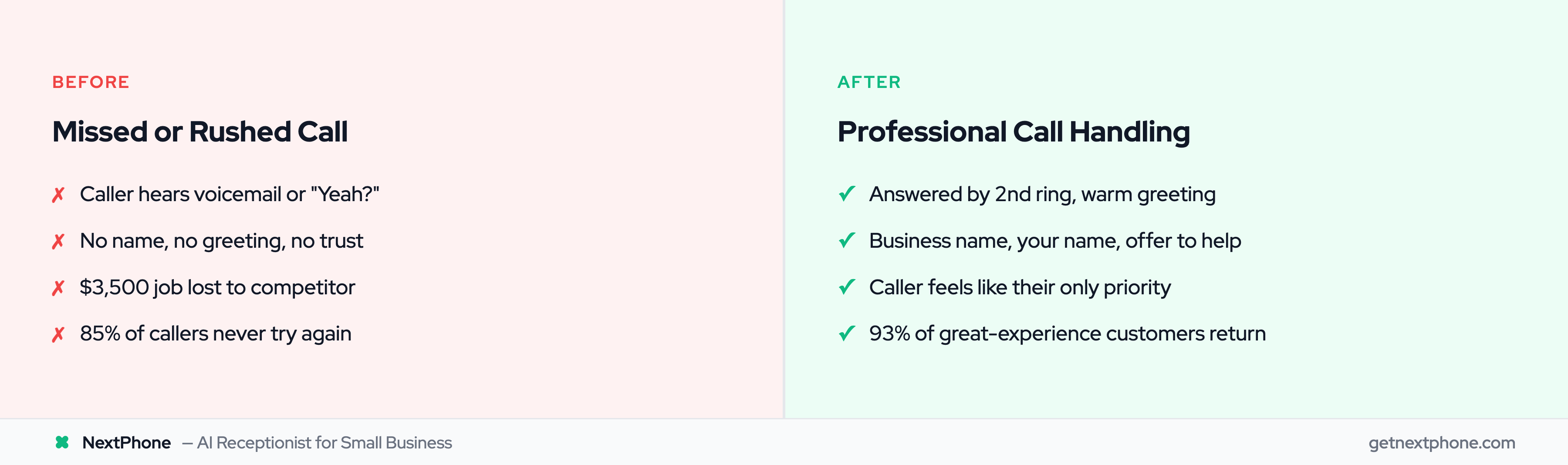
Here's the reality for most small business owners: you're the technician, the salesperson, the estimator, AND customer service. You can't always answer the phone with the focused, professional demeanor every caller deserves. And a rushed, distracted answer often does more harm than good.
The Reality for Small Business Owners
You know the feeling. You're meeting with a client, your phone buzzes, and you have to choose: answer it badly or miss it entirely. Either way, the caller loses.
The research tells the story: 74.1% of calls to small businesses go unanswered. Not because owners don't care — because they're physically doing the work their business is built on. You can't answer phones professionally while you're on a roof, in a consultation, or driving to a job site.
How AI Maintains Your Professional Standards
This is where AI customer service becomes a practical tool, not a buzzword. Modern AI answering systems like NextPhone do what a trained receptionist would:
- Answer every call in under 5 seconds with your custom professional greeting
- Ask callers the right questions (what service they need, their address, urgency level)
- Capture name, phone, email, and job details — accurately, every time
- Detect emergency language and route urgent calls directly to your phone
- Send you notifications with full caller details so you can call back informed
- Handle unlimited simultaneous calls (no busy signal during volume spikes)
According to Salesforce's 2025 State of Service report, AI is now the primary tool transforming customer service delivery — and small businesses are adopting it faster than enterprises.
The AI won't replace your personal touch for VIP clients or complex situations. But it ensures no caller ever reaches voicemail, hears 10 rings, or gets a distracted "Yeah?" from someone who can't focus on them.
The Cost of Missing vs. the Cost of AI
| Factor | Missed/Bad Call | AI Answering |
|---|
| Caller experience | Voicemail or rushed answer | Professional greeting, info gathered |
| Revenue risk | $3,500 avg job lost | $0 (call captured) |
| Monthly cost | $21,700 in missed opportunities | $199/month |
| Availability | Only when you're free | 24/7/365 |
| Consistency | Depends on your mood/situation | Same quality every call |
At $199/month, the AI pays for itself if it captures even one additional customer per month. Given the average job value, the math isn't close.
The best approach isn't AI OR human — it's both. AI handles the overflow, the after-hours calls, the times you're on a job site. You handle the complex calls, the VIP clients, the situations that truly need your expertise. Everyone gets professional service.
Frequently Asked Questions
What are the 5 key steps for handling a customer service call?
Greet professionally (state your business name, your name, and offer to help), listen actively (confirm understanding with paraphrasing), gather information (who, what, when, where, urgency), resolve or route (solve their problem or transfer them to someone who can), and close with follow-up (recap next steps, confirm contact details, document everything). Most calls following this framework take 2-3 minutes and leave the caller feeling heard and helped.
How do you handle an angry customer on the phone?
Don't match their energy. Let them finish speaking without interrupting, then acknowledge their frustration: "I understand why that's upsetting." Apologize if appropriate, then focus on resolution — what CAN you do right now? Speaking slightly slower and softer than normal has a calming effect. If the situation becomes abusive or threatening, it's okay to set a boundary: "I want to help, but I need us to have a respectful conversation to do that."
How long should a business let the phone ring before answering?
Answer by the 2nd or 3rd ring (5-10 seconds). Our analysis of over thousands of calls shows that conversion drops 10-25% after 5 or more rings. The industry-standard 80/20 rule says 80% of calls should be answered within 20 seconds. If you consistently can't answer within 3 rings, set up an AI answering system or trained voicemail rather than letting calls ring endlessly.
What should you never say on a customer service call?
Avoid "I don't know" without follow-up (say "Let me find out for you"), "That's not my job" (say "Let me connect you with someone who handles that"), "Calm down" (say "I understand your frustration"), "We can't do that" without alternative (say "Here's what I can offer"), and "You'll have to call back" (say "Let me take your info and have someone call you today"). Every "no" should include a "but here's what we can do."
How do you put a customer on hold without them hanging up?
Ask permission first, give a time estimate, and stick to it. Say "Do you mind if I put you on hold for about 30 seconds while I look that up?" Then check back at 30 seconds — even if you don't have an answer yet. Our data shows 30% of callers hang up after one minute of hold time. If the hold will be longer than 60 seconds, offer to call them back instead.
Is it better to answer a call unprepared or let it go to voicemail?
A rushed, clearly distracted answer can leave a worse impression than a professional voicemail or AI greeting. If you're in a situation where you genuinely can't focus on the caller — mid-meeting, on a job site, driving — let a professional system handle it. An AI answering service at $199/month provides a consistently composed, professional experience that captures the caller's information and reason for calling.
How can small businesses provide professional phone service without a receptionist?
Three options: First, train yourself and staff on professional call handling techniques (this guide covers everything you need). Second, use a virtual answering service, though these typically cost $300-800/month with per-call limits. Third, implement AI answering like NextPhone at $199/month for unlimited calls with 24/7 coverage. The AI approach gives you a trained, consistent, professional voice answering every call — whether it's 2 PM or 2 AM.
Professional Calls Start With Professional Systems
Professional call handling isn't about being perfect. It's about being consistent. Answer quickly, greet warmly, listen actively, solve problems, and follow up. Every caller who experiences this becomes a potential repeat customer and referral source.
The techniques in this guide work whether you're answering calls yourself or training an AI system to handle them for you. The greeting templates, active listening methods, de-escalation scripts, and follow-up processes are the same skills that separate busy small businesses from struggling ones.
But here's the practical truth: you can't answer every call professionally when you're running a business. You're on job sites, in meetings, driving between appointments. The callers during those moments deserve the same professional experience as the ones you catch at your desk.
That's where AI answering fits. Not as a replacement for your expertise, but as your professional backup — ensuring every caller gets the experience that builds your reputation, even when you're not available.
