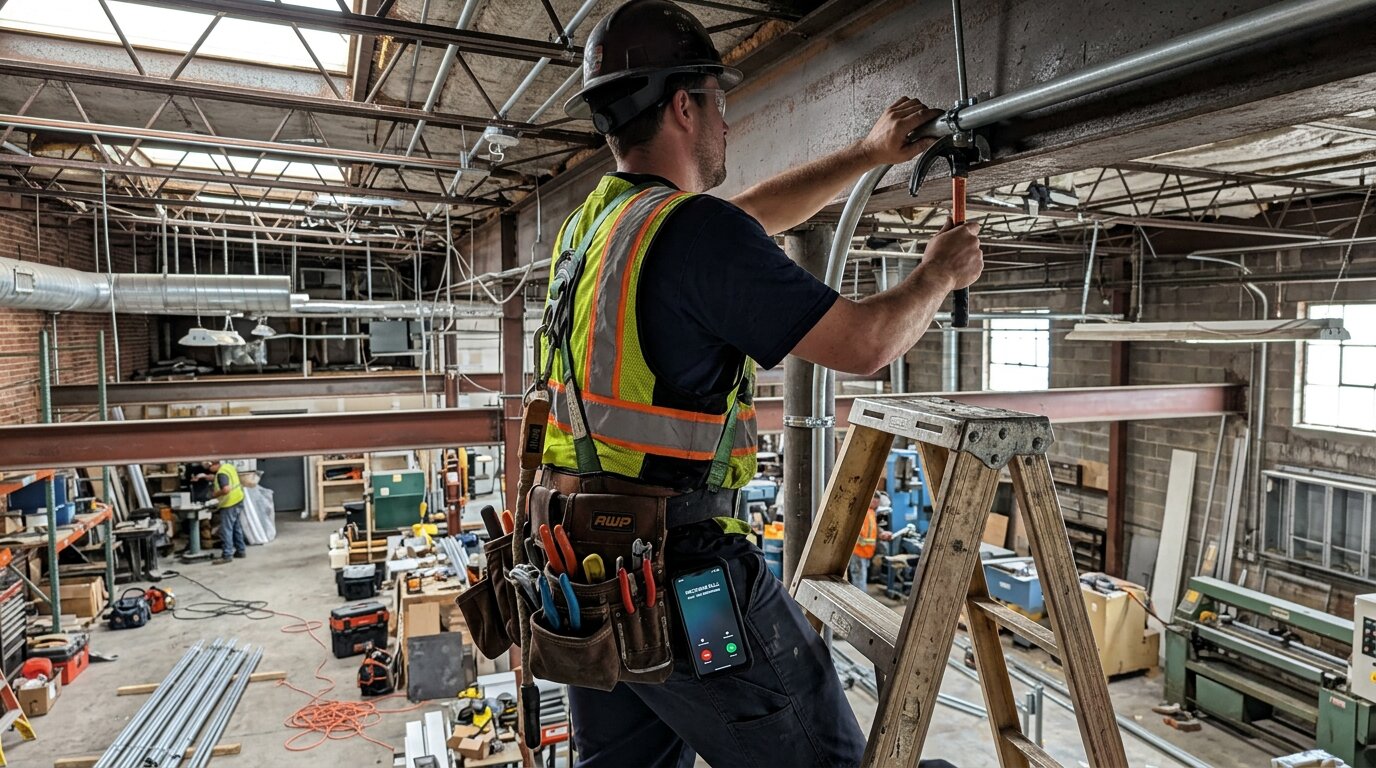
You're on a ladder installing a new light fixture. Your phone rings. A potential customer needs electrical work, could be a $2,500 job. But your hands are full, and by the time you climb down, they've hung up. They called the next electrician. Job lost.
This happens thousands of times every day.
Conversion rates are 8x greater when leads are contacted in the first 5 minutes, yet only 0.1% of leads are engaged within that window. Industry research shows 74.1% of calls to home services contractors go completely unanswered. That's three out of every four potential customers calling someone else.
And here's the brutal truth: 85% of callers won't call back if their call isn't answered. They just move on to the next contractor.
42% of SMBs lose $500+ per month to missed calls, and 78% of customers buy from the first company to respond. The difference between answering on the first ring and answering on the fifth ring? That's the difference between a $3,500 job and nothing.
Let's talk about instant call pickup: what it is, why it matters, and how it can capture calls you're missing right now.
Why Every Second Counts When the Phone Rings
Customer Expectations Have Changed
Here's what used to be acceptable: A phone rings five times, someone picks up, conversation starts. Total time: 20-25 seconds. No big deal.
That doesn't work anymore.
Research shows that 60% of customers define "immediate" as 10 minutes or less when it comes to support tickets. But for phone calls? Their expectations are measured in seconds, not minutes. A typical phone call rings for approximately five rings before being answered, if it's answered at all. That's 20-25 seconds of the customer wondering if anyone will pick up. Research shows the average real estate agent takes 917 minutes (over 15 hours) to respond to leads. By then, the customer has long moved on.
Each ring feels longer when you're the one waiting. By the third ring, they're wondering if you're even there. By the fifth ring, they're already looking up your competitor.
The Three-Ring Rule Is Dead
The old customer service standard was "answer within three rings." That meant 12-15 seconds was acceptable.
But acceptable doesn't win jobs anymore.
When a homeowner's AC dies in 95-degree heat, they don't wait patiently through five rings. They call three HVAC companies at the same time. The first one to answer gets the job. The other two? They don't even know a customer tried to reach them.
What Happens When You're Too Slow
Research on customer behavior reveals what happens when businesses answer slowly, or not at all:
- 85% of callers won't call back if their call isn't answered
- 80% would rather contact a competitor than leave a voicemail
- 52% of customers decided to stop purchasing from a business due to slow response times
Here's a scenario that plays out every day: A homeowner's AC just died; it's 95 degrees outside. They call three HVAC companies. The first goes to voicemail. The second rings six times before someone answers. The third picks up on the first ring.
Who gets the $3,200 emergency repair job? Not the one with the best reviews. Not the cheapest. The one who answered fastest.
What Is Instant Call Pickup?
Defining "Instant" (Seconds, Not Rings)
Instant call pickup means answering calls in 5 seconds or less, typically within one ring or less.
Not "fast for an answering service." Not "pretty quick for a small business." Instant. The phone rings, and someone (or something) picks up before the caller even thinks about hanging up.
The 5-Second Rule
Why 5 seconds?
Because that's the threshold where customers perceive a response as immediate. When you answer within 5 seconds, there's no time for frustration to build. No time to wonder if you're open. No time to start looking up your competitor's number.
It's the difference between "they picked up right away" and "I had to wait."
First Ring vs Traditional Answer Times
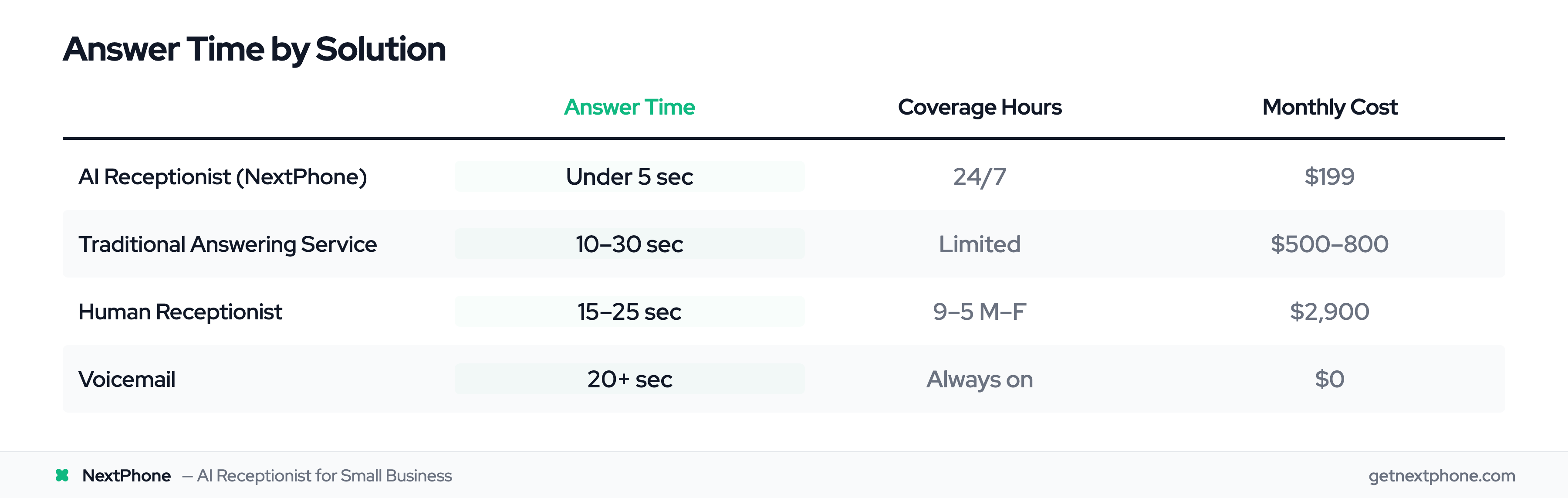
Here's how different solutions stack up:
| Solution | Answer Time | Rings | Customer Experience |
|---|---|---|---|
| Instant Pickup (AI) | <5 seconds | 1 or less | Immediate answer, professional greeting |
| Traditional Answering Service | 10-30 seconds | 2-6 | Waiting, wondering if anyone will pick up |
| Human Receptionist | 15-25 seconds | 3-5 | Standard wait time |
| Voicemail | 20+ seconds | 4+ | Frustration, usually hang up |
Traditional answering services claim to be "fast," but they still average 10-30 seconds. That's 2-6 rings. A human receptionist needs time to notice the phone, stop what they're doing, and physically answer. That's 15-25 seconds on average.
With instant call pickup, the answer happens in under 5 seconds. One ring. Often less.
That 10-20 second difference? That's the competitive advantage.
How Instant Call Pickup Works
AI Receptionist Technology
Instant call pickup is powered by AI receptionist technology: voice AI that can hold natural conversations, answer questions, and handle calls just like a human receptionist would. A voice AI receptionist answers every call in under 5 seconds, 24/7.
The difference? An AI receptionist doesn't need to look up from a computer. Doesn't need to finish helping someone else first. Doesn't need to walk across the office to grab the phone.
Best-in-class voice AI achieves 510ms latency, with 70% rise in vertical voice AI startups at Y Combinator. When a call comes in, the AI detects it instantly and picks up. Total time: under 5 seconds, every single time.
Always-On Availability
Here's what makes instant pickup possible: the AI is always there.
Not "on break." Not "helping another customer." Not "after hours." There's no switching cost, no delay, no "let me get that."
The phone rings. The AI answers. Simple.
No Human Delay
A human receptionist needs 15-25 seconds on average to answer a call. Here's why:
- Notice the phone is ringing (2-3 seconds)
- Finish current task or put current conversation on pause (5-10 seconds)
- Physically reach for the phone and answer (3-5 seconds)
- Context switch to "phone mode" (2-5 seconds)
Total: 15-25 seconds minimum.
An AI receptionist? Zero delay. The call arrives. The AI is already "there." It picks up in the time it takes the phone to ring once. When a call comes in, there's no receptionist finishing an email, no stepping away from lunch, no "let me get that." The AI is already waiting. The phone rings once. Answered. Total time: 3 seconds.
6 Benefits of Answering on the First Ring
1. Capture More Leads (Zero Missed Calls)
Industry research shows 74.1% of calls to home services businesses go completely unanswered. For a typical contractor receiving 42 calls per month, that's 31 missed calls: 31 potential customers who called someone else.
Instant call pickup changes that to zero.
90% of customers rate immediate response as critical, with 60% defining "immediate" as under 10 minutes. Every call is answered. Every caller gets a professional greeting. Every lead is captured.
2. Win Emergency Jobs
Calls containing urgency language (words like "emergency," "urgent," or "ASAP") rank among the top reasons people call. And these calls matter more than routine calls. Emergency jobs typically bring in around $4,200 in revenue, compared to $3,500 for routine work.
Here's what happens in an emergency: It's 2 AM. A homeowner wakes up to a flooded basement: pipe burst. They Google "emergency plumber near me" and start calling. The first three go to voicemail. The fourth picks up immediately. Who gets the $5,000 emergency repair?
Research shows leads are 21x more likely to qualify when contacted within 5 minutes versus 30 minutes. The first one to answer. Not the best plumber. Not the cheapest. The first one who picked up the phone.
When you deliver instant pickup, you're first. You win the emergency job.
3. Beat Your Competition
While your competitors' phones ring five times (25 seconds of the customer waiting and getting more frustrated with each ring), yours is answered on the first ring.
The customer doesn't even dial the next number. They got an answer. Fast. Professional. Helpful.
You just won by being 20 seconds faster.
4. Better First Impressions
The phone interaction is often the first real contact a customer has with your business. An immediate answer signals professionalism, reliability, and readiness.
No frustration. No wondering if you're even open. No anxiety about whether someone will pick up. Just a professional greeting within seconds of calling.
That's the first impression you want.
5. 24/7 Availability Without Hiring
A full-time receptionist costs about $35,000 per year. That's $2,900 per month. And they only work 9-5, Monday through Friday. After-hours calls? Weekends? Holidays? Those go to voicemail.
An AI receptionist delivering instant pickup costs $199 per month. And it works 24/7. Every call is answered in under 2 seconds, whether it's Tuesday at 2 PM or Saturday at 2 AM.
No lunch breaks. No sick days. No "I'm helping someone else." Just instant answer, every single time.
6. Eliminate Hold Music and Frustration
Here's what traditional answering services do: "Your call is important to us. Please hold for the next available agent." Then hold music. Then more waiting. Then maybe someone picks up after 30 seconds.
Instant call pickup eliminates all of that.
No hold music. No queue. No "your call is important to us" messages that make customers feel the opposite. 62% of customers prefer chatbots over waiting for human agents. Multi-language support delivers 60-80% lower international expansion costs, with live chat averaging 47-second first response and 87% satisfaction. Just immediate answer and natural conversation from second one.
