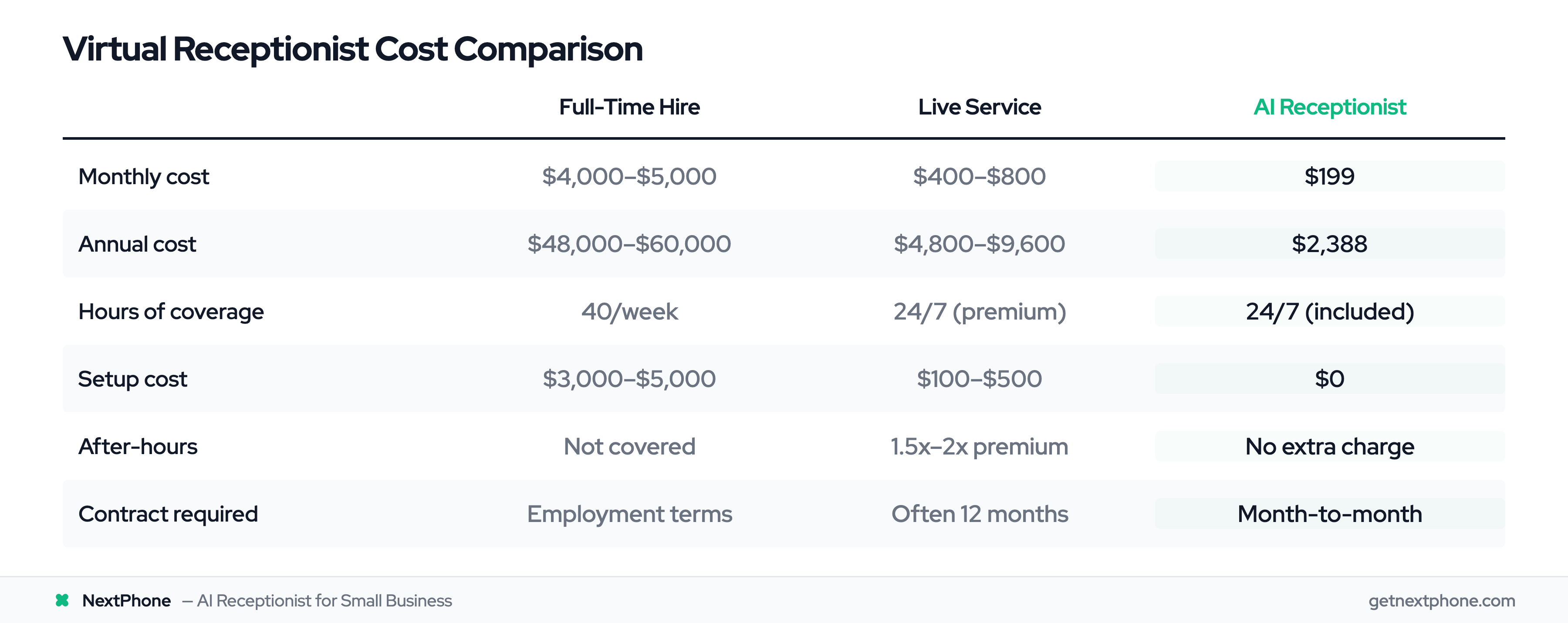
Quick answer: Virtual receptionist costs run $25-$300/month for AI, $200-$800/month for live answering services (Posh, Ruby, ReceptionHQ, Smith.ai sit in this band), and $4,000-$5,000/month for a full-time in-house hire. The billing model — per-minute, per-call, or flat-rate — drives the real bill more than the sticker price. Pick the model that fits your call durations, not the lowest base rate.
Introduction
Looking for NextPhone's pricing? You're in the right place — and we won't make you dig. NextPhone runs on a flat monthly plan: one price, unlimited calls, no per-minute charges. See current plans → or start your free trial →. The rest of this guide compares every model in the category so you can see exactly how the math stacks up.
You searched "cost of virtual receptionist" expecting a straightforward answer. Here it is, then we'll break down every option in detail — including how short calls and per-minute rounding wreck the headline pricing.
| Type | Monthly Cost | Includes | Catch |
|---|---|---|---|
| AI Receptionist | $99-$299/mo | 24/7, unlimited calls | No human voice |
| Live Answering Service | $300-$800/mo | Human operators | Per-minute overages, rounding inflation |
| Full-Time Hire | $4,000-$5,000/mo | Dedicated employee | 40 hrs/week only |
What drives these costs? Call volume matters, but so do the hours you need coverage, the per-minute billing increment, and the share of calls that land after hours. A contractor who needs calls answered while on job sites all day has different needs than a law firm looking for after-hours overflow support.
What you'll pay in practice: verified pricing at a glance
A virtual receptionist costs $199–$350/month depending on pricing model — flat-rate AI plans are predictable before the month starts; per-minute and per-call live services grow with your call volume.
| Provider | Starting Price | Pricing Model | Realistic Cost at 60 Calls/Month |
|---|---|---|---|
| NextPhone (AI) | $199/mo | Flat rate, unlimited calls | $199/mo — never changes |
| Ruby | From $245/mo | Per-minute (50 min base, 30s rounding) | ~$290/mo |
| Smith.ai (human tier) | From $292.50/mo | Per-call (30 calls base) | ~$640/mo |
| PATLive | From $199/mo | Per-minute (75 min base) | ~$200–$250/mo |
| Full-time hire | — | Salary + benefits | ~$4,383/mo |
Pricing verified June 2026 from each provider's published pricing page.
The key difference isn't the starting price — it's what happens in a busy month. Per-minute and per-call plans charge you more when call volume is highest. Flat-rate plans don't. "What does my bill look like in my busiest month?" is the right question to ask every vendor you're evaluating.
Let's break down each option — and then the math nobody publishes: what per-minute virtual receptionist pricing actually costs when applied to the real-world distribution of short calls, hang-ups, and after-hours traffic.
What 15,830 real inbound calls revealed about virtual receptionist pricing
Most pricing comparisons treat a "call" as an abstract 3-minute unit. That's the math that makes Posh's "starting at $137/mo" and Ruby's "$250 for 50 minutes" look reasonable on the brochure. Real call distributions don't behave that way.
We pulled the most recent 9 days of inbound traffic (post-2026-05-16 when our outcome taxonomy was finalized) from our production database — 15,830 calls after spam filtering, drawn from 1,446,980 total inbound calls processed end-to-end. The numbers nobody else in this category publishes:
That distribution is what makes per-minute virtual receptionist pricing a trap — which is the next section.
A short call doesn't mean a useless call. Most inbound calls wrap in under a minute — name, scope, callback window — exactly the call shape Posh, Ruby, and ReceptionHQ round upward into a full 60-second bill on their per-minute plans.
Traditional Hiring: What a Full-Time Receptionist Really Costs
According to Bureau of Labor Statistics data, the median annual salary for a receptionist is $36,920. But that $37K is just the starting point:
- Base salary: $37,000
- Benefits (health insurance, PTO, retirement -- 30%): $11,100
- Training: $3,000
- Turnover costs (33% annual turnover, amortized): $1,500 Total: $52,600/year or $4,383/month
That $4,383/month gets you coverage 40 hours per week. The other 128 hours per week? Nobody's answering. If a customer calls at 6 PM or on Saturday, it goes to voicemail.
For a complete breakdown of hiring costs vs virtual receptionist pricing, see our detailed cost comparison.
Live Virtual Receptionist Services: What You'll Actually Pay
Live virtual receptionist services use real humans answering your calls. The appeal is obvious. The pricing — once you account for rounding, overages, setup, and after-hours premiums — is not.
Major Providers and Their Published Rates
| Provider | Starting Price | Included | Overage | Typical Rounding |
|---|---|---|---|---|
| Posh | $137/mo | 50 min | $2.59-$3.00/min | 60s |
| Ruby Receptionists | $250/mo | 50 min | $4.25-$6.39/min | 30s |
| ReceptionHQ | $25/mo (msg-only) / $175+/mo (live) | 25 calls / 100 min | $1.85-$3.25/min | 60s |
| Smith.ai | $300/mo | 30 calls | $11.50/call (human) | n/a (per-call) |
| AnswerConnect | $325/mo | 100 min | $2.95/min | 60s typical |
| Grasshopper | $29/mo (IVR only) | n/a — routing/voicemail | n/a | n/a |
| Alliance Virtual Offices | $125/mo | 50 min | $2.25/min | 60s typical |
| PATLive | $250/mo | 75 min | $1.95/min | 60s typical |
A few notes on what those numbers actually mean:
- Posh publishes seven tier names (Chic, Vogue, Elegant, Luxurious, Prestigious, Lavish, Exclusive). The $137 entry tier gets you 50 minutes — which on our call mix would cover roughly 100-120 inbound calls of typical length once rounded up, but only if no individual call ever runs over a minute. Realistically, the 50-minute tier supports ~20-30 calls before overages kick in.
- Ruby is the premium brand, and it bills like one: $250/mo for 50 minutes is effectively $4.90/minute baseline before any overage. Live virtual reception starts at $175/mo.
- Smith.ai uses per-call pricing instead of per-minute, which kills the rounding issue but means you pay $11.50 for a 5-second wrong number on the human tier (the AI tier is $3.25/call).
- Grasshopper isn't really a virtual receptionist — it's an IVR + voicemail routing system. Useful for routing, not for actually answering and capturing.
- Alliance Virtual Offices bundles virtual address + virtual receptionist; pricing varies by which combination.
Verify these numbers yourself (snapshots dated 2026-05-26)
Virtual receptionist pricing shifts quarterly and most providers don't email customers about it. The screenshots below were captured directly from each vendor's published pricing page on 2026-05-26 so you can verify the math instead of trusting our table.
NextPhone — Flat-rate $199/month for unlimited inbound calls, 24/7 coverage, and every feature included. No per-minute meter, no per-call charge, no overage tier — the only flat-rate AI receptionist in this comparison.
| Plan | Price | Calls included | Overage |
|---|---|---|---|
| NextPhone Pro | $199/mo | Unlimited | None |
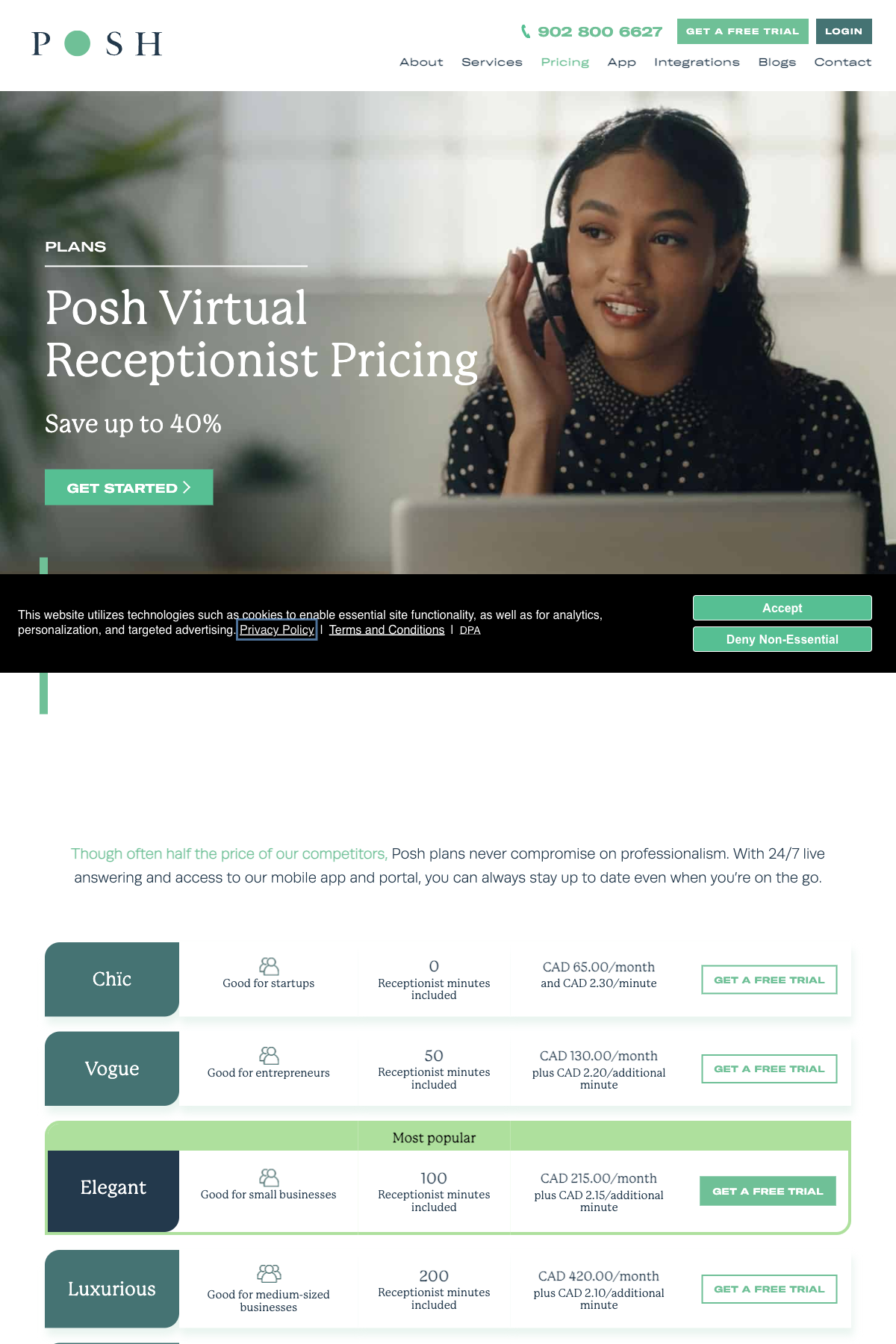
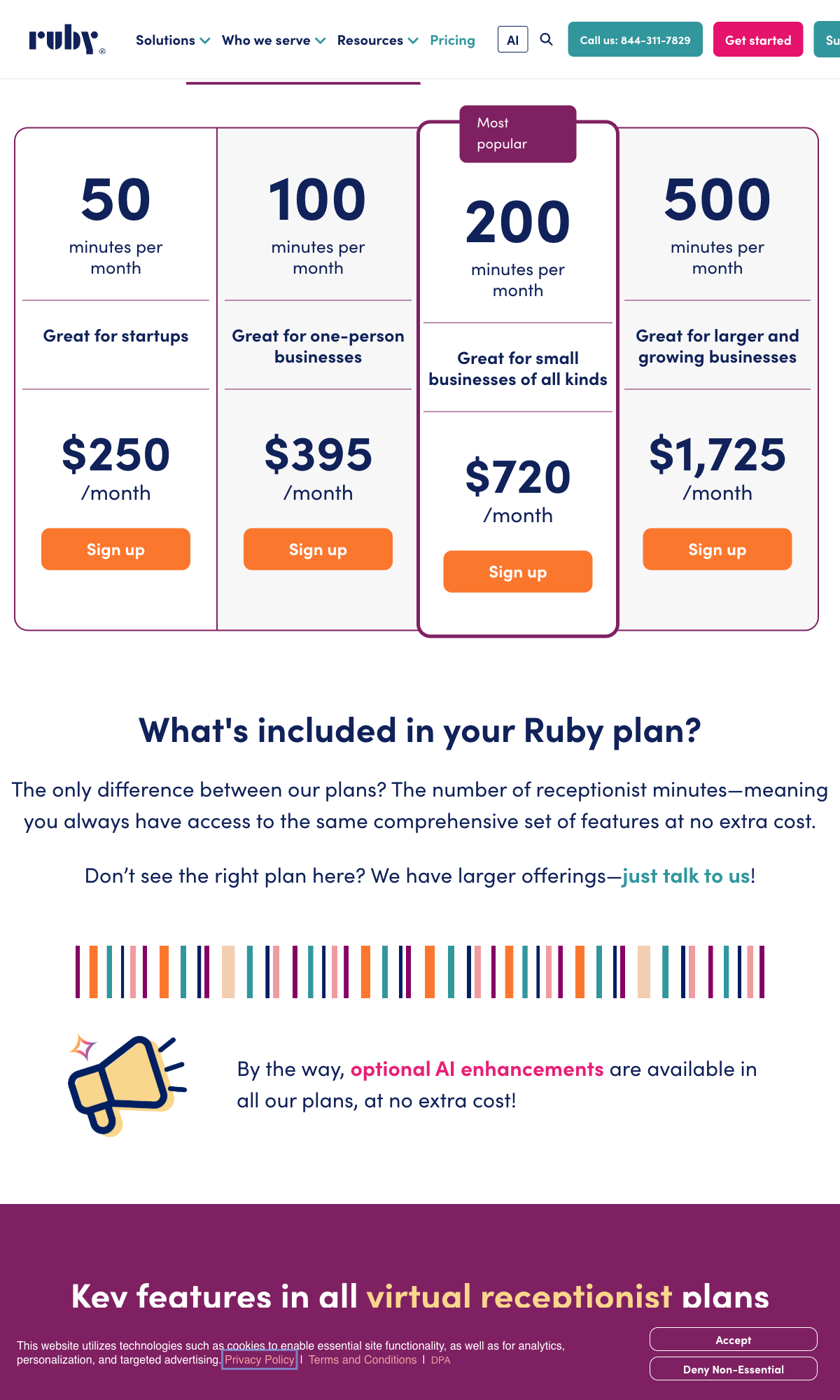
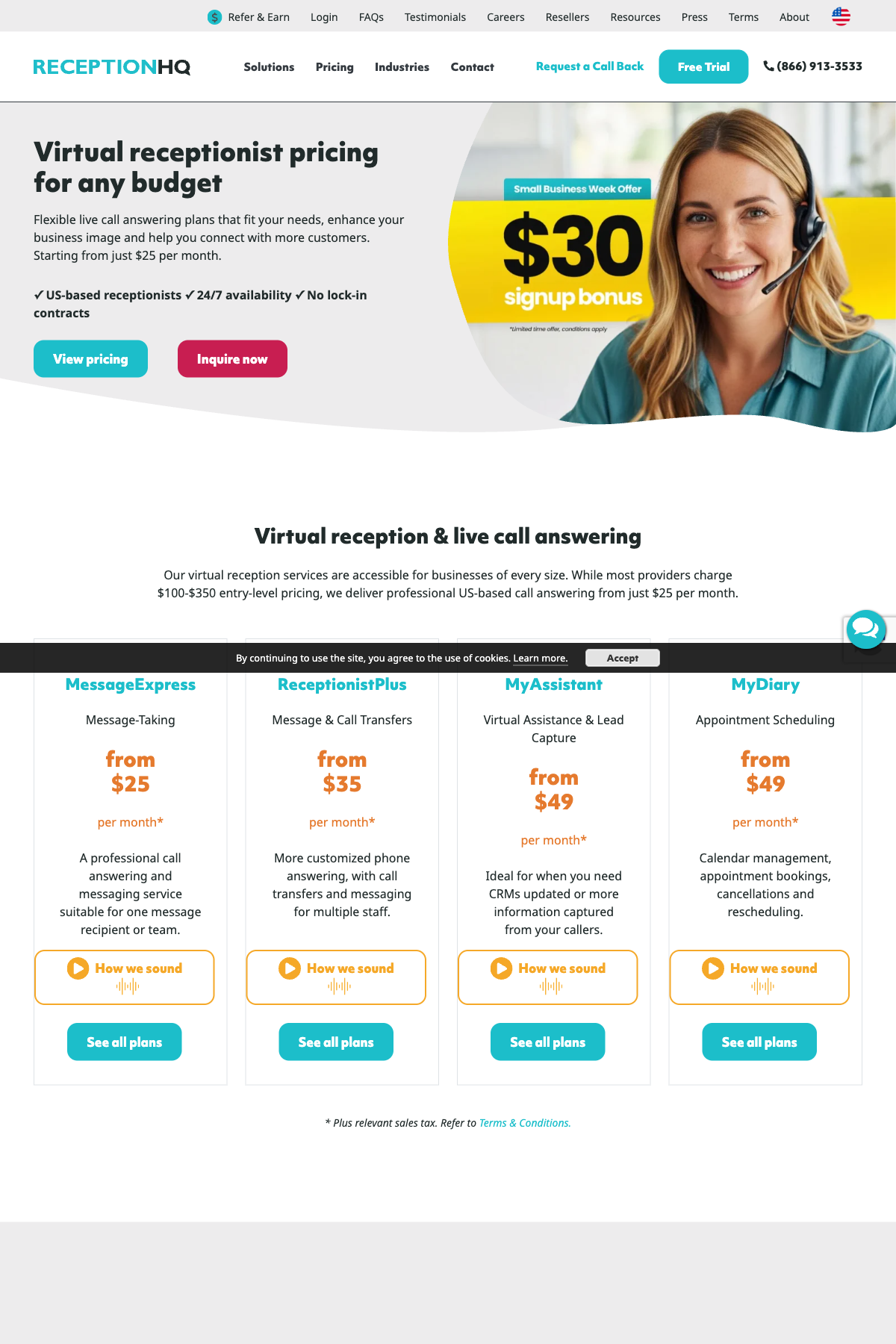
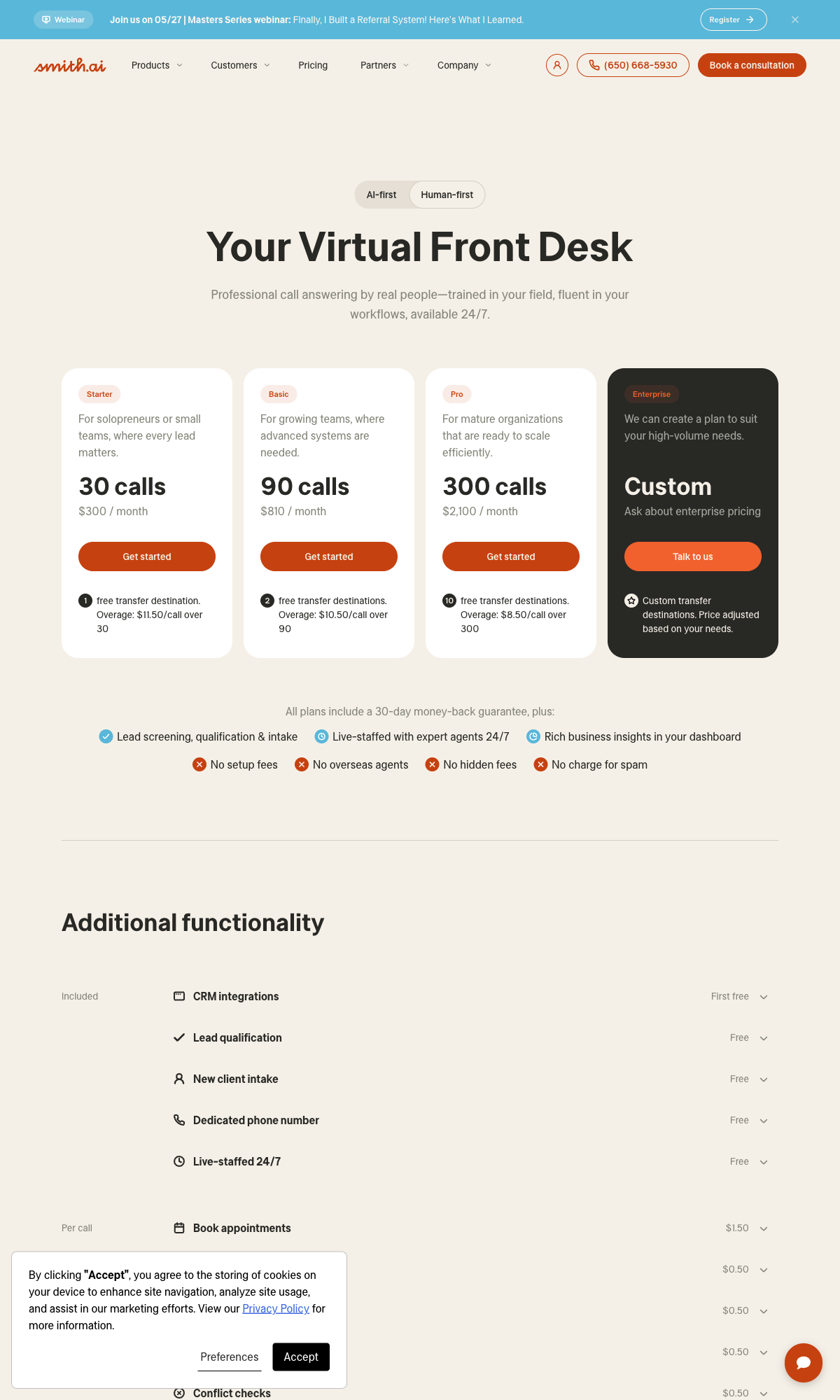
If you spot a delta between a screenshot and our prose, the screenshot is the source of truth — let us know and we'll refresh the page.
What Real Call Math Looks Like — The Posh / Ruby / ReceptionHQ / Smith.ai Spread
Actual talk time at 30.7s average × 100 calls = 51.2 minutes of real conversation.
Now apply each provider's billing rule:
Posh ($137/mo + $2.59/min overage, 60s rounding):
- 100 calls × 1 minute minimum (after 60s rounding) = 100 billed minutes (vs 51 actual)
- 100 − 50 included = 50 overage minutes × $2.59 = $129.50
- Total: $137 + $129.50 = $266.50/month
- Effective rate per real minute: $5.20
Ruby ($250/mo + $4.25/min overage, 30s rounding):
- 100 calls × ~1 billed minute avg (30s rounding on 30.7s avg often crosses into next 30s) ≈ 81 billed minutes
- 81 − 50 included = 31 overage minutes × $4.25 = $131.75
- Total: $250 + $131.75 = $376.75/month
- Effective rate per real minute: $7.36
ReceptionHQ ($175/mo for live tier + $1.95/min overage, 60s rounding):
- 100 calls × 1 minute minimum = 100 billed minutes
- 100 − 100 included = 0 overage (if you sized to the 100-min plan)
- Total: $175/month — but the plan only covers 100 billed minutes (~50 real minutes). One more call and you're paying overage.
Smith.ai ($300/mo for 30 calls, $11.50/call human tier overage):
- 100 calls − 30 included = 70 overage × $11.50 = $805
- Total: $300 + $805 = $1,105/month
- Per-call billing is rounding-proof but punishing on a 100-call month
AnswerConnect ($325/mo + $2.95/min, 60s rounding):
- 100 billed minutes − 100 included = 0 overage at the right plan size
- Total: $325/month — but the plan caps at ~50 real minutes of talk time
NextPhone (flat): $199/month. No rounding. No overage. No after-hours surcharge. Whether you get 40 calls or 400, the bill stays $199.
See how fast "starting at $137" balloons? Budget $300-$900/month for realistic small-business virtual receptionist volume on per-minute or per-call plans. The dispersion is almost entirely about the billing model, not service quality. See our answering service pricing guide for a full breakdown of per-minute vs per-call vs flat-rate models.
A real after-hours intake — captured lead, callback promised, urgency triaged.
How much does a virtual receptionist cost at 200+ calls per month?
For businesses handling 200 or more calls per month, the billing model drives the real cost — not the advertised starting price. Per-minute and per-call services bill more when business is good; flat-rate plans don't.
Cost comparison at higher call volumes (verified June 2026 pricing, 60-second rounding applied):
| Provider | Base plan | At 200 calls/mo | At 300 calls/mo |
|---|---|---|---|
| NextPhone (AI, flat plan) | $199/mo, unlimited calls | $199 | $199 |
| PATLive | $199/mo (75 min included) | ~$444 | ~$638 |
| AnswerConnect | $325/mo (100 min included) | ~$620 | ~$915 |
| Ruby | $245/mo (50 min included) | ~$883 | ~$1,308 |
Overage rates: PATLive ~$1.95/min, AnswerConnect $2.95/min, Ruby $4.25/min. Calculation uses 60-second billing rounding on an average 30.7-second call (~1 billed minute per call). Pricing verified June 2026 from each provider's published pricing page.
At 200 calls per month, businesses on per-minute plans typically spend $240–$680 more per month than a flat-rate AI service — on identical call volume. At 300 calls per month, that gap grows to $440–$1,100. Per-minute billing charges you most in the months business is busiest.
The right question to ask every provider: "What does my bill look like in my busiest month?" With a flat monthly plan, the answer is always the same number. With a per-minute service, it scales with every additional call — and accelerates as you grow.
AI Virtual Receptionists: The Modern Alternative
AI virtual receptionists charge a flat monthly fee regardless of call volume. No per-minute charges, no overage fees, no surprises.
A quality AI virtual receptionist at the $199/month price point typically includes: 24/7 call answering, unlimited calls, message taking, emergency routing, spam filtering, appointment scheduling, and custom greetings. Compare that to live services where scheduling is often a premium add-on and 24/7 coverage bumps you to a higher tier.
Other AI virtual receptionists include Dialzara ($29-$199/mo), Upfirst ($24.95-$159.95/mo), and My AI Front Desk ($79-$119/year) — though feature sets vary significantly at lower price points.
NextPhone offers AI receptionist service at $199/month with everything included. No setup fee. No per-minute charges. No annual contract required.
For that same 100-call example: NextPhone $199/month vs Ruby $376.75/month = $177.75/month savings ($2,133/year). Vs Smith.ai human tier at $1,105/month: $776/month savings ($9,312/year).
Pick the voice — every AI virtual receptionist sounds different
One thing the live-service vs AI-service comparison usually skips: with a live service, you don't get to pick who answers. With a flat-rate AI virtual receptionist, the voice is part of the configuration. Three of the most-picked voices from our production library:
Default pick for client-facing intake. Friendly, organized, trustworthy. Pairs well with most service-business brands.
Sharper diction than Emma. Good for high-volume reception lines where clarity matters more than warmth.
Default male pick for B2B service businesses. No fluff, no upspeak. Reads as competent on the first sentence.
For detailed AI receptionist pricing across 8+ providers, see our AI receptionist pricing guide.