Key Takeaways
- ChatGPT alone cannot answer phone calls - it requires integration with telephony services like Twilio to work as a receptionist
- Purpose-built AI receptionist services cost $50-300/month, compared to $33,000+/year for a full-time human receptionist
- 62% of small business calls go unanswered, and 85% of those missed callers never call back
- AI receptionists handle routine calls well but struggle with emotional situations, emergencies, and complex problem-solving
- NextPhone offers intelligent call handling specifically designed for service businesses at $199/month with unlimited calls
You've probably seen ChatGPT write emails, summarize documents, and answer questions with impressive accuracy. OpenAI's State of Enterprise AI report shows 82% of enterprises now use GenAI weekly. So a logical question follows: can ChatGPT answer your business phone?
The short answer? Not by itself. But the longer answer reveals some genuinely useful options - and a few pitfalls worth avoiding.
This guide breaks down what ChatGPT can and can't do as a receptionist, compares your real-world options, and helps you find the right solution for your business. No marketing fluff. Just practical answers.
Can ChatGPT Actually Answer Your Business Phone? (The Short Answer)
Let's get this out of the way: ChatGPT cannot directly answer phone calls.
ChatGPT is a text-based AI. You type, it responds. There's no built-in microphone, no phone number, no way for a customer to dial in and start talking.
OpenAI did launch a consumer hotline (1-800-CHATGPT) that lets people call and talk to ChatGPT. But there's a 15-minute limit per number, and it's designed for personal use - not business operations.
To use ChatGPT as a receptionist, you'd need to build (or buy) a system that:
- Receives incoming phone calls
- Converts the caller's speech to text
- Sends that text to ChatGPT
- Gets ChatGPT's response
- Converts that response back to speech
- Plays it for the caller
This requires telephony integration (typically Twilio), API access to ChatGPT, speech-to-text and text-to-speech services, and either technical knowledge or developer resources.
Some companies have built exactly this. Services like Answering.ai and others now offer "ChatGPT-powered" or "GPT-4 powered" receptionists.
But here's the real question: is a ChatGPT integration actually what your business needs? Or is there something better?
Why Business Owners Are Searching for "ChatGPT Receptionist"
The search makes sense. Business owners are trying to solve a painful problem: missed calls.
The numbers are brutal. Research shows 62% of calls to small businesses go unanswered. For contractors specifically, that number climbs to 60-80% of incoming calls missed.
Think about that. Most of your potential customers hear ringing, then voicemail, then silence.
And they don't leave messages. Less than 3% of callers bother with voicemail anymore. Why would they? They can just call the next contractor on their list.
Even worse: 85% of people whose calls you miss never call back. That customer is gone. Forever.
The Real Cost of Missed Calls

The average business loses $126,360 annually from unanswered calls. That's not a typo.
MIT researchers found that companies responding to leads within five minutes are 21 times more likely to convert. Not 21% more likely. Twenty-one times.
For service businesses, timing matters even more. When someone's pipe bursts at 7 PM, they're not comparison shopping. They're calling until someone answers.
Our data at NextPhone shows exactly what callers need:
- Approximately one in four callers explicitly requests a callback
- Urgent calls rank among the top reasons people call
- Emergencies requiring immediate attention are a recurring reason people call
- Spam and robocalls get filtered out before they ever ring you
The math is simple. Every missed call costs money. That's why "ChatGPT receptionist" has become a search term - business owners want an affordable solution that answers every call.
ChatGPT-Powered Receptionist Services: Your Options
Several companies now offer AI receptionists built on ChatGPT or similar large language models. Deloitte's research on generative AI in customer service shows rapid enterprise adoption. Here's what's actually available.
Dedicated AI Receptionist Platforms
Answering.ai markets itself as "designing your virtual receptionist like writing a ChatGPT prompt." They use GPT-4o from OpenAI and focus on small teams of 10 or fewer. Setup takes minutes, and you describe how you want calls handled in natural language.
NextPhone costs $199/month flat rate with unlimited calls. Purpose-built for contractors and home services, this AI virtual receptionist includes emergency call routing, spam filtering, and CRM integration. The flat-rate model means no surprises during busy season.
RingCentral AI Receptionist aims at larger companies. It includes CRM integration, appointment scheduling, and follow-up text messages. The pricing reflects the enterprise focus.
Smith.ai starts at $240/month for 30 calls with human backup. Their hybrid model combines AI efficiency with live agents for complex situations.
DIY Options (For Technical Users)
If you have developers on staff, you could build your own ChatGPT receptionist using Twilio for phone infrastructure, OpenAI's API for the intelligence, and various speech services for voice conversion.
Budget at least 20+ hours for initial setup. Plan for ongoing maintenance. And remember that API costs, telephony charges, and developer time add up fast.
Cost Comparison
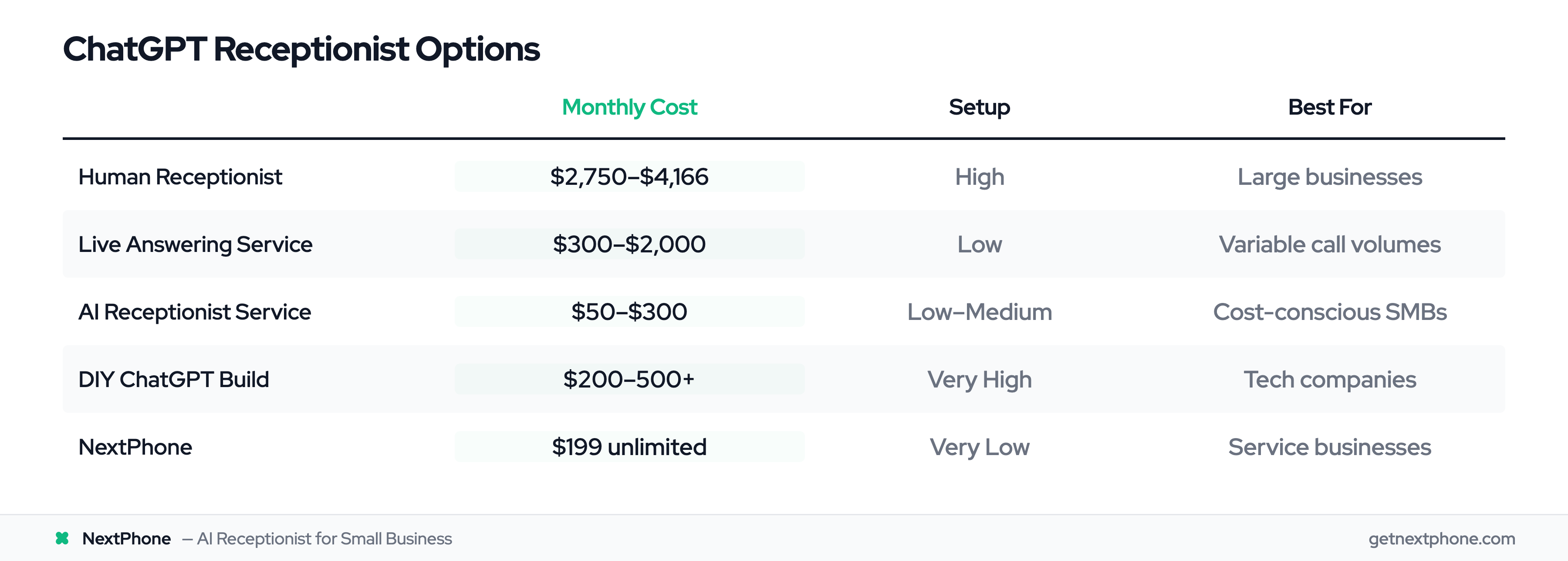
| Solution | Monthly Cost | Setup Complexity | Best For |
|---|
| Human Receptionist | $2,750-$4,166 | High (hiring process) | Large businesses with complex needs |
| Live Answering Service | $300-$2,000 | Low | Variable call volumes |
| AI Receptionist Service | $50-$300 | Low-Medium | Cost-conscious small businesses |
| DIY ChatGPT Build | $200-500+ | Very High | Tech companies with dev resources |
| NextPhone | $199 unlimited | Very Low | Service businesses, contractors |
What AI Receptionists Can (and Can't) Do Well
AI receptionist marketing makes everything sound perfect. Reality is more nuanced.
What AI Receptionists Handle Well
Generative AI adoption has accelerated across industries, and receptionist services are no exception.
24/7 availability. AI doesn't sleep, take breaks, or call in sick. Your phone gets answered at 2 AM on Christmas.
Basic information collection. Name, phone number, reason for calling - AI captures this consistently every time.
FAQ answering. For questions you get repeatedly ("What are your hours?" "Do you service my area?"), AI delivers instant, accurate responses.
Appointment scheduling. With calendar integration, AI can book appointments based on your real-time availability.
Call routing. AI can determine which team member should handle a call and transfer accordingly.
Multiple simultaneous calls. Unlike humans, AI handles ten calls at once without putting anyone on hold.
Where AI Receptionists Struggle
Emotional situations. When someone calls upset about a botched job or worried about a flooded basement, AI can't provide genuine empathy. It can simulate concern, but most people sense the difference.
Complex problem-solving. "My AC is making a weird noise, but only when the humidity is high, and it started after the power outage last week." This kind of troubleshooting requires human judgment.
Accents and slang. Speech recognition has improved dramatically, but regional accents and industry-specific terms still cause problems.
Building rapport. AI can be polite. It can't build the kind of relationship that turns one-time callers into loyal customers.
Compliance-sensitive industries. Healthcare, legal, and financial services have regulations that generic AI may not handle correctly.
The "Loop Problem"
The most common complaint about AI phone systems: getting stuck in loops.
You explain your problem. The AI asks a clarifying question. You answer. It asks the same question differently. Repeat until frustration.
Research shows 35% of consumers say automated services never solve their problems. And 78% say they'd rather talk to a human than a bot.
Older customers are particularly frustrated. They didn't grow up with voice assistants and find robotic interactions alienating.
The best AI receptionist isn't the one that handles everything - it's the one that knows when to hand off to a human.
The Honest Truth About ChatGPT as a Receptionist
Here's what the marketing won't tell you about using ChatGPT for phone answering.
ChatGPT's Real Limitations for Phone Work
Text-based by design. ChatGPT processes text, not audio. Every "ChatGPT receptionist" is actually ChatGPT wrapped in speech conversion layers. Each layer adds potential failure points.
No memory between calls. Standard ChatGPT doesn't remember previous conversations. Your receptionist won't know that Mrs. Johnson called twice yesterday about the same issue - unless you build custom memory systems.
Hallucination risk. ChatGPT occasionally invents information. In a business context, this means potentially telling customers the wrong hours, wrong pricing, or wrong availability.
API costs add up. ChatGPT API charges by usage. High call volume means high bills - and costs that are hard to predict.
Ongoing maintenance required. DIY builds need regular attention. APIs update, integrations break, and edge cases require tweaking.
Purpose-Built vs. ChatGPT-Powered
Services built specifically for phone answering often outperform ChatGPT integrations. Why?
Phone conversations have unique challenges. Interruptions, pauses, overlapping speech, background noise. Purpose-built systems train on these scenarios. ChatGPT was trained on text.
Purpose-built systems also include business features: CRM integration, appointment scheduling, spam detection, urgency routing. Building these around ChatGPT takes significant additional work.
When "ChatGPT Receptionist" Makes Sense
Fair assessment: ChatGPT-powered receptionists work reasonably well for:
- Businesses with simple, repetitive inquiries
- Tech-savvy teams comfortable with experimentation
- Situations where calls are supplements to other contact methods
- Companies willing to iterate based on caller feedback
When You Need Something Better
ChatGPT integrations fall short for:
- Service businesses where every call represents potential revenue
- Situations involving emergencies (a recurring reason people call, per our data)
- Complex scheduling, quoting, or consultation booking
- Industries where personal relationships drive repeat business
How to Tell If an AI Receptionist Is Just a ChatGPT Wrapper: 10-Question Checklist
Most products sold as "AI receptionists" in 2026 are ChatGPT wrappers—a text model in a voice costume. They look clever in a demo. They break on a real phone line.
Run every vendor you're evaluating through this list. Score one point per yes.
- Does the product own a real phone number you can forward to? Real systems own the telephony layer. Wrappers hand you a webhook and tell you to wire up Twilio yourself.
- Can it transfer a live caller to a specific human, mid-call? Not "hang up and send you an SMS"—actually hot-transfer the call. This is the single clearest wrapper-versus-system signal.
- Does it write real bookings to your calendar? Google Calendar, Cal.com, HubSpot—with a confirmed event, not a text recommendation.
- Does it show you a call log with transcript, recording, language, and outcome for every call? If there's no operational dashboard, there's no operational system.
- Does it filter spam at the telephony layer before the call is answered? If every robocall burns your minutes, it's not filtering—it's absorbing.
- Does it handle Spanish, French, or other languages natively in voice? Dedicated per-language STT and TTS, not a prompt instruction like "please respond in Spanish."
- Does it detect urgency and escalate in real time? Not a next-morning email summary—an immediate transfer, SMS, or alert.
- Does it answer with sub-second latency and handle barge-in? Pause mid-sentence and interrupt it. If it keeps talking, it's a wrapper.
- Does it persist contact state across calls? When Mrs. Johnson calls a second time, the system should know about her first call.
- Does it publish operational metrics? Transfer rate, after-hours share, language mix, spam rate, average turns. Real systems measure themselves.
Scoring:
- 0–3 yes: This is a ChatGPT wrapper. Do not use it to answer real business calls.
- 4–7 yes: Hybrid product. Some production pieces, big gaps. Pressure-test the gaps before signing.
- 8–10 yes: Real AI receptionist. Shortlist it.
The rule of thumb: if nothing the bot says or does has a real-world consequence—a booking, a transfer, a dispatched technician, a refund—a wrapper is probably fine. If it does, you need a production AI receptionist.
What 1,446,980 Business Calls Prove About Voice Workflows
We analyzed every call our AI receptionist handled in 2025—1,446,980 calls across 2,074 businesses in 17+ industries. This is what voice workflows really do, and what a ChatGPT wrapper structurally can't.
Routing, not answering. 73.8% of handled calls end in a transfer to the right person. A text-only wrapper cannot do this—it can generate the sentence "I'll transfer you now," but there's no one to transfer to and no phone line to transfer on.
Real conversations, not one-shot responses. Average conversation length is 7.1 exchanges. 47% of calls go seven or more turns. Booking calls average about 15 turns. Wrappers lose state; production systems carry per-contact memory turn-to-turn and call-to-call.
51.2% of inbound calls are real leads. Hot plus warm leads with active buying signals. The cost of dropping those to voicemail or a broken bot is measurable, not theoretical.
Urgency is the norm. 51.5% of conversations contain urgency language—"today," "right now," "as soon as possible." A wrapper doesn't escalate. A production AI receptionist transfers the call, texts the owner, or pages an on-call tech depending on the rule.
After-hours is a profit center, not an edge case. 28.5% of calls arrive outside business hours. 34.8% of those callers express buying intent. If your "AI" only runs when a website visitor opens chat, you're missing the best-converting traffic you have.
Spam is relentless. 20.3% of engaged calls are spam. 26,320 calls were filtered automatically in 2025. Without telephony-layer filtering, a wrapper burns every spam call as a billable minute.
Multilingual reality. 8.0% of calls are in Spanish, 1.7% in French. Real voice support for those languages isn't a prompt tweak—it requires separate STT and TTS models running per language.
None of these numbers are accessible to a ChatGPT wrapper. They're accessible to a system that owns the phone line, the state, and the actions.
What Service Businesses Actually Need from Phone Answering
Generic AI receptionists treat every call the same way. Your business shouldn't.
A homeowner calling about a clogged drain has different needs than a property manager scheduling quarterly maintenance. An emergency leak at midnight requires different handling than a question about pricing.
The Problem with One-Size-Fits-All AI
Most AI receptionists follow a simple script: greet, collect information, promise callback. They can't distinguish between:
- A potential $15,000 kitchen renovation and a price-shopper who'll never hire you
- An urgent request that needs same-day response and a general inquiry that can wait
- A loyal customer who deserves priority and a first-time caller who needs qualification
This one-size-fits-all approach loses you money. High-value calls get the same treatment as price-shoppers. Emergencies sit in the same queue as casual questions.
What NextPhone Does Differently
NextPhone was built specifically for service businesses - contractors, HVAC companies, plumbers, electricians, and similar trades.
Instead of generic call handling, NextPhone understands service business communication patterns. The system identifies:
- Urgency indicators - Language patterns that signal time-sensitive needs
- Emergency situations - The calls requiring immediate escalation
- Callback requests - The roughly one in four callers who explicitly ask to be called back
- Spam and robocalls - Filtered out before they ever ring you
Every call gets intelligent routing based on actual business rules, not generic scripts.
Pricing is simple: $199/month for unlimited calls. No per-minute charges that balloon with success. No surprise bills when a marketing campaign drives call volume.
Setup takes minutes. Forward your existing number or get a new one. Configure your preferences. Start catching every call.
Making the Right Choice for Your Business
Different businesses need different solutions. Here's how to decide.
Choose DIY ChatGPT Integration If:
- You have technical resources in-house (developers, IT staff)
- Your call volume is low and inquiries are simple
- You have budget for experimentation and iteration
- You enjoy building and maintaining systems
- You're okay with potential downtime during troubleshooting
Choose Generic AI Receptionist Services If:
- Most calls involve FAQs and basic scheduling
- You don't have industry-specific needs
- Call volume is moderate (watch those per-minute costs)
- You want plug-and-play simplicity
Choose NextPhone If:
- You're a contractor or service business
- Every missed call represents a potential lost job
- You need intelligent handling, not just answering
- Predictable pricing matters for business planning
- You want setup in minutes, not weeks
- Emergency and urgency detection is valuable
Questions to Ask Any AI Receptionist Provider
Before signing up for any service, ask:
- How does it handle urgent vs. routine calls?
- What happens when AI can't help the caller?
- Is pricing per-minute or unlimited?
- How quickly can I get started?
- What spam filtering exists?
- How are emergencies escalated?
- Can I customize for my specific business?
Getting Started with AI Phone Answering
You've decided AI phone answering makes sense. Now what?
If You Choose the DIY Route
Budget realistic time: 20+ hours for initial setup, minimum. Plan for ongoing maintenance - APIs update, integrations break, and caller complaints require attention.
Test extensively before going live. Record test calls. Have friends call with unusual requests. Find the breaking points before customers do.
Have a fallback plan. When (not if) something breaks, where do calls go?
If You Choose NextPhone
The process is straightforward:
- Sign up - Takes under 5 minutes
- Configure - Set your business hours, service area, and handling preferences
- Connect - Forward your existing number or get a new one
- Go live - Start catching every call immediately
No technical setup. No developer required. No ongoing maintenance on your end.
You'll have intelligent call handling running before you finish your coffee.
Frequently Asked Questions
Can ChatGPT directly answer phone calls?
No. ChatGPT is text-based AI. To use it for phone calls, you need telephony integration that converts speech to text, sends it to ChatGPT, and converts the response back to speech. Several services offer this integration pre-built, including NextPhone and others.
How much does a ChatGPT-powered receptionist cost?
DIY builds using ChatGPT API typically cost $200-500+/month when you factor in telephony services, API fees, and maintenance time. Pre-built AI receptionist services range from $50-300/month, usually with per-minute charges. NextPhone offers unlimited calls at $199/month with no per-minute fees.
Is an AI receptionist as good as a human?
For routine tasks - answering FAQs, taking messages, basic scheduling - AI performs comparably at a fraction of the cost. For emotional situations, complex problem-solving, and building genuine customer relationships, humans still excel. Many businesses find the best approach combines AI for routine handling with human escalation for complex situations.
What percentage of calls can AI receptionists handle?
Most services report handling 70-85% of routine calls without human intervention. The remaining 15-30% typically need human attention for complex issues, emotional situations, or requests outside the AI's training.
Will customers know they're talking to AI?
Modern AI receptionists sound increasingly natural, but most callers can still tell within a few exchanges. Research suggests this matters less than you might think - customers care more about getting help quickly than whether a human or AI provides it.
How do AI receptionists handle emergencies?
Quality AI receptionists detect urgency indicators and escalate immediately. NextPhone identifies the calls that are true emergencies and routes them appropriately - to your phone, an on-call technician, or whatever escalation path you configure.
Can I try an AI receptionist before committing?
Most services offer free trials. NextPhone provides a trial period so you can experience intelligent call handling with your actual customers before making a commitment.
Stop Missing Calls. Start Growing Your Business.
Here's the bottom line: ChatGPT alone won't answer your business phone. But AI-powered solutions can - and for service businesses losing revenue to missed calls, they should.
The question isn't whether to use AI for phone answering. It's which solution fits your business.
If you're a contractor or service business, if every missed call hurts your bottom line, if you need intelligent handling and not just generic answering - NextPhone was built for exactly your situation.
$199/month. Unlimited calls. Intelligent routing. Emergency detection. Spam filtering. Setup in minutes.
