
Key Takeaways
- Call centers handle high-volume, complex interactions across multiple channels; answering services focus on message-taking and call routing
- Average answering service call duration: under 1 minute. Average call center call: 4-5 minutes
- Answering services typically cost $135-$500/month; call centers start at $1,000+/month for dedicated agents
- AI answering services offer a third option with 24/7 coverage, unlimited calls, and predictable pricing
- Your choice should depend on call volume, interaction complexity, and budget constraints
What Is an Answering Service?
An answering service functions as a virtual receptionist for your business. When you cannot answer your phones - whether during lunch, after hours, or when lines are busy - the answering service picks up calls on your behalf.
The core purpose is straightforward: ensure every call gets answered by a professional who can take a message, provide basic information, or route the call appropriately.
How Answering Services Work
When a customer calls your business line, the call forwards to the answering service if you don't pick up within a set number of rings. An operator answers using your company name, follows your instructions for handling different types of calls, and either takes a message or transfers the call based on your protocols.
The interaction is typically brief. Industry data shows the average answering service call lasts under one minute. The operator captures the caller's name, contact information, and reason for calling, then delivers that message to you via text, email, or app notification.
Common Answering Service Capabilities
Most answering services offer a standard set of features:
- Message taking and delivery - Capturing caller information and forwarding it promptly
- Call screening and routing - Filtering calls by urgency or type and directing them accordingly
- Appointment scheduling - Booking directly into your calendar system
- After-hours coverage - Answering calls when your office is closed
- Emergency call triage - Identifying urgent matters that need immediate attention
- Basic FAQ responses - Answering common questions about hours, location, or services
Who Uses Answering Services
Answering services work best for businesses where calls are inbound, relatively simple, and benefit from a personal touch. Medical practices use them for after-hours urgent call triage. Law firms rely on them for professional reception without hiring full-time staff. Real estate agents depend on them to capture leads while showing properties.
The common thread: these businesses receive a manageable call volume, callers need relatively simple assistance, and a personalized experience matters.
What Is a Call Center?
The call center and contact center outsourcing market reached $97.31B in 2024 and is projected to hit $163.86B by 2030. A call center is a larger-scale operation designed to handle high volumes of customer interactions across multiple channels. Unlike answering services, call centers handle both inbound and outbound calls and typically offer far more comprehensive customer service capabilities.
How Call Centers Work
Call centers employ teams of agents who work from scripts and knowledge bases to handle customer inquiries. The CCaaS (Contact Center as a Service) market is valued at $7.27B in 2025 and expected to reach $39.25B by 2034, growing at 20.6% CAGR. Advanced technology routes calls to appropriate agents based on the issue type, customer history, or agent skillset.
Calls are longer and more complex than answering service interactions. The average call center call lasts four to five minutes, with complex technical support or complaint resolution calls extending to 10-15 minutes. The same data shows call center turnover runs 30-40% annually, and the average call center handles 4,400 calls per month.
Modern call centers also handle communication beyond phone calls. 66% of call centers have transitioned to cloud by 2024, with 73% of call center leaders offering remote/hybrid options. Many offer omnichannel support including email, live chat, social media messaging, and SMS.
Common Call Center Capabilities
Call centers provide a comprehensive suite of customer interaction services:
- Customer support and issue resolution - Handling complaints, processing returns, resolving problems
- Technical troubleshooting - Walking customers through product issues and fixes
- Order processing and confirmation - Taking orders, confirming details, tracking shipments
- Payment processing - Handling billing questions and taking payments
- Sales and upselling - Converting inquiries into sales, suggesting additional products
- Outbound campaigns - Making calls for surveys, follow-ups, or marketing
- Multichannel support - Managing email, chat, and social media alongside phone
Who Uses Call Centers
Call centers serve businesses with high interaction volumes and complex customer needs. E-commerce companies use them to handle order inquiries and returns at scale. Software companies rely on them for technical support. Utilities and telecom providers need them for billing and service management.
The common thread: these businesses receive hundreds or thousands of customer contacts daily, interactions require detailed knowledge and problem-solving, and consistency across channels matters more than personalization.
Call Center vs Answering Service: Key Differences
Understanding the distinctions between these services helps you match the right solution to your business needs.
Call Volume and Capacity
Answering services are built for low to moderate call volume. They work well when you receive dozens of calls per day, not hundreds. If call volume spikes unexpectedly, answering services may struggle to keep up.
Call centers are engineered for high throughput. Industry benchmarks from ContactBabel track abandonment rates and performance metrics that guide operational decisions. They can absorb large call volumes, handle seasonal spikes, and scale agent capacity based on demand. If your business regularly handles hundreds of daily calls, a call center architecture makes more sense.
Call Direction
Answering services handle inbound calls exclusively. They answer when customers call you. They don't make outbound calls on your behalf.
Call centers handle both directions. They can answer incoming customer inquiries and make outgoing calls for sales, surveys, appointment reminders, or follow-ups. If outbound calling is part of your customer communication strategy, you need a call center.
Call Duration and Complexity
The average answering service call lasts under one minute. Operators take a message, answer a quick question, or transfer the call. They're not equipped for extended troubleshooting or complex problem-solving.
Contact center statistics show interactions average four to five minutes, with many calls running much longer. Agents work from detailed scripts and knowledge bases to resolve issues, walk customers through technical problems, or complete sales transactions.
Personalization vs Standardization
Answering services emphasize personalization. Operators train on your specific business, learn your preferences, and handle calls without reading from scripts. Callers often can't tell they're speaking with an external service.
Call centers prioritize standardization. Scripts ensure consistent responses regardless of which agent answers. This approach handles high volume efficiently but can feel less personal to callers.
Technology and Channels
Answering services are primarily phone-based. Some offer basic integrations with scheduling software or CRM systems, but the core service revolves around voice calls.
Call centers deploy sophisticated technology stacks: automated call distribution (ACD), customer relationship management (CRM) integration, interactive voice response (IVR), and multichannel platforms. Major vendors like Genesys and Talkdesk lead the 2025 Gartner Magic Quadrant for CCaaS. They can manage customer conversations across phone, email, chat, and social media from unified systems.
Side-by-Side Comparison
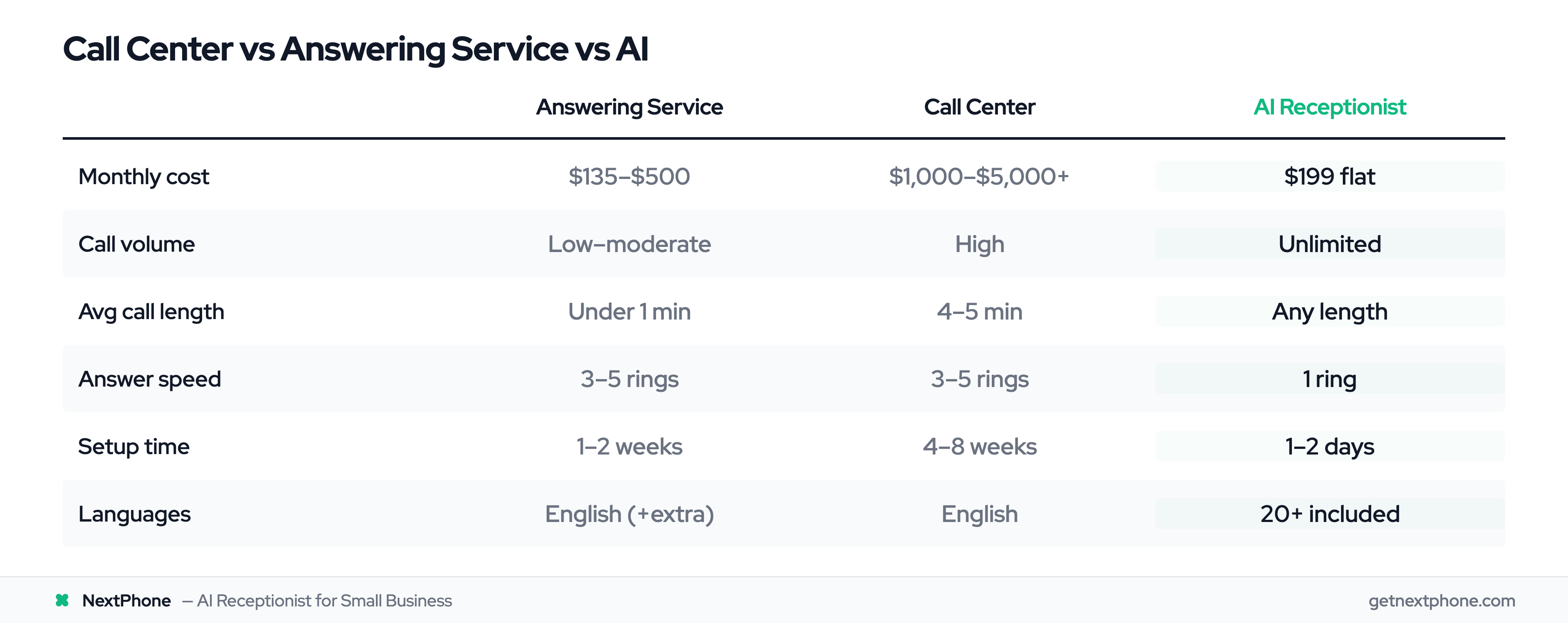
| Factor | Answering Service | Call Center | AI Receptionist |
|---|---|---|---|
| Reality check | $300-500/mo per-minute | $1,000-5,000/mo | $199/mo unlimited |
| Call volume | Low to moderate | High | Unlimited |
| Call direction | Inbound only | Inbound + outbound | Inbound + transfers |
| Average call length | Under 1 minute | 4-5+ minutes | Any length |
| Personalization | Varies by agent | Standardized scripts | Trained on YOUR business |
| Channels | Phone | Multichannel | Phone |
| Answer speed | 3-5 rings | 3-5 rings | 1 ring |
| Setup time | 1-2 weeks | 4-8 weeks | 1-2 days |
| Languages | English (extra for Spanish) | English | 20+ included |
Cost Comparison: What to Expect
Budget often drives the decision between answering services and call centers. Understanding pricing structures helps you avoid surprises.
Answering Service Pricing
Most answering services charge between $135 and $500 per month for small business packages. Pricing models vary:
Monthly plans include a set number of minutes or calls for a flat fee. This makes budgeting predictable as long as you stay within your allocation.
Per-minute billing charges around $0.85 to $1.50 per minute of operator time. Some industries pay more - healthcare contact centers with regulatory compliance charge $1.25 to $2.50 per minute, a 15-30% premium over standard rates.
Per-call billing charges a flat rate per call regardless of duration. This model has fallen out of favor because providers count wrong numbers, hang-ups, and brief inquiries as full calls.
Call Center Pricing
Call centers cost significantly more, especially for dedicated agent models:
Shared agents handle calls for multiple clients and cost $150 to $1,000 per month. The customer care BPO market grew from $22.6B in 2022 and is projected to reach $34.6B by 2028 at 7% CAGR. Response times may be slower since agents balance multiple accounts.
Dedicated agents work exclusively for your business and cost $1,000 to $5,000+ per month per agent. You get consistent service but pay for their full capacity whether you use it or not.
Per-call costs in call centers average $2.70 to $5.60 per interaction - significantly higher than answering service rates.
Setup costs also differ substantially. Answering services typically onboard clients in one to two weeks with minimal upfront investment. Call centers may require four to eight weeks of setup, custom scripting, training, and technology integration - often with significant implementation fees.
Hidden Fees to Watch For
Both service types can include fees that inflate the actual cost:
- 28-day billing cycles - Some providers bill every 28 days, resulting in 13 invoices per year instead of 12
- Holiday surcharges - Extra fees for coverage on holidays, or reduced service if you don't pay
- Script change fees - Charges of $15-$50 each time you update call handling instructions
- Overage rates - Per-minute charges beyond your plan allocation, often at premium rates
- Minimum commitments - Enterprise answering services may require $1,000-$5,000 monthly minimums
When to Choose an Answering Service
An answering service makes sense when your needs align with their strengths: moderate call volume, straightforward interactions, and personalized service.
Ideal Scenarios for Answering Services
You need after-hours or overflow coverage. Your in-house team handles calls during business hours, but you need professional coverage when they're unavailable.
Your call volume is manageable. You receive dozens of calls daily, not hundreds. Peak times are predictable rather than overwhelming.
Callers need simple assistance. Most calls involve taking messages, answering basic questions, or scheduling appointments rather than complex problem-solving.
Personalization matters to your customers. Callers expect to feel like they're reaching your business directly, not a generic call center.
Budget constraints exist. You need professional phone coverage but can't justify $1,000+ monthly for call center services.
Real-World Use Cases
A doctor's office uses an answering service for after-hours coverage. When patients call at night, the service triages calls - urgent matters get forwarded to the on-call physician while routine appointment requests become messages for the morning.
A solo attorney uses an answering service as a virtual receptionist. Calls get answered professionally during court appearances or client meetings, messages arrive promptly, and potential clients never hit voicemail.
A property management company uses an answering service to handle maintenance requests after hours. The service captures details, assesses urgency, and dispatches emergency calls to on-call technicians.
When to Choose a Call Center
Call centers make sense when your business operates at scale with complex customer needs across multiple channels.
Ideal Scenarios for Call Centers
You handle high call volumes. Hundreds or thousands of customer contacts daily require the infrastructure only call centers provide.
Customers need complex support. Technical troubleshooting, detailed product questions, or multi-step problem resolution require trained agents with access to comprehensive knowledge bases.
Outbound calling is essential. Sales follow-ups, appointment reminders, satisfaction surveys, or marketing campaigns require outbound capabilities answering services don't offer.
Multichannel presence matters. Your customers expect to reach you via phone, email, chat, and social media with consistent service across all channels.
Detailed scripting is required. Compliance requirements, complex product lines, or regulated industries need standardized scripts that ensure accuracy.
Real-World Use Cases
An e-commerce company uses a call center to handle order inquiries, process returns, and resolve shipping issues. Agents access order management systems directly to track packages, issue refunds, and update customer accounts.
A software company uses a call center for technical support. Agents work through troubleshooting scripts, escalate complex issues to specialists, and document solutions in the knowledge base.
A utility company uses a call center to manage billing inquiries, process payments, and handle service requests. Agents access customer account systems to answer questions, resolve disputes, and schedule service appointments.
The Third Option: AI-Powered Answering Services
The choice between call centers and answering services assumes you must pick one or the other. But technology has created a third category that combines benefits of both while addressing their limitations.
AI-powered answering services use conversational AI to handle phone calls automatically. An AI virtual receptionist answers every call instantly, engages callers in natural conversation, handles common requests, and escalates to humans when needed.
How AI Answering Services Work
When a call comes in, AI answers immediately - no hold times, no busy signals, no after-hours voicemail. Natural language processing enables the AI to understand what callers need and respond appropriately.
The AI can answer frequently asked questions, capture lead information, schedule appointments, and route calls based on urgency or topic. For situations requiring human judgment, calls transfer to your team or an on-call contact.
Modern AI answering services integrate with business tools - syncing with calendars for real-time appointment booking, updating CRM records automatically, and triggering workflows based on call outcomes.
Benefits of AI Answering
True 24/7 coverage. AI doesn't sleep, take breaks, or call in sick. Every call gets answered at 2 PM or 2 AM, on holidays and weekends.
Unlimited scalability. AI handles one call or one hundred simultaneous calls without degradation. Sudden call spikes don't result in hold times or missed calls.
Consistent quality. Every caller gets the same professional experience. No variance based on which agent happens to answer.
Cost predictability. Most AI services charge flat monthly rates rather than per-minute billing. No surprise overages when call volume increases.
Cost efficiency. Industry analysis shows AI answering services cost 60-80% less than equivalent human-staffed solutions. A service providing call center-level capabilities might cost what you'd pay for basic answering service coverage.
Zero missed opportunities. Every call is answered, every lead is captured, every customer inquiry gets a response. No more calls going to voicemail because lines are busy.
When AI Answering Makes Sense
AI answering services work especially well for:
Businesses wanting call center capabilities at answering service prices. You need 24/7 coverage and sophisticated call handling but can't justify call center costs.
Companies with unpredictable call volumes. Per-minute pricing punishes you when calls spike. Flat-rate AI pricing stays consistent regardless of volume.
Service businesses prioritizing lead capture. Missing a call often means losing a potential customer. AI ensures every inquiry gets answered and captured.
Organizations needing true after-hours coverage. Rather than paying premium rates for overnight answering service shifts, AI provides the same quality at all hours.
Services like NextPhone exemplify this category - offering AI answering with call center-level capabilities at $199/month, with no per-minute charges and unlimited calls. For many small and medium businesses, this represents the best value for professional phone coverage.
How to Choose the Right Solution for Your Business
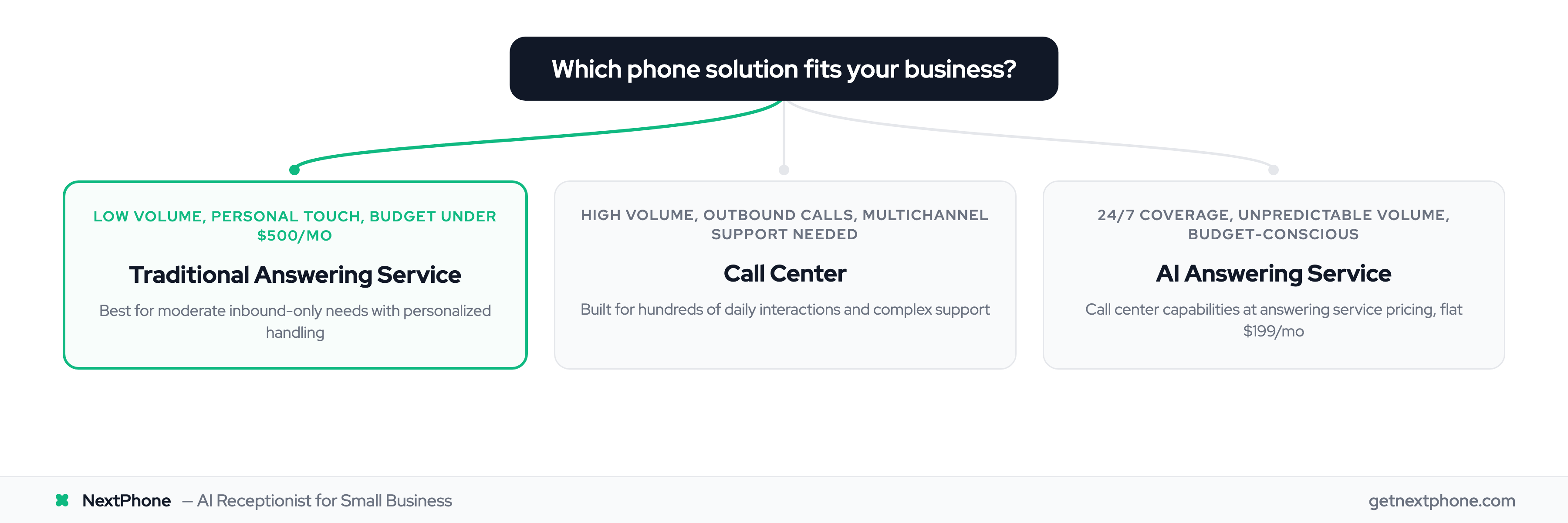
With three options available, matching the right solution to your needs requires evaluating several factors.
Key Questions to Ask
-
What's your typical call volume?
-
Under 100 calls per month: Answering service or AI answering
-
100-500 calls per month: AI answering or traditional answering service
-
500+ calls per month: Call center or AI answering with high capacity
-
What do callers typically need?
-
Basic information and message-taking: Answering service or AI
-
Complex support or technical troubleshooting: Call center
-
Mix of simple and complex: AI with human escalation path
-
Do you need outbound calling capabilities?
-
Yes: Call center is your only traditional option
-
No: Answering service or AI work fine
-
What's your monthly budget for phone coverage?
-
Under $500/month: Answering service or AI answering
-
$500-$2,000/month: AI answering or shared call center agents
-
$2,000+/month: Dedicated call center agents or premium AI service
-
How critical is 24/7 availability?
-
Essential: AI is most cost-effective for true around-the-clock coverage
-
Nice to have: Answering service with after-hours package
-
Business hours only: Any option works
Quick Reference Guide
| Your Situation | Recommended Solution |
|---|---|
| Small business, low volume, personalization priority | Traditional answering service |
| High volume, complex support needs, multichannel | Call center |
| 24/7 coverage needed, budget-conscious | AI answering service |
| Growing business, unpredictable call volume | AI answering service |
| Need outbound calling and inbound support | Call center |
| Simple needs, occasional overflow coverage | Answering service |
Frequently Asked Questions
Can an answering service handle complex customer issues?
Answering services are designed for simpler interactions - taking messages, providing basic information, and routing calls. Some specialized services offer deeper training for specific industries, but they're generally not equipped for extended troubleshooting or complex problem resolution. For complex issues, a call center or AI service with human escalation handles situations more effectively.
How quickly can I set up an answering service vs a call center?
Answering services typically onboard new clients in one to two weeks. You provide your business information, call handling preferences, and any scripts you want followed. Call centers require four to eight weeks for full implementation due to more complex integrations, script development, and agent training. AI answering services often offer same-day or next-day setup since they don't require training human agents.
Will my customers know they're talking to an answering service?
Quality answering services train their operators on your business and have them answer using your company name. The goal is a seamless experience where callers can't tell they're speaking with an external service. Operators learn your common questions, follow your preferences, and represent your brand professionally. Similarly, well-implemented AI answering services are designed to feel like part of your team.
What happens if my call volume suddenly increases?
Traditional answering services may struggle with sudden spikes - they have finite operator capacity and may experience longer wait times or missed calls during surges. Call centers can scale with advance notice but need time to add agents. AI answering services handle volume spikes automatically since they can manage unlimited simultaneous calls without degradation.
Can I use both an answering service and a call center?
Yes, some businesses use a hybrid approach. A common setup uses an answering service for after-hours coverage and simpler interactions while a call center handles complex daytime support. However, this adds complexity and cost. AI answering services can sometimes eliminate the need for this hybrid approach by providing comprehensive coverage at a single price point.
Are there industry-specific answering services?
Yes, specialized answering services exist for healthcare, legal, property management, and other industries. These services charge 15-25% premiums over general answering services due to specialized training and compliance requirements. If your industry has specific regulatory requirements, verify that any service you consider can meet those standards.
How do AI answering services compare to live human operators?
AI excels at consistency, availability, and scalability - every call answered instantly, the same quality at 3 AM as 3 PM, and no capacity limits during busy periods. Human operators handle emotional or highly complex situations better, where empathy and nuanced judgment matter. The best AI services offer hybrid models where AI handles routine calls and escalates complex situations to humans when appropriate.
Making the Right Choice
The decision between a call center and answering service - or the AI-powered alternative - comes down to understanding your specific needs.
Choose an answering service if you value personalized interactions, have moderate call volume, and primarily need message-taking and basic call routing. The lower cost and high-touch approach suit small businesses and professional service firms well.
Choose a call center if you handle high volumes, need complex support capabilities, require outbound calling, or must support customers across multiple channels. The higher investment delivers comprehensive customer service infrastructure.
Choose AI answering if you want 24/7 coverage without 24/7 pricing, need scalability for unpredictable call volumes, or want call center capabilities at answering service costs. The technology has matured to the point where AI provides professional, natural interactions that satisfy callers while capturing every opportunity.
Whatever you choose, the goal remains the same: ensuring every customer who calls your business reaches someone who can help them. In a world where 90% of consumers expect immediate response when they reach out, getting this right directly impacts your bottom line.
Looking for professional phone coverage without the complexity? NextPhone's AI answering service offers 24/7 coverage, unlimited calls, and smart call handling for $199/month - no per-minute charges, no hidden fees.