
Your phone rings at 7:45 PM. An Atlanta homeowner has water pouring through their ceiling from a burst pipe. You're finishing dinner with your family after a long day on job sites. The call goes to voicemail. They call the next plumber on Google. You just lost a $4,500 emergency job to someone who picked up.
This scenario plays out hundreds of times every day across metro Atlanta. Contractors and service businesses are growing faster here than almost anywhere in the country. But that growth means nothing if you're not answering when customers call.
Here's the good news: you don't have to choose between working and answering your phone anymore. An Atlanta answering service with a local 404 number can capture every call, 24/7, without you lifting a finger.
Why Atlanta Businesses Need Professional Call Answering
Atlanta is booming. The Metro Atlanta Chamber reports that Atlanta ranks as the #3 best city for small businesses in America, according to Entrepreneur's 2024 rankings. Georgia small businesses employ over 42% of all workers in the state. Over the past five years, Georgia small businesses increased employment by 15,000 and generated $10 billion in new sales.
The construction sector is leading the charge. Metro Atlanta was named the top U.S. city for construction growth, with a 2.35% annual sector growth rate in 2025. There are more than 220,900 people employed in Georgia construction as of August 2024.
But here's the problem nobody talks about: 66% of construction firms report significant workforce shortages. When you're short-staffed, answering phones becomes the first thing to slip.
The Contractor's Dilemma
If you're a roofer in Marietta installing shingles in July heat, you can't exactly pull out your phone every time it rings. If you're a plumber in Decatur with your head under a sink, taking a call isn't happening. If you're an HVAC tech in Buckhead replacing a compressor, your hands are full.
The problem is the physical reality of doing the work. Your phone buzzes. You see the missed call notification two hours later. By then, that customer has already hired someone else.
The Atlanta market is competitive. When homeowners need help, they call until someone answers. If that someone isn't you, it's your competitor down the street.
The 404 Area Code Advantage
Not all phone numbers are created equal. In Atlanta, your area code sends a message before you even say hello.
Why Local Numbers Build Trust
The 404 area code is the original Atlanta code, established in 1947. When Atlanta residents see a 404 number on their caller ID, they instinctively know it's local. That matters.
According to industry research, local phone numbers see 60-70% answer rates with only 2-5% spam perception. Compare that to toll-free numbers like 800 or 888, which get just 40-50% answer rates with 20-30% spam perception. People have been trained to ignore toll-free numbers because so many spam calls use them.
Atlanta's Area Code Map
The metro Atlanta area uses three primary codes:
- 404: Central Atlanta, highest recognition and prestige
- 678: Broader metro Atlanta overlay
- 770: Suburban Atlanta ring
If you're building a small business in Atlanta and want maximum local credibility, 404 is the gold standard. When a Midtown homeowner sees a 404 number calling them back about their AC repair, they answer. When they see an 800 number, they assume it's a telemarketer and hit ignore.
Getting a 404 number for your business used to require going through traditional phone carriers and dealing with availability issues. Today, services like NextPhone let you choose a local Atlanta number as part of your answering service package.
The Real Cost of Missed Calls for Atlanta Contractors
Let's talk numbers. Not vague claims about "losing business" but actual data about what's happening to Atlanta service companies right now.
The 74.1% Problem
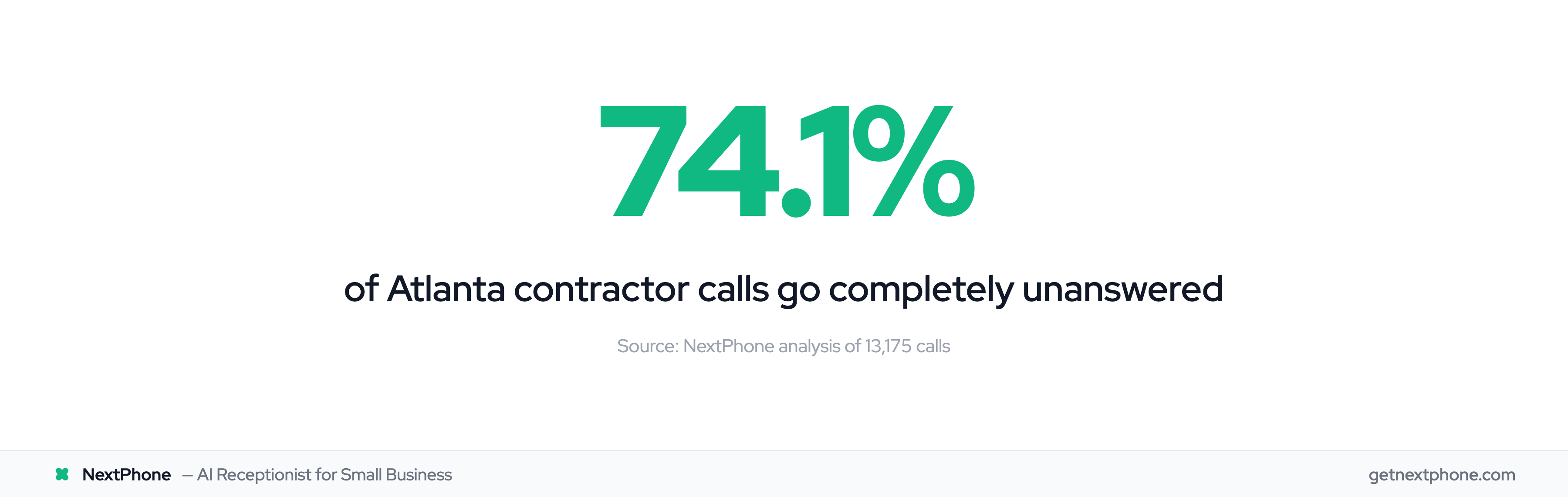
Industry research shows 74.1% of calls to home services contractors go completely unanswered. That's three out of every four potential customers calling someone else because nobody picked up.
These contractors are businesses run by hardworking people who are physically unable to answer while doing their jobs. The phone rings while they're on a roof, under a house, or driving to the next appointment.
What Happens When Customers Hit Voicemail
Here's where it gets worse. According to industry research, 85% of callers who can't reach someone won't call back. They don't leave a message. They don't wait. They just call the next contractor on the list.
Approximately one in four callers explicitly asks for a callback. Without a system to track these requests, most never happen. The caller moves on.
And calls containing urgency language like "emergency," "urgent," or "ASAP" rank among the top reasons people call. These are the highest-value calls, often true emergencies worth premium pricing. Missing one costs the best job of the day.
The Math Nobody Wants to See
Let's run the calculation for a typical Atlanta contractor:
| Metric | Number |
|---|---|
| Average calls per month | 42 |
| Miss rate | 74.1% |
| Missed calls per month | 31 |
| Conversion rate | 20% |
| Average job value | $3,500 |
| Monthly lost revenue | $21,700 |
| Annual lost revenue | $260,400 |
That's a quarter-million dollars walking out the door every year because nobody answered the phone.
Types of Answering Services for Atlanta Businesses
If you've decided you need help answering calls, you have options. Each comes with trade-offs in cost, quality, and coverage.
Traditional Live Answering Services
These are the call centers you've probably heard of. Real humans answer your phone, take messages, and forward urgent calls. They operate from scripts and can handle basic inquiries.
Pros:
- Human touch for every call
- Can handle complex conversations
- Available 24/7
Cons:
- Cost: $500-800/month for around 100 calls
- Often charge per-call fees that add up
- Agents aren't specialists in your industry
- Can sound generic or "call center-ish"
- Quality varies by time of day and agent
Virtual Receptionist Services
A step up from basic answering services, virtual receptionists get more training on your specific business. They can answer common questions, not just take messages.
Pros:
- More personalized than basic answering
- Can answer FAQs about your services
- Better caller experience
Cons:
- Higher cost: Often $800-1,500/month
- Still limited by agent knowledge
- Turnover means retraining
AI-Powered Answering Services
The newest option uses conversational AI to answer calls, understand what callers need, and respond appropriately. This isn't the old "press 1 for sales" system. Modern AI can have natural conversations.
Pros:
- Answers in under 2 seconds, every time
- Unlimited calls at fixed monthly price
- 24/7/365 with no sick days or vacations
- Consistent quality on every call
- Can be trained on your specific business
Cons:
- Not ideal for highly emotional situations
- Some callers prefer humans
Voicemail (The Baseline)
This is what most contractors default to. It's free. It's also costing you a fortune.
As we covered, 85% of callers won't leave a voicemail. They just call someone else. Voicemail isn't really an answering solution. It's a way to collect messages from the 15% of callers patient enough to wait.
AI Answering Services vs. Traditional Live Services
The rise of AI in business communication has created a real alternative to traditional answering services. Understanding where each option excels helps you make the right choice.
Where AI Excels
Speed: AI answers in under 2 seconds. Traditional services average 15-30 seconds or more, depending on call volume. Those extra seconds matter when 30% of callers abandon after one minute of waiting.
Consistency: AI gives the same quality response at 3 AM as it does at 3 PM. Human agents get tired, have bad days, or rush through calls during peak periods.
Cost: AI services like NextPhone run $199/month for unlimited calls. Traditional services charging per call can hit $800+ for the same volume.
Scalability: AI handles one call or twenty simultaneous calls without degradation. Human services have finite capacity.
Data Accuracy: AI captures caller information with 99%+ accuracy. No typos, no misheard phone numbers, no forgotten details.
Where Traditional Services Still Win
Complex Empathy: For genuinely emotional situations like complaints or crises, humans can read between the lines and respond with nuanced empathy. AI is getting better at this, but humans still have an edge.
Unusual Requests: If someone calls with a truly unusual question that's never come up before, a human can improvise. AI handles common scenarios well but can stumble on edge cases.
Relationship Building: For high-value clients you see repeatedly, some prefer the human connection of talking to "their" receptionist.
AI-First with Smart Forwarding Works Best
The question isn't really "AI versus hiring" or "AI versus traditional." The best approach is AI-first with smart forwarding.
AI handles the 60-80% of calls that are routine: business hours, pricing questions, appointment scheduling, basic inquiries. For these, AI is actually better than humans because of speed and consistency.
You handle the 20% that genuinely need your judgment: major complaints, VIP clients, complex emergencies.
Smart forwarding means AI extends your capacity 24/7 while you focus on what matters most. Research shows 60-70% of customers are comfortable with AI for simple tasks, and 80%+ want the option to reach a human when needed. Smart forwarding gives them that path.
Cost Comparison: What Atlanta Businesses Actually Pay
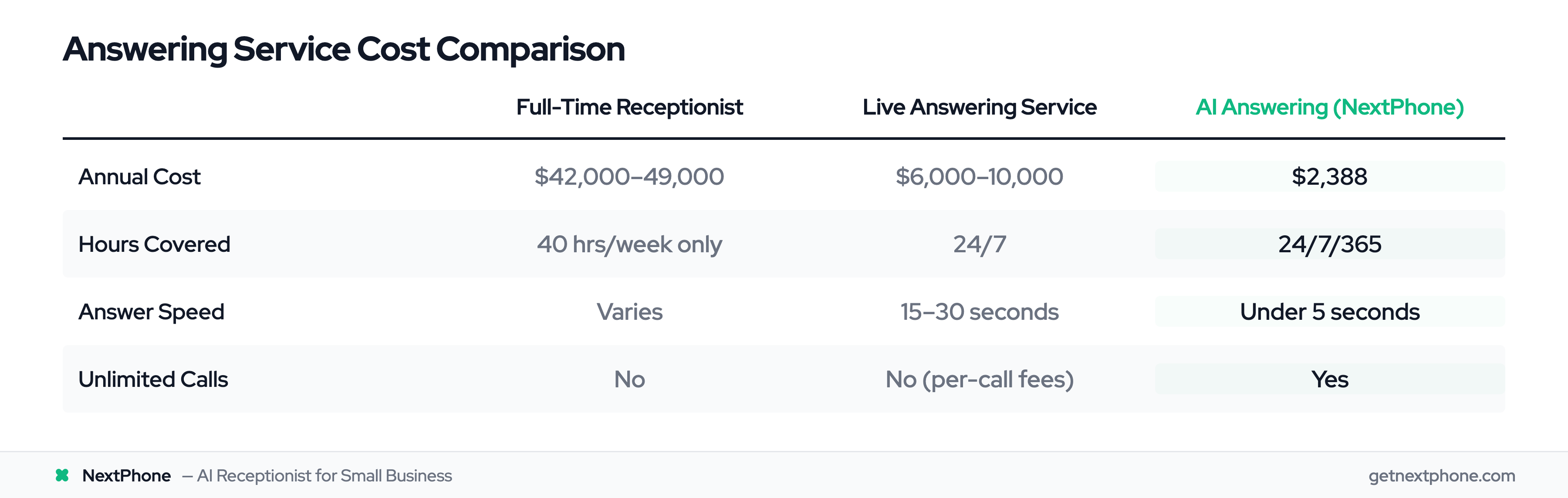
Let's break down the real costs of each option: what you're actually spending and what you get for it.
Option 1: Hire a Full-Time Receptionist
According to the Bureau of Labor Statistics, the median wage for receptionists is $17.90 per hour.
- Base salary: $35,000-38,000/year
- Benefits (healthcare, PTO, etc.): Add 25-30%
Total cost: $42,000-49,000/year
What you get: Coverage during business hours only (40 hours/week). No nights, no weekends, no holidays. Plus sick days, vacation days, and the occasional resignation that leaves you scrambling.
Option 2: Traditional Live Answering Service
Most traditional services charge $500-800/month for a base package of around 100 calls. Go over that, and per-call fees kick in.
- Monthly fee: $500-800
- Overage charges: $1-3 per call beyond limit
- Setup fees: Often $100-200
Total cost: $6,000-10,000/year
What you get: 24/7 coverage with human agents. Quality varies. They don't know your business as well as you do. Scripts can make them sound generic.
Option 3: AI Answering Service
Services like NextPhone offer flat monthly plans from $199 for unlimited calls.
- Monthly fee: $199
- Overage charges: None (unlimited)
- Setup: Usually free or minimal
Total cost: $2,388/year
What you get: 24/7 coverage, instant pickup (under 2 seconds), unlimited calls, consistent quality. Can be trained on your specific business. Includes local Atlanta phone numbers.
The ROI Calculation
The real question isn't which is cheapest. It's which captures the most revenue.
If you're currently missing 31 calls per month (the average at 74.1% miss rate), and an answering service captures even half of those:
- 15 additional answered calls/month
- At 20% conversion rate: 3 new jobs
- At $3,500 average job value: $10,500/month additional revenue
Against a $199/month investment, that's a 52x return.
For a detailed breakdown of pricing options, see our complete AI receptionist pricing guide.