
Introduction
You're on the phone with a customer discussing a $5,000 project. Your other line starts ringing. Then your cell phone buzzes. You can hear both going to voicemail. By the time you finish the first call—15 minutes later—you've missed two potential customers. They've already called your competitor.
This is phone call overflow, and it happens to every small business. You can only handle one call at a time, but customers don't wait in an orderly queue. They call when they need you.
Our analysis of 130,175 customer calls from 45 home services contractors revealed a brutal reality: 74.1% of calls go completely unanswered. Many of those missed calls happen during overflow—when you simply can't get to the phone because you're already on it, or multiple calls come in faster than any human could answer.
The worst part? Customers don't wait. They call the next name in search results.
This guide shows you exactly how to handle high call volume periods without losing customers. You'll learn why traditional queue management fails small businesses, how AI provides instant backup, and specific strategies for never missing an overflow call again—no matter how busy things get.
What Is Phone Call Overflow Management?
Phone call overflow management is exactly what it sounds like: handling incoming calls that exceed your capacity to answer them.
The Simple Definition
When more calls come in than you can handle, you have overflow. For a solo operator, that means any time you're already on a call and another one rings. For a small team, it's when all lines are busy simultaneously.
Overflow management is your system for handling those excess calls—routing them somewhere, having someone (or something) answer them, ensuring callers don't hit dead ends.
Without overflow management, those excess calls either:
- Get a busy signal (caller immediately hangs up)
- Ring endlessly (caller gives up after 30 seconds)
- Go to voicemail (80%+ of callers hang up without leaving a message)
None of those outcomes helps your business.
Why Overflow Happens
For small businesses, overflow happens constantly because of practical limitations:
You can only answer one call at a time. If you're a plumber discussing a repair with Customer A, and Customer B calls about an emergency, you physically cannot answer both. Customer B is overflow.
You're often unavailable. Contractors are on job sites. Doctors are with patients. Attorneys are in court. When you're doing your actual work, every call is potential overflow. After hours, the problem compounds—AI after-hours answering handles both scenarios.
Call timing is unpredictable. You might go an hour with no calls, then get 4 in 10 minutes. Those 3 calls you couldn't answer? Overflow.
Research shows 41% of small businesses have no overflow handling capability at all. When their line is busy or they can't answer, calls simply go nowhere. Call center statistics show the average call center handles 4,400 calls monthly with 30-40% annual turnover—small businesses face even greater challenges.
When Overflow Becomes Critical
Overflow transitions from minor annoyance to business crisis when:
- Customers complain they can't reach you
- You see voicemails from frustrated callers who called multiple times
- Reviews mention difficulty getting through
- You know you're losing business during busy periods
- Emergency calls are going unanswered because you're on routine calls
If any of these sound familiar, your overflow problem is costing you money.
The Real Cost of Call Overflow
Every overflow call that goes unanswered is a potential customer choosing your competitor. Let's quantify the damage.
What Happens to Overflow Calls

When a customer can't get through, research shows clear behavioral patterns. Contact center industry benchmarks confirm these trends:
- 80% won't call back after getting a busy signal
- 34% will immediately call a competitor—your next search result neighbor
- 67% say first-call resolution affects whether they'll do business with you
Customers in 2025 expect to reach someone when they call. "Call back later" isn't a strategy; it's a way to donate revenue to competitors.
The Revenue Impact
Our analysis of 130,175 calls found 74.1% go unanswered. For contractors in our study, that translated to $189,068 in lost revenue per year per business.
Let's break down a typical overflow scenario:
Daily overflow example:
- You receive 10 calls during business hours
- 7 of those come during peak hours (10 AM - 2 PM)
- You can realistically answer 4 during peak
- 3 calls are overflow
Weekly impact:
- 3 overflow calls/day × 5 days = 15 overflow calls/week
- 15 calls × 20% close rate = 3 jobs lost
- 3 jobs × $500 average = $1,500/week in lost revenue
That's $78,000 per year—just from daily peak-hour overflow.
During seasonal spikes (storm season, busy summer, tax time), the math gets worse:
Seasonal spike example:
- Normal: 50 calls/week
- Storm season: 150 calls/week (3X normal)
- You can still only answer 35/week
- Overflow jumps from 15/week to 115/week
- 115 × 20% × $500 = $11,500/week in lost revenue
Eight weeks of busy season at that rate? $92,000 gone.
Beyond Money: Customer Experience Damage
Revenue loss is the obvious cost. The hidden costs compound over time:
Reputation damage: Customers who can't reach you leave negative reviews mentioning "impossible to get through" or "never answers the phone." Industry standards show 5-8% is acceptable for abandonment rates, with anything above 10% considered high.
Lost referrals: Happy customers refer friends. Customers who couldn't reach you refer no one.
Emergency failures: In our data, 6.2% of calls were genuine emergencies. If those go unanswered during overflow, customers have real problems—and they remember who wasn't there.
One contractor told us: "A customer posted on Nextdoor that I never answer my phone. I was on a job site all day. But that one post probably cost me 10 referrals."
Why Traditional Queue Management Fails Small Businesses
The enterprise solution to overflow is call queuing: put callers on hold until an agent is available. For small businesses, this approach has fatal flaws.
The Hold Time Death Spiral
Customer patience has limits. Research on call abandonment rates shows:
- 60% of customers hang up after 1 minute on hold
- 33% abandon after 2-3 minutes
- Average acceptable hold time: Under 2 minutes
- Industry standard abandonment rates are 5-8%; anything above 10% is considered high
- Call center statistics for 2025 show these patterns are consistent across industries
Now apply this to a small business scenario. You're on a 10-minute call. A second customer calls and enters your "queue." After 1 minute, they're frustrated. After 2 minutes, 60% have already hung up. By the time you finish your first call—8 more minutes—nearly everyone in your "queue" is gone.
Enterprise call centers work because they have 50 agents handling the queue. When you're alone, a queue is just hold music playing while customers abandon you. In 2024 alone, 1.1 billion calls were terminated due to repetitive or confusing phone system prompts—frustrated customers don't wait around.
Why Queuing Doesn't Work for Solo Operators
If you're a one-person business, queuing has a fundamental problem: there's no one to take calls out of the queue.
Consider these realities:
You're on a job site. A plumber under a sink can't answer a phone. A roofer on a ladder can't take queue calls. An electrician in an attic can't work through a call queue. Every single call is overflow.
Calls stack faster than you can handle them. Average call length is 3-5 minutes. If 3 calls come in during a 15-minute window, you can answer 1, maybe 2. The third person has been waiting 10+ minutes—they're long gone.
You can't predict volume. You might handle 3 calls calmly in an hour, then get 5 in 10 minutes. The queue system can't conjure more humans to answer.
Queuing assumes humans are available to work the queue. For most small businesses, they're not.
When Voicemail Isn't Enough
"Just let it go to voicemail" is the default overflow strategy for most small businesses. It fails badly.
- 80%+ of callers hang up when they reach voicemail
- 62% of voicemail callbacks result in no answer—customer already hired someone else
- Average callback time: 2-4 hours (customer isn't waiting that long)
In our data, 25.4% of callers explicitly requested callbacks. That means 75% didn't even bother asking—they expected a live answer or moved on.
Voicemail worked in 1995 when customers had limited options. In 2026, with every competitor a Google search away, voicemail is just a polite busy signal.
AI as Instant Overflow Backup
If queuing fails because there's no one to answer the queue, and voicemail fails because customers won't leave messages, what actually works?
AI provides what traditional solutions can't: instant, unlimited overflow capacity.
Zero Wait Time Solution
When an overflow call comes in, AI answers immediately—within 2-3 rings, about 6-8 seconds. No hold time. No queue. No voicemail.
The customer hears a professional greeting and starts interacting right away. From their perspective, someone answered the phone. That's exactly what they wanted.
Compare that to:
- Traditional queue: 60% abandon after 1 minute of hold
- Voicemail: 80%+ hang up without leaving a message
- AI backup: Zero abandonment because there's no wait
When there's no hold time, there's no abandonment. Every overflow call gets answered.
Unlimited Simultaneous Call Capacity
Here's where AI fundamentally changes overflow math: AI can handle unlimited simultaneous calls.
You can only answer one call at a time. Your receptionist can only answer one call at a time. Even an answering service with 20 operators can only handle 20 calls simultaneously.
AI has no such limit. Whether 1 overflow call comes in or 100 overflow calls come in during a storm-related spike, AI handles all of them. Simultaneously. Without wait times.
That means:
- Busy season surge? Handled.
- Post-marketing campaign spike? Handled.
- Everyone calling at 10 AM? Handled.
The concept of "overflow" essentially disappears because capacity is unlimited.
How AI Backup Actually Works
In practice, AI overflow backup works like this:
- Call comes in while you're busy with another call or unavailable
- AI answers in 2-3 rings with professional greeting
- AI handles the interaction: answers questions, takes messages, schedules appointments, or detects emergencies
- You get notified: full transcript, contact info, what they needed, urgency level
- You follow up on important calls when you're free
You never heard the overflow call ring. You didn't have to choose between hanging up on your current customer and answering the new one. AI handled it.
For emergencies—6.2% of calls in our data—AI detects urgency keywords ("flooding," "no heat," "sparks," "emergency") and routes immediately to your cell phone. Important calls still reach you. Routine overflow is handled without interruption.
What AI Handles During Overflow
AI doesn't just take messages. During overflow calls, AI can:
Answer common questions: "What are your hours?" "Do you service my area?" "How much is a service call?"—instant answers without callback needed.
Schedule appointments: AI checks your calendar, finds available slots, books the customer, sends confirmation.
Take detailed messages: Name, phone, address, problem description, best callback time—captured accurately, every time.
Route emergencies: Urgent language detected? Call transfers to your phone immediately, even during high volume.
Filter spam: 7% of calls in our data were spam. AI intercepts these so they never add to your overflow burden.
The result: most overflow calls are fully handled without you. You review summaries, return the calls that need personal attention, and never lose a customer because lines were busy.
Queue Management Strategies That Actually Work
Even with AI backup, smart queue management improves customer experience. Here's what actually works for small businesses.
Smart Call Routing Rules
Set up routing rules that match how you work:
Tiered routing: Call rings your main line → if no answer in 10 seconds, rings cell phone → if no answer in 15 seconds, routes to AI
Time-based routing: During peak hours (10 AM - 2 PM), route overflow directly to AI. You focus on current customers without interruption.
Location-based routing: On job site? All calls route to AI. In office? Calls ring normally first.
The key is creating a path that ensures every call reaches someone—never a dead end.
Callback Options Instead of Hold
If you must use any queuing, offer callbacks instead of hold:
"We're currently helping other customers. Leave your number and we'll call you back within 30 minutes."
Our data shows 25.4% of callers request callbacks. They prefer this to endless hold. The difference: you're committing to a callback window, not asking them to wait indefinitely.
AI handles this well: takes the callback request, logs it with priority, reminds you when the callback window approaches.
Emergency Call Prioritization
Not all overflow is equal. A question about your hours can wait. A burst pipe cannot.
Set up priority detection:
- Emergency keywords: "flooding," "no water," "sparks," "no heat," "emergency," "urgent," "ASAP"
- Priority action: Route immediately to your cell, even during high volume
In our data, 6.2% of calls were genuine emergencies. Those customers will remember whether you answered or whether you sent them to voicemail during your "busy period."
Spam Filtering to Reduce Volume
7% of calls in our study were spam—robocalls, "warranty" scams, irrelevant sales pitches. That's 7% of your call volume adding nothing but overflow burden.
AI filters these automatically. Spam call comes in, AI intercepts it, you never hear about it. Your real capacity increases because you're not wasting time on junk.
Planning for Peak Times and Seasonal Spikes
Overflow is often predictable. Plan for it instead of reacting to chaos.
Understanding Your Peak Hours
Our data shows consistent patterns: call volume peaks between 10 AM and 2 PM, with lower volume early morning and late afternoon.
Track your own patterns:
- When do most calls come in?
- When are you most unavailable?
- When do calls go to voicemail most often?
Once you know your peak hours, you can prepare. Route overflow to AI during those windows. Return routine calls during off-peak times. Schedule breaks and site visits around when overflow risk is highest.
Seasonal Overflow Planning
Some overflow is predictable by calendar:
- Storm season: Roofers, tree services, restoration companies see 3-5X call spikes after major weather
- Tax season: Accountants and financial services overwhelmed February-April
- Summer: HVAC companies slammed with AC calls
- Holiday periods: Retail, travel, catering services experience surges
If you know a spike is coming, prepare:
- Set up AI backup before busy season starts
- Create overflow protocols for your team
- Adjust callback timeframes during peak periods
- Consider temporary help for truly massive spikes
One HVAC contractor told us: "Every summer I'd be drowning in calls and losing customers. Now I have AI backup active from May through September. I capture 3X the business I used to."
Marketing Campaign Surge Preparation
Running ads? Expect a call spike. If you can't handle the surge, you just paid for advertising that benefits your competitors.
Before launching marketing:
- Estimate call volume increase (agencies can help predict)
- Ensure overflow handling can scale
- Test your backup system at higher volume
- Monitor results and adjust
$5,000 in advertising generating 200 calls only works if you can answer 200 calls. Otherwise, you spent $5,000 training customers to call your competitors.
Choosing the Right Overflow Solution
Different businesses need different solutions. Here's how to decide.
Option 1: Hire Additional Staff
How it works: Hire a receptionist or additional phone coverage person.
Cost: $35,000/year minimum (salary), plus benefits, training, management time.
Pros: Human judgment, relationship building, can handle complex situations.
Cons: Expensive, limited hours (8-hour shift vs. 24-hour need), still limited to one call at a time, sick days/vacations create gaps.
Best for: High-volume businesses that need constant human judgment and can afford the overhead.
Option 2: Traditional Answering Service
How it works: Calls route to a call center with live operators who take messages.
Cost: $300-800/month base plus $1-2 per minute of call time. High-volume months can hit $1,000+.
Pros: Live humans answering, available 24/7.
Cons: 30-90 second answer time (customers in queue), per-minute pricing adds up fast, operators don't know your business well, inconsistent quality.
Best for: Businesses needing 24/7 human presence, willing to pay variable costs.
Option 3: AI-Powered Backup
How it works: AI answers overflow calls instantly, handles routine interactions, routes emergencies, takes messages for complex issues.
Cost: $199/month flat rate (NextPhone), unlimited calls.
Pros: Instant answer time (no queue), unlimited simultaneous calls, predictable cost regardless of volume, learns your business, 24/7 coverage.
Cons: Not human (some customers prefer people for complex issues), requires initial setup/training.
Best for: Small businesses needing reliable overflow handling at predictable cost, especially during variable-volume periods.
Cost Comparison
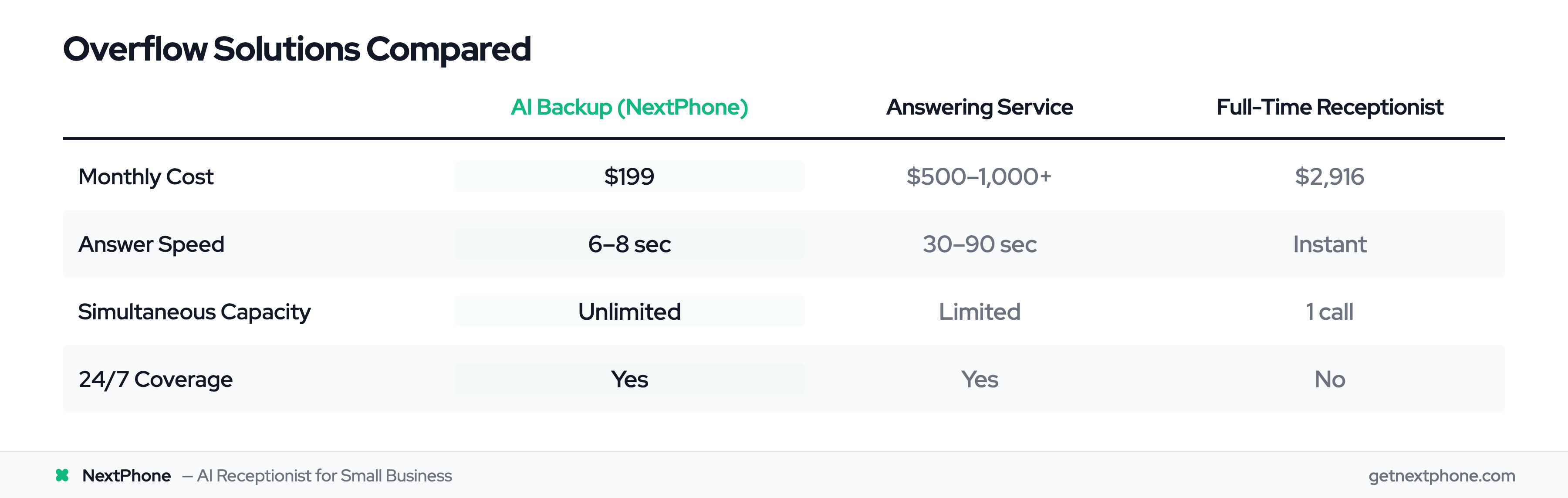
| Solution | Monthly Cost | Answer Speed | Simultaneous Capacity | 24/7 |
|---|---|---|---|---|
| AI backup (NextPhone) | $199 | 6-8 sec | Unlimited | Yes |
| Answering service | $500-1,000+ | 30-90 sec | Limited | Yes |
| Full-time receptionist | $2,916 | Instant | 1 call | No |
For most small businesses, AI provides the best combination of coverage, cost, and capacity. You're not paying $3,000/month for a person who can only answer one call at a time. You're paying $199/month for instant, unlimited overflow backup.
How NextPhone Handles Call Overflow
NextPhone was built specifically for the overflow problem small businesses face.
Instant Backup When You're Busy
When you can't answer—whether you're on another call, at a job site, or simply unavailable—NextPhone answers in 2-3 rings.
No busy signal. No endless ringing. No "sorry, leave a voicemail" that 80% of callers ignore.
The customer gets a professional answer immediately. From their perspective, your business picked up the phone. That's the experience they wanted.
Unlimited Overflow Capacity
Busy season hitting? Marketing campaign generating calls? Storm brought emergency calls?
NextPhone handles it all. 5 overflow calls at once? Handled. 50 overflow calls during a spike? Handled. There's no capacity ceiling because AI scales infinitely.
Your cost stays the same: $199/month. No per-minute fees. No surprise bills during high-volume periods. Whether you have 10 overflow calls in a month or 1,000, the price is identical.
That's predictable budgeting for unpredictable call volume.
Full Visibility of Every Call
Every overflow call is logged with:
- Full transcript of the conversation
- Caller's contact information
- What they needed (question, quote, emergency, appointment)
- Urgency level
- Recommended action
You see every call that came in while you were busy. No more guessing whether important calls came through. No more mystery voicemails. Complete visibility into overflow activity.
Emergency calls—water leaks, no heat, electrical issues—route immediately to your phone. You handle the urgent situations personally while AI manages the routine overflow.
Frequently Asked Questions
How do I know if I need call overflow management?
If you're missing calls because you're busy with other calls, on job sites, or getting more volume than you can handle during certain hours, you need overflow management. Industry standards put acceptable abandonment at 5-8%, with 10%+ considered problematic. Clear signs include: customers mentioning they couldn't reach you, multiple voicemails from the same person trying repeatedly, reviews complaining about phone accessibility, or knowing you missed calls when checking your phone after a job. Our data shows businesses miss 74.1% of calls without proper handling—the question isn't whether you need overflow management, but how much you're losing without it.
What's the difference between call queuing and call overflow handling?
Call queuing puts callers on hold in a line until someone is available—they wait for you. Call overflow handling routes calls to a backup solution (another person, service, or AI) that can answer immediately. For small businesses, overflow handling is usually better because queuing requires someone to work the queue. If you're alone, callers in your queue are just listening to hold music until they give up—60% abandon after 1 minute. Overflow handling ensures someone answers the call rather than asking customers to wait indefinitely.
Can I just route overflow calls to my cell phone?
Basic call forwarding to your cell phone is an option, but it has limitations. You can still only answer one call at a time on your cell, so multiple simultaneous overflow calls create the same problem. You might be on a job site with no cell service. You'll receive spam calls on your personal phone. And when you're already on a call, your cell phone just sends the next caller to voicemail too. Better solutions use AI as first-line overflow that can handle unlimited calls, filter spam, answer routine questions, and only route emergencies or important calls to your cell when you're available.
How much does call overflow management cost?
Costs vary significantly by solution. Hiring additional staff runs $35,000+ per year for a single person who can only handle one call at a time. Traditional answering services cost $300-800 per month base plus per-minute fees—high-volume months can exceed $1,000. AI solutions like NextPhone cost $199 per month flat with unlimited calls, regardless of volume. For most small businesses, AI provides the best value: unlimited overflow capacity at predictable monthly cost with no surprise fees during busy periods.
How quickly can I set up overflow handling?
Basic call forwarding to a backup number takes a few minutes through your phone provider. AI-powered overflow like NextPhone can be fully operational within 1-2 hours: connect your existing phone number, configure your routing preferences (when to route to AI vs. ring your phone), and set up emergency keywords that should reach you immediately. No technical expertise required—it's designed for business owners, not IT departments. The AI improves in the first few weeks as it learns your specific business and common customer questions.
Stop Losing Customers During Busy Times
Phone call overflow isn't just an occasional inconvenience—it's a consistent revenue drain. With 74.1% of calls going unanswered across small businesses and 80% of callers refusing to try again after a busy signal, every overflow call that goes to voicemail is likely becoming your competitor's customer.
Traditional solutions don't solve the problem. Queuing fails because small businesses don't have staff to work the queue—60% of customers abandon after 1 minute of hold anyway. Voicemail fails because 80% of customers hang up without leaving a message. Hiring staff is expensive and still limits you to one call at a time.
AI changes the math. Instant answer time means zero abandonment. Unlimited simultaneous capacity means no overflow call ever goes unanswered. Predictable $199/month pricing means no surprise bills during busy season.
Every call answered. Every customer captured. Every overflow handled.
Stop losing customers during busy times. Start your free trial with NextPhone and never miss an overflow call again.