
You're at a client's home, tape measure in one hand, fabric samples in the other. Your phone buzzes in your pocket. Then buzzes again. You can't answer—you're mid-conversation about crown molding options for their dining room.
By the time you check your phone three hours later, you've missed two calls. One left a voicemail: "Hi, we just bought a house and need help with the whole first floor. Call us back when you can." The other didn't leave a message at all.
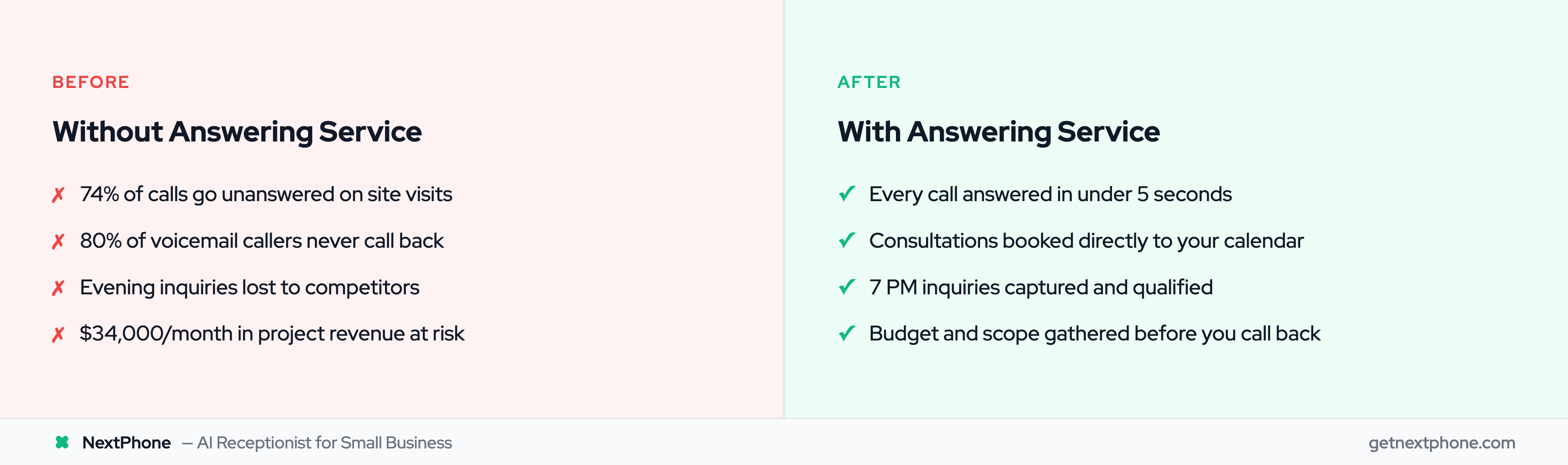
Here's what most designers don't realize: according to BIA/Kelsey research, 80% of callers who reach voicemail never call back. And that first-floor renovation? Probably a $25,000 project that just went to whoever answered their phone.
This guide covers how interior design answering services work, what features matter most for scheduling consultations, and how to choose the right one for your business. You'll also see the actual numbers behind missed calls—because the cost is likely higher than you think.
Why Interior Designers Miss So Many Calls
Design work doesn't happen at a desk. It happens in clients' homes, at showrooms, during installations, and in meetings where picking up the phone would be unprofessional. That's the nature of the job—and it's exactly why designers miss calls at alarming rates.
The Hands-On Reality of Design Work
Think about a typical day. You're measuring a living room for custom built-ins. You're supervising a furniture delivery. You're walking a client through tile options at a supplier. In each of these situations, answering your phone either isn't possible or would be rude.
One designer described it this way: "I feel frazzled every time I see a missed call and voicemail showing up on my phone." And that feeling is justified. Every missed call represents a potential client who needed something—and couldn't reach you.
The Solo Designer Dilemma
Large design firms have office staff. Solo practitioners and small firms don't. If you're a one-person operation or a small team, there's simply no one else to answer when you're busy.
The math is brutal. According to NextPhone's analysis of thousands of service business calls over seven months, 74.1% of calls went completely unanswered. That's nearly three out of every four potential clients calling someone else.
What Happens When You Can't Answer
Here's the sequence that plays out dozens of times each month for most designers:
- Potential client gets excited about a renovation project
- They search for interior designers in their area
- They call you (often in the evening, after work)
- Phone goes to voicemail
- They hang up and call the next designer on the list
- That designer answers
- They book a consultation
- You've lost a client you never knew you had
The data backs this up. NextPhone's research shows 73% of calls to service businesses come outside standard 9-5 hours. These evening and weekend callers aren't casual browsers—they're homeowners who just decided they need help and want to talk to someone now.
The Real Cost of Missed Consultation Calls
Missing calls isn't just inconvenient. It has a concrete dollar value that most designers drastically underestimate.
Every Missed Call Has a Price Tag
Let's start with consultation fees. According to HomeGuide's 2025 data, initial design consultations range from $50 to $500, with most falling between $150 and $250. That's money you never collect when a caller reaches voicemail and moves on.
But the consultation fee is the small part. The average interior design project runs $8,526, according to the same research. Full-service projects range from $2,000 to $12,000+ per room. High-end kitchen and bath renovations can hit $50,000 or more.
When you miss a call, you're not losing a $200 consultation. You're losing the $15,000 project that consultation would have led to.
The Math That Should Keep You Up at Night
Let's run the numbers for a typical solo designer:
- Monthly inquiry calls: 25
- Missed calls (at 74.1%): 19
- Callers who would have booked consultations (50%): 9-10
- Consultation fees lost: 10 × $200 = $2,000/month
- Projects those consultations would have generated (40% conversion): 4 projects
- Project revenue lost: 4 × $8,500 = $34,000/month
- Annual impact: Over $400,000 in lost opportunity
Even if you cut these numbers in half to be conservative, you're looking at $200,000+ in projects that went to your competitors simply because you couldn't answer the phone.
The Speed-to-Lead Factor
Timing matters more than most designers realize. MIT's Lead Response Management Study found that 78% of customers buy from whichever company responds first. Not the cheapest. Not the best reviewed. The first one to pick up.
The same research shows that calling a lead back within 5 minutes makes you 100x more likely to reach them compared to waiting 30 minutes. Wait an hour, and you're 7x less likely to qualify that lead. Wait until the next morning, and they've probably already scheduled a consultation with someone else.
That homeowner who called at 7 PM about their kitchen renovation? By 9 AM, they've already booked with the designer who answered at 7:01 PM.
What Is an Interior Design Answering Service?
An answering service for interior designers does exactly what you'd expect—it answers your phone when you can't. But modern services go far beyond taking messages. They're essentially a virtual receptionist trained specifically for your business.
More Than a Voicemail Replacement
When a client calls an answering service, they reach a live voice (human or AI) that:
- Greets them professionally using your business name
- Asks about their project and needs
- Captures their contact information
- Checks your calendar availability
- Books a consultation on the spot
- Sends confirmation to both you and the client
The client feels attended to. You get a qualified lead with all the details you need. Everyone wins.
How It Works for Design Businesses
The best services are trained on your specific business. They know what services you offer, your general pricing structure, your service area, and your availability. When someone asks "Do you do commercial spaces?" or "What's your hourly rate?", the service can answer accurately.
Here's a typical flow:
- Client calls your business number at 8 PM
- Answering service picks up within seconds
- They ask: "I'd love to help schedule a consultation. Can you tell me about your project?"
- Client explains: "We just bought a house and need help with the living room and kitchen."
- Service asks: "Wonderful. Do you have an approximate budget in mind for the project?"
- Client responds: "$30,000-40,000."
- Service checks your calendar: "Sarah has availability Thursday at 2 PM or Friday at 10 AM. Which works better?"
- Consultation booked. Confirmation sent. You receive an email summary.
You wake up to a new consultation on your calendar from a client with a $35,000 budget. That's the difference an answering service makes.
Types of Answering Services
Two main options exist:
Human receptionist services employ trained staff who answer your calls. They're excellent at handling complex conversations and building rapport. Costs typically run $300-800/month, often with per-call limits.
AI-powered services use conversational AI to answer calls. Modern AI sounds natural, not robotic. These services answer instantly (under 5 seconds), work 24/7/365, and cost significantly less—typically $199/month for unlimited calls.
Scheduling Consultations Through Your Answering Service
The scheduling capability is what transforms an answering service from "nice to have" into a business necessity for designers.
Real-Time Calendar Integration
Modern answering services connect directly to your calendar—whether that's Google Calendar, Calendly, or industry-specific tools. When a client wants to book, the service sees your actual availability in real time.
This prevents the nightmare scenario of double-booking. If you're already meeting with a client Thursday at 2 PM, the service won't offer that slot. It'll suggest your next available window instead.
What Information Gets Captured
Beyond basic contact details, a good service captures everything you need to prepare for the consultation:
- Project type: Whole home, single room, specific space (kitchen, bath, home office)
- Scope: New construction, renovation, refresh/styling
- Budget range: Helps you qualify and prepare appropriately
- Timeline: When they want to start, any deadlines
- Consultation type: In-home visit, virtual, or studio meeting
- How they found you: Referral, Houzz, Google search
Armed with this information, you can walk into (or dial into) that consultation fully prepared. No more spending the first 15 minutes gathering basic details.
Confirmation and Reminder Workflows
The moment a consultation is booked, the service can trigger:
- Immediate confirmation email to the client
- Calendar invitation with meeting details
- Reminder text 24 hours before the appointment
- Day-of reminder with any preparation instructions
These automated touchpoints reduce no-shows and make your business look polished and professional. Clients appreciate the clear communication—and you didn't have to send a single message manually.
Handling Reschedules and Cancellations
Life happens. Clients need to reschedule. A good answering service handles this too. Instead of playing phone tag, the client calls, explains they need to move the appointment, and gets rebooked on the spot.
You receive a notification of the change. Your calendar updates automatically. No back-and-forth emails required.
Essential Features for Interior Design Answering Services
Not all answering services are created equal. Here's what to look for when evaluating options for your design business.
Lead Qualification Questions
The best services ask the questions that matter for designers:
- Budget range: "Do you have an approximate budget in mind for this project?"
- Project scope: "Are you looking to update one room or multiple spaces?"
- Timeline: "When are you hoping to have the project completed?"
- Decision stage: "Have you worked with an interior designer before?"
These questions help you prioritize leads. A client with a $5,000 budget for a single room requires different preparation than one with $75,000 for a whole-home renovation.
Integration with Your Existing Tools
Your answering service should fit into how you already work:
- CRM integration: Lead information automatically syncs to HubSpot, Pipedrive, or your preferred system
- Calendar tools: Real-time availability, instant booking
- Email notifications: Summary of every call in your inbox
- SMS alerts: Instant notification for high-priority inquiries
The goal is zero manual data entry. Information flows automatically from the call to your systems.
After-Hours and Weekend Coverage
Remember: 73% of calls come outside business hours. A service that only operates Monday-Friday, 9-5 misses the majority of your potential clients.
Look for true 24/7/365 coverage. That Saturday afternoon call from a homeowner who just closed on their dream house? That's a high-intent lead who wants to talk about their vision right now. Capture them before Monday.
Call Transfer for Urgent Matters
Sometimes, you do want to take the call. Good services let you set up transfer rules:
- VIP clients always get routed to your cell
- Calls mentioning "emergency" or "urgent" get transferred
- Existing clients with active projects reach you directly
The AI handles the routine inquiries—hours, scheduling, service area—while important calls still reach you.
Professional Presentation
First impressions matter, especially in a visual, aesthetic business like interior design. The service should sound premium, not like a call center. It should use your business name, speak professionally, and match the experience clients expect from a design firm.
Cost Comparison: Service vs Hiring vs Voicemail
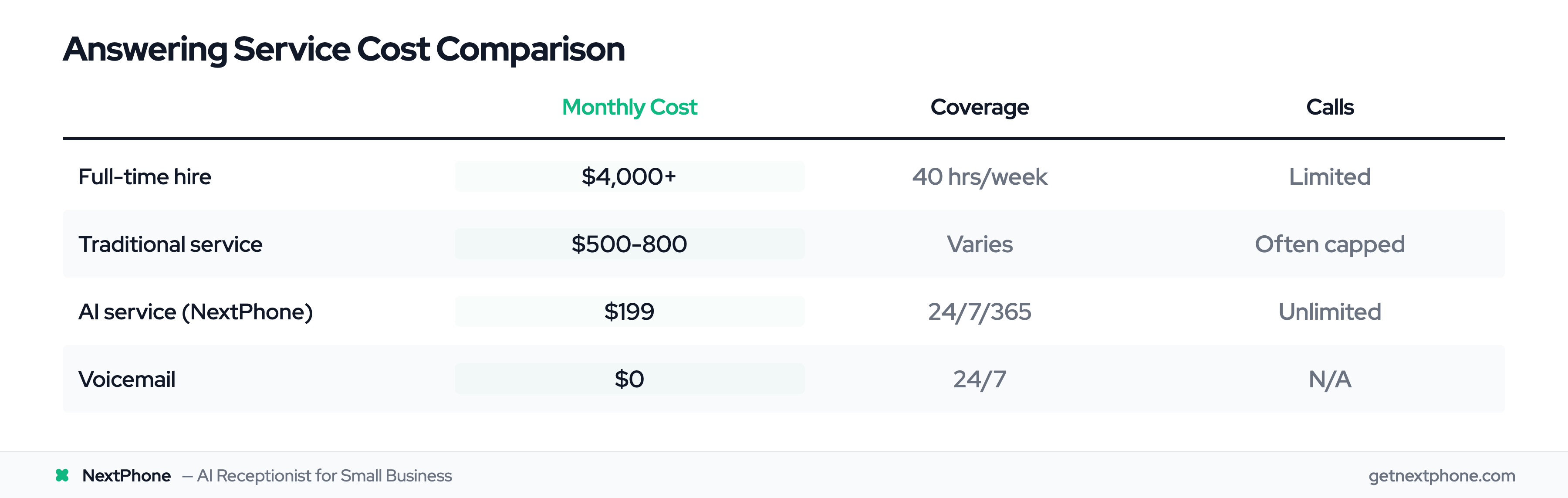
Let's break down the economics of each option.
The True Cost of a Full-Time Receptionist
Hiring someone to answer phones sounds ideal until you see the numbers:
- Salary: $33,000-45,000/year for an experienced receptionist
- Benefits: Add 25-30% for health insurance, PTO, etc.
- Training: Time and money to get them up to speed on design terminology
- Coverage gaps: They work 40 hours/week—what about evenings, weekends, holidays?
Total: $45,000-60,000/year for coverage that still doesn't answer calls at 8 PM on a Tuesday.
Traditional Answering Service Pricing
Human receptionist services like Smith.ai and Ruby typically charge:
- Base fee: $300-800/month
- Per-call overage: $5-12 per call after you hit limits
- Hours: May not include 24/7 coverage at base rate
A busy designer can easily spend $600-1,000/month with overage charges.
AI Answering Service Pricing
AI-powered services like NextPhone offer a different model:
- Flat rate: $199/month
- Calls: Unlimited
- Hours: 24/7/365
- Overage fees: None
For a solo designer or small firm, that's $2,388/year for complete coverage. Compare that to $45,000+ for a full-time hire.
The Hidden Cost of "Free" Voicemail
Voicemail costs nothing to maintain. But it costs everything in lost business.
- 80% of callers who reach voicemail never call back
- 78% hire the first business that responds
- At $8,500 average project value, losing just 4 projects per month costs $34,000
"Free" voicemail isn't free. It's the most expensive option on the list.
| Solution | Monthly Cost | Coverage | Calls | Real Cost |
|---|---|---|---|---|
| Full-time hire | $4,000+ | 40 hrs/week | Limited | $48,000+/year + gaps |
| Traditional service | $500-800 | Varies | Often capped | $6,000-10,000/year |
| AI service | $199 | 24/7/365 | Unlimited | $2,388/year |
| Voicemail | $0 | 24/7 | N/A | $400,000+ lost revenue |
AI vs Human: Which Works Better for Creative Businesses?
This is the question that keeps some designers hesitant. Will AI sound too robotic for clients expecting a premium experience?
The Creative Business Concern
It's a valid worry. Interior design is a relationship business. Clients are inviting you into their homes, trusting you with significant budgets, and expecting a certain level of sophistication. The first phone call sets the tone.
Early AI systems were clunky, obvious, and frustrating. Nobody wants their potential clients fighting with a bot that doesn't understand what "powder room refresh" means.
Where AI Excels
Modern conversational AI has improved dramatically. Here's where it beats human alternatives:
- Speed: Answers in under 5 seconds, every time
- Consistency: Same professional quality at 2 AM as 2 PM
- Availability: Never sick, never on vacation, never at lunch
- Accuracy: 99%+ data capture vs human error rates of 5-10%
- Cost: $199/month vs $500-800 for human services
For routine calls—scheduling, basic questions, information capture—AI handles them flawlessly.
Where Humans Still Win
Humans excel at:
- Complex empathy: Calming an upset client or handling a complaint
- Creative problem-solving: Unusual requests that don't fit standard scripts
- Relationship building: Long-term client rapport
AI-First with Smart Forwarding
The best solution is AI-first with smart forwarding. AI handles the 80% of calls that are routine: scheduling, basic questions, lead capture. When something requires your judgment, smart forwarding transfers the call to you or takes a detailed message.
Research from Gartner shows 60-70% of customers are now comfortable interacting with AI for simple tasks. But 80% still want the option to reach a human. Smart forwarding gives them both.
How NextPhone Helps Interior Designers
NextPhone was built for service businesses like interior design firms—professionals who can't sit by a phone all day but can't afford to miss calls either.
Built for Your Workflow
When a potential client calls:
- AI answers in under 5 seconds
- Greets them with your business name
- Captures project details, budget, timeline, and contact info
- Checks your real calendar availability
- Books the consultation on the spot
- Sends confirmation to the client
- Delivers a full summary to your inbox immediately
You get an email that reads like your ideal intake form, already filled out. The consultation is already on your calendar. No phone tag, no missed opportunities.
Key Features for Designers
- Consultation scheduling: Direct calendar integration books appointments in real time
- Lead qualification: Captures budget, scope, and timeline automatically
- Call transfer: VIP clients or urgent matters route to your cell
- SMS follow-up: Sends booking confirmations and links to clients
- CRM integration: Syncs lead data to your existing tools via webhooks
- 24/7 coverage: Captures those high-intent evening and weekend callers
Getting Started
Setup takes about an hour. Connect your phone number, add your business details, set your availability, and you're live. There's no contract and a 7-day free trial to make sure it fits your needs.
At $199/month with unlimited calls, the service pays for itself the first time it captures a consultation you would have otherwise missed.
Frequently Asked Questions
How much does an interior design answering service cost?
AI-powered services like NextPhone cost $199/month for unlimited calls with 24/7 coverage. Traditional human answering services range from $300-800/month, often with per-call limits. For comparison, a full-time receptionist costs $45,000-60,000/year and still doesn't answer phones at 8 PM.
Can an answering service actually book design consultations?
Yes. Modern services integrate with your calendar (Google Calendar, Calendly, or design-specific tools) and book consultations in real time. They see your actual availability, prevent double-bookings, and send automatic confirmations to clients.
What information should the service collect from potential clients?
For interior design, the service should capture: client name and contact info, project type (whole home, single room, commercial), approximate budget, timeline, and preferred consultation format (in-home vs virtual). This lets you prepare appropriately and qualify leads before calling back.
Will clients know they're talking to AI?
Modern AI receptionists sound natural and conversational—many clients don't realize it's AI. The best services are transparent about being AI assistants while maintaining a professional, helpful tone. They can transfer to a human when needed for complex situations.
How quickly do answering services respond to calls?
AI services answer in under 5 seconds—faster than most human receptionists. This matters because research shows 78% of clients hire the first business that responds. Traditional services may take 15-30+ seconds to answer, and voicemail means waiting hours or days for a callback.
Can I still receive urgent calls directly?
Yes. You can set up call transfer rules for VIP clients, emergencies, or specific situations. The AI handles routine inquiries—availability, scheduling, basic questions—while routing important calls to your phone immediately.
Stop Losing Consultations to Your Voicemail
Every missed call is a potential client who needed something you couldn't provide: an answer. With consultation fees running $150-500 and average projects at $8,500, the math on missed calls adds up fast.
The designers building successful practices in 2025 aren't necessarily more talented than you. They're simply answering every call. They're capturing those 7 PM inquiries from excited homeowners. They're booking consultations while their competitors' phones ring through to voicemail.
An answering service with scheduling capabilities isn't an expense. It's the most cost-effective business investment you can make. One captured consultation pays for months of service.