You're on a roof replacing shingles. Your phone buzzes in your pocket. You can't safely stop what you're doing to answer. By the time you climb down, check your phone, and call back, the homeowner has already booked with your competitor.
This happens thousands of times every day across the home services industry. Industry research says something most contractors don't want to hear: 74.1% of incoming calls to home services contractors go completely unanswered.
That's not a typo. Three out of every four potential customers are calling someone else because you couldn't pick up.
For a typical contractor receiving 42 calls per month, that missed call rate translates to 31 lost opportunities. If just 20% of those callers would have converted at an average $3,500 project value, you're looking at $21,700 per month in lost revenue. That's $260,400 per year walking out the door.
A 24/7 answering service for home services solves this problem by ensuring every call gets answered, every lead gets captured, and every emergency gets routed—whether you're on a ladder, under a house, or at your kid's soccer game.
The Hidden Cost of Missed Calls for Home Services Contractors
How Many Calls Are You Really Missing?
Most contractors dramatically underestimate how many calls they miss. They know they can't always answer, but the actual numbers are brutal.
One plumber discovered he'd racked up 76 missed calls in a single month. His reaction? "I didn't even know I was missing that many calls until I saw the data. I just thought business was slow."
His business wasn't slow. His phone was ringing constantly. He just couldn't answer while snaking a drain or crawling under a sink.
The pattern repeats across every trade. Roofers can't answer on steep pitches. Electricians working in panels have safety regulations preventing phone use. HVAC techs in attics or on units can't safely take calls. General contractors managing multiple job sites are constantly unavailable.
The Revenue Math That Should Scare You
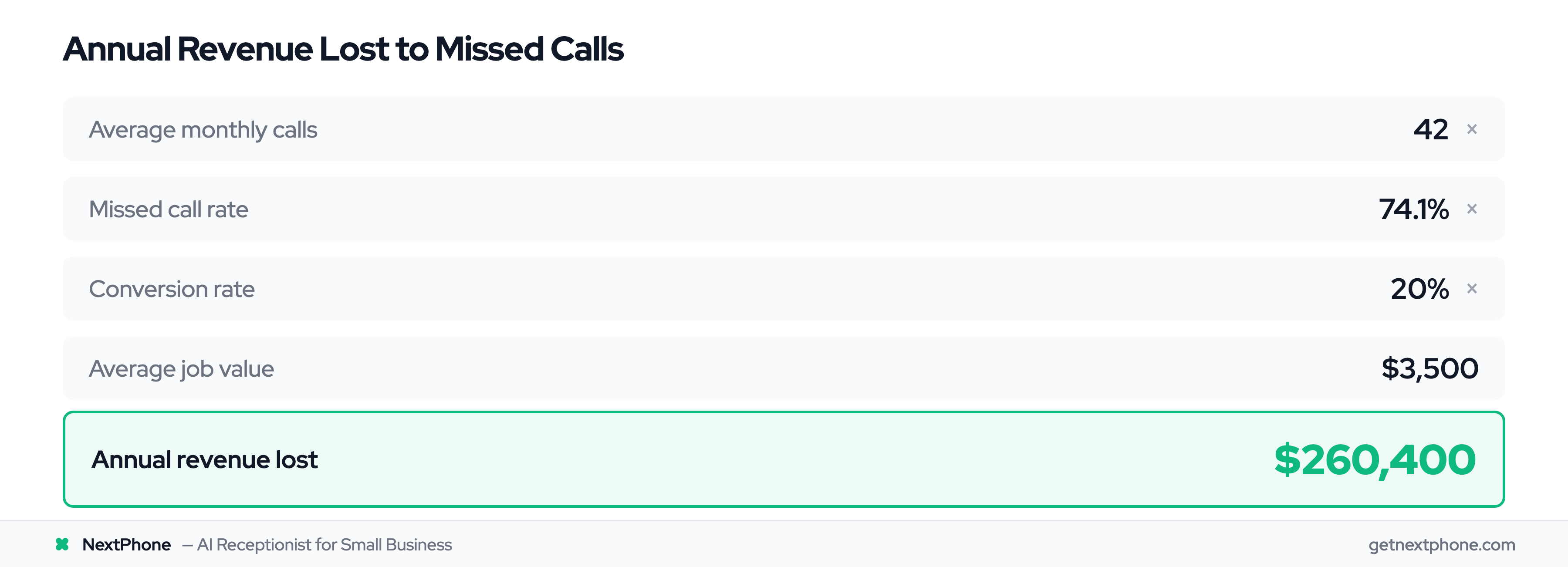
Let's walk through the numbers for a typical home services contractor:
- Average monthly calls: 42
- Missed call rate: 74.1%
- Calls missed per month: 31
- Potential conversion rate: 20%
- Average job value: $3,500
- Monthly revenue lost: $21,700
- Annual revenue lost: $260,400
According to research by Invoca, the average missed call costs home services businesses $1,200 in immediate revenue. Factor in lifetime customer value, and that number jumps to $5,000-$15,000 per missed opportunity.
Why Contractors Can't Just "Call Back Later"
Here's where voicemail fails you: 85% of customers who reach voicemail hang up without leaving a message. They don't wait for you to call back. They call the next contractor in their search results.
Even worse, only about 3% of callers actually leave a voicemail. The other 97% are gone forever.
The MIT Lead Response Management Study found that waiting just 30 minutes to return a call makes you 10x less likely to reach that lead. Wait an hour, and you're 7x less likely to qualify them. Wait a day? You might as well not bother—you're 60x less likely to close that customer.
Speed wins in home services. The contractor who answers first gets the job 78% of the time.
What Is a Home Services Answering Service?
A home services answering service is exactly what it sounds like: a service that answers your business phone calls when you can't. But modern answering services do far more than just take messages.
How It Works
When you're on a job site, in a crawl space, or otherwise unavailable, incoming calls forward to your answering service. Instead of hitting voicemail, callers reach a live person or AI assistant that can:
- Answer questions about your services and pricing
- Schedule appointments directly into your calendar
- Capture lead information for follow-up
- Route emergency calls to your phone immediately
- Send confirmation texts and emails to callers
The caller gets immediate help. You get a booked job or qualified lead. Nobody falls through the cracks.
Across the inbound calls our own AI receptionist answers for service businesses, the most common reasons people call — in ranked order — are:
- Booking, confirming, or rescheduling an appointment
- Asking about a specific service or repair
- Requesting a quote or estimate
- Checking the status of a job already scheduled
- Hours, location, and directions
- New-customer inquiries
- Emergencies — the calls you can least afford to miss
For a contractor, that list is mostly billable work. The answering service's job is to turn each of those calls into a booked job, a captured lead, or an immediate emergency route — not a voicemail nobody returns.
A real production call — the AI checks availability, books the appointment, and confirms by text. No human operator, no per-minute meter.
Why Home Services Contractors Need True 24/7 Answering Service Coverage
Not all answering services operate around the clock. Some only cover business hours. Others add premium fees for evenings and weekends. A true 24/7 answering service handles every call at consistent quality and price—whether it comes in at 2 PM Tuesday or 11 PM Saturday.
For contractors, this matters more than in most industries.
A large share of home services calls arrive outside traditional 9-5 hours. Homeowners call after work when they finally notice the water heater is leaking. They call Saturdays when they have time to deal with the dripping faucet they've been ignoring all week. And they call overnight when a pipe bursts and they need someone now.
These after-hours callers are often your highest-intent leads. They've waited long enough that they're ready to book immediately. An HVAC contractor who answers that Saturday morning call gets the job. One who doesn't answers Monday morning to find three competitors already have quotes out.
Key windows a 24/7 answering service covers that business-hours-only services miss:
- Evenings (6–10 PM) — homeowners free from work, planning repairs and maintenance
- Saturdays and Sundays — peak scheduling time for non-emergency service work
- Overnight emergencies — pipe bursts, no heat, AC failure — calls that command premium rates and book immediately
A production after-hours call — the AI greets, captures the emergency and contact details, and flags it for immediate callback. This is the call a voicemail box loses at 11 PM.
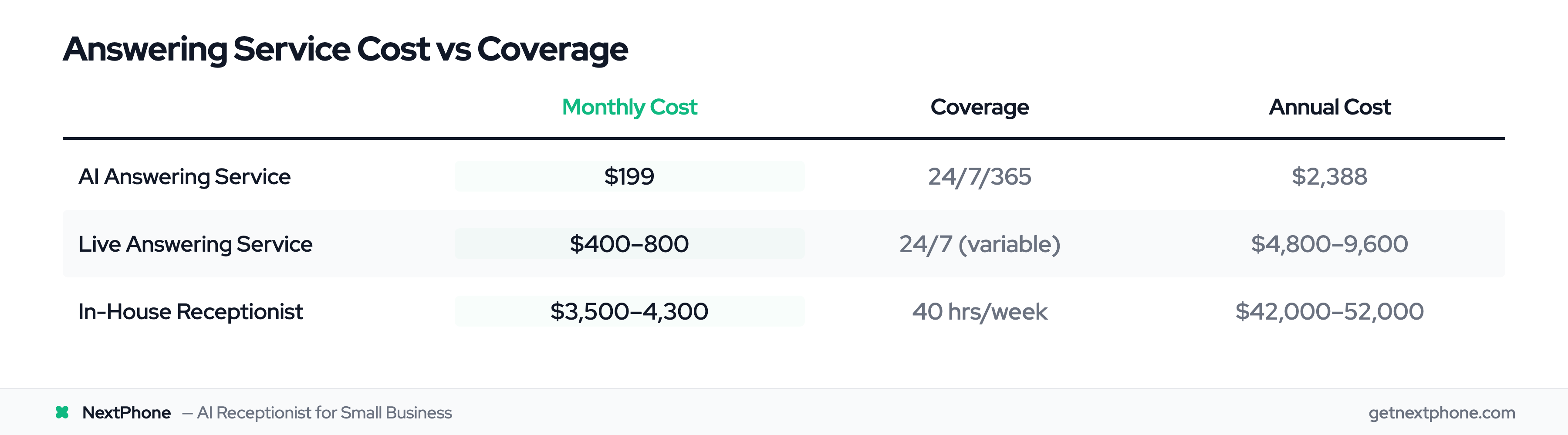
Traditional receptionists cost $35,000+/year and don't work nights or weekends. An after-hours answering service that's genuinely available 24/7 turns every after-hours call into a captured job—at $199/month flat, no after-hours surcharge.
Types of Answering Services
Live human receptionists provide a traditional call center experience. Real people answer calls, follow scripts, and handle requests. They excel at complex conversations and emotional situations but cost more and may have limited hours.
AI virtual receptionists use artificial intelligence to handle calls conversationally. They're available 24/7, cost significantly less, and handle routine calls with remarkable accuracy. Modern AI can understand context, answer questions, and even detect emergencies.
Hybrid models combine both approaches. AI handles the 80% of calls that are straightforward—scheduling, pricing questions, basic information. Humans step in for complex situations, upset callers, or high-value opportunities.
6 Features Every Contractor's Answering Service Must Have
Not all answering services are built for home services contractors. Here's what separates the useful ones from the ones that'll frustrate you and your customers.
1. 24/7/365 Availability
Most calls to home services businesses come outside traditional 9-5 hours. Evenings, weekends, and holidays are when homeowners are actually home to notice problems and make calls.
A 24/7 answering service that only covers business hours misses a large share of your opportunities. True 24/7 coverage—including holidays—is non-negotiable.
2. Emergency Call Detection and Routing
Across the 1,446,980+ inbound calls our AI receptionist has answered, emergencies and urgent calls rank consistently among the top call types for home services businesses—alongside appointment requests, service inquiries, and quote requests. Pipe bursts, power outages, AC failures in summer heat—these callers can't wait for a callback.
Your answering service needs to recognize these situations and act on them. When someone says "there's water everywhere," the service should immediately text or call you—not just take a message for callback in the morning.
Emergency service calls command 1.5x–2x standard pricing in after-hours situations. Missing even one emergency call per week adds up to significant lost revenue every month.
3. Appointment Scheduling
Taking messages isn't enough. A quality answering service books appointments directly into your calendar.
The best services integrate with Google Calendar, Outlook, Calendly, or your scheduling software. The AI or receptionist sees your availability in real time and schedules jobs without you lifting a finger.
When the service just takes a message, you still have to call back, play phone tag, and manually book. That defeats half the purpose.
4. CRM and Calendar Integration
Every lead should flow directly into your CRM or job management system. Automatically.
Modern answering services use webhooks and integrations to push caller information—name, phone, address, service needed, urgency level—directly into HubSpot, ServiceTitan, Housecall Pro, Jobber, or whatever system you use.
No more sticky notes. No more forgetting to log leads. No more data entry at 9 PM after a long day.
5. Trade-Specific Training
An answering service handling calls for a law firm won't understand plumbing terminology. Your service needs to know the difference between a tankless water heater and a standard tank, between single-phase and three-phase electrical, between a heat pump and a furnace.
The best services are either trained specifically on your trade or allow you to customize scripts and knowledge bases so they can answer questions accurately.
6. SMS and Email Follow-ups
After every call, your answering service should send:
- A confirmation text to the caller with appointment details
- A booking link if they need to schedule later
- A summary email to you with call details
- Follow-up reminders before appointments
These touchpoints reduce no-shows, improve customer experience, and keep your pipeline organized.