
Your phone rings while you're on a ladder installing a ceiling fan. You can't answer. The call goes to voicemail. That customer needed an electrician today. They call the next contractor on their list.
This scenario plays out constantly for contractors and small business owners. Industry research shows home services professionals miss 60-80% of incoming calls because they're doing the actual work that pays the bills.
Here's what makes it worse: 85% of people whose calls go unanswered don't call back. They just call your competitor instead.
MIT researchers found that companies responding to leads within five minutes are 21 times more likely to close the deal. But you can't respond in five minutes when you're in a crawl space or on a roof.
GPT-powered answering services offer a potential solution. These aren't the robotic "Press 1 for sales" systems that frustrate everyone. They use the same artificial intelligence technology behind ChatGPT to have actual conversations with your callers.
This guide breaks down what GPT answering services are, how the technology works, what they cost, and whether one makes sense for your business.
What Is a GPT Answering Service?
The Simple Explanation
GPT stands for Generative Pre-trained Transformer. That's a mouthful, but all it means is: a large language model trained on massive amounts of text that can understand and generate human-like responses.
When applied to phone answering, GPT technology takes a caller's spoken words, understands what they're actually asking for, and responds with relevant information. It can have back-and-forth conversations, ask clarifying questions, and adapt to how each caller speaks.
This is the same underlying technology that powers ChatGPT. The difference is that GPT answering services apply it to phone calls instead of text chats.
How It's Different from Older AI
If you've dealt with older automated phone systems, you probably hate them. "Press 1 for sales. Press 2 for support. Press 3 to repeat these options." Those systems use rigid scripts and keyword matching. Say something unexpected and they break down completely.
GPT-powered systems work differently. They understand intent and context, not just specific words.
Consider this example: A caller says "My basement is flooding, I need someone out here now." An older AI system might hear "basement" and route to general inquiries. GPT understands this is an emergency and needs immediate human attention.
According to Gartner research, 85% of customer service leaders will explore conversational GenAI by 2025. Deloitte's research on generative AI in customer service shows this technology is transforming how businesses handle customer interactions. We're already partway there. Companies using GPT-powered customer service report handling 93% of inquiries automatically while cutting resolution time by 60%.
The technology has reached a point where it actually works for real business conversations. OpenAI's State of Enterprise AI 2025 report shows 82% of enterprises now use generative AI weekly, and Federal Reserve research on generative AI adoption confirms this rapid enterprise uptake.
How GPT Answering Services Work
The Technology (Made Simple)
When someone calls a business using a GPT answering service, here's what happens:
- Speech recognition converts the caller's voice to text
- GPT processes that text, understanding the meaning and intent
- GPT generates an appropriate response based on your business information
- Voice synthesis converts that response to natural-sounding speech
All of this happens in milliseconds. The caller experiences a normal conversation, not robotic delays.
Training on Your Business
GPT doesn't just give generic responses. These services train the AI on your specific business information: your services, hours, service area, pricing ranges, and common questions.
So when a caller asks "Do you do mini-split installations?" the GPT knows your service list and answers accurately. When they ask about your service area, it knows which ZIP codes you cover.
This customization separates useful GPT answering from generic chatbots that provide irrelevant responses.
Smart Call Routing
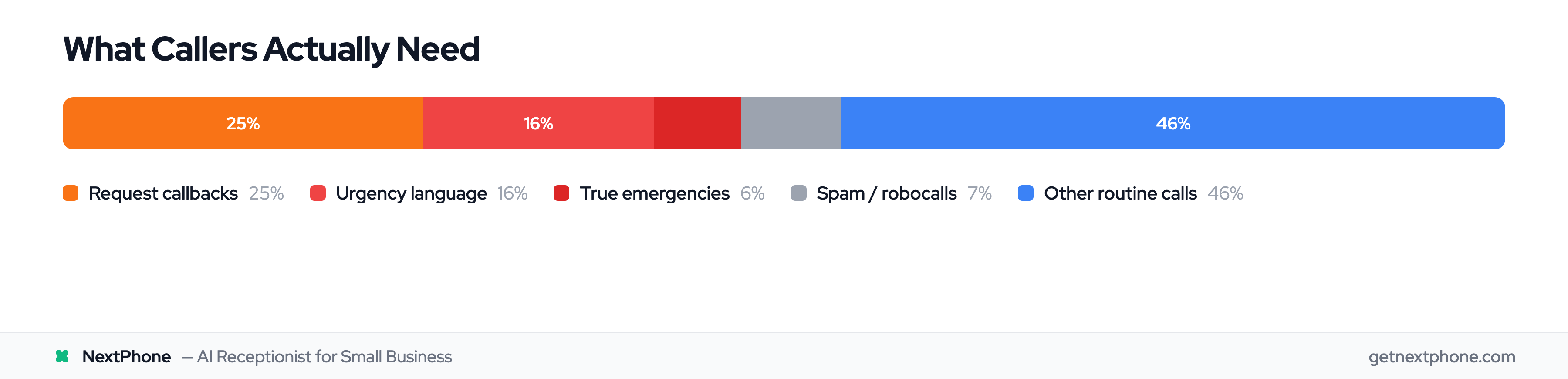
The real value comes from intelligent routing. GPT categorizes each call by intent and handles it appropriately.
Customer service data shows predictable patterns:
- 25.4% of callers explicitly request callbacks. GPT logs every single one with contact info, timestamp, and reason for calling.
- 15.9% of calls contain urgency language like "emergency," "urgent," "ASAP," or "flooding." GPT detects these and routes them to your phone immediately.
- 7% of calls are spam or robocalls. GPT identifies and blocks them so you never climb off a ladder for an extended warranty pitch.
- 6.2% are true emergencies requiring immediate response. GPT transfers these instantly.
The rest are routine: scheduling requests, general questions, quote inquiries. GPT handles these without interrupting your workday.
GPT vs Older AI Answering: What's Actually Different
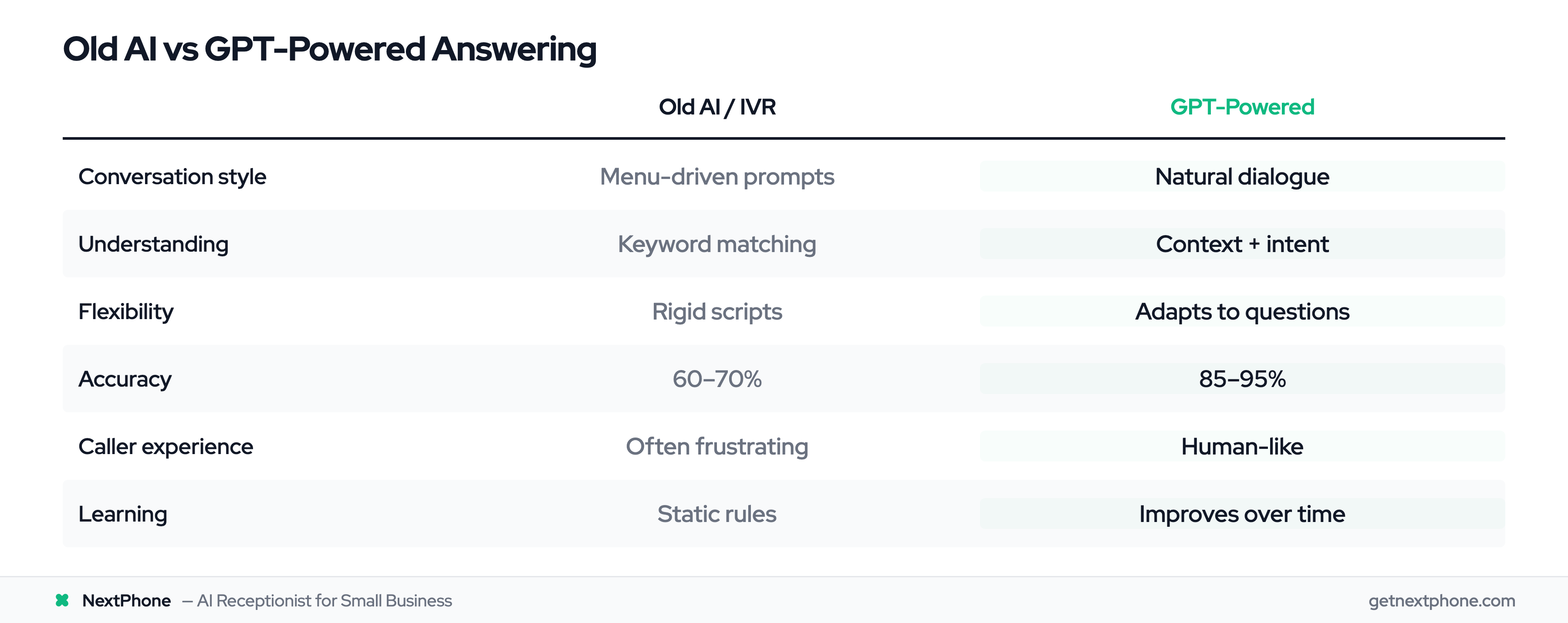
If you've tried AI phone systems before and hated them, GPT-powered services deserve a fresh look. The technology has fundamentally changed.
| Feature | Old AI/IVR Systems | GPT-Powered |
|---|---|---|
| Conversation | Menu-driven prompts | Natural dialogue |
| Understanding | Keyword matching | Context + intent |
| Flexibility | Rigid scripts | Adapts to questions |
| Accuracy | 60-70% | 85-95% |
| Caller Experience | Often frustrating | Human-like |
| Learning | Static rules | Improves over time |
Five years ago, voice AI accuracy hovered around 60%. Today's GPT systems hit 85-95% accuracy in understanding conversational speech. That's the difference between a useful tool and an annoying one.
Here's the practical impact: When a caller says something unexpected, old systems get confused and often transfer to voicemail. GPT understands the underlying request even when callers don't use the exact expected words.
Research shows 51% of consumers now prefer automated systems for instant service - but only when those systems actually work. GPT finally delivers on that promise for phone calls.
What GPT Answering Services Can Actually Do
Let's get specific about capabilities.
Answer Calls 24/7
The most basic function: never miss a call. GPT answering services pick up in 2-3 rings - under 10 seconds every time. They handle multiple simultaneous calls without putting anyone on hold.
For contractors missing 60-80% of calls, this alone captures significant lost revenue. After-hours calls get answered when your competitors are sending callers to voicemail.
Book Appointments Automatically
When someone calls to schedule service, GPT checks your calendar availability and books the appointment directly. The caller gets confirmation. You get a calendar invite. Nobody plays phone tag.
Analysis shows 7.7% of calls are scheduling requests. That's multiple weekly appointments GPT can book while you're actually working.
Take Detailed Messages
GPT captures caller information, reason for calling, and urgency level. Customer data reveals 25.4% of callers explicitly request callbacks. GPT tracks every single one.
Without a tracking system, industry research shows 42% of callback requests never get returned. Each one represents a customer who felt ignored. GPT prevents requests from falling through cracks.
Route Emergency Calls Instantly
When urgent calls come in, seconds matter. GPT detects urgency indicators in real-time.
Real example from customer data: "Urgent: AC not working in 98 degree heat. Needs immediate callback."
GPT recognizes this can't wait and transfers to your phone immediately. Emergency jobs often command premium pricing. Missing these high-value calls means competitors get that work instead.
Filter Spam
Nobody wants to stop working to answer a robocall about car warranties. Analysis found 7% of all incoming business calls are spam or robocalls.
GPT identifies these and blocks them automatically. That's hours saved monthly from pointless interruptions.
Answer Common Questions
Business hours. Service area. Whether you offer specific services. Pricing ranges.
Customer data shows 6.5% of calls are repetitive questions that don't require your expertise. GPT answers instantly from your business information. The caller gets help immediately. You stay focused on revenue-generating work.
The Hallucination Problem: Can GPT Make Things Up?
This concern deserves direct attention. AI hallucination - where GPT generates confident-sounding but incorrect information - is a real phenomenon.
In a widely reported case, Air Canada's AI chatbot told customers about a bereavement refund policy that didn't exist. More recently, a tech company's AI support system invented a product policy from scratch. These aren't edge cases.
So when you're considering GPT for answering your business calls, this worry is valid.
How Quality Services Prevent This
Good GPT answering services build safeguards:
Constrained responses. The GPT only answers questions using your verified business information. It can't make up services you don't offer or policies you don't have.
Confidence thresholds. When GPT isn't confident about an answer (below 80% certainty), it doesn't guess. It transfers to a human or takes a message.
Clear boundaries. Well-trained systems say "I don't have that information, let me connect you with someone who does" rather than fabricating answers.
Human backup. The hybrid model means humans catch what AI misses. Complex questions go to you, not to an AI making things up.
Questions to Ask Any Provider
Before choosing a GPT answering service:
- How do you prevent hallucinations and incorrect information?
- What happens when the AI isn't confident about an answer?
- How quickly does it transfer to a human when needed?
- Can I review and approve the response templates?
Providers who dodge these questions should raise red flags.
GPT Answering Service Limitations (Honest Assessment)
GPT technology has improved dramatically, but limitations remain. You should know them before investing.
Heavy accents and dialects. GPT still struggles with thick accents. Accuracy drops noticeably outside standard American English.
Industry-specific jargon. Technical terminology can confuse the AI. A caller saying "The compressor is cycling on overload" might not get properly categorized without industry-specific training.
Emotional callers. Angry or upset customers often need a human touch. GPT can detect frustration but lacks genuine emotional intelligence.
Complex multi-step issues. GPT handles routine inquiries well but struggles with problems requiring back-and-forth investigation.
Nuanced judgment calls. Experienced receptionists read between the lines. GPT takes things at face value.
When GPT Works Best
- Routine inquiries (60-80% of most businesses' calls)
- Simple scheduling
- Message taking
- FAQ answers
- Spam filtering
- Emergency detection and routing
When You Still Need Humans
- Complex complaints requiring investigation
- Highly technical discussions
- Emotional situations needing empathy
- Unusual edge cases
- Any negotiation
Research shows 78% of customers still prefer humans for complex issues. The hybrid model - GPT handles volume, humans handle complexity - addresses this reality.
How Much Does GPT Answering Service Cost?
GPT Answering Service Pricing
Pricing varies by provider and features:
- Entry level: $49-99/month (often limited minutes or calls)
- Mid-range: $199-300/month (unlimited calls for most businesses)
- Premium: $400-500+/month (advanced features, integrations)
- NextPhone: $199/month with unlimited calls
Cost Comparison
| Option | Monthly Cost | Annual Cost |
|---|---|---|
| In-house receptionist | $2,950 | $35,400 |
| Live answering service | $500-800 | $6,000-9,600 |
| GPT answering (NextPhone) | $199 | $2,388 |
Bureau of Labor Statistics data shows median receptionist salary at $35,400 annually - and that's before benefits, payroll taxes, and time off. Traditional live answering services charge $500-800 monthly for limited call packages.
GPT answering at $199/month with unlimited calls costs less than a single week of in-house receptionist salary.
The ROI Calculation
Numbers make this concrete.
Say you're an HVAC contractor getting 50 calls monthly during peak summer season. Industry data suggests you're missing 70% while on jobs - that's 35 missed calls.
Of those missed calls, 6.2% are true emergencies. That's roughly 2 emergency calls missed monthly.
Average emergency HVAC call value: $1,200.
Lost revenue from just emergencies: $2,400/month.
GPT answering cost: $199/month.
ROI: 12X return on emergency captures alone.
This doesn't count the callback requests (25.4% of calls), quote opportunities, or after-hours leads you're also capturing.
Ready to stop missing calls? See NextPhone's GPT answering in action →
Who Should Use GPT Answering Services?
Home Services (The Prime Use Case)
If you're a plumber, electrician, HVAC technician, roofer, or general contractor, GPT answering solves your core problem: you can't answer phones while working.
You're in attics, crawl spaces, on roofs, under sinks. Your hands are dirty or full. You're with a customer. The phone rings and you can't get it.
This is exactly what GPT answering addresses. Calls get answered. Emergencies get routed to you immediately. Routine questions get handled. Spam gets blocked.
The data supports this use case:
- 15.9% of calls contain urgency language (GPT detects it)
- 6.2% are true emergencies (GPT routes instantly)
- 7% are spam (GPT filters automatically)
- 25.4% request callbacks (GPT tracks 100%)
Healthcare and Professional Services
Dental offices, medical practices, legal firms, and real estate agents share similar challenges. High call volume. Appointment scheduling is core to business. Staff can't always answer.
GPT handles scheduling without staff time and ensures after-hours calls don't go to voicemail.
Any Business Where Calls Equal Revenue
The common thread: missing calls means losing money. If you get 30+ calls monthly and your team can't always answer - whether due to field work, serving customers, or being a one-person operation - GPT answering captures revenue you're currently losing.
Who Should NOT Use GPT (Yet)
GPT answering isn't for everyone:
- Businesses requiring deep expertise on every single call
- Industries with extreme regulatory requirements around communications
- Very low call volume (5-10 monthly) - the ROI doesn't justify it
How NextPhone Uses GPT to Answer Your Calls
NextPhone provides GPT-powered answering built specifically for contractors and small businesses who can't afford to miss calls.
Here's how it works: When a call comes in, NextPhone's AI answers in under 5 seconds. It's trained on your business information - services, hours, service area, pricing ranges, common questions.
For routine inquiries like "What are your hours?" or "Do you service my area?" - the GPT provides instant, accurate answers from your business profile.
For emergencies - that 15.9% of calls with urgency language - NextPhone detects keywords like "flooding," "no heat," "emergency," and transfers immediately to your phone. You get the calls that need you. The AI handles everything else.
The system also:
- Filters the 7% of calls that are spam
- Tracks 100% of callback requests (25.4% of callers ask for callbacks)
- Books appointments directly into your calendar
- Sends instant notifications with call summaries
Pricing: $199/month with unlimited calls. No per-minute charges that spike during busy season.
One HVAC contractor put it simply: "I can't answer my phone when I'm in an attic. NextPhone handles it and my schedule stays full. It's like having a receptionist for $200 a month."
How to Choose a GPT Answering Service
If you're evaluating options, here's what to look for:
Technology verification. Does it actually use GPT/LLM technology, or is it older IVR dressed up with marketing buzzwords? Ask directly.
Pricing model. Flat rate or per-minute? Per-minute pricing can spike unpredictably during busy periods.
Hallucination safeguards. What prevents the AI from making things up? This matters.
Human backup speed. How quickly does it transfer to a human when needed? Seconds or minutes?
Integration capability. Does it connect to your calendar? CRM? Existing phone system?
Industry training. Can it learn your specific business terminology and services?
Setup process. Hours or weeks? Most quality services have you live the same day.
Getting Started Steps
- Sign up and connect your phone number (forward or port)
- Input business information (hours, services, FAQs, service area)
- Set routing rules (what triggers emergency transfer, business hours handling)
- Test with sample calls
- Go live - typically same day for most providers
Is GPT Answering Service Right for You?
GPT-powered answering services represent a genuine advancement from the frustrating automated systems of the past. They understand natural conversation, handle routine inquiries effectively, and route urgent matters to humans immediately.
The technology makes sense if:
- You're missing 60-80% of calls because you're actually working
- After-hours calls happen and currently go to voicemail
- Emergencies need fast routing to your phone
- You're on job sites or with customers and can't answer
- Spam calls waste your time regularly
At $199/month versus $35,000+/year for a receptionist, the math works for most small businesses getting 30+ calls monthly.
AI resolves 90-95% of calls. Smart forwarding routes the rest to your phone. The real comparison isn't AI vs humans—it's AI vs voicemail. And AI wins that every time.
Just go in with realistic expectations. GPT isn't magic. It resolves 90-95% of calls autonomously, and smart forwarding routes the rest to your phone. For capturing missed calls while you're doing the work that actually pays, it delivers.
- Stop losing customers to missed calls. Try NextPhone's GPT answering free for 7 days →
Frequently Asked Questions
What is the difference between GPT answering service and regular AI answering?
GPT answering services use large language models - the same technology behind ChatGPT - to understand natural conversation. Older AI systems use keyword matching and rigid scripts ("Press 1 for sales"). GPT understands context and intent, so callers can speak naturally instead of navigating frustrating menus. The result is human-like interaction rather than the robotic experience most people associate with automated phone systems.
Can GPT answering services make mistakes or make things up?
Yes, AI hallucination is a real risk. GPT can generate confident-sounding but incorrect information, as seen in cases like Air Canada's chatbot inventing a refund policy. Quality GPT answering services prevent this by constraining responses to your verified business information, using confidence thresholds to transfer uncertain calls to humans, and implementing a hybrid model where humans catch what AI misses. Always ask providers directly about their hallucination prevention approach.
How much does a GPT answering service cost?
Pricing ranges from $49-500/month depending on features and call volume. NextPhone costs $199/month with unlimited calls. Compare that to $35,400/year for an in-house receptionist (per Bureau of Labor Statistics data) or $6,000-9,600/year for traditional live answering services. The ROI calculation typically shows that capturing just one or two emergency calls or quote opportunities monthly pays for the entire service.
Will callers know they're talking to AI?
Modern GPT sounds natural - nothing like the robotic systems from even a few years ago. Voice synthesis technology has improved dramatically. Some businesses disclose upfront that callers are speaking with an AI assistant; others don't. What matters most is whether callers get fast, helpful responses. Research shows customers increasingly prefer quick AI answers to slow human callbacks, as long as the AI actually helps them.
Can GPT answering service handle emergencies?
Yes, this is a core capability. GPT detects urgency language - words like "emergency," "urgent," "flooding," "no heat," "ASAP" - and transfers those calls to your phone immediately. Customer data shows 15.9% of calls contain urgency language and 6.2% are true emergencies. GPT catches these and routes them instantly rather than treating them like routine inquiries. This is often where the highest ROI comes from.
What happens when GPT doesn't understand a caller?
Quality services detect when their confidence is low (below 80% certainty) and respond appropriately. The AI might transfer to a human, or at minimum take a detailed message with caller contact information and reason for calling, then send you an immediate notification. The hybrid approach ensures no caller gets stuck in an AI loop with no resolution. Always ask providers how they handle low-confidence situations before choosing a service.
How long does GPT answering service setup take?
Setup typically takes hours, not weeks. The process involves connecting your phone number, inputting business information (hours, services, pricing, FAQs), setting routing rules for emergencies and after-hours calls, testing with sample calls, and going live. Most services like NextPhone have customers operational the same day they sign up. Compare that to hiring and training a human receptionist, which takes weeks before they're fully productive.