
It's 2 PM on a Tuesday in July. The temperature in Dallas has hit 102 degrees. Your phone rings. A homeowner's AC just died, and they need help now. But you're on a rooftop in Plano, installing a new unit, and your phone is in your truck three stories below.
By the time you climb down and check your phone, the caller has already found someone else. That $4,000 emergency repair went to your competitor.
This happens more than you think. Industry research shows 74.1% of calls to home services contractors go completely unanswered. For Dallas businesses competing in one of the fastest-growing metros in the country, those missed calls translate directly to missed revenue.
An answering service with a local Dallas number solves this problem. Here's everything you need to know about finding the right one for your business.
Why Dallas Businesses Are Missing Calls (And Revenue)
Dallas is home to over 62,000 businesses, with 1.4 million people employed at small businesses across the DFW metroplex. The competition for every customer is intense. And yet, most businesses are letting potential customers slip through their fingers.
The Missed Call Problem
The numbers tell a brutal story. Industry research on home services contractors found that 74.1% of calls go completely unanswered. That's not a typo. Three out of every four potential customers reach voicemail.
What happens next makes it worse. According to industry research, 85% of callers who don't reach someone won't call back. They don't leave a message. They don't wait for you to return their call. They call your competitor.
One plumber we worked with put it this way: "I didn't even know I was missing that many calls until I saw the data. I just thought business was slow."
What Missed Calls Cost Dallas Contractors
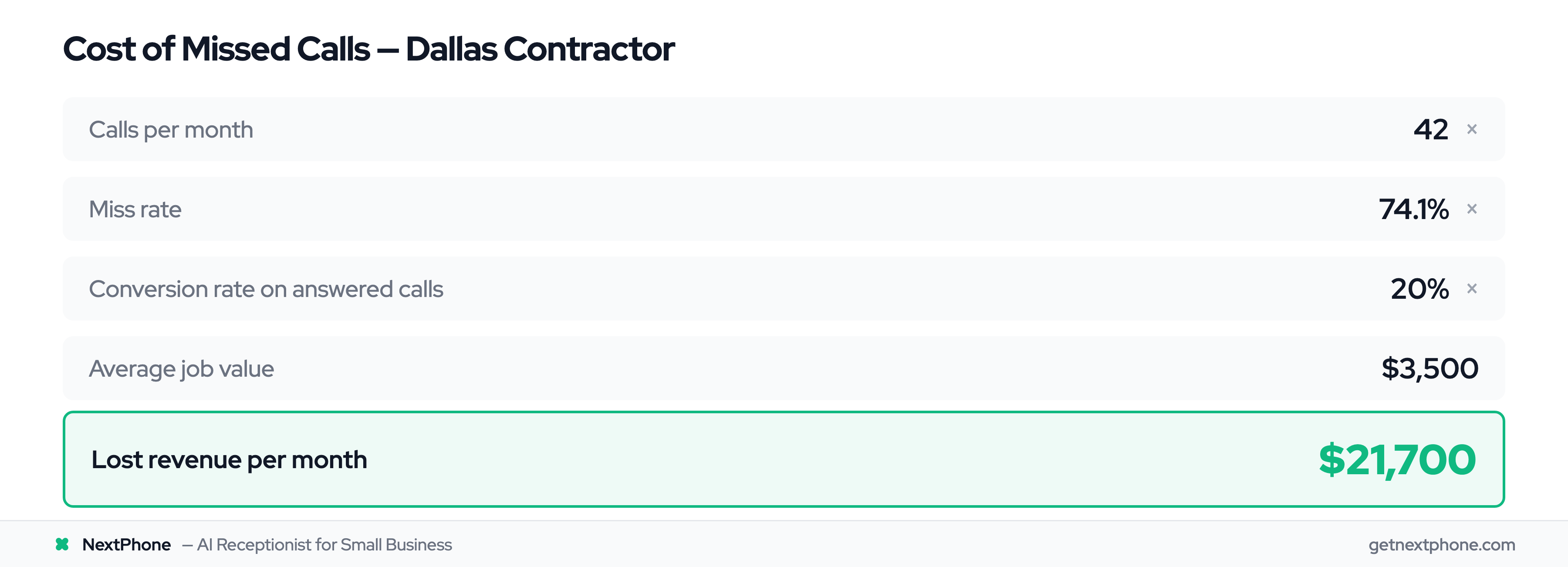
Let's do the math for a typical Dallas contractor.
The average home services business receives 42 calls per month. With a 74.1% miss rate, that's 31 missed calls. If just 20% of those callers would have converted at an average job value of $3,500, you're looking at $21,700 in lost revenue every month.
That's $260,400 per year walking out the door.
The After-Hours Challenge
Here's another problem: 30-35% of all calls to small businesses come outside standard 9-5 hours. For home services contractors, our data shows that number climbs even higher. Emergency calls don't wait for business hours.
When a pipe bursts at 10 PM or an AC dies on a Saturday afternoon, those customers are calling for help. If they get voicemail, they're moving on to whoever answers.
Dallas Area Codes: Why 214, 469, and 972 Numbers Matter
When your phone displays an incoming call, what do you notice first? The area code.
Dallas Area Codes Explained
Dallas uses four main area codes:
- 214 - The original Dallas area code, established in 1947. This is the most recognized Dallas code and carries the strongest local association.
- 972 - Created in 1996 to handle growth in the suburbs. Covers much of the DFW metroplex.
- 469 - Added in 1999 as an overlay for the entire region.
- 945 - The newest overlay, introduced to meet demand.
All four codes serve the greater Dallas-Fort Worth area. From a caller's perspective, any of these codes signals "local Dallas business."
The Local Number Trust Factor
Phone number type directly affects whether customers answer your calls and trust your business. Data from Hiya's State of the Call Report shows the difference is significant:
- Local numbers (214, 469, 972): 60-70% answer rate, only 2-5% perceived as spam
- Toll-free numbers (800, 888): 40-50% answer rate, 20-30% perceived as spam
When customers see a local Dallas number, they assume you're a local business. That assumption builds trust. When you call them back from the same local number, they're far more likely to pick up.
Getting a Dallas Number Without a Dallas Office
Here's what many business owners don't realize: you don't need a physical office in Dallas to get a Dallas phone number.
Virtual phone numbers let you establish a local presence anywhere. A contractor based in Fort Worth can have a 214 number. A business owner in Austin can answer calls from a 469 number.
Modern answering services provide local numbers as part of their package. You pick the area code, and calls to that number route to the service.
Types of Answering Services Available in Dallas
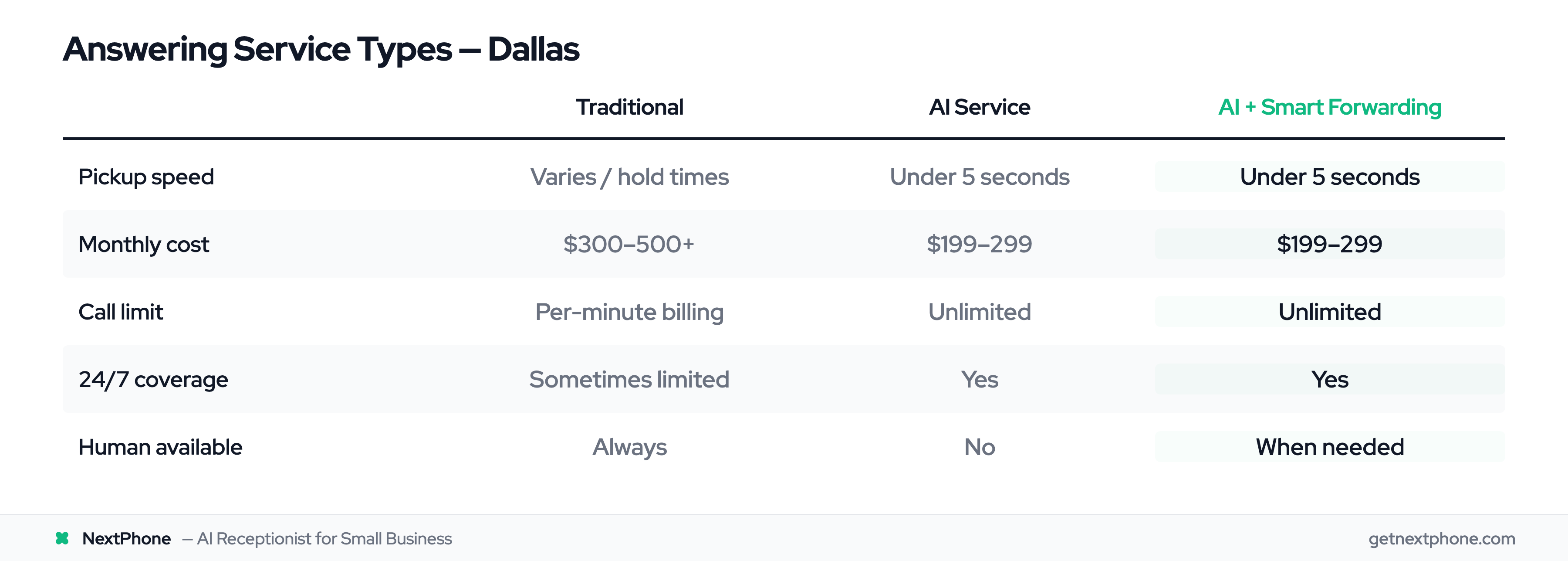
Not all answering services work the same way. Understanding your options helps you pick the right fit.
Traditional Live Answering Services
Traditional services employ human operators who answer your calls. They follow scripts you provide, take messages, and forward information.
Pros:
- Human touch for callers who prefer speaking to a person
- Can handle complex conversations
- Established industry with many providers
Cons:
- Per-minute or per-call billing adds up quickly
- Operators may handle dozens of clients, leading to inconsistent quality
- Limited hours at some services (not truly 24/7)
- Pricing typically runs $300-500+ per month for moderate call volume
AI-Powered Answering Services
AI answering services use conversational artificial intelligence to handle calls. Modern AI can understand natural language, answer questions, collect information, and route calls appropriately.
Pros:
- Answers every call in under 5 seconds
- Unlimited calls for flat monthly pricing
- True 24/7/365 coverage with no holidays or sick days
- Consistent quality on every call
- Typically $199-299 per month
Cons:
- Some callers still prefer human interaction
- May struggle with highly complex or unusual requests
AI-First with Smart Forwarding
The best solution for most businesses is AI-first with smart forwarding. AI handles the routine calls that make up the majority of your volume: business hours, pricing questions, appointment scheduling, basic information.
When calls need your attention, whether that's a complex question, an upset customer, or a true emergency, smart forwarding routes them to you or your team.
This approach captures the efficiency of AI while maintaining direct access to you when it matters most. Research shows AI can effectively handle 60-80% of typical business calls, freeing humans to focus on the 20-40% that truly require personal attention.
| Feature | Traditional Service | AI Service | AI + Smart Forwarding |
|---|---|---|---|
| Pickup Speed | Varies (may have hold times) | Under 5 seconds | Under 5 seconds |
| Monthly Cost | $300-500+ | $199-299 | $199-299 |
| Call Limit | Often per-minute billing | Unlimited | Unlimited |
| 24/7 Coverage | Sometimes limited | Yes | Yes |
| Human Available | Always | No | When needed |
Essential Features for Dallas Answering Services
When evaluating answering services, look for these capabilities.
24/7 Availability
Dallas summers don't care about your business hours. When temperatures hit triple digits, AC emergencies happen around the clock. When a pipe bursts at midnight, that homeowner needs help immediately.
Our data shows urgent calls rank among the top reasons people call home services businesses, using language like "emergency," "urgent," or "ASAP." True emergencies are a recurring reason people call and require an immediate response. Emergency jobs average $4,200 in revenue, significantly higher than routine work.
An answering service that works after hours captures this revenue instead of letting it go to voicemail.
Bilingual Support (English and Spanish)
The Dallas-Fort Worth metroplex has a significant Spanish-speaking population. Offering bilingual support expands your potential customer base and shows that you value serving the entire community.
Many traditional services charge extra for Spanish-language support. AI services can often handle multiple languages at no additional cost.
Call Routing and Emergency Handling
Not every call needs the same response. A question about your business hours can go to voicemail or be answered by AI. A customer whose basement is flooding needs to reach you immediately.
Look for services with smart emergency routing. The system should be able to identify urgent calls based on keywords and caller behavior, then route those calls directly to you while handling routine inquiries automatically.
CRM Integration and Call Logging
An answering service that doesn't connect to your other systems creates extra work. Look for services that integrate with:
- CRM systems (HubSpot, Salesforce, Zoho)
- Calendar tools (Google Calendar, Calendly)
- Communication platforms (Slack, email)
Every call should create a record. You should be able to see who called, when, what they needed, and what happened, without hunting through multiple systems.