Key Takeaways
- Call transcription automatically converts spoken conversations into searchable text
- Modern AI transcription achieves 85-99% accuracy depending on audio quality
- Primary benefits include searchable records, faster staff training, compliance documentation, and dispute resolution
- Businesses save an average of 2.2 hours per week by eliminating manual note-taking
- Call transcription is essential for healthcare, legal, and financial businesses with compliance requirements
- Built-in phone system transcription offers the simplest implementation path
What Is a Call Transcription Service?
Ready to Stop Missing Customer Calls?
Try NextPhone's AI receptionist free for 7 days. See how other small businesses are capturing more leads 24/7.
Get StartedA call transcription service uses speech-to-text technology to convert spoken words from phone calls into written text. The technology captures audio from your business calls and processes it through advanced AI algorithms that recognize speech patterns, apply grammar and punctuation, and produce readable transcripts.
Think of it as having a highly skilled note-taker on every call who captures every word accurately and delivers a clean document when the conversation ends.
Modern call transcription services use artificial intelligence and machine learning to continuously improve their accuracy. These systems can recognize different speakers, handle various accents, and even identify industry-specific terminology when properly configured.
Real-Time Transcription
Real-time transcription displays text on your screen as the conversation happens. Words appear almost instantly as each person speaks, allowing you to follow along with a written version of the call while it's still in progress.
This approach proves particularly useful for accessibility purposes, helping team members who are deaf or hard of hearing participate fully in phone conversations. It also allows you to copy specific phrases or quotes during the call itself.
Post-Call Transcription
Post-call transcription processes the audio after your conversation ends. The system typically delivers a complete transcript within minutes—often requiring about 30% of the original call duration to process.
Many businesses prefer post-call transcription because the additional processing time often results in higher accuracy. The AI has more context to work with and can apply corrections across the entire conversation rather than making split-second decisions about each word.
How Accurate Is Call Transcription?
Accuracy is the question everyone asks about call transcription services. The good news: modern AI-powered transcription has reached impressive levels that make it practical for everyday business use.
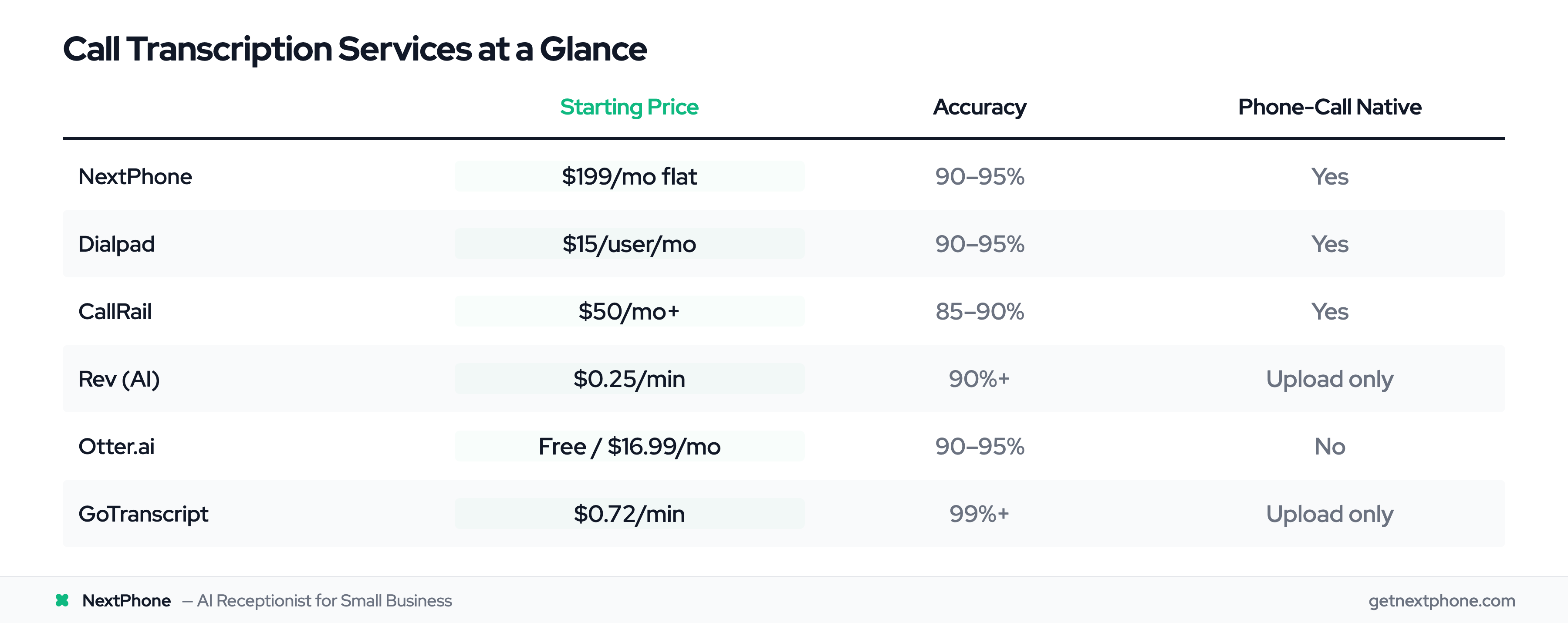
Industry-standard AI transcription achieves 85-99% accuracy depending on audio quality and speaking conditions. The standard measurement is Word Error Rate (WER), which calculates the percentage of words transcribed incorrectly. A 4% WER equals 96% accuracy—generally considered the threshold for professional-quality transcription.
Several factors affect transcription accuracy:
Audio Quality: Clear audio produces better results. High-quality headsets, good phone connections, and minimal background noise all contribute to higher accuracy rates.
Background Noise: Transcription systems struggle with competing sounds. A quiet office produces better results than a busy coffee shop or a manufacturing floor.
Speaker Clarity: Clear enunciation helps the AI recognize words correctly. Fast talkers, heavy accents, or mumbled speech can reduce accuracy.
Industry Terminology: Standard vocabulary transcribes more accurately than specialized jargon. Some services allow you to add custom dictionaries for industry-specific terms.
Number of Speakers: Conversations with multiple overlapping speakers present more challenges than one-on-one calls.
In optimal conditions with clear audio and distinct speakers, leading transcription services consistently achieve 95% or higher accuracy. Even in challenging conditions with background noise or difficult audio, accuracy typically remains above 85%.
For comparison, human transcriptionists average about 96% accuracy—a 4% error rate. AI transcription has essentially reached human-level performance for most business applications, with the added benefits of instant availability and dramatically lower cost.
When does accuracy matter most? Healthcare, legal, and financial services often require higher accuracy levels due to compliance requirements. For these industries, some businesses use human review to verify AI transcripts for critical documentation.
7 Key Benefits of Call Transcription for Your Business
Call transcription delivers value across multiple dimensions of business operations. Here are the seven most significant benefits that drive adoption.
1. Never Miss Important Details
The most immediate benefit of call transcription is simple: you capture every word without scrambling to write notes. When you're focused on taking notes during a call, you're not fully present in the conversation. You miss nuances, fail to ask follow-up questions, and struggle to build rapport because you're distracted by documentation.
With automatic transcription, you can give your full attention to the person on the other end of the line. Listen actively. Ask thoughtful questions. Build the relationship. The transcript captures the details so you don't have to.
After the call, you have an exact record of what was discussed. No more wondering, "Did they say the budget was $50,000 or $15,000?" No more second-guessing whether you remembered a deadline correctly. The transcript has the answer.
This accuracy extends to commitments made during calls. When a customer requests a specific feature or a vendor agrees to certain terms, the transcript provides an unambiguous record that both parties can reference.
2. Create Searchable Call Records
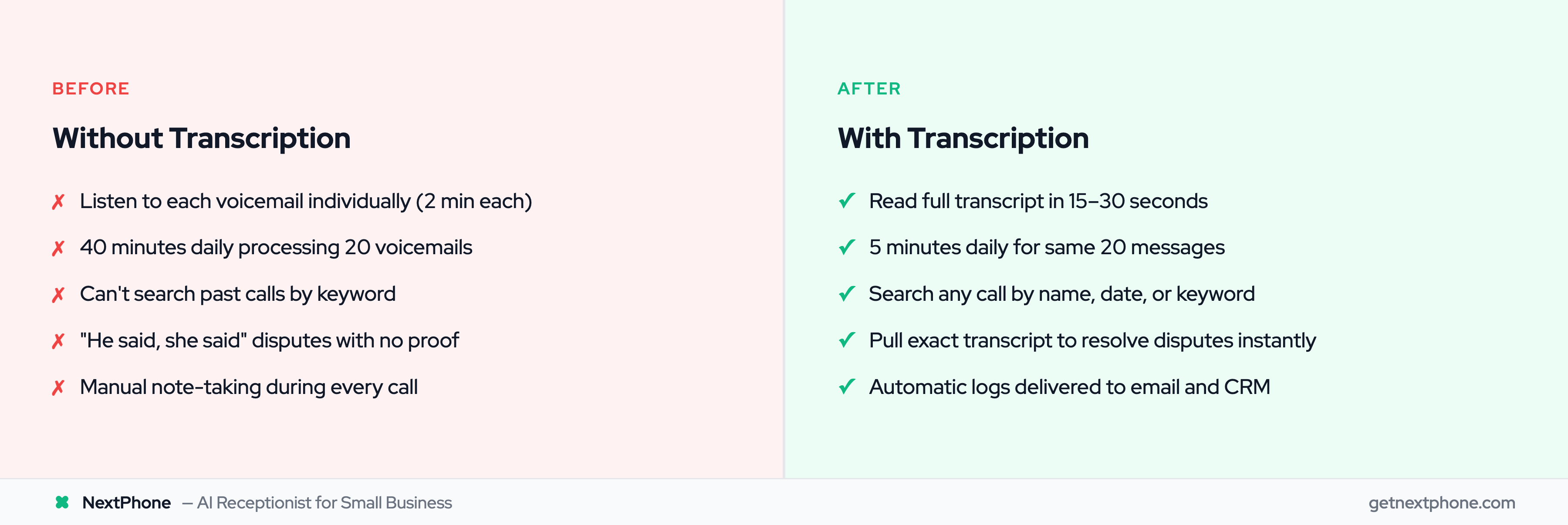
Recording calls is useful, but listening to hours of audio to find one specific conversation wastes valuable time. Call transcription solves this by converting audio into searchable text.
Need to find every call where a customer mentioned a competitor's product? Search for the competitor's name. Want to review all conversations with a specific client from the past quarter? Search their company name and filter by date. Looking for the call where your team discussed revised pricing? Search for relevant keywords.
This searchability transforms your call history from an inaccessible archive into a valuable knowledge base. Information that would take hours to locate through audio review becomes available in seconds.
Teams can share transcripts easily, allowing colleagues to quickly get up to speed on customer situations or project discussions. New team members can review past conversations to understand client relationships without requiring lengthy handoffs from departing employees.
3. Train New Staff Faster
Every business has high performers—salespeople who consistently close deals, support agents who turn frustrated customers into loyal advocates, account managers who build lasting relationships. Their calls contain valuable lessons, but those insights typically stay locked in their heads or lost in audio files.
Call transcription changes this equation. Transcripts from successful calls become training materials that show new hires exactly how experienced team members handle real situations.
Instead of role-playing hypothetical scenarios, trainees can study actual conversations. They see how top performers handle objections, ask discovery questions, or de-escalate frustrated customers. The specific language and techniques become visible and learnable.
Training time decreases because new employees learn from real examples rather than abstract concepts. They can reference transcripts when facing similar situations, building confidence faster. Managers can highlight specific transcript sections during coaching sessions, providing concrete feedback rather than vague direction.
4. Resolve Disputes Quickly
Disagreements happen in business. A customer claims they were promised a discount. A vendor says they never agreed to expedited shipping. A client insists the scope of work included additional services.
Without documentation, these disputes become frustrating exercises in memory and credibility. Each party believes their recollection is correct, and resolution often requires painful compromises or damaged relationships.
Call transcription provides objective documentation that resolves disputes quickly. The transcript shows exactly what was said, eliminating ambiguity and preventing misunderstandings from escalating.
This documentation also protects your business legally. If a dispute reaches formal proceedings, transcripts serve as evidence of what occurred. Many jurisdictions accept properly documented transcripts as legally admissible records.
Beyond dispute resolution, transcripts build trust with customers. When disagreements arise, you can review the exact conversation together, demonstrating transparency rather than defensiveness. This approach often strengthens relationships even when misunderstandings occur.
5. Meet Compliance Requirements
For businesses in regulated industries, call transcription isn't optional—it's required. Healthcare organizations must maintain accurate records of patient communications under HIPAA. Financial services firms face documentation requirements from multiple regulatory bodies. Legal practices need detailed records of client consultations.
HIPAA violations alone carry penalties ranging from $100 to $50,000 per incident, with annual maximums reaching $1.5 million per violation category. The cost of inadequate documentation far exceeds the investment in proper transcription.
According to the American Health Information Management Association, over 70% of healthcare organizations now rely on digital transcription to streamline documentation. The efficiency gains and compliance benefits make transcription a standard practice rather than an optional tool.
Call transcription creates time-stamped records that demonstrate compliance during audits. Regulators can verify that proper disclosures were made, required information was communicated, and documentation standards were maintained.
Even businesses outside heavily regulated industries benefit from compliance-ready documentation. Employment disputes, contract disagreements, and liability claims all become easier to address when you have accurate call records.
6. Extract Insights from Call Patterns
Individual call transcripts are useful. Hundreds of transcripts analyzed together reveal patterns that drive business improvement.
What questions do customers ask most frequently? Which objections come up repeatedly in sales calls? What language do your most successful team members use that others don't? Where do conversations typically stall or lose momentum?
Call transcription provides the raw material for answering these questions. With transcripts in searchable text format, you can identify trends across hundreds or thousands of conversations.
Sales teams discover which talking points resonate and which fall flat. Support teams identify recurring issues that might indicate product problems. Marketing teams learn which messages customers respond to and which create confusion.
Some transcription services include AI-powered analysis that automatically surfaces insights from call patterns. These tools can identify sentiment trends, track specific topic mentions over time, and flag calls that need attention.
The key insight: transcripts turn calls from ephemeral conversations into business intelligence that improves operations systematically.
7. Improve Accessibility
The Americans with Disabilities Act requires businesses to accommodate employees and customers with disabilities. For team members who are deaf or hard of hearing, phone calls present obvious barriers to full participation.
Call transcription removes these barriers. Real-time transcription allows deaf employees to follow phone conversations as they happen. Post-call transcripts ensure everyone has equal access to information discussed in calls they couldn't fully hear.
Beyond legal compliance, accessibility features reflect organizational values. When all team members can participate fully regardless of hearing ability, you retain talented employees who might otherwise struggle in phone-heavy roles.
Transcripts also benefit people without disabilities in various situations: reviewing calls in noisy environments, following up on conversations while commuting, or processing information more effectively through reading than listening.
Who Needs Call Transcription Services?
While call transcription benefits virtually any business that handles phone calls, certain industries and roles see particularly strong returns on investment.
Healthcare Practices
Medical offices document patient consultations, telehealth sessions, and care coordination calls. HIPAA-compliant transcription creates proper records while allowing providers to focus on patient care rather than documentation.
Specialists who conduct intake calls benefit from complete records that can be added to patient charts. Mental health practitioners maintain session documentation without the distraction of note-taking during sensitive conversations.
Legal Firms
Attorneys document client consultations, witness interviews, and opposing counsel conversations. Transcripts become part of case files and can serve as evidence in proceedings.
Law firms handling high volumes of calls use transcription to ensure nothing falls through the cracks during busy litigation periods. Paralegals can review transcripts to prepare case summaries without listening to hours of recordings.
Sales Teams
Sales professionals conduct discovery calls, product demonstrations, and negotiation conversations. Transcripts capture customer requirements, objections raised, and commitments made—information that often determines deal outcomes.
Sales managers review transcripts to coach team members, identify winning approaches, and understand why deals close or stall. Win-loss analysis becomes data-driven rather than based on salesperson recollections.
Customer Service Centers
Support teams document customer issues, troubleshooting steps, and resolution details. Transcripts create continuity when multiple agents work with the same customer over time.
Quality assurance teams review transcripts to evaluate agent performance, identify training needs, and ensure service standards are met. Customer complaints become easier to investigate when exact conversation records exist.
Any Business Taking Calls That Matter
Small businesses without dedicated note-takers benefit from automatic documentation. Remote teams need shared records that everyone can access. Busy professionals who handle calls while multitasking appreciate having transcripts to review later.
If a phone call contains information you need to remember, reference, or share, call transcription provides value.
Key Features to Look for in a Call Transcription Service
Not all call transcription solutions offer the same capabilities. Here are the features that separate adequate services from excellent ones.
Essential Features
Automatic Transcription: The best services transcribe calls automatically without requiring you to remember to press a button or start a recording. Set it and forget it.
High Accuracy: Look for services that consistently achieve 85% or higher accuracy. Ask about performance in challenging conditions and whether the system improves over time.
Speaker Identification: Quality transcripts label which person said what. Without speaker diarization, transcripts become confusing documents where you can't tell who made specific statements.
Timestamps: Time markers let you jump to specific moments in the original audio if you need to verify a transcript section or hear the tone of a particular exchange.
Searchable Archive: Transcripts should be searchable by keyword, date, participant, and other criteria. An archive you can't search provides limited value.
Advanced Features
Real-Time Transcription: Live text display during calls enables accessibility and allows copying quotes while conversations are still in progress.
AI Summaries: Some services automatically generate call summaries highlighting key points, action items, and decisions made.
Keyword Alerts: Set up notifications when specific words or phrases appear in transcripts—useful for tracking competitor mentions, compliance terms, or customer sentiment.
CRM Integration: Transcripts that automatically attach to customer records in your CRM eliminate manual data entry and ensure information stays connected.
Voicemail Transcription: Extend transcription to voicemails so you can scan messages quickly without listening to each recording.
Security Features
Encryption: Ensure transcripts are encrypted both in transit and at rest. Sensitive business conversations require proper protection.
Compliance Certifications: For healthcare, look for HIPAA compliance. For businesses with European customers, verify GDPR compliance. Financial services may require additional certifications.
Access Controls: Determine who can view which transcripts. Some conversations may be confidential to specific team members.
How NextPhone Makes Call Transcription Easy
Many businesses approach call transcription as a separate service to add onto their existing phone system. This creates complexity: multiple vendors, additional software, integration challenges, and extra costs.
NextPhone takes a different approach by building transcription directly into the business phone system. Every call can be automatically transcribed without additional software, separate subscriptions, or technical configuration.
When transcription is built into your phone system, setup is simple. There's no integration project, no API connections to configure, and no separate login to manage. Transcription works automatically across all your business calls.
Transcripts appear in the same interface where you manage calls, voicemails, and contacts. Search across your call history to find any conversation. Review transcripts alongside call recordings. Share relevant conversations with team members with a few clicks.
This integrated approach means one provider handles your business phone service and call transcription together. One bill. One support team to contact with questions. Consistent experience for everyone on your team.
For businesses that want call transcription without the complexity of bolting together separate systems, built-in transcription provides the simplest path forward.
Getting Started with Call Transcription
Implementing call transcription effectively requires some planning. Here's how to approach it.
Assess Your Needs: Consider your call volume, compliance requirements, and how you'll use transcripts. A small business taking 20 calls per day has different needs than a call center handling thousands.
Evaluate Accuracy Requirements: Standard business calls typically work fine with AI transcription at 85-95% accuracy. Healthcare, legal, or compliance-critical conversations may require human review for sensitive documentation.
Check Integration Requirements: Will transcripts need to appear in your CRM, helpdesk system, or other tools? Verify that your chosen solution supports necessary integrations.
Review Security Features: Ensure the service meets your industry's compliance requirements and provides appropriate encryption and access controls.
Test Before Full Rollout: Start with a small group to evaluate accuracy with your specific types of calls, speaking styles, and terminology. Adjust configuration based on results.
Brief Your Team: Let employees know that calls will be transcribed. Explain the benefits and how to access transcripts. Address any concerns about the new capability.
Establish Organization Systems: Create naming conventions, folders, or tags that will make transcripts easy to find as your archive grows. A few minutes of planning prevents hours of searching later.
Frequently Asked Questions
How accurate is automatic call transcription?
Modern AI-powered call transcription achieves 85-99% accuracy depending on audio quality and speaking conditions. Clear audio with minimal background noise and distinct speakers produces the best results, often exceeding 95% accuracy. Challenging conditions like noisy environments, heavy accents, or overlapping speakers may reduce accuracy to the 85-90% range. For comparison, professional human transcriptionists average about 96% accuracy.
Is call transcription legal?
Recording and transcribing calls is legal in most circumstances, but consent requirements vary by location. Some states and countries require only one party's consent (which can be you), while others require all parties to consent. Best practice is to inform callers that the call may be recorded and transcribed, either through a brief disclosure at the start of the call or through your phone system's automated announcement. Consult with legal counsel about requirements in your specific jurisdictions.
How long does it take to get a transcript?
Real-time transcription displays text immediately as words are spoken. Post-call transcription typically delivers complete transcripts within minutes after the call ends—often requiring about 30% of the call's duration for processing. A 10-minute call might have a transcript available in 3-4 minutes. Some services prioritize speed while others prioritize accuracy, so processing times vary by provider.
Can call transcription work with my existing phone system?
Many transcription services integrate with popular business phone systems through APIs or built-in partnerships. However, integration complexity varies significantly. Some require technical configuration, while others work only with specific phone platforms. The simplest approach is using a phone system with transcription built in, which eliminates integration challenges entirely. NextPhone includes transcription as a native feature.
What about confidential or sensitive calls?
Reputable transcription services use encryption to protect transcripts in transit and at rest. Look for services with security certifications appropriate to your industry—HIPAA for healthcare, SOC 2 for general business use. Access controls let you restrict who can view specific transcripts. For highly sensitive conversations, consider services that process data on-premises rather than in the cloud, or that offer enhanced security tiers.
How much does call transcription service cost?
Pricing varies widely. Some business phone systems include transcription in standard plans at no additional cost. Standalone transcription services typically charge per minute of audio (often $0.10-0.50 per minute) or through monthly subscriptions based on usage tiers. Enterprise solutions may offer volume discounts. When evaluating cost, factor in the time savings—if transcription saves 2 hours per week of manual note-taking, the ROI often justifies the investment quickly.
Can I transcribe past call recordings?
Many transcription services accept uploaded audio files, allowing you to transcribe historical recordings. This batch processing typically incurs per-minute charges similar to live transcription. Audio quality of older recordings affects accuracy, so results may vary. If you have a backlog of important recordings to transcribe, ask potential providers about bulk pricing and expected accuracy for your specific audio quality.
Turn Your Calls Into Business Assets
Every business call contains valuable information: customer needs, commitments made, problems identified, opportunities discovered. Without transcription, that information exists only in participants' memories—memories that fade, distort, and eventually disappear.
Call transcription transforms ephemeral conversations into permanent, searchable business records. Details that would otherwise be forgotten become accessible forever. Information trapped in audio files becomes text you can find in seconds.
The benefits compound over time. Training materials accumulate from successful calls. Dispute resolution becomes straightforward with accurate records. Compliance documentation happens automatically. Customer insights emerge from patterns across hundreds of conversations.
For businesses ready to stop losing information from phone calls, call transcription has become an essential capability. The technology is mature, accuracy is high, and costs have fallen to the point where transcription makes sense for businesses of virtually any size.
NextPhone builds transcription directly into the business phone system, eliminating the complexity of separate services and integrations. If you're ready to turn your calls into searchable, shareable business assets, it's worth exploring how integrated transcription can work for your team.