
The Phone Rings. Is It Worth Answering?
Americans receive 158 million robocalls every single day. U.S. consumers received 52.5 billion robocalls in 2025—the highest in 6 years. That translates to 1,833 spam calls hitting phones across the country every second. For business owners and professionals, each one of those calls represents a decision: answer and risk wasting time on spam, or ignore and potentially miss a customer emergency.
This calculation has become exhausting. And the hidden cost runs deeper than the momentary annoyance. According to research from the University of California, Irvine, every interruption - even a brief one - steals an average of 23 minutes and 15 seconds of productive focus. When you multiply that by the volume of unwanted calls hitting business phones, the productivity drain becomes staggering.
AI call screening has emerged as the solution that changes this equation entirely. Rather than forcing you to make split-second decisions about every incoming call, artificial intelligence handles the analysis instantly - blocking spam, identifying genuine urgency, and routing calls to the right destination before you even know the phone rang.
This technology operates on three pillars: spam filtering to block the bad calls, priority detection to identify the urgent ones, and intelligent routing to ensure every legitimate caller reaches the right person. The result is a phone system that works for your business rather than against it.
The Spam Call Problem: Understanding the Scale
The numbers behind America's robocall epidemic are difficult to comprehend. In the first eight months of 2024 alone, U.S. phones received 38.8 billion robocalls, according to data from YouMail's Robocall Index.
Hiya's State of the Call report found that roughly 30% of calls to mobile phones are spam, and only 52% of calls are answered by Americans—partly due to this spam epidemic.
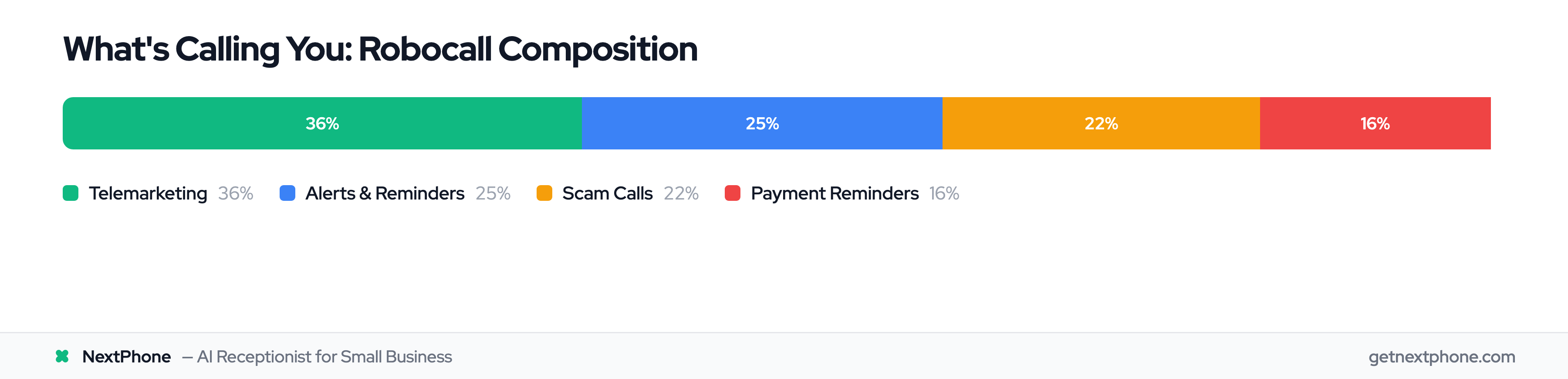
Breaking down the composition of these calls reveals a mixed picture. Telemarketing accounts for 36% of all robocalls, while alerts and reminders make up 25%. Scam calls - the truly malicious ones - represent 22% of the total, with payment reminders comprising the remaining 16%. Analysis of 2025 spam call data shows the financial impact continues climbing, with victims losing an average of $3,690 to scam robocalls in the first half of 2025, up 16% from the previous year. 68 million Americans (26%) have lost money to phone scams.
For businesses specifically, the spam problem manifests differently across industries. Data from NextPhone's analysis of real business call patterns shows that 7% of all incoming calls to businesses are spam or robocalls - automatically filtered before they reach users. That might sound manageable, but certain industries face far higher rates. Electricians, for example, experience a 15.5% spam rate - the highest among trades. That means roughly one in six calls to an electrical contractor is unwanted noise.
The threat landscape is also evolving. Robocalls hit a 6-year high in 2025 with a 15.4% surge, while only 44% of voice providers have installed caller ID authentication. Research from Hiya's Voice Intelligence Platform found that 25% of calls analyzed in their honeypot systems contained AI-generated audio—1 in 4 spam calls now use AI-generated voices. Of those AI-generated calls, 55% were identified as fraud - scammers using deepfake technology to deceive recipients. This isn't a future problem; it's happening now.
The True Cost of Phone Interruptions
Beyond the annoyance factor, every unwanted call carries a measurable productivity cost. Dr. Gloria Mark's groundbreaking research at UC Irvine established that workers need an average of 23 minutes and 15 seconds to fully refocus after an interruption. The interruption itself might last only seconds, but the cognitive recovery extends far longer.
The frequency compounds this problem dramatically. Studies show that knowledge workers are interrupted approximately 15 times per hour - once every four minutes on average. Research from Michigan State University demonstrated that even brief interruptions of just 4.4 seconds can triple the rate of errors when employees return to their original task. A 2.8-second interruption doubles the error rate.
At scale, these interruptions represent enormous economic losses. Research from Basex calculated that interruptions cost the U.S. economy $588 billion annually. Jonathan Spira, author of Overload!, estimated that interruptions consume 28 billion wasted hours each year, representing nearly $1 trillion in lost productivity.
Consider the math for a typical small business receiving 30 calls per day. If 7% are spam - the average from NextPhone's data - that's roughly two unwanted calls daily. At 23 minutes of lost focus per interruption, that's 46 minutes of productivity lost to spam calls every single day. Over a five-day work week, that's nearly four hours. Annually? That approaches 200 hours of productive time evaporated.
And this calculation only accounts for spam. The interruption cost applies equally to legitimate calls that arrive at inconvenient moments. This is where AI call screening's second capability - priority detection - becomes critical. The goal isn't merely blocking bad calls; it's ensuring that when your phone does ring, it's genuinely worth answering.
How AI Call Screening Works: The Technology Behind Smart Filtering
Modern AI call screening systems combine multiple technologies to make instant, accurate decisions about incoming calls. Understanding these components helps explain why AI screening dramatically outperforms traditional call blocking methods.
Machine Learning Pattern Recognition
At the foundation of AI call screening lies machine learning - algorithms that analyze patterns across millions of calls to identify spam signals. Unlike static blocklists that only recognize previously flagged numbers, ML systems detect anomalies in real-time: repetitive calls from the same number hitting thousands of phones simultaneously, unusual timing patterns, volume spikes from specific area codes, and caller behavior that deviates from legitimate calling patterns.
Critically, these systems learn continuously. When carriers migrated from static rules to real-time machine learning, they reported 40% higher catch rates in identifying spam calls. The system grows smarter with every call it analyzes.
Natural Language Processing for Intent Recognition
Natural language processing (NLP) enables AI to understand not just who is calling, but why they're calling. Through automatic speech recognition (ASR), the system transcribes and analyzes the first seconds of a call in real-time.
This analysis detects multiple signals. Robocall signatures like monotonic pitch, fixed pacing, and scripted phrases ("urgent message," "final notice") trigger immediate filtering. Conversely, the system identifies genuine urgency indicators - language patterns that suggest a caller has a time-sensitive need versus sales pressure tactics designed to create false urgency.
NextPhone's analysis found that 15.9% of calls to businesses contain urgency language. AI screening distinguishes between authentic urgency ("there's water flooding my basement") and manufactured pressure ("this is your final warning"), ensuring legitimate urgent calls receive priority while manipulation attempts get filtered. This urgency detection feeds directly into AI lead qualification, scoring callers based on intent and readiness to buy.
Voice Analysis and Authentication
The most sophisticated AI screening systems incorporate voice analysis to combat emerging threats. STIR/SHAKEN protocols - mandated by the FCC - authenticate caller ID information to detect spoofing. Beyond authentication, AI models analyze voice characteristics to detect synthetic speech.
Research shows that models combining MFCC spectrograms (audio frequency analysis) with transformer-based encoders achieve 92% precision in robocall detection while maintaining latency under 250 milliseconds. These same architectures detect AI-generated speech by analyzing phase coherence and breath-noise artifacts - subtle audio characteristics that distinguish human voices from deepfakes.
This multi-layered approach - pattern recognition, intent analysis, and voice authentication - enables AI screening to make accurate decisions in fractions of a second, before you even register that your phone rang.
The Three Pillars of AI Call Screening

Effective AI call screening delivers value through three distinct capabilities: defense against spam, detection of priority calls, and intelligent direction to the right destination.
Pillar One: Spam and Robocall Filtering (Defense)
The defensive layer blocks unwanted calls before they become interruptions. When a call arrives, AI screening cross-references multiple data sources: known spam databases, caller ID authentication results, and behavioral analysis of the calling pattern.
Real-time decisions happen instantly. Known spam numbers get blocked outright. Suspicious calls might route to voicemail for screening. Calls from verified business numbers or known contacts pass through normally.
NextPhone's data shows this filtering layer intercepting 7% of all incoming business calls as spam or robocalls. For industries like electrical contracting - where spam rates reach 15.5% - effective filtering can eliminate one in six incoming interruptions entirely.
The system also adapts continuously. When new spam campaigns launch using fresh phone numbers, pattern recognition identifies the coordinated behavior and begins filtering before traditional blocklists update.
Pillar Two: Priority and Urgency Detection (Detection)
Blocking spam addresses only half the challenge. AI screening's detection layer identifies which legitimate calls deserve immediate attention versus which can wait.
This capability relies on urgency language recognition - NLP analysis that identifies keywords, phrases, and speech patterns indicating time-sensitivity. NextPhone's analysis reveals that 15.9% of business calls contain urgency language. Not all of these are true emergencies, but they represent calls where the caller perceives immediate need.
The system weighs multiple factors beyond language. Caller history matters: repeated calls from the same number might indicate increasing urgency. Time context matters: a call at 10 PM carries different weight than the same call at 2 PM. Caller identification matters: known VIP customers or emergency contacts receive automatic priority.
Pillar Three: Intelligent Call Routing (Direction)
The third pillar ensures calls reach the right destination efficiently. Traditional phone systems force callers through rigid menus or require human receptionists to triage calls. AI routing makes these decisions instantly and intelligently.
NextPhone data indicates that 6.2% of calls to businesses are genuine emergencies requiring immediate routing. AI screening identifies these calls and ensures they reach someone who can help - whether that means breaking through do-not-disturb settings, routing to on-call staff, or escalating to business owners directly.
For non-emergency calls, intelligent routing reduces wait times by 30-40% compared to traditional systems. Callers reach the right person on the first attempt rather than bouncing through transfers. The result is better customer experience and reduced burden on staff who no longer serve as human switchboards.
AI Screening in Action: Real-World Scenarios
Understanding how AI call screening works in practice makes its value tangible.
The Contractor on a Job Site
An HVAC technician is troubleshooting a commercial unit when his phone buzzes. Without AI screening, he faces a choice: answer and potentially lose focus on a complex diagnosis, or ignore and potentially miss an urgent customer call.
With AI screening, that decision is made for him. The spam call trying to sell extended warranties never rings through - blocked automatically. Twenty minutes later, another call comes in. This one rings because AI detected urgency language: a longtime customer's AC failed during a heat wave. The technician takes the call knowing it warranted the interruption.
The Small Business After Hours
A plumber receives a call at 7 PM, well after business hours. AI screening analyzes the call in real-time. The caller mentions a "burst pipe" and "water everywhere" - clear emergency language. The system routes the call directly to the on-call plumber, bypassing voicemail entirely.
An hour later, another after-hours call arrives. This caller wants to schedule a routine appointment for next week. AI screening recognizes the non-urgent nature and routes to voicemail with a professional message promising next-day callback. The on-call plumber's evening remains uninterrupted for non-emergencies.
The High-Volume Service Business
A property management company handles 50+ calls daily. Without AI screening, staff spend significant time on spam calls, sales pitches, and routing calls to the right department. With AI screening, spam gets filtered automatically (that 7% represents 3-4 fewer interruptions daily), urgent maintenance requests get priority, and routine calls route to appropriate team members without human switchboard intervention.
The Electrician's Challenge
An electrical contractor faces the 15.5% spam rate that plagues the trade - the highest among all service industries. Without AI screening, roughly one in six calls is wasted time. With AI filtering, those calls never ring through. The electrician answers their phone with confidence, knowing the screening layer has already eliminated the noise.
How NextPhone Approaches AI Call Screening
NextPhone built its AI call screening capabilities specifically for small businesses and service professionals who can't afford dedicated IT resources but need enterprise-grade call management. Combined with AI virtual receptionist functionality, the system provides comprehensive call handling.
The system automatically filters the 7% of calls identified as spam or robocalls - preventing interruptions before they happen. For the remaining calls, urgency detection identifies the 15.9% containing language indicating time-sensitive needs, ensuring these callers receive priority handling.
Emergency routing recognizes the 6.2% of calls representing genuine emergencies. These calls break through do-not-disturb settings and reach business owners or on-call staff immediately - whether that's a pipe burst at midnight or a customer stranded with a broken-down vehicle.
What distinguishes NextPhone's approach is the underlying data. These aren't theoretical capabilities based on lab testing. The 7% spam rate, 15.9% urgency detection, and 6.2% emergency routing figures come from analysis of actual calls to real businesses. The system understands industry-specific challenges - like the elevated 15.5% spam rate electricians face - because it's learned from real patterns.
Setup requires no complex IT infrastructure. The system works with existing phone numbers, operates on mobile devices, and begins learning business-specific patterns immediately upon activation.
The Future of AI Call Screening
AI call screening technology is advancing rapidly, driven by both technological progress and regulatory support.
Apple's iOS 26 and Android's native AI screening features signal that call filtering is becoming standard phone functionality, not optional software. Google's on-device AI scam detection began rolling out broadly in 2024, though adoption remains relatively low - fewer than 4% of Android users have enabled screening features.
Regulatory momentum is accelerating adoption. The FCC's 2024 ruling explicitly made AI-generated voices in robocalls illegal, expanding enforcement tools against deepfake scammers. The FTC's Project Point of No Entry reduced illegal robocall traffic by 70% from targeted providers, demonstrating that coordinated action can meaningfully reduce spam volumes.
For businesses, early adoption of AI screening creates competitive advantage. While the technology becomes increasingly standard, organizations implementing sophisticated screening today protect their productivity now and build call pattern data that makes their systems smarter over time.
Industry research indicates that 90% of telecom companies are already using AI in some capacity, with 41% actively deploying AI solutions and 48% in piloting phases. Business adoption is following, recognizing that AI call screening has moved from nice-to-have to essential infrastructure.
Frequently Asked Questions
How does AI call screening differ from traditional call blocking?
Traditional call blocking relies on static blocklists - databases of known spam numbers that get blocked automatically. This approach only catches calls from previously identified numbers. AI call screening uses pattern recognition, real-time analysis, and intent detection to identify spam calls even from new, unknown numbers. The system learns continuously, adapting to new spam tactics as they emerge rather than waiting for blocklist updates.
Will AI call screening block legitimate calls by mistake?
False positive rates on modern AI screening systems are extremely low - well under 1% for properly calibrated systems. Most solutions offer whitelist capabilities for important contacts, ensuring they always get through regardless of other signals. Emergency override features allow callers to bypass screening when truly urgent. Additionally, systems learn from user corrections: if you mark a blocked call as legitimate, the system adjusts its model accordingly.
How quickly does AI make screening decisions?
AI call screening decisions happen in fractions of a second - typically under 250 milliseconds for initial analysis. Callers experience no perceptible delay. The system continues analyzing throughout the call for ongoing threat detection, but the initial route/block decision happens essentially instantaneously.
Can AI call screening detect deepfake or AI-generated voices?
Yes. Advanced screening systems analyze voice characteristics to detect synthetic speech. Models combining audio frequency analysis with neural network architectures achieve 92% precision in identifying robocalls and AI-generated voices. As deepfake technology improves, detection capabilities are advancing in parallel - this is an active area of development across the industry.
What types of businesses benefit most from AI call screening?
Any business where phone interruptions impact productivity benefits from AI screening. High-volume businesses (50+ calls daily) see the most immediate impact from spam filtering. Service professionals - contractors, trades, healthcare providers - benefit from urgency detection that ensures emergencies get through while spam gets blocked. Industries with elevated spam rates, like electrical contractors facing 15.5% spam, see particularly strong ROI from filtering capabilities.
How does AI determine if a call is urgent or an emergency?
AI screening analyzes multiple factors to assess urgency. Language analysis identifies keywords and phrases indicating time-sensitivity ("emergency," "flooding," "broken down"). Caller history matters - repeated calls from the same number may indicate increasing urgency. Time-of-day context influences routing: after-hours calls receive different treatment than business-hours calls. Caller identification allows known VIP customers or emergency contacts to receive automatic priority regardless of what they say.
Is AI call screening expensive to implement?
Modern AI call screening solutions are accessible for businesses of all sizes. Cloud-based systems eliminated the need for expensive on-premise hardware. Many solutions operate on per-user or per-line pricing that scales with business size. The ROI calculation typically favors adoption: between productivity savings (eliminating 23-minute interruptions from spam calls) and improved customer experience (urgent callers reaching the right person faster), the investment often pays for itself quickly.
Conclusion: Let AI Handle the Filtering So You Can Focus on What Matters
AI call screening represents a fundamental shift in how businesses manage incoming calls. Rather than forcing human judgment on every ring - answer or ignore, urgent or spam, transfer or handle - artificial intelligence makes these decisions instantly and accurately.
The technology delivers value across three dimensions. Defense blocks the 7% of calls that are spam or robocalls, eliminating interruptions that steal productivity. Detection identifies the 15.9% of calls containing urgency language, ensuring time-sensitive callers receive priority attention. Direction routes the 6.2% of genuine emergencies to the right person immediately, regardless of time or circumstances.
The underlying economics make the case clearly. With interruptions costing 23 minutes of refocus time each, and spam calls reaching billions per month nationwide, AI screening isn't optional for businesses that value productivity. Organizations implementing AI call screening report 95%+ accuracy in distinguishing wanted from unwanted calls - letting the phone become a business tool again rather than a constant source of interruption.
Your phone should connect you to customers, not telemarketers. To opportunities, not scammers. To emergencies that need your attention, not robocalls that waste your time. AI call screening makes that vision reality - filtering the noise so you can focus on what actually matters for your business.
Ready to experience phone calls that work for you instead of against you? Explore how NextPhone's AI call screening protects your productivity while ensuring you never miss an important call.
Sources: University of California, Irvine (Dr. Gloria Mark); YouMail Robocall Index; Hiya Voice Intelligence Platform; Federal Trade Commission; Federal Communications Commission; Basex Research; Michigan State University; Stanford University; NextPhone proprietary data analysis.