Your phone buzzes while you're hooking up a Honda Civic on I-95. A stranded motorist needs help - their car just died in the middle lane with traffic flying past. But you can't answer with your hands on a winch cable and your back to oncoming traffic.
Thirty seconds later, they've called your competitor. Job lost.
This happens constantly in the towing business. The US towing industry handles over 100 million roadside calls annually, according to industry data. Every one of those calls represents someone in need - and typically, the first company to answer gets the job.
This guide breaks down what towing answering services do, how much they cost, and how to pick one that keeps your phone answered while you're doing what you do best: getting people back on the road.
Why Every Missed Call Costs Your Towing Business
The towing industry faces a unique problem: the very act of doing the job makes it nearly impossible to answer the phone.
The On-the-Hook Problem
When you're securing a vehicle on a busy highway, you can't safely reach for your phone. When you're operating a winch, you can't chat with a customer. When you're navigating a flatbed through traffic, you can't take dispatch calls.
This creates a brutal catch-22. The busier you are (good for business), the more calls you miss (bad for business). And unlike other service industries where customers might leave a voicemail and wait, towing customers are usually stranded somewhere they don't want to be.
They're not going to wait.
Why Towing Is a First-to-Answer Business

Car emergencies happen at the worst possible times - 3 AM on a Tuesday, during a rainstorm, on the side of a dark highway. When someone's car breaks down, they want help now. Not in an hour. Not tomorrow. Now.
This urgency changes the competitive dynamics entirely. Research shows that 78% of customers buy from whichever company responds first. Not the cheapest. Not the best-reviewed. The first one to pick up the phone.
In towing, that's not a statistic - it's the entire business model. If you don't answer, someone else will.
The Industry Scale: 100+ Million Calls
The towing industry is bigger than most people realize. According to IBISWorld's 2025 industry report, the US automobile towing market is worth $11.3 billion, spread across 39,202 businesses.
AAA alone responds to over 30 million roadside assistance calls per year. Add in all the independent towing companies, police rotations, and roadside assistance programs, and the industry handles an enormous volume of calls daily.
That's a lot of competition. And every call you miss is a call your competitor answers.
What Is a Towing Answering Service?
A towing answering service is a third-party solution that answers your business calls around the clock, so you don't have to choose between towing a car and talking to a customer.
How Towing Answering Services Work
The setup is straightforward:
- A customer calls your towing company's phone number
- The call forwards to the answering service (either automatically or after a few rings)
- A live agent or AI receptionist answers professionally with your business name
- They collect the caller's information: location, vehicle type, nature of the problem
- They either dispatch a driver, transfer the call to you, or send you a text/email with the details
The goal is simple: make sure every call gets handled, whether you're on the hook, eating dinner, or sleeping.
Types of Services: Live Agents vs AI
Towing answering services fall into two main categories:
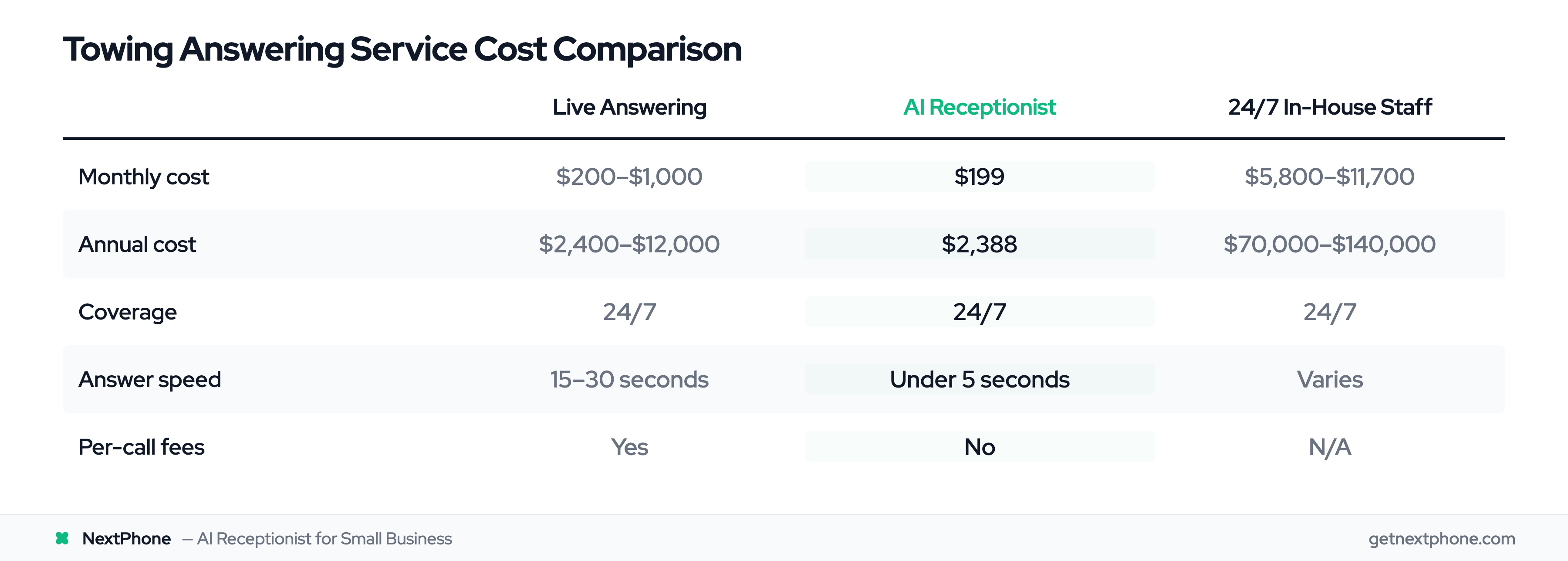
Live answering services employ human agents who answer calls on your behalf. They follow scripts you provide and can handle complex conversations, emotional callers, and unusual situations. However, they typically charge per minute or per call, and quality can vary depending on the agent.
AI receptionists use artificial intelligence to answer calls, collect information, and take actions like sending text alerts or booking appointments. They answer instantly (usually under 5 seconds), work for a flat monthly fee regardless of call volume, and provide consistent responses every time. For routine calls, they're often faster and more reliable than human agents.
Most towing companies find that AI handles 80-90% of calls effectively, with the option to transfer complex situations to a human.
What They Handle for You
A good towing answering service handles the standard tasks that eat up your time:
- Collecting caller information (name, phone, location)
- Gathering vehicle details (make, model, color, license plate)
- Assessing urgency (breakdown vs. accident vs. stuck in a dangerous location)
- Dispatching notifications to your drivers
- Answering common questions (service area, estimated arrival, pricing)
- Taking messages when immediate dispatch isn't needed
The result: you get the information you need without the interruption of answering every call yourself.
The Real Cost of Missed Towing Calls
Missing calls isn't just inconvenient - it's expensive. Let's look at the actual numbers.
The Math: What One Missed Call Costs
The average local tow costs around $150. Long-distance tows, heavy-duty jobs, and emergency calls often run $350 or more.
Let's do some simple math:
-
Conservative scenario (local tows): Conservative scenario (local tows):
-
1 missed call per day
-
$150 average tow
-
30 days per month
-
Assuming 20% would have converted to paying jobs
That's 30 missed calls × $150 × 20% = $900/month minimum in lost revenue
-
More realistic scenario (mix of tow types): More realistic scenario (mix of tow types):
-
1 missed call per day
-
$200 average tow value
-
30 days per month
-
25% conversion rate
30 × $200 × 25% = $1,500/month lost
But here's the real kicker: many towing companies miss far more than one call per day. One tow truck company owner put it bluntly: "We were losing at least one call a day, and at $150 a tow, that adds up fast. That's over $4,000 a month, just gone."
That company later recovered $50K+ in annual revenue simply by fixing their call handling.
| Missed Calls/Day | Avg Tow Value | Monthly Loss (20% conv.) | Annual Loss |
|---|---|---|---|
| 1 | $150 | $900 | $10,800 |
| 1 | $250 | $1,500 | $18,000 |
| 2 | $150 | $1,800 | $21,600 |
| 2 | $250 | $3,000 | $36,000 |
| 3 | $200 | $3,600 | $43,200 |
Why 85% of Callers Never Call Back
Here's the part that makes missed calls so devastating: the customer you didn't answer almost certainly isn't trying again.
Research from BIA/Kelsey shows that 85% of callers who reach voicemail never call back. They don't leave a message. They don't try later. They call the next company on their search results.
Think about it from the caller's perspective. They're stranded on the side of the road. They need help. They called you and got voicemail. Are they going to wait around hoping you call back? Or are they going to immediately dial the next number?
You know the answer.
The First-Responder Advantage
The Lead Response Management Study from MIT found that 78% of customers buy from whichever vendor responds first. In towing, this effect is amplified because:
- Customers are often in stressful, time-sensitive situations
- They don't want to shop around while sitting on a highway
- The service is commoditized - one tow truck is pretty much like another
- Speed and availability matter more than price for most emergency calls
This means the battle for towing customers often comes down to one simple question: Who answered the phone first?
Key Features Every Towing Answering Service Needs
Not all answering services are created equal. For towing companies specifically, here's what to look for.
24/7/365 Availability
This one's non-negotiable. Breakdowns don't follow business hours. Neither do accidents, dead batteries, or flat tires.
If your answering service only works Monday through Friday, 9 to 5, you're missing the calls that matter most. After-hours calls often represent higher-value emergency work with less competition (because other companies aren't answering either).
Research from Ruby Receptionists shows that 30-35% of calls to service businesses come outside traditional business hours. For towing companies, that number is likely even higher given the emergency nature of the work.
Emergency Call Escalation and Routing
A good towing answering service doesn't treat every call the same. Someone whose car won't start in their driveway is different from someone stranded on a dark interstate at midnight.
Look for services that can:
- Recognize urgency keywords (emergency, accident, stranded, dangerous)
- Immediately transfer urgent calls to your on-duty driver
- Send instant text alerts for emergencies that need fast action
- Follow custom escalation protocols you define
The goal is to make sure truly urgent calls get to you immediately, while routine calls can be handled without interrupting your work.
Dispatch Integration and Driver Alerts
The answering service is only as good as its ability to get information to your team. At minimum, look for:
- Text message alerts with caller details and location
- Email notifications with full call summaries
- Phone call transfers for urgent situations
- Optional integration with dispatch software
The best services can send alerts to multiple drivers based on who's on duty, which jobs they're assigned to, or which zone they're working in.
Bilingual Support
Depending on your service area, Spanish-English bilingual support can be valuable. Language barriers cost calls, and if a Spanish-speaking customer can't communicate with your answering service, they'll find one they can communicate with.
Many AI answering services include multilingual support at no extra cost.
Call Recording and Logging
Every call should be recorded and logged for quality control, dispute resolution, and training purposes. You should be able to review:
- Call recordings (audio)
- Transcripts (text)
- Caller information collected
- Actions taken (dispatch sent, message taken, call transferred)
- Timestamps for accountability
This creates a complete record of every customer interaction, which protects both you and the customer.