
Introduction
A new client works up the courage to call your practice. They've been thinking about it for weeks - maybe months. They finally pick up the phone, hands shaking slightly, heart racing.
They get your voicemail.
The recording says you'll call back within 24-48 hours. But for someone who already struggled to dial your number, that voicemail feels like a wall. Research shows 85% of callers who don't reach someone won't try again. For mental health callers battling anxiety, stigma, or shame, that percentage is almost certainly higher.
A therapist answering service catches those calls when you can't. It handles confidential intake, schedules first appointments, and triages crisis situations - all while maintaining the privacy and security your practice requires.
Here's how it works, what it costs, and what to look for.
Why Therapists Miss Calls (And Why It Matters More)
The Solo Practitioner Reality
Most therapists are solo practitioners or work in small group practices without dedicated administrative staff. Your typical day looks something like this:
- 8:00 AM - 12:00 PM: Back-to-back 50-minute sessions, 10-minute breaks barely enough for notes
- 12:00 PM - 1:00 PM: Lunch, returning yesterday's calls (if you're lucky)
- 1:00 PM - 6:00 PM: More sessions, more 10-minute breaks
- 6:00 PM - 7:00 PM: Finishing notes, dealing with insurance claims, trying to return calls
During those 8 hours of sessions, every incoming call goes straight to voicemail. And unlike a plumbing company or a law firm, you can't hire a minimum-wage receptionist to sit at a desk - you need someone who understands confidentiality, speaks with empathy, and knows what information they can and can't collect.
The result is a painful loop: you're too busy seeing clients to bring in new clients.
The Vulnerability Factor
Here's what makes therapy practices different from every other industry that misses calls: your callers are often at their most vulnerable.
Someone reaching out to a therapist for the first time is frequently dealing with anxiety, depression, grief, relationship crisis, or other difficult situations. The act of calling already required overcoming significant internal resistance. Stigma. Shame. The voice saying "you don't really need help."
When that person reaches voicemail, they don't just think "I'll try again later" like someone calling a restaurant. They think: "Maybe this is a sign. Maybe I'm not ready. Maybe I shouldn't bother."
The barrier to calling back is exponentially higher for mental health callers than for any other type of business inquiry. That 85% who won't call back? For therapy practices, the real number likely approaches 90% or higher.
The Math on Missed New Clients
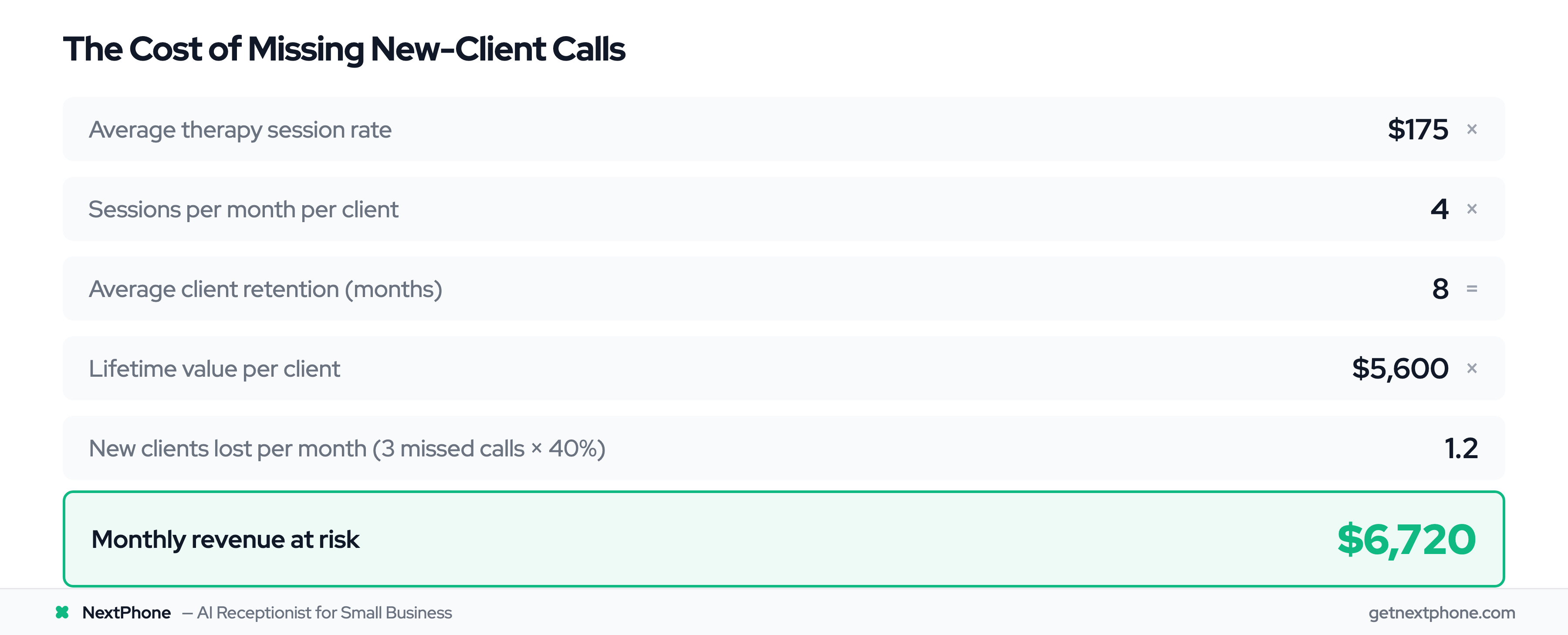
Let's put revenue numbers on this:
- Average therapy session: $150-$250 (let's use $175 as a midpoint)
- Weekly sessions per client: 1 (standard for most practices)
- Monthly revenue per client: $175 x 4 = $700
- Average client retention: 6-12 months (let's use 8 as average)
- Lifetime value per client: $700 x 8 = $5,600
Now consider: if you miss just 3 new-client inquiry calls per month that would have converted (a 40% conversion rate on intake calls is typical for therapy), that's:
- 3 calls x 40% = 1.2 new clients lost per month
- 1.2 x $5,600 LTV = $6,720/month in lost revenue
- Annual impact: $80,640 in potential revenue never realized
For a solo practitioner earning $120,000-$180,000 per year, losing $80K in potential revenue is massive. And it's happening silently - you never know about the calls you never received.
Handling Sensitive Client Information
Therapy intake calls carry information clients expect to stay private — name, phone number, reason for reaching out, insurance details, sometimes referral context. Your answering service is handling that information on your behalf, so its data practices matter.
What to Collect on Intake (and What Not To)
A well-configured intake call collects what's needed to schedule and prepare, nothing more:
- Appropriate to collect: Name, phone number, email, insurance carrier and member ID, preferred appointment times, general reason for seeking therapy (anxiety, relationship issues, grief), referral source, whether they've seen a therapist before
- Not appropriate for intake calls: Detailed symptom history, trauma narratives, medication details, previous diagnoses, anything that belongs in a clinical setting
The line is: collect enough to schedule and prepare, save clinical details for the session.
What to Ask Your Answering Service About Data
Before sharing any client information with a provider, ask:
- Encryption. Is call data encrypted in transit and at rest?
- Access controls. Who can view recordings, transcripts, and call logs?
- Audit trails. Is there a log of who accessed what, and when?
- Retention and deletion. Where is data stored, for how long, and can you delete it on request?
- Incident response. What happens if there's a security issue?
Services differ widely. Some are purpose-built for regulated healthcare; others are general business tools. Verify your provider's practices match your practice's obligations before sharing any client data.
What Confidential Client Intake Looks Like
A proper therapy intake call isn't a generic "how can I help you" script. It's a carefully structured conversation that collects necessary information while respecting boundaries and projecting warmth.
Essential Information to Collect
The intake call should capture:
- Contact details: Full name, phone number, email address
- Scheduling preferences: Days/times available, in-person vs telehealth preference
- Insurance information: Carrier name, member ID, group number (for verification before first session)
- Referral source: How they found your practice (helps with marketing)
- General presenting concern: "What brings you to therapy?" (brief, not clinical depth)
- Urgency level: Routine inquiry vs immediate need vs crisis
- Therapist preferences: Gender, specialization area, specific therapist requests (for group practices)
Sensitive vs Non-Sensitive Fields
A good answering service draws a clear line:
| Information Type | Collect on Intake? | Why |
|---|---|---|
| Name and contact info | Yes | Needed to schedule and follow up |
| Insurance details | Yes | Verify coverage before first session |
| General reason for calling | Yes (briefly) | Helps match with right therapist |
| Preferred schedule | Yes | Books appropriate time slot |
| Detailed symptoms | No | Clinical conversation for session |
| Trauma history | No | Requires therapeutic environment |
| Medication list | No | Clinical, verify during session |
| Previous diagnoses | No | Discuss with therapist directly |
How AI Handles Intake Questions
Modern AI answering services conduct intake conversationally, not like a checklist interrogation. The flow sounds natural:
- "Hi, thank you for calling [Practice Name]. I'd be happy to help you get started. Can I get your name?"
- "And what brings you to us today?" (open-ended, lets caller share what they're comfortable with)
- "I'd love to get you scheduled for a first appointment. Do you have a preference for days and times?"
- "Do you have insurance you'd like us to verify? I just need the carrier name and your member ID."
The AI adapts based on responses. If a caller shares only that they're "going through a hard time," that's enough. No pressing for details. If they volunteer more, it's documented appropriately.
What Gets Stored and How
All collected information should be:
- Encrypted at rest and in transit
- Accessible only to authorized practice staff
- Stored in compliance with your record retention requirements
- Available for the therapist to review before the first session
- Deletable upon request or end of relationship
The therapist receives a summary: caller name, contact info, insurance, availability, brief reason for calling, and urgency level. That's enough to prepare without reading a clinical narrative.
Handling Crisis Calls: When Seconds Matter
This is the highest-stakes scenario for any therapist answering service. A caller in crisis can't wait for a callback.
Identifying Crisis Situations
The answering service must recognize crisis indicators:
- Explicit statements of self-harm or suicidal ideation
- Expressions of immediate danger to self or others
- Severe distress that can't wait for a scheduled appointment
- References to harming others
- Callers who sound impaired or confused in alarming ways
AI-powered services can be trained to flag specific language patterns and immediately change protocols when crisis indicators appear.
Escalation Protocols
A proper crisis triage protocol works in tiers:
- Immediate transfer: Call routed to the on-call therapist's cell phone
- If on-call unavailable: Warm transfer to local crisis line or 988 Suicide & Crisis Lifeline
- Documentation: Every crisis call logged with timestamp, caller info, and action taken
- Follow-up notification: Therapist receives urgent alert even if transfer succeeded
The key principle: a crisis caller should never be left with only a voicemail. Ever. The answering service must have a clear path to a live human for emergencies.
When to Transfer Immediately
Configure your answering service with clear rules:
- Any mention of suicide, self-harm, or harm to others = immediate transfer
- Caller in active distress and requesting to speak with therapist = immediate transfer
- Caller reporting domestic violence or abuse situation = immediate transfer or crisis line
- All other calls = message taken, therapist notified, standard callback timeline
This isn't just good practice - it's an ethical obligation. And it's something voicemail simply cannot provide.
Features That Matter for Mental Health Practices
Not every answering service works for therapists. Here's what the right one offers.
Clear Data Practices
Your answering service handles client information on your behalf. Verify how it stores, encrypts, and controls access to call data — and make sure those practices match what your practice is obligated to provide.
Empathetic, Conversational Tone
First impressions matter enormously in therapy. Your answering service is often a client's very first interaction with your practice. The greeting should be:
- Warm, not corporate
- Patient, not rushed
- Validating ("Thank you for reaching out - that's an important step")
- Non-judgmental in language and tone
AI services can be configured with specific personality parameters. The best ones sound like a kind, competent office coordinator - not a robot reading a script.
Appointment Scheduling Integration
Your answering service should connect with your practice management system or calendar. When a new client calls, the service should be able to offer available time slots and confirm the appointment on the spot. No "someone will call you back to schedule."
This is critical because for anxious callers, every delay creates another opportunity to back out. Scheduling during the first contact locks in commitment.
After-Hours Coverage
Mental health crises don't follow business hours. Neither do moments of motivation. When a client finally decides "today's the day I get help," it might be 9 PM on a Saturday. An after-hours answering service captures that motivation before it fades.
Research suggests 30-35% of calls to small businesses come outside standard hours. For therapy practices where clients work during the day and reflect at night, that percentage may be even higher.
Customizable Intake Questions
Every practice is different. A CBT-focused anxiety clinic needs different intake information than a couples therapist or a child psychologist. Your answering service should let you customize:
- Which questions to ask (and in what order)
- How deeply to explore presenting concerns
- What specializations to route to (in group practices)
- Which insurance carriers you accept
- Telehealth vs in-person availability
What a Therapist Answering Service Costs
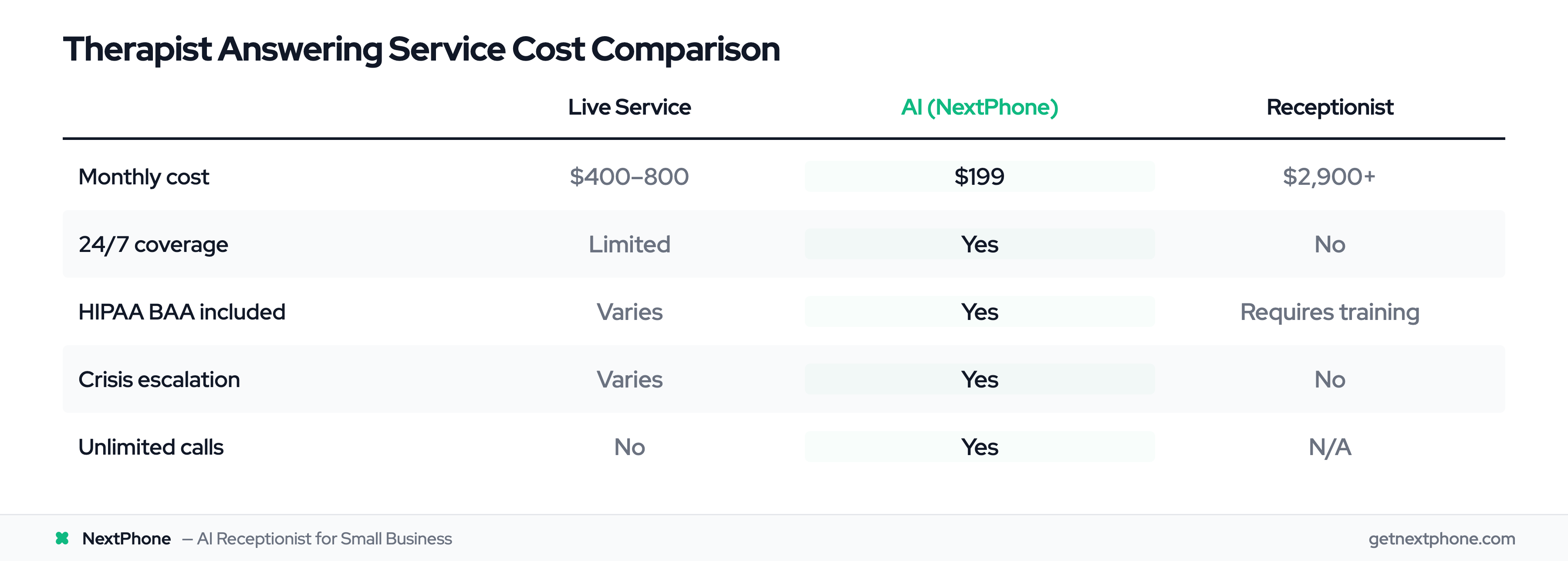
Traditional Live Services ($400-800/month)
Live answering services with trained operators typically cost $400-800/month for a set number of calls. Per-call overages apply during busy periods. You get human operators who understand mental health terminology and can handle sensitive calls with empathy.
Pros:
- Human connection for sensitive calls, experienced operators
Cons:
- Expensive, per-call overages, may still have limited hours
AI Answering Services ($100-300/month)
AI-powered options like NextPhone run $199/month for unlimited calls with no overages. The AI answers instantly, conducts intake, schedules appointments, and escalates crisis calls - all 24/7.
Pros:
- Unlimited calls, instant response, 24/7, much cheaper, consistent tone
Cons:
- Not a human voice (though modern AI is highly conversational)
Hiring a Receptionist ($35,000+/year)
A part-time front desk person costs $18-22/hour for limited coverage. Full-time is $35,000+ annually. Neither covers after-hours, and both require privacy training you'll need to provide and document.
Pros:
- Human, handles other admin tasks, flexible
Cons:
- Limited hours, expensive, requires privacy training, sick days
The ROI for Therapists
The math is straightforward:
- Annual cost of NextPhone: $199/month x 12 = $2,388/year
- Lifetime value of ONE new client: $5,600 (8 months x $700/month)
- ROI if you capture just one extra client per year: 134% return
In reality, a 24/7 answering service will likely capture significantly more than one additional client per year. For a solo practitioner, even two or three extra clients per year means the service pays for itself many times over.
Compare that to the alternative: $80,000+ in potential revenue silently walking away because you were in session when they called.
How NextPhone Handles Confidential Therapy Intake
NextPhone takes the AI approach to therapy answering: the AI picks up every call in under 5 seconds with a warm, empathetic greeting configured specifically for mental health practices.
Here's what that looks like:
- Instant, empathetic response: Answers before the third ring with a greeting tailored to your practice's tone
- Custom intake workflow: Configured for mental health - collects appropriate information, avoids clinical depth
- Crisis detection: Trained to recognize crisis language and immediately transfer to your on-call number or crisis line
- Appointment scheduling: Integrates with your calendar to book first sessions on the spot
- SMS confirmations: Sends appointment reminders to reduce no-shows
- Email notifications: Delivers intake summary to you after each call
- $199/month unlimited: No per-call charges, no overages, no surprises
The combination of instant response, confidential handling, and crisis triage means your most vulnerable callers get help immediately - not a voicemail that feels like a door closing.
Frequently Asked Questions
Is it secure to use an AI answering service for therapy?
Security depends on the specific provider. Look for encryption in transit and at rest, access controls on recordings and transcripts, clear retention and deletion policies, and a defined incident response process. Verify your provider's practices match your practice's obligations before sharing any client information.
Can an answering service handle crisis calls?
A properly configured service should never leave a crisis caller with just a voicemail. The service should recognize crisis indicators (suicidal ideation, self-harm, immediate danger) and immediately transfer to your on-call number or a crisis line like 988. This is a minimum requirement for any therapy answering service.
What information should intake calls collect for therapists?
Collect: name, contact info, insurance carrier and member ID, general reason for seeking therapy, scheduling preferences, and referral source. Do not collect: detailed symptom history, trauma narratives, medication lists, or previous diagnoses. Save clinical depth for the actual session with the therapist.
How much does a therapist answering service cost?
Traditional live answering services run $400-800/month with per-call overages. AI-powered services like NextPhone cost $199/month for unlimited calls. A part-time receptionist costs $18-22/hour for limited coverage. Given that one new client represents $5,600+ in lifetime value, even the most expensive option typically delivers positive ROI.
Will clients feel comfortable talking to an AI about mental health?
Modern AI answering services don't conduct therapy - they handle intake logistics. Clients speak with the AI about scheduling, insurance, and general reasons for calling. The conversation is brief, practical, and professional. Most callers care more about reaching someone quickly than whether that someone is human. What matters is warmth, competence, and getting their appointment scheduled.
Stop Losing Clients to Voicemail
Every missed intake call represents someone who gathered the courage to seek help - and hit a wall. For therapy practices, the cost isn't just financial (though at $5,600 per lost client, it adds up fast). It's the clients who needed you and couldn't reach you.
A therapist answering service ensures that when someone is ready to start therapy, there's a warm, confidential, professional voice on the other end. Not a recording. Not silence. An actual response.
The practices building full caseloads aren't necessarily the best clinicians. They're the ones answering every call.