
It's 2 AM. Your phone rings. Is it an 80-year-old with no heat during a snowstorm? Or someone casually asking about a quote for next month's AC installation?
Without triage, you have two bad options. Option one: wake up your technician for every call, burning them out and paying overtime for non-emergencies. Option two: send everything to voicemail, missing the genuine emergencies that represent your highest-value work.
Neither works. What you need is triage—a system that routes truly urgent calls to on-call staff while scheduling callbacks for everything else. In healthcare, nurse triage is safe in 97% of cases, and the same principles apply to any service industry with emergencies.
In our analysis of 130,175 calls to home services businesses, 15.9% contained urgency language like "emergency," "urgent," or "ASAP." But only 6.2% were true emergencies—active flooding, total power loss, no heat in dangerous cold. The other 9.7% felt urgent to the caller but could absolutely wait until morning.
Here's how to build a triage system that catches the real emergencies and lets everyone else sleep.
The Case for After-Hours Triage

After-hours calls aren't a nuisance—they're where some of your best opportunities live. A dedicated AI after-hours answering system captures these opportunities automatically.
Research shows 73% of calls to home services businesses happen outside standard 9-5 hours. That's evenings, weekends, early mornings—times when most businesses send callers to voicemail.
The problem with voicemail for everything: you miss the emergencies. A burst pipe at 2 AM doesn't wait until 8 AM. By the time you get the message, water has been flooding for six hours, the customer called three other plumbers, and someone else is already onsite.
Emergency jobs average $4,200—significantly higher than routine work. They command premium pricing because customers need help now. Miss the call, miss the premium.
But the problem with routing everything to on-call: burnout. If your technician gets woken up for quote requests and routine scheduling, they won't last. And you're paying overtime for calls that could have been voicemails.
Triage solves both problems. In medical settings, proper triage achieves ED avoidance rates up to 90% and saves an average of $84.58 per triaged call. For home services, emergencies reach someone immediately. Everything else gets scheduled for callback.
Three-Tier Triage: Emergency, Moderate, Routine
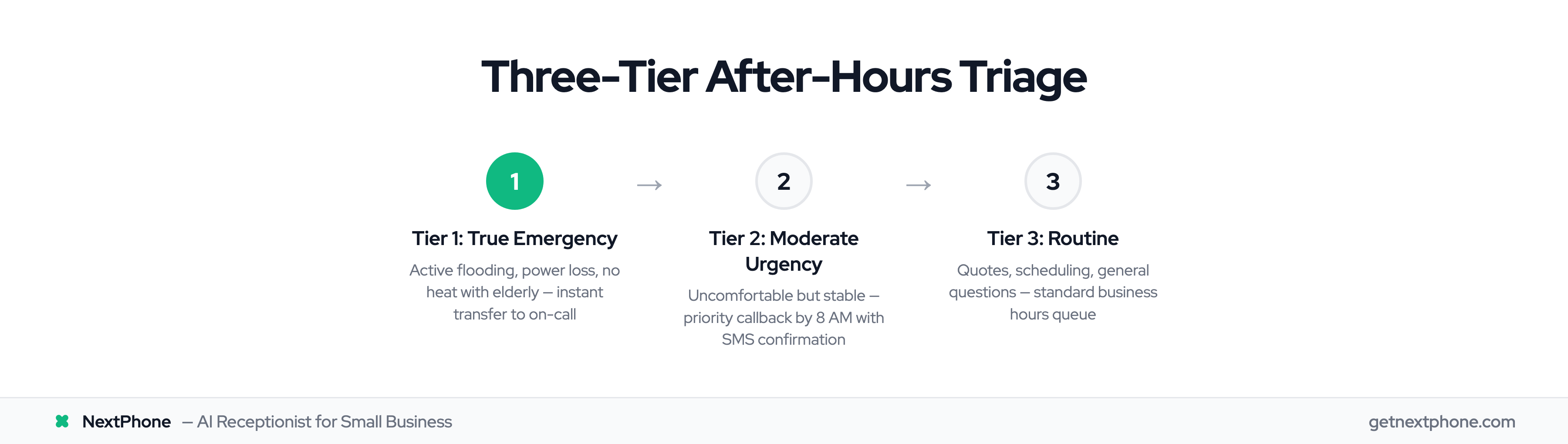
Effective triage uses three levels, not two. A 2025 pediatric triage study found 78.2% of calls were appropriately triaged using structured protocols. The binary "emergency or not" misses the middle category—calls that are genuinely urgent but don't need a 2 AM technician dispatch.
Tier 1: True Emergency
Definition: Immediate safety risk, active damage occurring, or vulnerable people involved.
Characteristics:
- Someone could be harmed if not addressed immediately
- Damage is actively getting worse right now
- Involves elderly, children, or people with medical conditions in dangerous situations
Action: Instant transfer to on-call staff. No voicemail option. Caller must reach someone.
Examples:
- Pipe burst and water is flooding the house
- Complete power loss with medical equipment dependent on electricity
- No heat and temperature inside is dropping below 50—F with elderly resident
- Gas smell
Tier 2: Moderate Urgency
Definition: Problem exists and is concerning, but not an immediate safety risk. Needs attention soon—ideally first thing tomorrow—but not at 2 AM.
Characteristics:
- Situation is uncomfortable but not dangerous
- Problem is stable, not actively worsening
- Morning response would be acceptable
Action: Collect caller information, confirm early next-morning callback (by 8-9 AM), send SMS confirmation.
Examples:
- AC not cooling well on a warm (but not dangerous) night
- Slow drain that's getting worse but not yet blocked
- No hot water (uncomfortable, not dangerous)
- Refrigerator stopped working (food at risk but not emergency)
Tier 3: Routine
Definition: General inquiries, quotes, scheduling requests—anything that can wait for normal business hours.
Characteristics:
- No urgency
- Informational or planning-oriented
- Standard business day response is expected
Action: Voicemail or callback queue. Acknowledgment message that response will come during business hours.
Examples:
- Quote requests for future projects
- Questions about services offered
- Scheduling for next week
- Follow-up on existing proposals
What Counts as Emergency by Industry
"Emergency" means different things in different contexts. A clear definition for your industry prevents false alarms and ensures real emergencies get through.
HVAC Emergencies
True Emergency (Tier 1):
- No heat in winter with temperature below 50—F inside
- No AC when outside temperature exceeds 95—F with elderly or very young children
- Gas smell from furnace
- Carbon monoxide alarm sounding
Moderate Urgency (Tier 2):
- AC not cooling effectively but home is still livable (80—F inside, not 100—F)
- Heat working inconsistently—warm air sometimes
- Strange noise from unit but still functioning
Routine (Tier 3):
- Maintenance scheduling
- Quote for new system installation
- Questions about efficiency or upgrades
Key Context: "No AC" in July with 95—F outside and elderly homeowner is Tier 1. "No AC" in April with 70—F outside is Tier 3.
Plumbing Emergencies
True Emergency (Tier 1):
- Active flooding—water is spreading
- Burst pipe with water flowing
- Sewage backup into living space
- No running water in entire house
Moderate Urgency (Tier 2):
- Leak under sink but contained with bucket
- Slow drain getting progressively worse
- No hot water (water heater issue)
- Toilet clogged but other bathroom available
Routine (Tier 3):
- Dripping faucet
- Quote for bathroom renovation
- Water pressure seems lower than usual
Key Context: "Water leak" could be Tier 1 or Tier 3 depending on whether it's active flooding or a minor drip.
Electrical Emergencies
True Emergency (Tier 1):
- Complete power loss (not neighborhood outage)
- Burning smell from outlet or panel
- Sparking outlet
- Exposed wires due to damage
Moderate Urgency (Tier 2):
- Partial power loss (some circuits working)
- Breaker keeps tripping
- Light flickering in one area
Routine (Tier 3):
- Outlet not working (single outlet)
- Adding circuits for renovation
- Questions about electrical panel upgrade
Key Context: "Power out" needs clarification—neighborhood outage (not your problem) vs house-specific (potentially your emergency).
Legal/Professional Services
True Emergency (Tier 1):
- Client arrested and needs representation
- Court deadline within hours
- Restraining order needed immediately
- Document must be filed tonight
Moderate Urgency (Tier 2):
- Consultation needed within 24-48 hours
- Urgent question about ongoing case
- Document review needed soon
Routine (Tier 3):
- General inquiry about services
- Quote for future matter
- Scheduling a consultation
Roofing/Exterior
True Emergency (Tier 1):
- Active leak during rain—water entering home
- Tree through roof
- Structural damage visible
Moderate Urgency (Tier 2):
- Leak noticed, rain expected within 24 hours
- Damage visible but not actively leaking
- Gutter detached and hanging
Routine (Tier 3):
- Quote for replacement
- Shingle damage spotted, no immediate concern
- Maintenance questions
How to Route Each Urgency Level
Once you've classified the call, route it appropriately.
Tier 1: Immediate Transfer
True emergencies get transferred to on-call staff instantly. No voicemail option—the caller must reach a human.
Routing logic:
- Detect emergency indicators (keywords, caller confirmation)
- Transfer immediately to on-call phone
- If no answer after 30 seconds — escalation tree (see next section)
- Confirm with caller: "I'm connecting you to our on-call technician now"
The caller should never hit voicemail for a true emergency. If your primary on-call doesn't answer, the system escalates.
Tier 2: Scheduled Priority Callback
Moderate urgency gets acknowledgment and a specific callback commitment.
Routing logic:
- Collect caller information (name, phone, issue description)
- Confirm callback window: "We'll call you back first thing tomorrow, by 8 AM"
- Send SMS confirmation: "Received your call about [issue]. Callback scheduled for tomorrow by 8 AM."
- Place in priority queue for morning
The caller knows exactly what to expect. They're not left wondering if their message was received.
Tier 3: Standard Queue
Routine calls go to voicemail or standard callback queue.
Routing logic:
- Thank caller for reaching out
- Explain response timing: "We'll return your call during business hours"
- Route to voicemail or callback system
- No urgency commitment—normal priority
This is your default for non-urgent after-hours calls.