
Your phone rings. You're on a ladder installing shingles, hands full of roofing nails. By the time you climb down, the caller has already moved on to the next contractor on their list.
This scene plays out thousands of times every day across America. Industry research on calls to home services businesses found a brutal reality: 74.1% of calls go completely unanswered. That's three out of every four potential customers who never reach a live person.
The fix isn't hiring a $35,000/year receptionist most small businesses can't afford. The answer is finding an answering service that fits your budget while capturing those missed opportunities. This guide breaks down every option - from budget-friendly AI to premium live services - so you can pick the right solution for your business.
What Missed Calls Actually Cost Your Business
Most business owners underestimate how much unanswered calls hurt their bottom line. The numbers tell a different story.
The Math Behind Lost Revenue
Let's walk through the calculation for a typical home services contractor:
A plumber, electrician, or HVAC technician receives about 42 calls per month. With a 74.1% miss rate, that's 31 calls going unanswered every single month.
Now, not every call converts to a job. But if just 20% of those missed callers would have become customers at an average project value of $3,500, the math gets ugly fast:
31 missed calls x 20% conversion x $3,500 = $21,700 per month in lost revenue
Stretch that over a year: $260,400 walking out the door.
One plumber running a two-truck shop discovered he'd missed 76 calls in a single month. His reaction? "I didn't even know I was missing that many calls. I just thought business was slow."
Emergency Calls: The Highest-Value Losses
Not all calls are created equal. Our call data shows urgent calls with keywords like "emergency," "urgent," or "ASAP" rank among the top reasons people call. True emergencies are a recurring reason too - burst pipes, power outages, AC failures in 95-degree heat.
Emergency jobs average $4,200 in revenue, significantly higher than routine work. Missing just one emergency call per week costs $16,800 per month - over $200,000 annually.
When a homeowner's basement is flooding at 9 PM, they're not leaving a voicemail and waiting until morning. They're calling the next plumber on Google.
Why Voicemail Doesn't Work Anymore

Here's the uncomfortable truth about voicemail: industry research shows that 80% of callers who reach voicemail never call back. Even worse, 75% don't bother leaving a message at all.
They don't hate your business. They just have ten other options one Google search away.
The MIT/InsideSales speed-to-lead study found that 78% of customers buy from whichever company responds first. Not the cheapest company. Not the best-reviewed company. The first one to pick up the phone.
Every unanswered call hands a potential customer to your competition.
Understanding Your Options: 4 Types of Answering Services
Before picking a service, you need to understand what's available. Answering services fall into four main categories, each with distinct advantages and trade-offs.
Live Answering Services (Human Receptionists)
Live answering services employ actual humans who answer calls on your behalf. They can handle complex conversations, build rapport, and navigate tricky situations that require emotional intelligence.
Popular providers include Ruby Receptionists, Smith.ai, and AnswerConnect. These services shine when relationship-building matters - think legal consultations or high-value sales calls where personal connection drives decisions.
The downside? Cost. Ruby's plans range from $250/month for just 50 minutes to $1,725/month for 500 minutes. That per-minute billing can cause bill shock during busy seasons.
AI Answering Services
AI answering services use natural language processing to hold actual conversations with callers. The technology has improved dramatically - modern AI handles appointment scheduling, answers FAQs, collects customer information, and routes urgent calls to your phone.
These services typically charge flat monthly rates between $50-$300, making budgeting predictable. They answer instantly (under 5 seconds) and handle multiple simultaneous calls without putting anyone on hold.
About 70% of consumers now say they're comfortable interacting with AI for routine tasks. The technology handles 70-85% of typical business inquiries without human intervention.
Automated IVR Systems
Interactive Voice Response systems - the "press 1 for sales, press 2 for support" menus - represent the cheapest option. Some are free with business phone plans.
But there's a reason IVR systems frustrate callers. Nobody wants to navigate menu trees when they have a simple question. Abandonment rates are high, and the experience feels impersonal. For small businesses competing on customer service, IVR often does more harm than good.
AI-First with Smart Forwarding
The newest approach is AI-first with smart forwarding. AI handles routine inquiries 24/7 while complex or sensitive calls forward directly to you.
This addresses the main weakness of each older approach: AI's occasional inability to handle unusual situations and humans' inability to work around the clock affordably.
Here's something most competitors don't mention: a large share of calls to home services businesses come outside traditional 9-5 hours. Evenings, weekends, holidays - when live receptionists typically aren't available or cost premium rates.
AI doesn't care what time it is. Neither do customers with emergencies.
Answering Service Pricing: What to Expect in 2025
Pricing varies wildly across the industry. Understanding the models helps you avoid surprises on your bill.
Live Answering Service Costs
Human-staffed services typically charge by the minute or by call:
Per-minute pricing: $0.75 to $2.50 per minute. A 3-minute call costs $2.25 to $7.50. One hundred calls per month at 3 minutes each runs $225 to $750.
Package pricing: Services like Ruby offer bundled minutes. Their entry plan provides 50 minutes for $250/month. Their top tier offers 500 minutes for $1,725/month.
Per-call pricing: Some services charge $5-$12 per call regardless of duration. This works well if your calls tend to run long but becomes expensive at high volumes.
AI Answering Service Costs
AI services typically offer flat-rate pricing:
- Full-featured AI (like NextPhone): $199/month unlimited calls
- Premium tiers: $200-$300/month
The predictability is the major advantage. Whether you get 50 calls or 500, your bill stays the same.
The Hidden Fee Trap
Watch for costs that don't appear in headline pricing:
- Setup fees: Some services charge to configure your account
- Overage charges: Can add 30-60% to your monthly bill
- After-hours premiums: Some live services charge extra for nights and weekends
- Holiday surcharges: Premium rates during holidays
- Integration fees: Extra charges for CRM or calendar connections
Always ask for total cost estimates based on your actual call volume.
Comparison to Hiring In-House
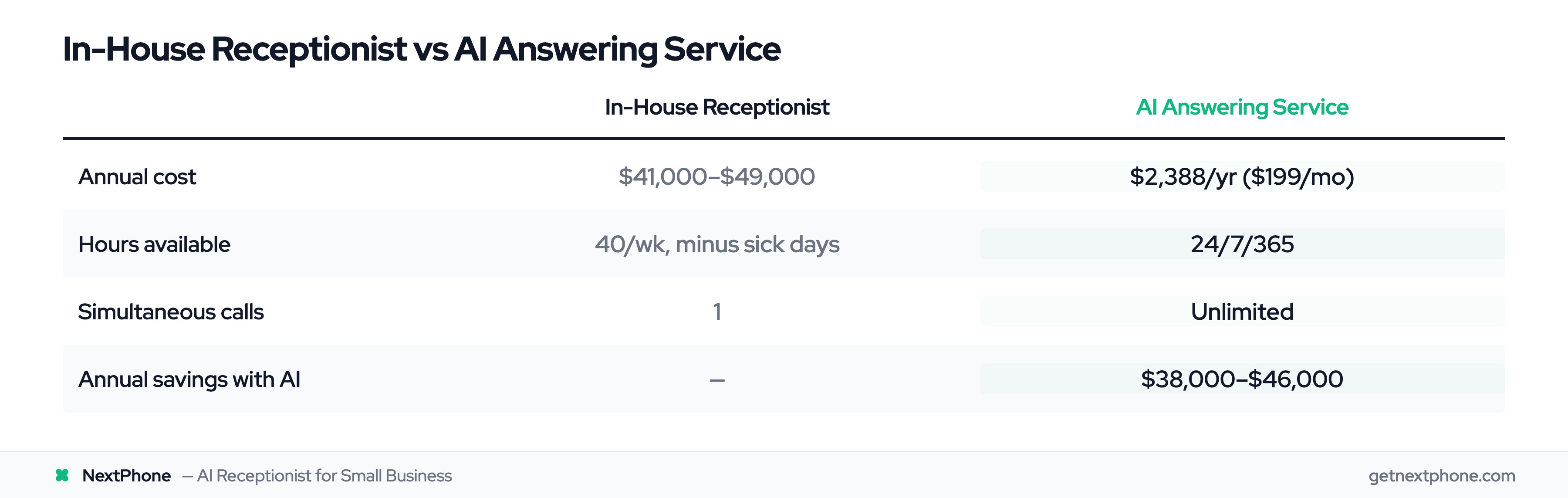
For perspective, here's what a dedicated receptionist costs:
| Factor | In-House Receptionist | AI Answering Service |
|---|---|---|
| Base Salary | $33,000-$39,000/year | N/A |
| Benefits (25%) | $8,000-$10,000 | N/A |
| Total Annual Cost | $41,000-$49,000 | $2,388 ($199/mo) |
| Hours Available | 40/week, minus sick days | 24/7/365 |
| Simultaneous Calls | 1 | Unlimited |
- Annual savings with AI: $38,000-$46,000 - plus you get around-the-clock coverage instead of 9-5 only.
7 Features Every Small Business Answering Service Needs
Not all answering services are created equal. Here's what to look for when evaluating options.
1. True 24/7 Availability
"24/7 support" sometimes means "we have after-hours voicemail." Verify that actual call answering happens at 2 AM on a Sunday, not just message taking.
Remember: plenty of home services calls come outside business hours. If your service only works 9-5, you're missing a big chunk of your opportunities.
2. Seamless Call Transfer
Urgent calls need to reach you immediately. The best services detect urgency (keywords like "emergency" or "flooding") and transfer callers directly to your phone mid-conversation.
Check whether transfers work to mobile phones. You're not sitting at a desk all day - neither should your answering service.
3. Appointment Scheduling
Direct calendar booking eliminates phone tag. Look for integration with Calendly, Google Calendar, or your scheduling software.
The service should ask relevant questions (service needed, property address, preferred time) and book directly rather than just taking messages.
4. Real-Time Message Delivery
How fast do you get notified about calls? Options include:
- Instant SMS alerts
- Email summaries
- Push notifications via app
- Full call transcripts
Slow notification defeats the purpose. If you learn about a morning call at 6 PM, that customer has already hired someone else.
5. CRM and Tool Integration
Automatic lead logging into your CRM eliminates manual data entry. Information captured during calls should flow directly to HubSpot, Salesforce, Jobber, or whatever system you use.
This isn't just convenience - it prevents leads from falling through cracks when someone forgets to log a call.
6. Customizable Scripts and Training
Generic responses signal "this isn't a real person" immediately. Your answering service should be trained on:
- Your specific services and pricing
- Service area boundaries
- Common customer questions
- Your business policies
The conversation should feel like calling your actual office, not a generic call center.
7. Spam and Robocall Filtering
Our data shows spam and robocalls are a real share of the calls to small businesses. A good service filters these out before they ever ring you, saving you time reviewing junk messages.
Check how spam detection works. You don't want legitimate customers flagged incorrectly.