Why Your Restoration Company Loses Jobs Before You Even Know They Called
It's 2:47 AM. A homeowner in your service area watches water pour through their ceiling from a burst pipe upstairs. They grab their phone and search "emergency water damage restoration near me." Your company shows up first. They call.
Your phone buzzes on the nightstand. You're exhausted from a 14-hour fire damage job. The call goes to voicemail.
By 3:15 AM, they've already booked with your competitor who answered on the second ring. That $8,000 job? Gone before you even woke up.
This scenario repeats thousands of times daily across the $7.1 billion US restoration industry, where more than 60,000 businesses compete for emergency calls. And here's the uncomfortable truth: industry research shows 74.1% of calls to home services businesses go completely unanswered. That's three out of every four potential customers calling someone else.
For restoration companies, where a single water damage job averages $3,500 and fire damage runs $10,000 or more, those missed calls add up fast.
This guide breaks down how emergency restoration answering services work, what they cost, and how to choose one that actually captures the calls you're currently losing.
The Hidden Cost of Missed Emergency Calls
Why Restoration Companies Miss So Many Calls
Restoration work makes answering phones nearly impossible. Your technicians are crawling through flooded basements, operating extraction equipment, or climbing ladders to assess roof damage. They can't exactly pause a water extraction to take a call.
Even when you're in the office, you're probably managing multiple jobs simultaneously. While you're on the phone with an insurance adjuster about one project, three new emergencies are calling in. Your competition only needs to answer one of them to steal the job.
The math gets worse when you factor in timing. Pipes don't burst during convenient hours. House fires don't wait until Monday morning. Yet most restoration companies stop actively answering phones at 5 or 6 PM, leaving 12+ hours of prime emergency time completely unmonitored.
The Revenue Impact of Every Missed Emergency
BIA/Kelsey research found that 80% of callers who reach voicemail never call back. They don't leave a message. They don't try again tomorrow. They call the next company on the list.
When someone has water pouring into their home, they're not patiently waiting for a callback. Research from Invoca shows 85% of customers who can't reach a business on the first attempt won't call back at all. Even more damaging, 48% immediately search for a competitor.
For restoration work, speed-to-lead isn't just about winning jobs - it's about being the only option. The first company to answer gets the contract. Period.
Real Numbers: What Missed Calls Cost Your Business
Let's do the math for a typical restoration company:
- Average monthly calls: 42
- Missed call rate: 74.1% = 31 missed calls
- Percentage that are emergencies: 15-20% = 5-6 emergency calls missed
- Average emergency job value: $5,000
- Monthly revenue loss: $25,000-$30,000
- Annual revenue loss: $300,000-$360,000
That calculation assumes you're average. If your miss rate is higher (which it probably is during active jobs), or your average emergency value is higher (fire damage, large commercial work), that number climbs accordingly.
One restoration contractor we spoke with discovered he'd missed 76 calls in a single month. His response: "I didn't even know I was missing that many calls. I just thought business was slow."
The 24-48 Hour Window: Why Response Time Matters More in Restoration
Water Damage: The Mold Clock Starts Immediately
Here's what most homeowners don't understand about water damage: the moment water touches building materials, a countdown begins. Within 24 to 48 hours of sustained moisture, mold spores start colonizing damp surfaces. What started as a $3,000 water extraction becomes a $15,000 mold remediation project.
Every hour you don't answer that call, the job gets bigger - but not in your favor. The customer still expects the original quote estimate. They blame you for the mold even if they waited two days to call. And their insurance adjuster has questions about why remediation wasn't started sooner.
Fast response doesn't just win jobs. It keeps jobs profitable.
Fire Damage: Smoke Residue Compounds Over Time
Fire damage operates on a similar clock. Smoke residue doesn't just sit on surfaces waiting to be cleaned. It's chemically active, continuing to etch into materials, discolor finishes, and penetrate deeper into porous surfaces with each passing hour.
A fire restoration job addressed within 24 hours often requires significantly less labor than the same job started a week later. But if you miss that first call, you're not getting a second chance. The homeowner already hired whoever answered.
After-Hours Reality: When Most Emergencies Happen
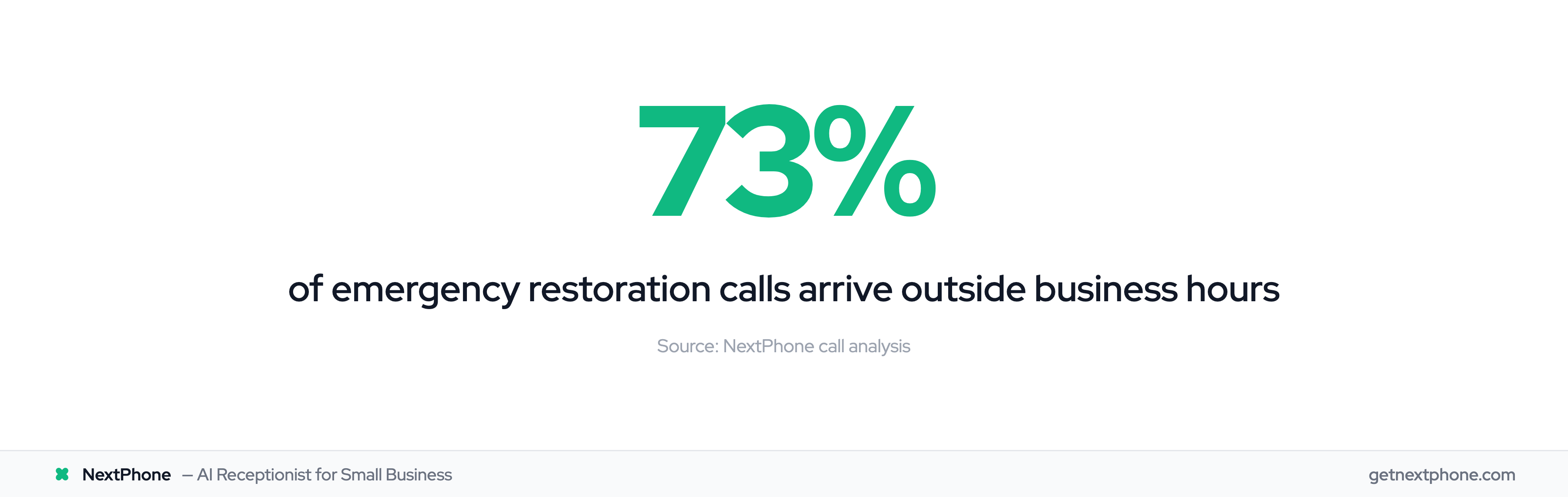
Most calls to home services businesses come in outside traditional 9-5 business hours. Think about when disasters typically strike:
- Pipes burst when temperatures drop overnight
- Storms roll through during evening hours
- Kitchen fires happen during dinner preparation
- Appliance failures occur when homes are occupied (evenings and weekends)
If you're only answering phones 40 hours per week, you're unavailable for the majority of emergency calls. And those after-hours emergencies often command premium pricing - 1.5x to 2x your standard rates - making them even more valuable to capture.
According to FEMA, more than 40% of businesses never reopen after experiencing a disaster. Your customers are desperate, scared, and ready to pay for immediate help. They're calling someone. The question is whether that someone is you.
What Is an Emergency Restoration Answering Service?
Core Functions: More Than Message Taking
An emergency restoration answering service does exactly what the name suggests: it answers your phone when you can't. But modern services go far beyond simply taking messages.
A quality answering service for restoration companies handles:
- Emergency triage: Determining if a call is urgent (active flooding) or routine (quote request for next week)
- Information gathering: Collecting damage type, address, insurance information, and contact details
- Appointment scheduling: Booking assessment visits or callback times
- Call routing: Directing urgent calls to on-call technicians while queuing non-urgent inquiries
The best services essentially act as your front office, handling the entire customer intake process so you can focus on the actual restoration work.
Emergency Dispatch: Getting Technicians on Scene
Dispatch capability separates true emergency services from basic message-taking operations. When a caller reports a flooded basement at 2 AM, you don't need a message waiting for you in the morning. You need someone to wake up your on-call technician now.
Effective dispatch services maintain your on-call schedule, know your escalation protocols (if the primary doesn't answer, try the backup), and can reach your team via phone, SMS, or app notification. Industry data suggests professional dispatch services reduce average response times by 17 minutes compared to voicemail-based systems.
24/7/365 Coverage: No Holidays, No Sick Days
The entire point of an answering service is consistent availability. That means:
- Every night, including weekends
- Every holiday (Thanksgiving flooding doesn't pause for turkey)
- During your busiest periods when staff is stretched thin
- When your office manager is sick or on vacation
With an answering service, you never have to choose between taking a vacation and potentially missing emergency calls. Coverage just happens, automatically.
Types of Emergency Answering Services: Which Is Right for You?
Traditional Live Answering Services (Human Operators)
Live answering services employ human operators to answer calls on your behalf. They follow scripts you provide, gather information, and either take messages or dispatch according to your instructions.
Pros:
- Human empathy for distressed callers
- Ability to handle unusual situations or complex questions
- Familiar technology (just forwarding your phone)
Cons:
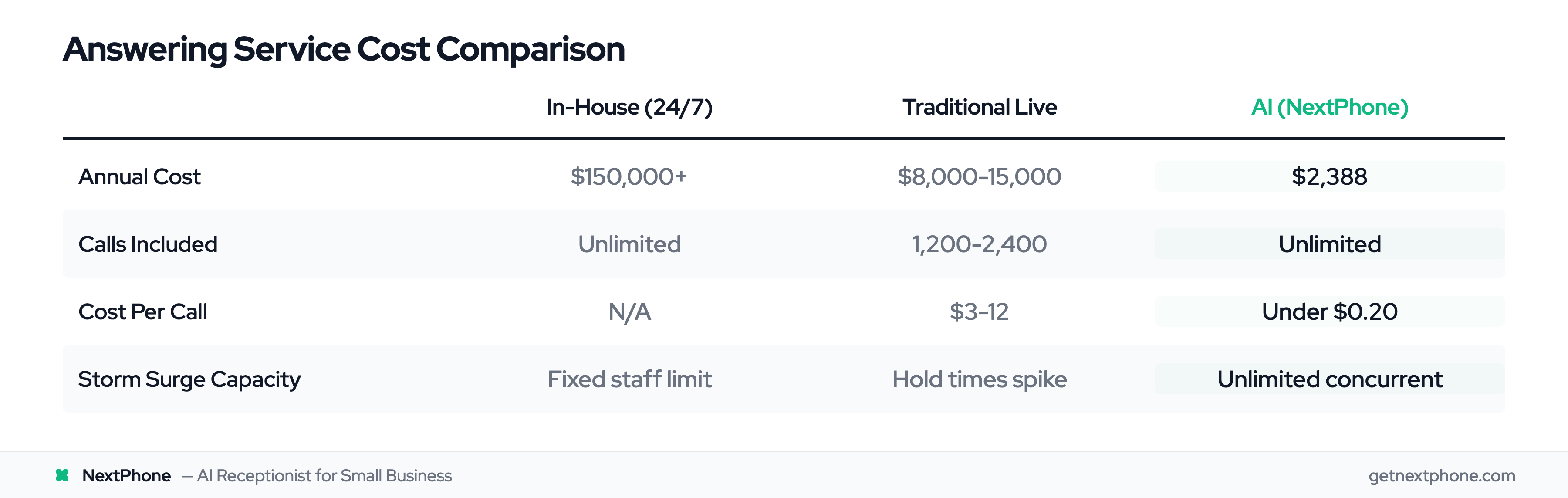
- Typically $500-800 per month for 100-200 calls
- Overage charges during busy periods (storm season gets expensive)
- Quality varies by operator - inconsistent caller experience
- Hold times during peak periods when multiple calls come in
Traditional services work well for restoration companies with moderate call volume who value human interaction above all else. However, the cost-per-call model means your bill spikes exactly when business is busiest.
AI-Powered Answering Services
AI answering services use conversational technology to handle incoming calls. Modern AI has progressed dramatically - callers often can't tell they're not speaking with a human, and the AI can handle complex conversations, gather detailed information, and make decisions about routing and dispatch.
Pros:
- Fixed monthly cost regardless of volume ($199/month for NextPhone)
- Unlimited concurrent calls (no hold times during storms)
- Consistent quality on every single call
- Instant response (answers in under 5 seconds)
- 24/7 availability without staffing constraints
Cons:
- Some callers still prefer human interaction
- Initial setup requires defining protocols and scripts
- Very complex or emotional situations may need human handoff
AI services excel for high-volume operations and companies that prioritize consistent response times. The fixed pricing model means storm season doesn't destroy your budget.
Hybrid Solutions: The Best of Both Worlds
AI-first services with smart forwarding handle routine calls and information gathering, while smart forwarding routes complex situations or callers requesting a person directly to your team.
According to Gartner research, 60-70% of customers are now comfortable interacting with AI for simple tasks. But 80% or more still want the option to reach a human when needed. Smart forwarding satisfies both preferences.
For most restoration companies, AI-first with smart forwarding offers the ideal balance: AI captures every call instantly, gathers information efficiently, and handles routine requests, while you remain available for upset callers or unusual situations.
Quick Comparison
| Factor | Traditional Live | AI-Powered | AI + Smart Forwarding |
|---|---|---|---|
| Monthly Cost | $500-800+ | $199 fixed | $250-400 |
| Concurrent Calls | Limited | Unlimited | Varies |
| Answer Speed | 15-30 seconds | Under 5 seconds | Under 5 seconds |
| After-Hours | Extra cost | Included | Included |
| Human Option | Always | On request | On request |
| Consistency | Variable | 100% | High |
Essential Features for Restoration Emergency Dispatch
Emergency Keyword Detection and Prioritization
Not all calls require the same response. Someone asking about your service area can wait until morning. Someone reporting a kitchen fire needs immediate attention.
Quality answering services detect urgency through keywords and context. Across the 1,446,980+ business calls we've answered, calls containing urgency language like "emergency," "flood," "burst," or "fire" rank among the top reasons people call. True emergencies requiring immediate dispatch are a recurring reason people call.
The system should automatically escalate calls containing these triggers while routing routine inquiries to standard processes. This ensures your on-call technician isn't woken up for non-emergencies while genuine disasters get immediate response.
Dispatch and On-Call Escalation
Effective dispatch requires more than just calling one number. Your service needs:
- Primary/backup/tertiary contacts: If the first on-call doesn't answer, try the next
- Multiple contact methods: Call, SMS, app notification, email
- Escalation timing: How long to wait before trying the backup
- Confirmation tracking: Did the technician acknowledge the dispatch?
The goal is ensuring every genuine emergency reaches a human who can respond, regardless of who's officially on call.
Information Capture for Insurance Claims
Restoration work means insurance claims. The information gathered during that first call impacts everything downstream:
- Property address and access instructions
- Type and extent of damage (as described by caller)
- Insurance company and policy number
- Adjuster name and contact if available
- Photos if the caller can provide them
AI services capture this information with 99%+ accuracy, eliminating the data entry errors common with handwritten messages or rushed conversations. That clean data syncs directly to your CRM for seamless claims processing.
Software Integration
Your answering service should work with your existing tools, not create more work. Look for integration with:
- Restoration management software (Xactimate, PSA, etc.)
- CRM systems (HubSpot, Salesforce, Zoho)
- Scheduling tools (Calendly, Google Calendar)
- Communication platforms (Slack, SMS)
NextPhone's HTTP webhook system connects to virtually any software, automatically pushing lead information wherever it needs to go.
Scalability During Major Events
A typical Tuesday might bring 5 calls. The day after a major storm could bring 50. Your answering service needs to handle both without degrading performance.
Traditional services with limited staff may experience hold times during surges. AI services scale instantly - unlimited simultaneous calls receive the same instant response as 5. For restoration companies in storm-prone areas, this scalability isn't optional.