
Key Takeaways
- Speed matters more than you think: Companies responding within 5 minutes are 100x more likely to connect with leads than those waiting 30 minutes
- Urgent calls rank among the top reasons people call - a large share of callers needs an immediate response
- Industry research shows 74.1% of calls to home services businesses go unanswered, giving faster competitors an automatic advantage
- The 7 strategies: Prioritize urgent calls, automate first response, enable AI answering, create callback systems, set response time goals, eliminate barriers, and measure continuously
- AI answering service technology can reduce response time to zero seconds - answering every call immediately, 24/7
Introduction

Your phone rings. You're up on a roof, under a sink, or elbow-deep in an electrical panel - and by the time you can call back, that customer has already hired your competitor.
This is the customer service response time problem that costs small businesses millions in lost revenue every year. Research shows 78% of customers go with the first company to respond. When you're busy doing the actual work, being first is nearly impossible.
This guide covers 7 strategies that actually work to improve your response time, even when you're a one-person operation. We'll show you why so many of your calls need immediate attention, and how AI technology is giving small businesses the response speed that only large companies used to have.
No theory. Just practical strategies you can implement this week.
Why Response Time Is Your Competitive Edge
Customer expectations have fundamentally changed. Research shows that 90% of customers rate immediate response as critical, with 60% defining "immediate" as under 10 minutes. 52% of customers will stop purchasing due to slow response times. They're not comparing you to what service was like 10 years ago - they're comparing you to Amazon, Uber, and every other company that responds instantly.
For small service businesses, this creates a brutal dynamic. You're competing against companies with full-time staff while you're literally working with your hands.
The Customer Expectation Shift
Today's customers don't just prefer fast response - they expect it. They have phones in their pockets with instant access to your competitors. When they need a plumber, electrician, or contractor, they often call 2-3 companies and hire the first one that answers or calls back.
The data backs this up: 78% of customers buy from the company that responds first. In real estate, 78% of homebuyers work with the first agent to respond, yet the average lead-to-client conversion rate is only 0.4-1.2%. Not the cheapest. Not the best reviews. The first one to engage.
What Happens When You're Slow
When you're slow to respond, you're not just losing that one customer. You're:
- Handing business directly to competitors who answer faster
- Training customers to expect slow service from your business
- Missing high-value urgent jobs that go to whoever picks up
- Wasting your own marketing spend by failing to convert leads
Industry research shows 74.1% of calls to home services businesses go completely unanswered. Not sent to voicemail where someone might leave a message - completely missed. That's nearly three out of every four potential customers who called and got nothing.
Every one of those missed calls is a potential job that went to someone else. MGMA research shows missed or delayed inquiries reduce annual revenue by 15-24% for healthcare practices—and the pattern holds across service industries.
The Speed-to-Lead Research: What the Data Shows
The importance of response time isn't just anecdotal. Researchers have studied this extensively, and the data is clear: speed wins.
The 5-Minute Rule
The most cited speed-to-lead research comes from studies that measured what happens to lead conversion at different response intervals. The MIT Lead Response Management Study and Dr. James Oldroyd's research established that you're 21x more likely to qualify a lead within 5 minutes versus 30 minutes. The findings changed how businesses think about response time:
- Responding within 5 minutes makes you 100x more likely to connect with a potential customer compared to waiting 30 minutes
- After 5 minutes, lead qualification drops by 400%
- A Harvard Business Review study found companies responding within an hour were 7x more likely to qualify leads than those waiting even an hour longer—and auditing 2,241 US firms found the average lead response time was 42 hours
This isn't a gentle slope. It's a cliff. Every minute you wait, your chances of winning that business drop dramatically.
How Response Time Affects Conversion
Think about what happens when a homeowner has a problem. Their water heater stops working on a Tuesday morning. They google "water heater repair near me" and call the first three results.
- Company A: No answer, goes to voicemail
- Company B: No answer, goes to voicemail
- Company C: Answers immediately, schedules appointment for that afternoon
Company C gets the job. Companies A and B don't even know they lost it. By the time they call back 3 hours later, the customer already has someone on the way.
This scenario plays out thousands of times daily across every service industry. Testing of the top 74 real estate brokerages found 41% didn't respond to inquiries at all, and the average real estate agent takes 917 minutes (over 15 hours) to respond.
Industry Benchmarks You Should Know
So what does "good" response time actually look like?
For phone calls, customers expect an answer within 20 seconds - about 4 rings. After 6 rings, 75% of callers hang up.
For callbacks, research suggests:
- Urgent inquiries: Within 30 minutes (ideally much faster)
- Standard inquiries: Within 4 hours
- Same day: Minimum acceptable for most customers
The businesses winning on customer service are targeting 5-minute or faster callback times for all inquiries. That's the new competitive standard. Research shows businesses using marketing automation for follow-up see 451% more leads, and 9x more conversions with 5-minute follow-up. 70% of prospects are lost due to inadequate follow-up.
Understanding Urgency: Which Calls Need an Immediate Response
Here's something no other response time guide will tell you: not all calls are created equal.
The Urgency Language Finding
Across the 1,446,980+ business calls we've answered, we discovered something important. Calls containing urgency language rank among the top reasons people call - words and phrases indicating the caller needs help immediately.
That's a big share of your inbound calls.
These aren't casual "I'd like to get a quote sometime" calls. These are "water is coming through my ceiling" calls. And they're coming in at a rate most businesses don't expect.
What Urgent Calls Sound Like
Urgency language includes phrases like:
- "Emergency" or "urgent"
- "ASAP" or "right away"
- "Today" or "immediately"
- Problem-specific urgency: "flooding," "no heat," "no AC," "burst pipe," "power out"
- Time pressure: "before the weekend," "my tenant is waiting," "the inspector comes tomorrow"
When a caller uses these words, they're signaling readiness to hire immediately. They're not price shopping. They're not comparing three quotes. They want someone now.
Within those urgent calls, true emergencies are a recurring reason people call - situations requiring immediate response and typically commanding premium pricing.
Why Urgency Detection Matters
If you treat every call the same, you're making a critical mistake.
The customer asking for a quote on a bathroom remodel next year can wait 4 hours for a callback. The customer whose basement is flooding cannot.
But without a system to identify urgency, you have no way to prioritize. You might call back the remodel quote first simply because they called first, while the flooding basement calls your competitor and hires them in 10 minutes.
Smart customer service response time improvement means responding fastest to the calls that matter most.
7 Strategies to Improve Customer Service Response Time
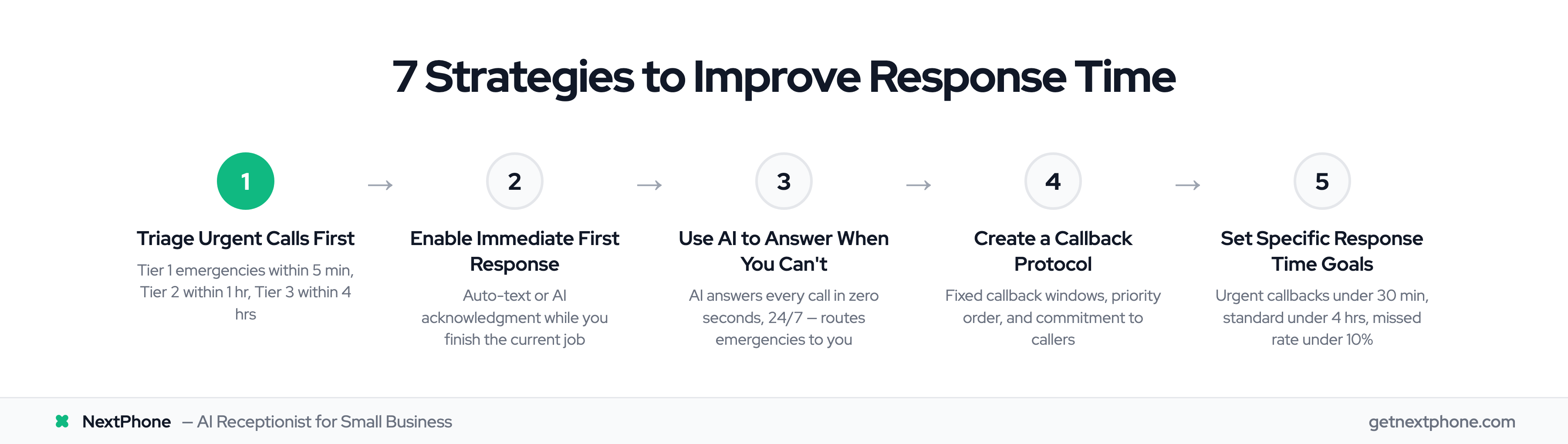
Here are 7 strategies that actually work for improving response time - especially for small businesses and contractors who can't simply "answer the phone faster" while working.
Strategy 1: Prioritize Urgent Calls (Triage System)
Not all calls deserve the same response speed. Create a triage system:
Tier 1 - Emergency: Water/gas leaks, safety hazards, no heat/AC in extreme weather. Response target: Immediate (within 5 minutes).
Tier 2 - Urgent: Same-day service requests, time-sensitive repairs, customers using urgency language. Response target: Within 1 hour.
Tier 3 - Standard: Quote requests, scheduling inquiries, general questions. Response target: Within 4 hours.
This requires either checking messages frequently and categorizing, or using technology (like AI) that can detect urgency automatically and route appropriately.
Strategy 2: Enable Immediate First Response
When you can't solve the problem immediately, at least acknowledge the call. An immediate first response buys you time while signaling that you're responsive.
Options include:
- Auto-text reply: "Thanks for calling [Business]. We're on a job but will call back within 1 hour." (32% of consumers open texts within 60 seconds)
- AI answering: System answers, takes message, and confirms someone will follow up
- Voicemail with callback commitment: "Leave a message and we'll call back within 30 minutes"
Something is better than nothing. Customers appreciate acknowledgment even when they can't get immediate resolution.
Strategy 3: Use AI to Answer When You Can't
This is the game-changer for small businesses.
The fundamental problem is that you can't answer the phone with your hands on a pipe, up a ladder, or in the middle of wiring a panel. That's not a discipline problem - it's physics.
AI receptionists solve this by answering every call immediately, 24/7. 62% of customers prefer chatbots over waiting for human agents, and live chat averages 47-second first response with 87% satisfaction rates. While you're working, the AI:
- Answers with your business name
- Takes detailed messages
- Handles FAQs (hours, service area, general pricing)
- Detects urgency language and can route emergencies directly to you
- Schedules appointments to your calendar
- Filters spam and robocalls
Your response time becomes zero seconds for the initial answer. Messages come to your phone when you're ready to check them. Urgent calls get routed through immediately.
At $199/month for a service like NextPhone, it costs less than one missed job.
Strategy 4: Create a Callback Protocol
Structure beats willpower. Create a callback protocol you follow every day:
Set callback windows: Check and return calls at fixed intervals - every hour, after each job, at lunch and end of day. Pick what works for your schedule and stick to it.
Priority order: Return Tier 1 calls first, then Tier 2, then Tier 3. Never let a lower-priority callback happen before a higher-priority one.
Set expectations: If you tell customers "I'll call back within 2 hours," you must call back within 2 hours. Reliability builds trust. Baylor University research on cold calling confirms that consistency in follow-up dramatically improves conversion rates.
Batch efficiently: Returning 5 calls in a 30-minute window is more efficient than checking your phone 20 times throughout the day.
Strategy 5: Set Response Time Goals
"Respond faster" isn't a goal. "Answer within 20 seconds or callback within 30 minutes for urgent calls" is a goal.
Set specific targets:
- Phone answer goal: If you answer live calls, target under 20 seconds (4 rings)
- Urgent callback goal: Under 30 minutes
- Standard callback goal: Under 4 hours
- Missed call rate goal: Under 10% (industry average is 74%)
Write these down. Track against them weekly. Goals you measure are goals you achieve.
Strategy 6: Eliminate Response Barriers
What slows down your response time? Identify and fix these barriers:
Phone accessibility: Is your phone always within reach? If it's in your truck while you're in the house, you'll miss calls.
Notification settings: Are notifications on and volume up? Silent mode costs jobs.
Voicemail length: Are you listening to 2-minute voicemails? Get voicemail-to-text transcription for faster reading.
Information gathering: Are callbacks slow because you need to look up customer history? Keep notes organized for quick reference.
Decision paralysis: Do you delay callbacks because you need to think about pricing? Have standard pricing ready so you can quote quickly.
Every barrier you remove shaves minutes off your response time.
Strategy 7: Measure and Continuously Improve
What gets measured gets improved.
Track three key metrics weekly:
- Missed call rate: What percentage of calls go unanswered?
- First response time: How long until initial acknowledgment?
- Callback completion time: How long from message to returned call?
Start with your baseline. Most small businesses are shocked when they actually measure their missed call rate - it's usually much higher than they thought.
Then improve systematically. Target 20% improvement each month until you hit your goals. Celebrate wins and diagnose problems.