Why Philadelphia Businesses Need a Local Answering Service
It's 2 PM on a Thursday in July. The temperature just hit 94 degrees in Philadelphia. Your phone rings - a homeowner in Fishtown needs their AC fixed today. But you're on a roof in Roxborough, hands full of tools. The call goes to voicemail. They call the next contractor on Google. You just lost a $4,200 emergency job.
This happens dozens of times every week to Philadelphia contractors and service businesses. And in a city of 1.57 million people with 29,460+ small businesses competing for customers, every missed call means someone else gets the work.
Philadelphia's economy is growing. The city just launched a $5 million Small Business Catalyst Fund to help growth-ready businesses expand. Median income has climbed from $39,043 in 2014 to $60,521 in 2024. More money means more homeowners calling for services. The question is: who's answering when they call?
Philadelphia by the Numbers
According to Economy League's Philadelphia Baseline 2025, the city has experienced meaningful economic gains over the past decade:
- 1.57 million residents - the 6th largest city in the United States
- 29,460 small businesses as of 2023, a 7.5% increase over the decade
- 47% of local jobs generated by small and midsize enterprises
- Median income up 55% from $39,043 (2014) to $60,521 (2024)
- Unemployment down from 8.2% to 4.5% over the same period
That growth means more homeowners with money to spend on home improvements, more businesses needing services, and more phone calls from people ready to hire. The contractors who answer those calls win the work.
Key Neighborhoods Driving Business Growth
Philadelphia's business activity concentrates in commercial and central neighborhoods. Zip code 19103 in parts of Center City leads with new business approvals. Other active areas include 19106, 19102, and 19145 - a mix of Center City, South Philly, and West Philadelphia.
For home services contractors, this spread matters. Your customers live across Fishtown, Northern Liberties, Roxborough, Manayunk, South Philly, and the Northeast. When someone in Bella Vista needs a plumber at 8 PM, they want a local company that knows the neighborhood.
Why Competition Makes Every Call Count
The challenge for Philadelphia businesses goes beyond just being busy. SEPTA's recent service reductions and fare increases affect how employees get to work. When staff arrive late, morning calls go unanswered. When you're short-staffed, afternoon calls pile up.
Meanwhile, with nearly 30,000 small businesses in the city, your competitors are just one phone call away. Miss that call, and someone else gets the job.
The 215 Area Code: Philadelphia's Original Business Code
What the 215 Area Code Covers
The 215 area code is one of the original North American area codes, established in 1947. It serves Philadelphia proper along with significant portions of Bucks and Montgomery counties. Combined, the region covers over 3.6 million people in southeastern Pennsylvania.
When a Philadelphia resident sees a 215 number on their caller ID, they know it's a local business. Not a telemarketer from another state. Not a spam call from overseas. A company from their community.
Overlay Codes: 267 and 445
Due to population growth and increased phone number demand, Philadelphia added overlay codes:
- 215 - The original code (1947)
- 267 - Added in 1997
- 445 - Added in 2018
All three area codes serve the exact same geographic region. To customers, there's no meaningful difference - they all signal "local Philadelphia business." When you get a business number with NextPhone, you can choose any of these area codes.
Why Area Code Recognition Matters
The Philadelphia area operates in Eastern Time, aligned with major business centers like New York and Washington DC. Local businesses benefit from this alignment when coordinating with customers, vendors, and partners.
More importantly, a recognized local area code builds instant credibility. In a city where people are cautious about unknown callers, a 215 number opens doors that an 800 number can't.
How Many Calls Are Philadelphia Contractors Missing?

The Data on Missed Calls
Industry research tells a brutal story: 74.1% of calls to home services contractors go completely unanswered. That's three out of every four potential customers calling someone else.
For a typical Philadelphia contractor receiving 42 calls per month, that means 31 calls going to voicemail every single month.
Here's what those calls look like:
- Approximately one in four asks for a callback - they want you to call back, but without a tracking system, most never get returned
- Urgent calls rank among the top reasons people call - words like emergency, urgent, or ASAP
- Emergencies are a recurring reason people call - pipe burst, no power, AC out in 95-degree heat
- Quote requests are among the top reasons people call - high-value leads ready to buy
- Booking or rescheduling an appointment is the single most common reason people call
What Happens When Callers Reach Voicemail
According to industry research, 85% of callers who don't reach someone won't call back. They don't leave a message. They don't wait. They call your competitor.
The few who do leave a voicemail? About 80% of those messages never get returned promptly. The callback request falls through the cracks, and by the time someone follows up, the customer has already hired someone else.
One plumber we work with discovered he had 76 missed calls in a single month. His reaction? "I didn't even know I was missing that many calls. I just thought business was slow."
Calculating the Revenue Impact
Let's do the math for a typical Philadelphia contractor:
- 42 calls per month (average for home services)
- 74.1% go unanswered = 31 missed calls
- 20% would have converted = 6 lost jobs
- $3,500 average job value = $21,000 lost per month
That's $252,000 per year in potential revenue walking out the door - or rather, calling your competitor.
According to Invoca research, home services businesses can lose an average of $1,200 per missed call. For emergency calls, the impact is even worse. Emergency jobs average $4,200 in revenue - significantly higher than routine work. Missing just one emergency call per week costs $16,800 per month.
Why a 215 Number Wins More Business
How Customers Judge Businesses by Phone Number
When a Philadelphia homeowner sees a phone number pop up on their screen, they make a split-second decision: answer or ignore?
That decision often comes down to one thing - the area code.
A 215 number tells the caller this is a local Philadelphia business. Someone in the community. Someone who knows Fishtown from Fairmount, South Philly from the Northeast. Not a telemarketer calling from across the country.
Local vs Toll-Free Answer Rates
According to research from DialMyCalls, people are nearly four times more likely to answer calls from local numbers compared to toll-free numbers:
- 27.5% said they're likely to answer a call from an unknown local number
- Only 7% said the same for unknown toll-free numbers
That's a 4x difference in answer rates just from having a local area code.
Survey data shows that 8 out of 10 people say they are "extremely unlikely" to answer incoming calls from an 800-style number. After years of spam and telemarketing, consumers have trained themselves to ignore toll-free numbers.
The Spam Problem
We all get spam calls. According to Hiya's State of the Call report, about 30% of all calls to mobile phones in the US are spam. That's made everyone cautious about answering unfamiliar numbers.
But the type of phone number dramatically affects whether customers answer:
| Number Type | Answer Rate | Spam Perception |
|---|---|---|
| Local (215, 267) | 60-70% | 2-5% |
| Toll-Free (800, 888) | 40-50% | 20-30% |
| Unknown Mobile | 45-55% | 15-25% |
A local 215 number nearly doubles your chances of customers actually answering when you call back. When 78% of customers hire whoever responds first, that answer rate advantage translates directly into won jobs.
Answering Service Options for Philadelphia Businesses
Traditional Live Answering Services
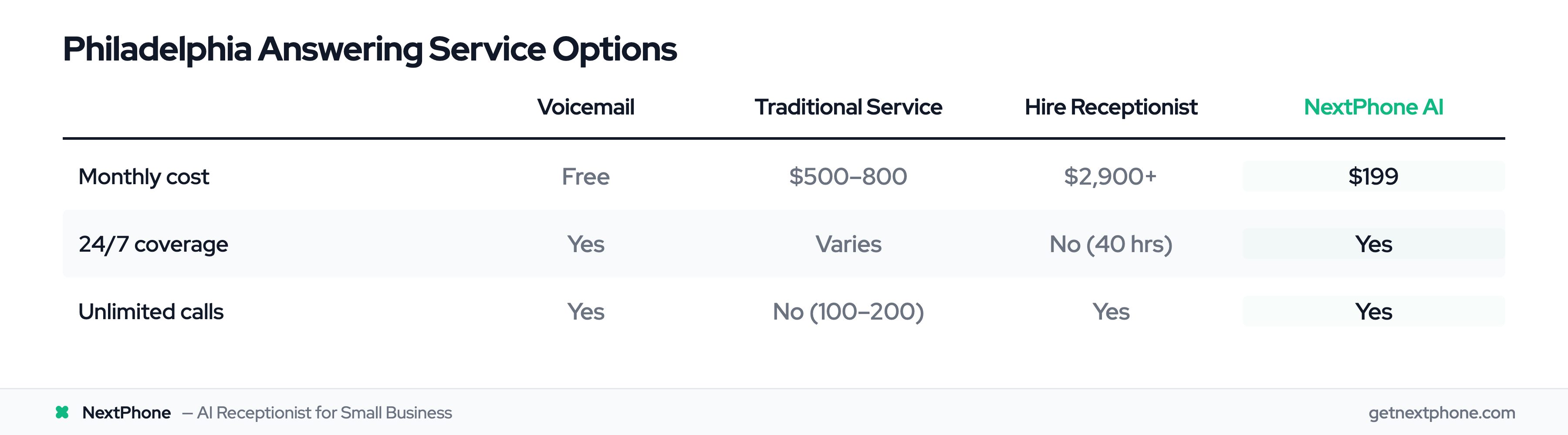
Traditional answering services have been around for decades. They charge $500-800 per month for about 100 calls. Go over that limit and you pay overage fees - sometimes $1-2 per additional call.
Most are based outside Philadelphia. Operators read from scripts and may not understand the difference between Fishtown and Chestnut Hill. They might not know that a call about a frozen pipe in January requires immediate routing, not a message to be returned tomorrow.
For a busy Philadelphia contractor during a summer heat wave or winter cold snap, 100 calls per month isn't nearly enough.
Voicemail and Call Forwarding (DIY)
Voicemail is free. That's about the only positive thing to say about it.
As we've covered, 85% of callers who reach voicemail won't call back. Around 80% don't even leave a message. For high-intent callers - the ones with emergencies, ready to book, cash in hand - voicemail means you've already lost them.
Call forwarding helps when you can answer. But when you're under a house running pipes, on a roof in the summer heat, or driving between jobs on I-76, you're back to voicemail.
AI Answering Services
AI answering services represent a newer approach that combines 24/7 availability with intelligent call handling.
The AI answers every call in under 5 seconds. It handles routine questions about hours, pricing, and scheduling. For emergencies or complex requests, it routes calls directly to your phone or takes a detailed message.
Modern AI achieves 70-85% resolution rates. That means most calls get handled completely by the AI, while truly complex or urgent situations reach you immediately via smart forwarding.
Hiring a Full-Time Receptionist
The Bureau of Labor Statistics reports the median receptionist wage at $17.90 per hour. That's roughly $35,000 per year in salary alone - before benefits, taxes, and the cost of someone who only works 40 hours per week.
A receptionist covers business hours Monday through Friday. But a large share of calls to home services businesses arrive outside standard 9-5 hours. That means a full-time hire still leaves evenings, weekends, and holidays uncovered.