Industry research on contractors turns up something alarming: 74.1% of incoming calls to home services businesses go unanswered. That's nearly three out of four potential customers hearing voicemail or endless ringing.
For the average contractor, this translates to $189,068 in lost revenue annually. Not because they didn't want the business - but because they were on job sites, in meetings, or simply unavailable when the phone rang.
AI voice agents have emerged as a real solution to this problem. The technology has matured significantly, moving well beyond the clunky phone trees and robotic voices of years past. The UCaaS market reached $21.7B in 2024 with 6.5% year-over-year growth, and 90% of organizations now use UCaaS as their primary communication platform. In 2026, AI voice agents can hold natural conversations, understand what callers need, and take meaningful action.
This guide explains what AI voice agents actually are, how they work, what they can do for your business, and whether they make sense for you. No technical jargon, no hype - just practical information for business owners evaluating this technology.
What Is an AI Voice Agent?
An AI voice agent is software that answers your business phone calls using artificial intelligence. It understands natural speech, processes what callers need, and responds conversationally - all without human involvement.
Think of it as an AI virtual receptionist that never sleeps, never takes breaks, and can handle unlimited calls simultaneously.
How AI Voice Agents Differ from IVR
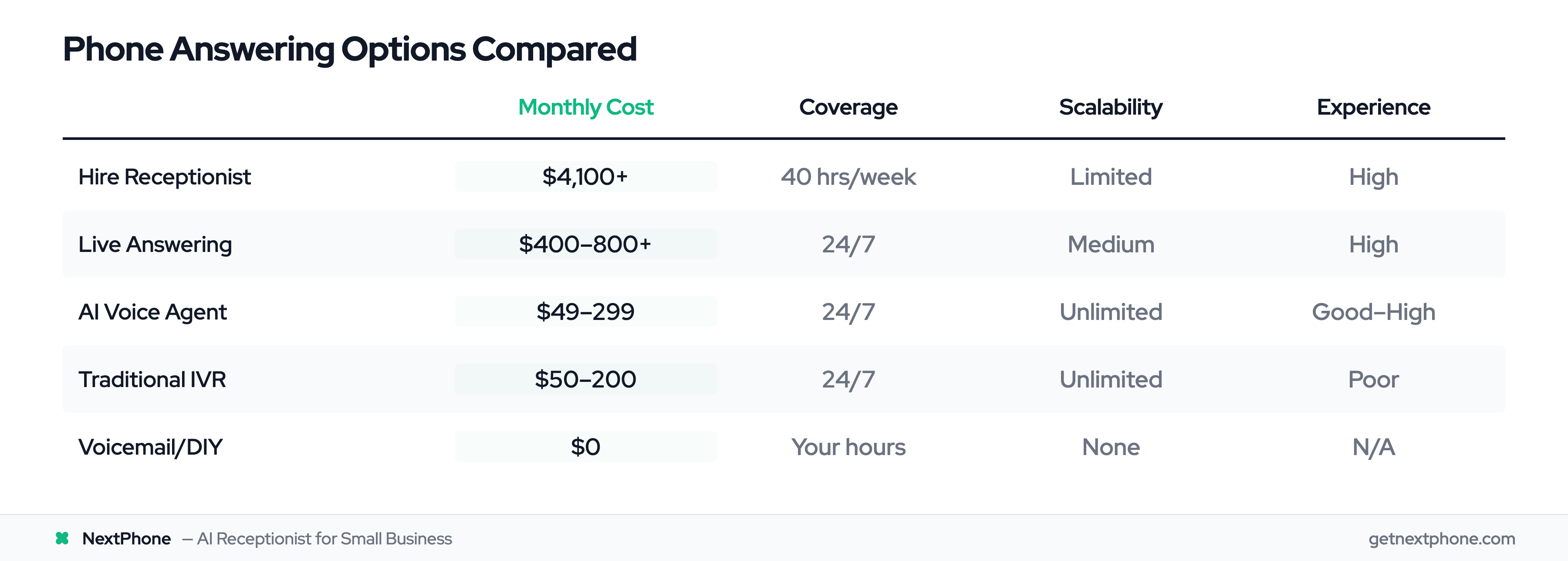
If you've ever called a company and heard "Press 1 for sales, press 2 for support, press 3 for..." - that's IVR (Interactive Voice Response). Traditional IVR systems are rigid menu structures that force callers into predefined paths.
AI voice agents work differently. Callers speak naturally, and the AI understands what they mean.
Traditional IVR: "Press 1 for appointments, press 2 for..." AI Voice Agent: "Hi, I need to schedule an AC tune-up for next week." "I can help with that. What day works best for you?"
No phone tree frustration. No pressing buttons. The caller states their need, and the AI handles it.
The 2025 State of Voice AI
The technology has improved dramatically in the past few years. Modern AI voice agents offer:
- Natural-sounding voices: Not robotic or synthetic - genuinely conversational
- Context understanding: The AI remembers the conversation flow and doesn't ask redundant questions
- Real-time processing: No awkward pauses while the system "thinks"
- Noise handling: Works with background noise, accents, and interruptions
- Nuanced understanding: Grasps intent, not just keywords
The clunky voice AI of 2020 is gone. 2025 systems handle real business conversations well. The business phone service market is projected to grow from $91.11B in 2023 to $144.1B by 2031, with AI-powered solutions driving much of that growth.
How AI Voice Agents Work
Understanding the technology helps you evaluate whether it fits your needs. Here's what happens when someone calls a business using an AI voice agent - in plain language.
Speech Recognition: Understanding What Callers Say
When a caller speaks, the AI converts those spoken words into text instantly. This happens in real-time, so there's no delay in the conversation.
Modern speech recognition handles different accents, speaking speeds, and speech patterns. It filters out background noise - dogs barking, traffic sounds, wind - to focus on the caller's words.
Accuracy rates in 2025 are high enough for business use. The AI correctly captures what people say the vast majority of the time.
Natural Language Processing: Understanding Intent
Converting speech to text is just step one. The AI then analyzes those words to understand what the caller actually wants.
This is where "natural language processing" comes in. The AI doesn't just match keywords - it understands meaning and context.
When someone says "I need someone to look at my furnace - it's making a weird noise and my house is freezing," the AI recognizes:
- Service request (not a sales call or spam)
- HVAC related (furnace)
- Urgency indicators (freezing house, something wrong)
- This might be an emergency worth routing immediately
The AI determines intent, not just words.
Response Generation: Speaking Back Naturally
Based on what it understands, the AI generates an appropriate response and speaks it in a natural voice.
This isn't pre-recorded audio clips stitched together. The AI creates responses dynamically based on the conversation, speaking in a human-like voice.
It maintains conversation flow, asks clarifying questions when needed, and adapts to what the caller says.
Action Execution: Getting Things Done
The AI doesn't just talk - it takes action. Depending on what's configured, it can:
- Capture caller information and send you a notification
- Book appointments directly on your calendar
- Route urgent calls to your cell phone immediately
- Log the call details in your CRM
- Send follow-up texts to the caller
- Trigger workflows in your business systems
The technology combines speech understanding with business system integration - all happening in milliseconds.
What AI Voice Agents Can Do for Your Business

Here's where theory meets practice. These are the specific capabilities that matter for business owners.
Answer Every Call, 24/7/365
The most fundamental benefit: no more missed calls.
Industry research shows 74.1% of calls to home services contractors go unanswered during normal business operations. These aren't after-hours calls - they're missed during the workday because staff is busy, on job sites, or unavailable.
An AI voice agent answers every call within seconds. Nights, weekends, holidays, lunch breaks - all covered. If someone calls at 2 AM with a burst pipe, the AI answers.
Take Messages and Send Alerts
When you can't take a call personally, the AI captures everything you need:
- Caller's name and contact information
- What they're calling about
- Urgency level
- Any specific details they mentioned
It sends you instant notifications via text, email, or app - however you prefer. You decide what's urgent enough to interrupt you versus what can wait.
Schedule Appointments
AI voice agents integrate with calendar systems like Google Calendar or scheduling software. When someone calls to book an appointment:
- AI checks your availability
- Offers open time slots
- Books the appointment directly
- Sends confirmations to both parties
No back-and-forth, no "let me check and call you back." Booking or rescheduling an appointment is the single most common reason people call - that's a meaningful chunk of calls handled automatically.
Route Emergencies Immediately
This capability matters enormously for service businesses. Emergencies are a recurring reason people call, and urgent calls rank among the top reasons overall.
AI voice agents detect urgency through keywords and context. When someone calls about a burst pipe, gas smell, or electrical fire - the AI recognizes this isn't a routine call and routes it to your cell phone immediately.
Your emergency calls never sit in voicemail while you're on another job.
Screen and Filter Calls
Not every call deserves your attention. Spam and robocalls get filtered out before they ever ring you.
AI voice agents identify and filter junk calls before they waste your time. They can also qualify leads - asking screening questions to determine if a caller is a genuine potential customer before routing them to you.
Integrate with Business Systems
Modern AI voice agents connect to your existing tools:
- CRM integration: Call details logged automatically in Salesforce, HubSpot, or other systems
- Callback tracking: In our data, a significant share of callers requested callbacks. The AI tracks these so none fall through the cracks
- Calendar sync: Appointments appear on your schedule instantly
- Workflow triggers: Automatically create tasks, send follow-ups, or notify team members
Who Uses AI Voice Agents? Key Industries and Use Cases
AI voice agents work across industries, but some businesses see particularly strong results.
Home Services and Contractors
Plumbers, HVAC technicians, electricians, roofers, and general contractors are prime candidates for AI voice agents. Here's why:
- You can't answer while working. When you're knee-deep in a plumbing repair, you're not picking up the phone.
- Emergency calls are high-value. A burst pipe or dead furnace means someone needs help now - and they'll pay for fast response.
- High revenue per job. When average jobs run $400-$3,500+, every missed call represents real money.
Contractors are exactly the group those industry numbers come from: an average of $189,068 lost annually to calls nobody picked up.
Medical and Dental Practices
Healthcare practices handle heavy call volume, often with limited front desk staff:
- Appointment scheduling (the bulk of calls)
- After-hours patient calls
- Triage questions about urgency
- Prescription refill requests
AI voice agents reduce front desk burden while ensuring patients always reach someone. Compliant options exist for practices with privacy requirements.
Legal Services
Law firms depend on phone inquiries for new clients:
- Lead intake and initial qualification
- After-hours potential client calls
- Time-sensitive legal matters
- Professional first impression
When a potential client calls about a car accident or DUI, the first firm to respond often wins the case. AI ensures you never miss that call.
Real Estate
Real estate runs on leads, and leads call at all hours:
- Property inquiries from listings
- Showing scheduling
- Lead qualification and routing
- Buyer and seller follow-up
Speed matters here - the agent who responds first usually wins the client.
Small Retail and Service Businesses
Any business that gets phone calls can benefit:
- Store hours and location questions
- Appointment-based services (salons, spas, repair shops)
- Product availability inquiries
- Basic customer service
AI voice agents handle routine calls so you can focus on customers physically in your store.