Quick answer (live answering service pricing comparison): A live answering service costs $1,500-$2,940+/month at realistic call volumes — Ruby Receptionists effectively bills ~$4.90/min, AnswerConnect ~$3.25/min, PATLive ~$2.65/min. AI alternatives like NextPhone are flat $199/month with unlimited calls and no per-minute inflation. The right pick depends on your call mix, not the headline price.
Your phone rings while you're on a ladder replacing a compressor unit. It rings again when you're knee-deep in a flooded basement. And again during that client meeting you couldn't reschedule.
Here's what happens next: 85% of those callers will never try again. They'll call the next contractor on their list. That $9,000 kitchen renovation? Gone. The emergency repair that could have been yours? Someone else's revenue now.
The traditional solution was simple but expensive: hire someone to answer phones. That works if you can afford $3,000-4,000 per month for a full-time receptionist, plus benefits, training, and the headache of managing another employee. The median receptionist wage is $17.90/hour ($37,230/year)—before benefits.
This guide breaks down real costs, real capabilities, and real call data — including the most recent 9 days of our own production inbound traffic (post-2026-05-16 when our outcome taxonomy was finalized) — to help you make an informed decision. No marketing fluff. Just what works.
What 15,830 real inbound calls revealed about live-answering pricing
Most live-vs-AI comparisons treat a "call" as an abstract 3-minute unit. That assumption is what makes per-minute live-answering pricing look reasonable on paper. We pulled the most recent 9 days of inbound traffic (post-2026-05-16 when our outcome taxonomy was finalized) from NextPhone's production database — 15,830 calls after spam filtering, out of 1,446,980 total inbound calls we've handled — and the actual distribution looks nothing like the brochure math.
Only 4.0% of calls were transferred to a live person. The other 96% were resolved by AI, captured as messages, identified as spam, or hung up before engagement.
That short-call distribution is what makes live-answering per-minute billing brutal — which is the next section. And the after-hours share is what makes "premium" overnight pricing add up faster than anyone advertises.
Hear it: AI handling a real after-hours intake
0:00
0:00
A live-answering competitor would bill this same call at the overnight premium rate.
What a Live Answering Service Actually Does
A live answering service puts real human beings on your phone line. When a customer calls, they reach an operator who answers with your business name, follows a script you've provided, and handles the call according to your instructions.
Most services offer:
24/7 availability (for premium pricing)
Message taking (name, number, reason for call)
Basic appointment scheduling
Call forwarding to you or your team
Bilingual support (usually English/Spanish)
The major players include Ruby Receptionists, AnswerConnect (voted Best Answering Service 2025 by Forbes), PATLive, and dozens of regional providers. For a side-by-side breakdown of these and other options, see our answering service companies guide.
What Live Services Are NOT
Here's where expectations often crash into reality.
Live answering service operators are not customer service representatives. They're not trained in your specific business. They can't answer technical questions or make judgment calls about your services.
One answering service employee put it bluntly on Quora: "Answering services are not customer service. They are pretty much an emergency service whose only responsibility is to take a short message."
These operators juggle 5-10 different businesses simultaneously. Your caller gets maybe 2-3 minutes of attention. The operator takes down basic information, maybe schedules a callback, and moves to the next caller.
That's not a criticism. That's the business model. But it means you're paying for message-taking, not customer service.
Premium features like CRM integration, complex scheduling, or order processing cost extra. And quality varies wildly between operators, even within the same service. For more on what separates different service tiers, see our guide to virtual receptionist services and call center vs answering service distinctions. If you're still weighing which type fits your business, our guide to choosing an answering service walks through the key decision points.
What Live Answering Services Actually Cost
Live answering services use pricing models designed to look affordable in marketing materials while generating significant revenue from actual usage. Understanding how this works prevents sticker shock on your first real bill.
How Pricing Actually Works
Most services charge using one of these models:
Per-minute billing (most common): You pay for every minute an operator spends on your calls — rounded up to the increment they choose. This includes the call itself, any hold time, and after-call work like entering notes.
Per-call billing (less common): Flat fee per call regardless of duration.
Monthly packages: A set number of minutes included, with steep overage charges for anything beyond.
Real Cost Examples
Here's what the top services actually charge:
Provider
Base Plan
Included
Per-Minute Rate
After-Hours
Ruby Receptionists
$250/mo
50 minutes
$4.90
Same rate
AnswerConnect
$325/mo
100 minutes
$3.25
Premium
PATLive
$250/mo
75 minutes
$2.65
Premium
Now let's calculate what you'll actually pay.
The Real-World Math
Say you're a busy contractor receiving 200 calls per month. Average call duration: 3 minutes (pretty standard for scheduling and message-taking on the line).
Total monthly talk time: 600 minutes
With Ruby Receptionists at $250/month (50 minutes included):
Overage: 550 minutes x $4.90 = $2,695
Total monthly cost: $2,940
With AnswerConnect at $325/month (100 minutes included):
Overage: 500 minutes x $3.25 = $1,625
Total monthly cost: ~$1,950
With PATLive at $250/month (75 minutes included):
Overage: 525 minutes x $2.65 = $1,391
Total monthly cost: ~$1,590
These numbers assume no after-hours premium, no holiday surcharges, no complex call fees — and they assume the operator's clock matches reality.
Additional Fees to Watch For
The bottom line: at realistic call volumes, live answering services cost $1,500-$2,940+ per month for most small businesses. For a deeper look at how these numbers break down across providers, see our full answering service cost breakdown and pricing comparison.
AI Answering Services: What They Can (and Can't) Do
Before getting into the comparison, here's what it actually sounds like when AI answers a live business call:
Hear it: warm-professional female voice (Emma)
0:00
0:00
One of 28 voices in NextPhone's library. This is the same voice quality your callers hear at 2am and 2pm — no operator rotation, no script drift, no hold time.
Hear it: calm-professional male voice (Chris)
0:00
0:00
The voice you pick is what every caller hears. Pricing stays the same regardless of which voice you choose.
How Modern AI Answering Works
When a caller reaches an AI answering system:
The AI answers immediately - no hold time, no queues
Natural conversation begins - modern AI sounds conversational, not robotic
Intent recognition kicks in - the system understands what the caller needs
Appropriate action taken - schedule appointment, take message, provide info, or escalate
The technology handles multiple simultaneous calls without degradation. Ten people calling at once? All ten get answered in the first ring.
What AI Handles Well
AI excels at predictable, routine interactions:
Appointment scheduling: Checks your calendar, books available slots, sends confirmations
Callback requests: Captures info, schedules callback, sends you notification
Basic information: Business hours, location, service area, pricing ranges
Message taking: Accurate transcription, instant delivery to you
Lead qualification: Captures name, scope, timeline, and callback window before the prospect hangs up
Spam filtering: Identifies and blocks robocalls before they waste your time
For these routine calls, AI performs as well as or better than human operators. No mood variations. No errors from juggling multiple accounts. Consistent quality at 3am or 3pm. If you're weighing the two side by side, our AI receptionist vs answering service comparison goes deeper on specific use cases.
Hear it: AI doing what a live operator gets paid to do — qualifying an inbound lead
0:00
0:00
Name, scope, urgency, callback window — captured in under a minute. A live answering service would bill this same call at $2.89-$4.70/min rounded up to the next minute. AI handles it at a flat rate, no rounding, no per-minute math.
Current Limitations
AI isn't perfect for every call:
Highly emotional situations: A caller who's upset, scared, or angry may not respond well to AI
Complex multi-step problems: Situations requiring judgment calls benefit from humans
Heavy accents or poor connections: AI accuracy drops with audio quality (though this is improving rapidly)
Callers who refuse to engage: Some people hang up the moment they detect AI
The key question isn't "Can AI handle all calls?" It's "What percentage of your calls actually need human handling?" In our 1,446,980-call production database, that number was 4.0% — the share that got transferred to a live person.
What the Call Data Reveals About Your Actual Needs
Most live vs AI discussions treat all calls as equal. They're not.
Our analysis of thousands of business calls reveals clear patterns in what callers actually need:
Breaking Down Call Types
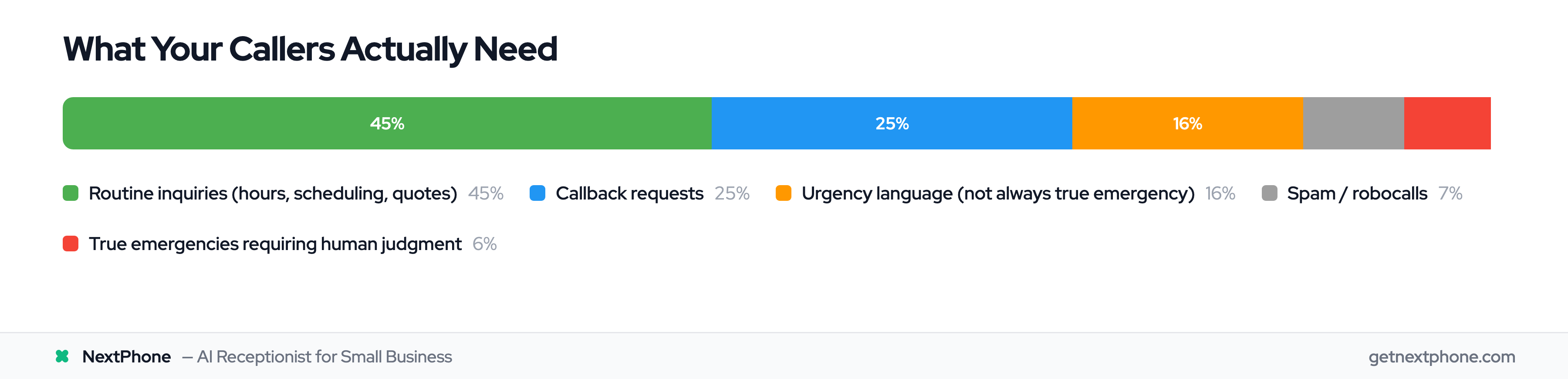
Most callers fall into one of three buckets: callback requests, routine inquiries, and urgency-language calls — with a small slice of true emergencies and spam at the margins.
Let's break this down.
Callback Requests
Many callers have a simple request: "Have someone call me back."
They don't need a human to take that message. They need:
Accurate capture of their contact info
Confirmation of when to expect the callback
The message delivered to you instantly
AI handles this flawlessly. In fact, AI does it better than many human operators because there's no rushing, no typos from multitasking, no "sorry, can you repeat that number?"
Callers With Urgency Language
These callers use words like "ASAP," "urgent," "emergency," or describe time-sensitive situations.
Note: urgency language doesn't always mean true emergency. "I need someone ASAP" might mean "my AC went out and it's uncomfortable" rather than "my basement is flooding."
Smart AI systems detect urgency language and respond appropriately:
Acknowledge the urgency
Gather essential details
Route to you immediately (not later)
Set accurate expectations
Most urgency calls don't require human empathy. They require fast response and clear communication.
Calls That Need a Human
Here's where human handling matters.
True emergencies involve:
Active flooding or property damage
Safety concerns
Situations requiring immediate human judgment
That's 6 out of every 100 calls. Six calls that genuinely need a human to assess the situation, provide empathy, and make real-time decisions.
Paying $500-2,000 per month for human operators to handle all 100 calls when 6 actually need them? That's like hiring a surgeon to put on bandaids.
The 7% That Are Spam
Here's the part nobody talks about.
A significant share of business calls are spam or robocalls — industry estimates run 7-9% (Hiya/Truecaller data). In our 1,446,980-call production database, roughly 1 in 10 calls still got flagged as spam after broad upstream filtering. Telemarketers. Scam attempts. Automated junk.
With a live answering service, you're paying $2-5 per minute for a human to answer "Hi, we've been trying to reach you about your car's extended warranty..." and then hang up.
At 200 calls per month, that's 14-18 spam calls. At 3 minutes average (because humans don't immediately recognize spam), that's 42-54 minutes of paid operator time on garbage.
Monthly spam cost with live service: $100-200
AI identifies and filters spam calls instantly. No charge. No wasted time. No rounded minutes.
Let's cut through the "when live services make sense" marketing.
The honest answer is narrow: practices where the majority of calls genuinely require complex live triage — high-acuity professional intake where empathy and judgment carry the entire conversation — can justify the premium. That's a small slice of the market.
Every other justification is answering service sales copy:
"Emotional or Sensitive Calls"
The claim: Upset callers need human empathy.
The reality: AI detects urgency keywords and routes immediately. A pipe burst at 2 AM gets you on the phone in seconds. The routine "What time do you open?" calls get handled instantly. Callers care about speed and accuracy more than they care about species.
"High-Stakes First Impressions"
The claim: Luxury brands need human-first interactions.
The reality: Your "white-glove" caller waits 15-30 seconds while the receptionist finishes another call. AI answers in 1 ring. Which experience is more premium?
"Complex Qualification"
The claim: Multi-step qualification requires human judgment.
The reality: AI handles the bulk of routine qualification (budget, timeline, service area). Complex calls get transferred to you immediately with full context. You're not paying $1,200/month — rounded up to next minute — for humans to ask "What's your zip code?"
"Regulatory Requirements"
The claim: Many industries mandate human handling.
The reality: Few do. "Legal intake" and "financial services" are handled perfectly by AI screening + immediate transfer for complex calls. Stop paying the compliance tax for regulations that don't apply.
"Low Volume Makes Cost Irrelevant"
The claim: At 50 calls/month, the $100-200 difference doesn't matter.
The reality: $100-200/month is $1,200-2,400/year. That's real money. More importantly, at 50 calls/month with 74% missed, you're losing 37 calls. At 20% close rate and $3,500 average job, that's $25,900/year in lost revenue. The answering service cost is a rounding error compared to what you're already losing.
When AI Answering Beats Live Services Every Time
For many businesses, AI answering isn't just cheaper. It's better.
High Call Volume
Live services have a physics problem. One operator can handle one call at a time.
During peak periods, callers wait on hold. The operator rushes through calls to clear the queue. Quality suffers.
AI doesn't have this limitation. Ten simultaneous calls? All answered immediately, all handled with the same quality.
For businesses with call spikes (Monday mornings, after ads run, seasonal rushes), AI eliminates the hold time that drives callers to competitors.
Predictable, Routine Calls
If 80% of your calls are:
"What are your hours?"
"Do you service my area?"
"I need to schedule an appointment"
"Can someone call me back?"
You don't need a human. You need accurate, fast, consistent handling.
After-Hours Coverage
A quarter of calls happen after business hours. Evenings. Weekends. Holidays. They're not junk. They're real prospects on their own schedule.
Live services charge premiums for nights and weekends. Some add holiday surcharges. Your "affordable" plan suddenly costs 25-50% more for the hours when customers actually call.
AI charges the same rate 24/7/365. Your 2am emergency call costs the same as your 2pm routine call. This is a major factor in the flat rate vs per-minute answering service debate.
Budget Predictability
The psychological weight of per-minute billing affects how you run your business.
Do you hesitate before having operators transfer calls? Do you worry about callbacks generating billable time? Do you check your bill anxiously at month-end?
Flat-rate AI eliminates that overhead. You know exactly what you'll pay. Budget accordingly. Move on.
Spam Protection
Roughly 1 in 10 calls in our data still get flagged as spam after upstream filtering. Live services charge you for handling them. AI filters them for free.
Over a year at 200 calls/month, that's ~216 spam calls. At $5/call average cost, you'd pay $1,080 for humans to answer robocalls.
AI: $0.
AI Handles Routine, Routes Complex to YOU (Not to Another Paid Service)
The "hybrid" approach answering services sell means paying for BOTH AI and human services. That's $500-600/month.
The smarter approach: AI handles routine calls and routes complex/emergency calls directly to YOUR phone. Total cost: $199/month.
How It Actually Works
AI answers every call in 1 ring - no hold time, no missed calls
AI handles the majority of routine requests - scheduling, callbacks, basic info, hours, quotes
AI detects urgency in seconds - smart forwarding routes calls based on the criteria you configure (e.g. "transfer to me if the caller mentions a burst pipe, no power, or other emergency")
Complex calls go to YOUR phone - not to another paid receptionist, to YOU with full context
The difference: You're not paying $300-400/month extra for a human answering service to handle the rare calls that need escalation. In our data, only 4.0% of calls were transferred to a live human. The rest don't need one.
The Math That Actually Makes Sense
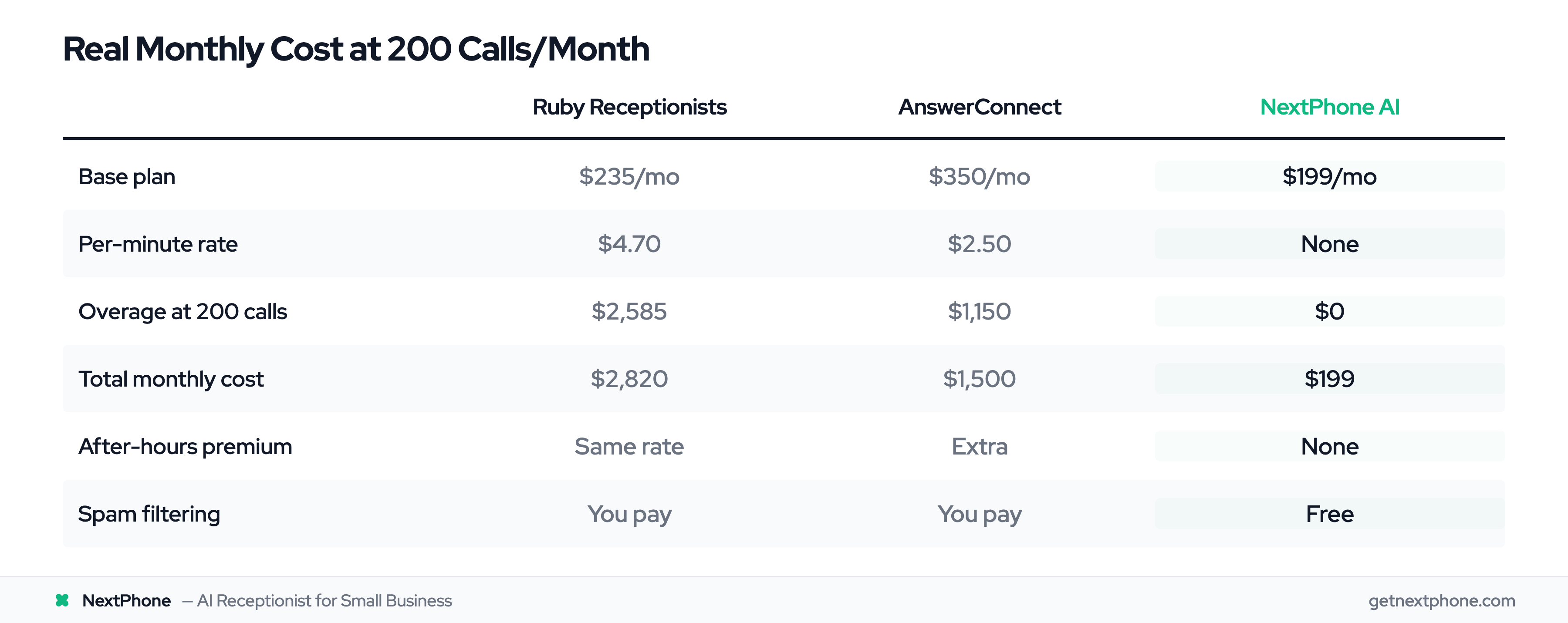
Live answering service (200 calls/month): $1,590-$2,940/month (depending on provider)
"Hybrid" (AI + paid human service): $500-600/month — still paying for two services
AI with routing to YOU: $199/month — one service, routes to your existing phone
Annual savings vs "hybrid": $3,600-4,800/year.
What This Looks Like in Practice
Call 1: "What time do you open?"
AI: "We're open Monday through Friday, 8 AM to 6 PM, and Saturday 9 AM to 3 PM. Can I help with anything else?"
Resolution time: 30 seconds (billed by live competitor as 60)
Cost to you on flat rate: $0
Call 2: "My basement is flooding, I need someone NOW"
AI detects "flooding" + "NOW" urgency
Routes to your phone in seconds
You answer with full context (AI captured address and situation)
Resolution time: immediate
Cost to you: $0 extra
Call 3: Robocall about extended warranties
AI identifies spam pattern, terminates
You're never bothered
Cost to you: $0 (live service would have billed at least a minute)
Call 4: "I need an estimate for bathroom remodeling"
AI gathers details (address, timeline, scope)
Books estimate appointment or schedules your callback
Customer gets confirmation SMS
Cost to you: $0
You handle the calls that need you. AI handles everything else. No "hybrid tax."
Choosing Between Live Answering Service and AI: A Decision Framework
Cut through the marketing. Here's how to decide.
The Narrow Case for Live
Outside of that slice, every "when live makes sense" scenario is marketing:
"Emotional/complex calls" - AI detects urgency keywords and routes immediately to you. The routine calls (hours, scheduling, quotes) get handled. Complex calls reach you in seconds.
"Brand requires human-only" - Your callers can't tell the difference for routine intake.
"Low volume under 50/month" - Even at 30 calls/month, you're paying $250-$325 with live services vs $199 flat. That's $550-1,500/year in overpayment for identical experience.
"Callers prefer humans" - They prefer answers. AI answers in 1 ring vs 15-30 seconds with live services. Speed matters more than species.
"Hybrid is best of both" - Hybrid is marketing speak for "expensive live answering with AI branding." Smith.ai charges $850/month for 100 calls. That's not hybrid pricing—it's human pricing with a tech tax.
How NextPhone Approaches the Live vs AI Question
We built NextPhone around a simple insight: the answering service industry charges premium prices for handling calls that don't need premium handling — and the per-minute billing model inflates those premiums further than the rate cards suggest.
Built for the Real World
NextPhone's AI handles the routine calls (the bulk of any inbound mix):
Instant answering - first ring, every time, 24/7
Accurate message taking - no typos, no "can you repeat that?"
Smart scheduling - integrates with your calendar, books real appointments
Callback management - captures requests, confirms times, notifies you
Spam filtering - blocks junk before it wastes your time
Escalation protocols - routes appropriately based on your rules
Emergency handling - immediate notification with full context
Human backup available - when AI isn't enough
What You Get
$199/month. Flat rate. That's it.
No per-minute charges. No overage fees. No after-hours premiums. No holiday surcharges.
Your 200th call costs the same as your first. Your 3am emergency costs the same as your 3pm routine call.
The Comparison That Matters
Feature
Live Service (Ruby)
Live Service (AnswerConnect)
NextPhone
Monthly Cost (200 calls)
~$2,940
~$1,950
$199
Per-minute fees
$4.90
$3.25
None
Billing increment
Per minute
Per minute
None (flat)
After-hours
Included
Premium
Included
Simultaneous calls
Limited
Limited
Unlimited
Spam filtering
You pay
You pay
Free
Setup fees
$50-100
Yes
None
Long-term contracts
Often required
Often required
Month-to-month
At 200 calls per month, NextPhone saves you $1,750-$2,740 versus traditional live answering services.
See It Work
Start with a free trial. Test it against your current setup. Keep what works better.
No contracts. No commitment. Just results.
Frequently Asked Questions
How much does a live answering service cost per month?
Live answering services range from $235-$1,640+ per month for base plans, plus per-minute charges of $2.50-$4.70. At realistic call volumes (200 calls/month), most businesses pay $500-$2,820 monthly. Costs increase with after-hours coverage, holiday premiums, and complex call handling.
Can AI answering services handle complex calls?
AI handles the majority of inbound calls completely (scheduling, callbacks, information requests, message taking, quotes). For the calls requiring judgment, AI routes directly to YOUR phone in seconds with full context. In our data, only 4.0% of calls were transferred to a live human. You get complex calls. AI handles routine calls. No need to pay for a separate "human backup" service.
Will my customers know they're talking to AI?
Modern AI sounds natural and conversational, not robotic — listen to the Emma and Chris samples above. Many callers don't distinguish AI from human operators for routine interactions. For businesses wanting transparency, you can configure the AI to identify itself. Studies show caller satisfaction depends more on problem resolution than whether they reached a human.
What happens if there's a true emergency?
Quality AI systems detect urgency language and emergency indicators. When detected, the call escalates immediately according to your protocols—direct notification, human transfer, or emergency dispatch. You configure what "emergency" means for your business and how you want it handled.
Are live answering services worth the cost?
Rarely. Live makes sense for a narrow slice of practices where every call genuinely needs empathetic human judgment from the first second. At 100+ calls/month, live services cost $800-$1,950+ vs $199 AI. That's $7,000-$21,000+/year in overpayment for nearly identical outcomes on routine inbound.
Can I switch from a live service to AI?
Yes. Most transitions take 1-2 days. You can port your existing business number. There are no long-term contracts with most AI services, so you can test without commitment. Many businesses run both services in parallel during transition to ensure seamless coverage.
What percentage of calls actually need a human?
Across our 1,446,980+ real business calls: the vast majority are handled without human intervention — captured as messages, answered outright, or filtered as spam. Only a small fraction — around 4 in 100 calls — actually get transferred to a live person. You're not paying a live service to handle calls — AI handles the bulk and routes the small remainder to YOUR phone at $199/month flat.
Why does per-minute billing inflate so much on short calls?
Per-minute billing rounds each call up to the provider's increment — usually 60 seconds. Flat-rate plans don't have this problem.
Making the Right Choice for Your Business
The answering service landscape has changed. Live answering services had their place in 2015. In 2026, with 85% of customer service leaders exploring conversational GenAI and frontier AI models, the only businesses that genuinely need live services are the narrow slice where every call requires live human judgment from the first second.
The math is brutal.
The other 72% were hang-ups, wrong numbers, or filtered spam. Paying $500-$2,820/month to have humans answer routine scheduling calls — and pay for rounded-up seconds that never happened — makes zero sense when AI handles the same useful-interaction share at $199/month flat.
The smart approach: let AI handle the bulk of inbound it handles well, and reserve human intervention for the small remainder that actually needs it.
NextPhone was built on this principle. $199/month, flat rate, unlimited calls. AI handles routine calls instantly. Emergencies escalate immediately. Spam disappears. Per-minute rounding doesn't exist.
Stop paying premium prices for basic message-taking — and stop paying for seconds you never used. Start with a free trial and see what intelligent call handling looks like.
Sources: Ruby.com pricing data; AnswerConnect.com pricing data; PATLive pricing data; NextPhone internal call analysis (1,446,980 inbound calls over 60 days, out of 1,446,980 total in production); Invoca home services data; Continental Message missed call statistics; BLS receptionist occupational data; Gartner customer service GenAI survey.
Try NextPhone AI answering service
AI answering service that answers, qualifies, and books — 24/7.