
The 2 AM Phone Call You're Missing
It's 2:17 AM on a Tuesday. A panicked parent just discovered their car is still running in the driveway with their toddler locked inside. They're calling locksmiths. Not one locksmith. Every locksmith they can find.
Whoever answers first gets the job. And the $400+ emergency rate.
But you're asleep. Or you're finishing another call across town. Or you're elbow-deep in a commercial lock installation and can't safely grab your phone.
The call goes to voicemail. They don't leave a message. According to customer service statistics, 67% of callers hang up when they hit voicemail, and 80% will call a competitor instead of waiting for a callback.
For locksmiths, every missed call represents $200-500 walking straight to your competition. This guide breaks down how locksmith answering services work, what they cost, and how to choose one that actually captures those emergency calls.
Why Locksmiths Can't Afford to Miss Calls
The 24/7 Nature of Locksmith Emergencies
Lockouts don't care about your business hours. According to AAA data, the organization assists roughly 4 million car lockouts per year. Combined with home and business lockouts, that's over 16,000 lockout emergencies happening every single day across the United States.
And they're not happening between 9 and 5. They're happening at 3 AM when someone comes home from a late shift. They're happening on Christmas morning when grandma locks herself out. They're happening during thunderstorms when a homeowner's electronic keypad fails.
Emergency service requests have increased by 20% in recent years as locksmith industry trends shift toward electronic lock troubleshooting, smart lock failures, and traditional lockouts alike.
Why Locksmiths Miss So Many Calls

The problem is simple: locksmiths work with their hands.
You can't safely answer a phone when you're:
- Picking a car lock at street level while traffic passes
- On a ladder installing commercial panic hardware
- Inside a vehicle programming a transponder key
- Driving 40 mph to your next emergency call
Solo operators and small crews face an impossible choice: stop working (and lose billable time) or miss calls (and lose new business). Neither option is good.
We analyzed thousands of service calls from home services contractors over 7 months. The finding that matters here: 74.1% of calls went completely unanswered. Three out of every four potential customers reached nobody.
The "First to Answer" Reality
Here's what most locksmiths understand instinctively but rarely quantify: when someone's locked out, they're calling multiple businesses simultaneously.
The person with a kid locked in their car isn't leaving a voicemail and patiently waiting for a callback. They're dialing the next number on their list before your voicemail greeting finishes playing.
Research from MIT and InsideSales.com confirms this behavior applies broadly: 78% of customers buy from whichever company responds first. Not the cheapest. Not the best-reviewed. The first one to pick up the phone.
For emergency locksmiths, being second might as well be being last.
The Real Cost of Missed Locksmith Calls
What Each Missed Call Costs
Let's do the math that most locksmith answering service articles skip.
Standard locksmith jobs typically range from $150-350:
- House lockout: $75-150
- Car lockout: $100-200
- Rekey locks: $100-200
- Lock replacement: $150-350
Emergency after-hours jobs command a premium. That same $150 house lockout at 2 AM becomes $250-400. Car lockouts with urgency (child inside, vehicle running, time-sensitive situation) can run $300-500.
Every missed call represents somewhere in that range walking to your competitor.
Annual Revenue Left on the Table
Our analysis of thousands of calls found that 74.1% went unanswered. Let's apply that to a typical locksmith operation:
- 40 incoming calls per month (conservative for an active locksmith)
- 74.1% missed = 30 missed calls monthly
- If 30% of those would have converted = 9 lost jobs per month
- At $250 average job value = $2,250/month in lost revenue
That's $27,000 per year in missed opportunity.
And that calculation assumes average job values. Miss a commercial emergency or a job that leads to a fleet account, and a single missed call could cost you thousands in immediate and future revenue.
One plumber in our dataset put it best: "I didn't even know I was missing that many calls until I saw the data. I just thought business was slow."
The Emergency Premium Math
Emergency calls are particularly expensive to miss because:
- Higher job values - After-hours emergencies command 1.5-2x standard rates
- Higher conversion rates - Desperate customers don't shop around as much
- More referrals - Someone you helped at 3 AM tells everyone
- Better reviews - Rescue situations generate the most grateful reviews
Our data shows 15.9% of service calls contain urgency language like "emergency," "urgent," or "ASAP." For locksmiths, that percentage is likely higher given the nature of lockout situations.
Missing one emergency call per week at $400 average = $1,600/month = $19,200/year. Just from emergencies.
How Locksmith Answering Services Work
Call Answering and Triage
The setup is simpler than most people expect. You forward your business line to the answering service when you can't answer (or all the time, depending on your preference). Calls ring to the service instead of voicemail.
A professional voice answers immediately, identifies themselves as answering for your company, and begins collecting information.
The first task is triage: Is this an emergency? How urgent?
For locksmith calls, "emergency" has levels:
- Critical: Child or pet locked in vehicle, security breach in progress
- Urgent: Customer stranded (locked out at night, far from home)
- Standard: Scheduled work, quotes, general inquiries
Information Collection
The answering service collects everything you'd want to know before dispatching:
- Customer name and callback number
- Location/address
- Type of service needed (lockout, rekey, repair, installation)
- For vehicle lockouts: make, model, year, color
- Anyone locked inside the vehicle or building?
- Is the vehicle running?
- Any security concerns (break-in, domestic situation, commercial property)?
This information goes to you immediately via text, email, call, or push notification, depending on your preference.
Emergency Dispatch Process
For true emergencies, the answering service contacts the on-call locksmith (that's you, or whoever is handling calls that shift) directly. You get the details instantly and can be rolling to the job while your competitor's phone is still ringing.
For standard inquiries or scheduling requests, the service can handle them independently, booking appointments or providing basic information without interrupting your current work.
Follow-Up and Confirmation
Better services also handle the customer side. They can text the caller with confirmation that help is coming and provide an estimated arrival time. This keeps the customer from continuing to call other locksmiths while they wait.
AI vs Live Answering Services for Locksmiths
Live Human Answering Services
Traditional answering services employ human receptionists who answer calls on behalf of your business.
Advantages:
- Human empathy for distressed customers
- Flexible handling of unusual situations
- Can exercise judgment on edge cases
Disadvantages:
- More expensive ($300-500/month typical with overages)
- Quality varies based on individual agent
- Possible hold times during busy periods
- Per-call or per-minute billing can spike during emergencies
Live services charge per-minute or per-call rates that add up fast during a busy night, often reaching $300-500/month with overages.
AI-Powered Answering Services
AI answering services use conversational AI to handle calls. Think of it as a very sophisticated automated system that can actually hold a conversation.
Advantages:
- Instant answer (under 5 seconds, every time)
- Consistent quality on every call
- Lower cost ($199/month flat rate typical)
- Unlimited calls without overages
- Available 24/7/365 without staffing concerns
Disadvantages:
- Less flexible with highly unusual requests
- Can't exercise human judgment on edge cases
Modern AI has improved dramatically. Research shows 60-70% of customers are now comfortable interacting with AI for routine tasks. For locksmith calls, which are mostly straightforward ("I'm locked out, I need help, how fast can you get here?"), AI handles the conversation well.
The Hybrid Approach
Some services, including NextPhone, offer both: AI handles the call initially, with the option to transfer to a human (or directly to you) when needed.
This means routine lockouts get answered instantly and efficiently, while complex commercial situations or particularly distressed callers can be escalated.
Which Works Best for Locksmiths?
For most locksmith operations, AI answering makes the most sense:
- Speed wins - AI answers in under 5 seconds vs 15-30+ seconds for live agents
- Locksmith calls are predictable - "I'm locked out" variations account for 80%+ of calls
- Cost matters - $199/month unlimited vs $300-500+ with overage risk
- 24/7 is non-negotiable - AI never sleeps, takes breaks, or calls in sick
Live human services make more sense if you handle complex commercial accounts, high-security installations, or specialized locksmith work where the initial call requires technical consultation.
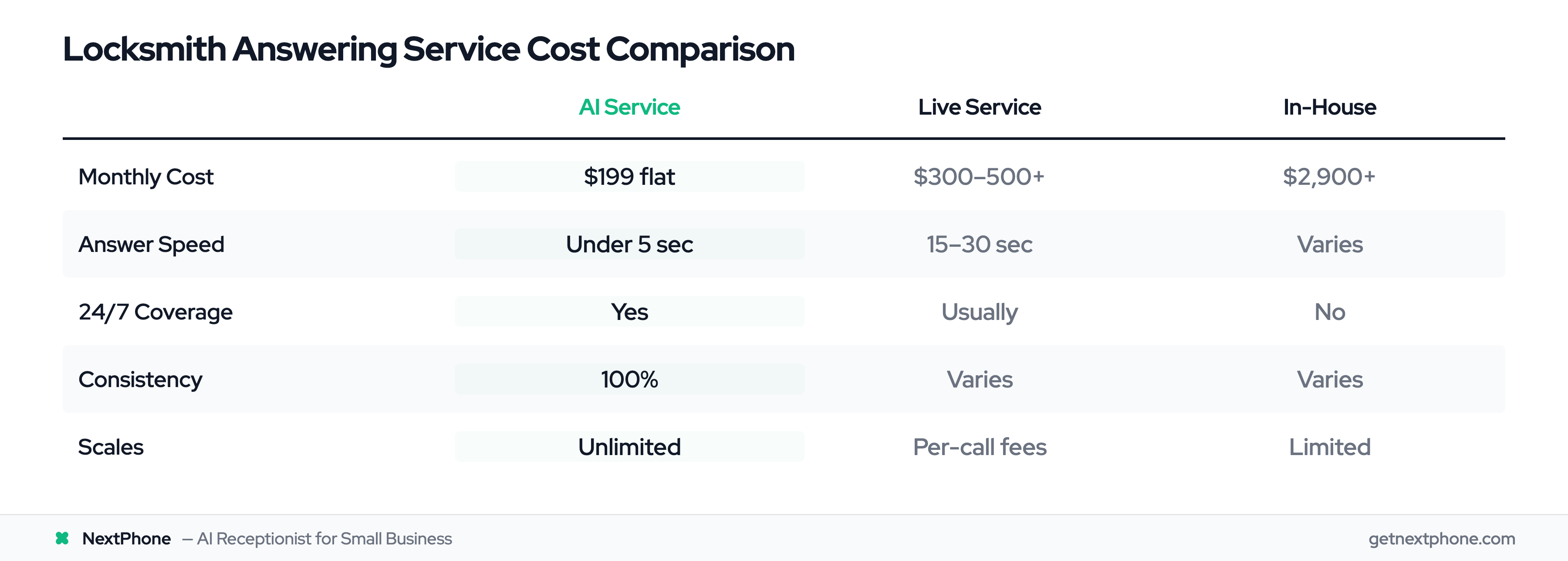
| Factor | AI Service | Live Service | In-House |
|---|---|---|---|
| Monthly Cost | $199 flat | $300-500+ | $2,900+ |
| Answer Speed | Under 5 sec | 15-30 sec | Varies |
| 24/7 Coverage | Yes | Usually | No |
| Consistency | 100% | Varies | Varies |
| Scales | Unlimited | Per-call fees | Limited |
Key Features for Locksmith Answering Services
24/7/365 Availability
This isn't a nice-to-have for locksmiths. It's mandatory.
Our data shows 73% of calls to home services businesses come outside traditional 9-5 hours. For locksmiths, that number is likely even higher. Lockouts are disproportionately after-hours events.
Any answering service you consider must provide true around-the-clock coverage. No "we cover 6 AM to midnight" exceptions. Lockouts at 3 AM on Christmas are real, and they're worth premium rates.
Emergency Detection and Routing
Your answering service should recognize urgency and act accordingly.
"Someone's locked out with a kid in the car" needs different handling than "I'd like a quote on rekeying my house." The first should reach you immediately. The second can wait until business hours.
Look for services that can:
- Detect urgency keywords and phrases
- Route emergencies to immediate dispatch
- Handle routine inquiries independently
- Flag high-priority situations for your attention
Information Collection Capabilities
Generic answering services ask generic questions. Locksmith-specific (or at least service-business-specific) platforms collect what you actually need:
- Exact location (not just city, but address or intersection)
- Vehicle details for auto lockouts
- Building type for residential/commercial
- Security concerns that affect how you approach the job
- Payment expectations if you require upfront deposits
AI platforms generally capture this information more accurately than human agents. Our data shows AI achieves 99%+ accuracy on data capture vs 5-10% error rates with human transcription.
Dispatch and Notification Options
You need to receive job details instantly, wherever you are. Look for:
- Text message dispatch (fastest, works everywhere)
- Phone call escalation for true emergencies
- Email backup for documentation
- Mobile app with push notifications
- Dashboard for reviewing call history
Integration With Your Systems
If you use CRM software, scheduling tools, or invoicing systems, integration saves double-entry and prevents lost leads. NextPhone and similar platforms can push call data directly to your existing tools.
Locksmith Answering Service Pricing
AI Answering Service Costs
AI-powered services typically charge flat monthly rates:
- Budget options: $25-50/month (often limited features)
- Mid-range: $50-150/month (full features, unlimited calls)
- Premium: $150-250/month (advanced integrations, priority support)
NextPhone runs $199/month with unlimited calls, emergency routing, SMS follow-up, and CRM integration included.
The key advantage: no per-call fees. During a busy night with 15 lockout calls, you pay the same as a quiet Tuesday.
Live Answering Service Costs
Human-staffed services typically use per-minute or per-call pricing:
- Base plans: $150-200/month for limited minutes
- Per-minute rates: $1-2/minute beyond included time
- Per-call rates: $3-8/call depending on complexity
During emergencies or busy seasons, these costs can spike dramatically. A night with 20 calls at $5/call adds $100 to your bill, on top of base fees.
In-House Receptionist Costs
Hiring a dedicated person to answer phones sounds simple but gets expensive:
- Salary: $33,960-40,000/year for entry-level per receptionist wages data
- Benefits: Add 25% ($8,500-10,000)
- Total: $42,000-50,000/year minimum
And they only work 40 hours. You'd need multiple people to cover 24/7, pushing costs toward $100,000+ annually.
For most locksmith operations, in-house simply doesn't make financial sense.
The ROI Reality
Compare the costs to what you're losing:
- Missing $27,000/year in calls (conservative estimate)
- AI service cost: $2,388/year ($199 x 12)
- Net gain: $24,612/year
Even if an answering service only captures two additional $250 jobs per month, it pays for itself. Everything beyond that is pure profit.
How NextPhone Handles Locksmith Calls
Instant Emergency Response
NextPhone answers every call in under 5 seconds. No voicemail. No hold music. No "all agents are busy" messages.
When someone's locked out at 2 AM and calling multiple locksmiths, you want to be the one that answers. NextPhone ensures you are, even when you're physically unable to grab your phone.
Smart Call Routing and Dispatch
The AI recognizes emergency situations and acts accordingly:
- Emergency lockouts: Collects info, dispatches to your phone immediately via text/call
- Urgent but not critical: Collects info, sends notification, allows you to respond when available
- Routine inquiries: Handles independently, schedules callbacks for business hours
You can configure routing rules to match your operation. Want all after-hours calls routed to you directly? Done. Prefer text notifications unless it's a child-in-car situation? That works too.
Complete Call Handling
Beyond just answering, NextPhone handles the full workflow:
- Collects location, lockout type, vehicle info, urgency level
- Texts the customer confirming help is on the way
- Sends you complete details via text, email, or app notification
- Logs everything in a dashboard for later review
- Syncs with your CRM if you use one
The result: You get qualified leads with all the information you need, customers get immediate reassurance, and nobody falls through the cracks.
At $199/month with unlimited calls, the math works for any locksmith operation losing even a handful of calls monthly.
Frequently Asked Questions
How much does a locksmith answering service cost?
AI-powered services like NextPhone charge $199/month flat with unlimited calls and emergency dispatch included. Live human services cost $300-500+/month with per-call or per-minute charges on top. Compare that to the $27,000+ most locksmiths lose annually from missed calls.
Can AI handle emergency locksmith calls?
Yes. Modern conversational AI understands context and urgency. It recognizes phrases like "locked out," "child in car," or "emergency" and routes those calls appropriately. AI collects all necessary information accurately and dispatches to you immediately. For the 80%+ of locksmith calls that follow predictable patterns, AI handles them as well as or better than human agents.
What information should an answering service collect for locksmiths?
At minimum: customer name, callback number, location/address, type of lockout (car, home, business, safe), and urgency level. For vehicle lockouts, make/model/year/color. Critical questions: Is anyone locked inside? Is the vehicle running? Any security concerns? Good services capture this automatically and send it to you with the dispatch notification.
Will customers accept talking to an AI?
Most do. Research shows 60-70% of customers are comfortable with AI for straightforward tasks. For someone locked out at 2 AM, they want fast answers and reassurance that help is coming. They're not looking for conversation. AI delivers instant response and consistent information, which is exactly what emergency situations require. Transfer to a human is always available for unusual cases.
How does emergency dispatch work?
The answering service answers the call, confirms it's an emergency, and collects relevant details (location, lockout type, urgency level). That information is immediately sent to the on-call locksmith via text message, phone call, or app notification. The customer receives confirmation that help is coming. Total time from call to dispatch: under 60 seconds with AI services.
Can I use an answering service if I'm a solo locksmith?
Absolutely. Solo operators benefit most from answering services. You can't answer when you're on a job, driving, or sleeping, but calls keep coming. An answering service captures those calls 24/7 without requiring you to hire staff. It's the most cost-effective way to provide around-the-clock coverage for a single-person operation.
How fast do AI answering services respond?
AI services like NextPhone answer in under 5 seconds. Compare that to 15-30+ seconds typical for live human services (who may have other calls in queue) or voicemail (which 67% of callers won't use anyway). For emergency locksmiths competing to be first, those seconds matter.
Stop Losing Emergency Calls to Voicemail
Locksmith work runs 24/7, but you can't answer 24/7. Every call that hits voicemail is likely going to your competitor instead. At $200-500 per missed call, the math adds up fast.
A locksmith answering service solves this for less than $200/month. AI-powered options like NextPhone answer instantly, collect all the information you need, and dispatch jobs to you while you're still finishing the current one.
The businesses winning in this industry aren't necessarily the best locksmiths. They're the ones who answer the phone.