
What Is a Legal Intake Answering Service?
A legal intake answering service does far more than take messages or transfer calls. It's a specialized system—staffed by trained humans, AI, or both—that qualifies potential clients, captures detailed case information, and routes leads appropriately before an attorney ever gets involved.
Think of the difference this way: A general receptionist might say, "I'll have someone call you back." A legal intake specialist asks about the accident details, injuries, timeline, and insurance information—then schedules a consultation and logs everything to your CRM while the caller is still on the line.
Looking for a service rather than a process guide? See our AI-powered legal intake answering service with 24/7 coverage at $199/mo.
The Intake Specialist Role
Legal intake specialists understand the terminology and urgency of legal matters. They know that a PI call about a car accident from last week is different from a criminal defense call about someone currently in custody. They're trained to handle callers in crisis—people going through divorce, recovering from injury, or facing criminal charges—with appropriate empathy.
This specialization matters. According to Clio's Legal Trends research, 52% of potential clients won't hire a firm if their initial contact isn't friendly or helpful enough. First impressions happen during intake, not during the attorney consultation.
Why Specialization Matters
Generic call centers treat every call the same. Legal intake services understand that a 2 AM call about a DUI arrest requires immediate attorney notification, while a 2 PM call about updating an estate plan can wait for a scheduled callback. This distinction between urgency levels is what separates intake from simple answering.
Why Legal Intake Determines Whether Potential Clients Become Paying Clients
The data on legal intake is stark: speed wins cases before you ever argue in court.
The First-Responder Advantage
According to industry research, 87% of potential clients hire the first attorney who responds to their inquiry. Not the best attorney. Not the cheapest. The first one who actually picks up the phone.
When someone searches "car accident lawyer near me" at 11 PM after leaving the emergency room, they're not comparison shopping. They're looking for help. The firm that answers wins.
This creates a dramatic competitive advantage. If your competitors send calls to voicemail while your intake system answers in under five seconds, you're capturing cases they'll never even know existed.
Conversion Rate Benchmarks
The conversion gap between firms is massive:
- Average law firm: 14% of leads convert to paying clients
- Well-optimized firms: 25-40% conversion rate
- Top performers: 40-50%+ conversion
What separates a 14% firm from a 45% firm? Process. Firms using structured 24/7 intake systems see 30% higher conversion rates than those with inconsistent call handling.
The Cost of Slow Response
Research from InsideSales found that responding within five minutes makes you 21 times more likely to convert a lead compared to waiting 30 minutes. After an hour, your odds drop by 60x compared to that first five-minute window.
Here's what that means practically: 42% of potential clients contact multiple firms simultaneously. They're comparison shopping in real-time. The firm that responds first and handles intake professionally wins the case. Everyone else is fighting for scraps.
How the Legal Intake Process Works: A Step-by-Step Breakdown
Understanding the actual intake workflow helps you evaluate whether your current system captures every lead—or lets them slip away.
Step 1: Initial Contact and Greeting
The clock starts the moment your phone rings. Best practice is answering within five seconds (about two rings). The greeting should be professional, include your firm name, and immediately signal helpfulness: "Thank you for calling Smith Law. This is Sarah—how can I help you today?"
Compare that to voicemail. Research shows that 80% of callers who reach voicemail hang up without leaving a message. They don't wait—they call the next firm on their list.
Step 2: Case Type Identification and Urgency Assessment
Within the first minute, intake should determine:
- Practice area fit: Is this a personal injury case? Family matter? Criminal charge?
- Urgency level: Is someone in custody? Is there a court date tomorrow? Is this a routine inquiry?
- Immediate needs: Does this caller need an attorney right now, or can they wait for a scheduled consultation?
Urgent matters—someone just arrested, a filing deadline approaching, or an emergency custody situation—need immediate escalation. In our analysis of thousands of calls, we found that 6.2% represent true emergencies requiring immediate action.
Step 3: Conflict Check and Qualification
Before any substantive conversation, intake must address conflicts. This means asking about:
- The opposing party (by name if possible)
- Any other parties involved in the matter
- Previous representation on this issue
The intake specialist checks these names against your existing client database. Potential conflicts get flagged for attorney review before any engagement letter goes out. This isn't optional—it's an ethical requirement that protects your license and your firm.
Step 4: Information Capture and Documentation
Once conflict check clears, structured intake begins. This includes:
- Contact information: Full name, phone, email, address
- Case details: What happened, when, where, injuries/damages, documents available
- Timeline: Any deadlines, upcoming court dates, statute of limitations concerns
- Goals: What outcome does the client want?
- Lead source: How did they find your firm?
Every piece of information goes directly into your system—whether that's a CRM, practice management software, or even a structured email to the handling attorney.
Step 5: Handoff and Follow-Up
Intake doesn't end when the call does. Proper handoff includes:
- Scheduling the consultation (or confirming callback time)
- Sending confirmation via SMS and/or email
- Logging all information to your CRM immediately
- Assigning the lead to the appropriate attorney
- Creating follow-up tasks if no immediate consultation scheduled
This systematic approach ensures no lead falls through the cracks—which happens more often than you'd think when attorneys try to manage intake themselves between depositions and court appearances.
What to Ask: Intake Questions by Practice Area
Generic intake forms miss critical case-specific information. Here's what matters for the most common practice areas.
Personal Injury Intake Questions
PI intake needs to establish liability, damages, and timing quickly:
- When and where did the accident occur?
- What type of accident was it? (auto, slip and fall, medical malpractice, product liability)
- Were you injured? What injuries did you sustain?
- Have you received medical treatment? From whom?
- Do you have the other party's insurance information?
- Was a police report filed?
- Have you spoken with any other attorneys about this case?
- Are you aware of any filing deadlines? (statute of limitations)
The goal is gathering enough to evaluate case viability before the attorney consultation.
Family Law Intake Questions
Family matters require sensitivity and understanding of case complexity:
- What type of family law matter is this? (divorce, custody, adoption, guardianship)
- Are there minor children involved? What are their ages?
- Is there an existing court case or order?
- Are there any safety concerns or domestic violence issues?
- What is the other party's likely position—contested or amicable?
- Are there any upcoming court dates or deadlines?
- What assets or debts are involved? (for divorce)
Safety questions matter enormously. If there's domestic violence involved, that changes how your firm handles every aspect of the case.
Criminal Defense Intake Questions
Criminal intake often happens under time pressure:
- What are the charges (or suspected charges)?
- Has an arrest been made? Is the person currently in custody?
- Is there a court date scheduled? When?
- Has the person spoken with police?
- Were any statements made?
- Are there witnesses to the incident?
- Is bail an immediate concern?
For criminal matters, the "is someone in custody right now?" question determines whether this is a 9 AM callback or a 2 AM jail visit.
Universal Questions (All Practice Areas)
Regardless of case type, always capture:
- Full legal name and preferred contact method
- How did you hear about our firm?
- Have you contacted other attorneys about this matter?
- What is your ideal outcome?
- Is there anything else we should know?
These questions help with lead source tracking, competitive intelligence, and setting appropriate expectations.
Live Human Intake vs AI Intake: An Honest Comparison
The legal industry is split between traditional live receptionist services and newer AI-powered intake. Both have genuine strengths—and the right choice depends on your firm's needs.
Where Live Human Intake Excels
Human intake specialists bring capabilities AI is still developing:
- Emotional intelligence: A trained human can recognize when a caller is in crisis and respond with appropriate empathy. Divorce clients, injury victims, and criminal defendants often need reassurance before they can provide case details.
- Complex problem-solving: Unusual situations that don't fit standard scripts require human judgment. "My landlord changed the locks, I think they're trying to steal my business inventory, and there might be a restraining order involved" needs a human to parse.
- Relationship building: Some high-value clients expect to speak with a person, not a system. For matters like estate planning for wealthy families, that personal touch can matter.
- Reading between the lines: Humans detect unstated needs. A caller asking about "updating my will" might really be dealing with a terminal diagnosis and need more comprehensive planning.
Where AI Intake Excels
Modern AI intake has substantial advantages:
- 24/7/365 availability: AI never calls in sick, takes vacation, or leaves at 5 PM. Every call gets answered—nights, weekends, holidays.
- Instant response: AI answers in under five seconds. No hold music, no "please wait while I transfer you."
- Perfect consistency: The 500th call of the day gets the same quality as the first. No fatigue, no bad moods, no Monday morning sluggishness.
- 99%+ data accuracy: AI doesn't mishear phone numbers or forget to ask about the statute of limitations. Everything captured is captured correctly.
- Unlimited scale: AI handles one call or 100 simultaneous calls with equal quality. Volume spikes don't create bottlenecks.
- Dramatic cost savings: AI intake runs $199/month versus $35,000-$50,000/year for a full-time receptionist—that's 93% less.
The Hybrid Approach: Best of Both Worlds
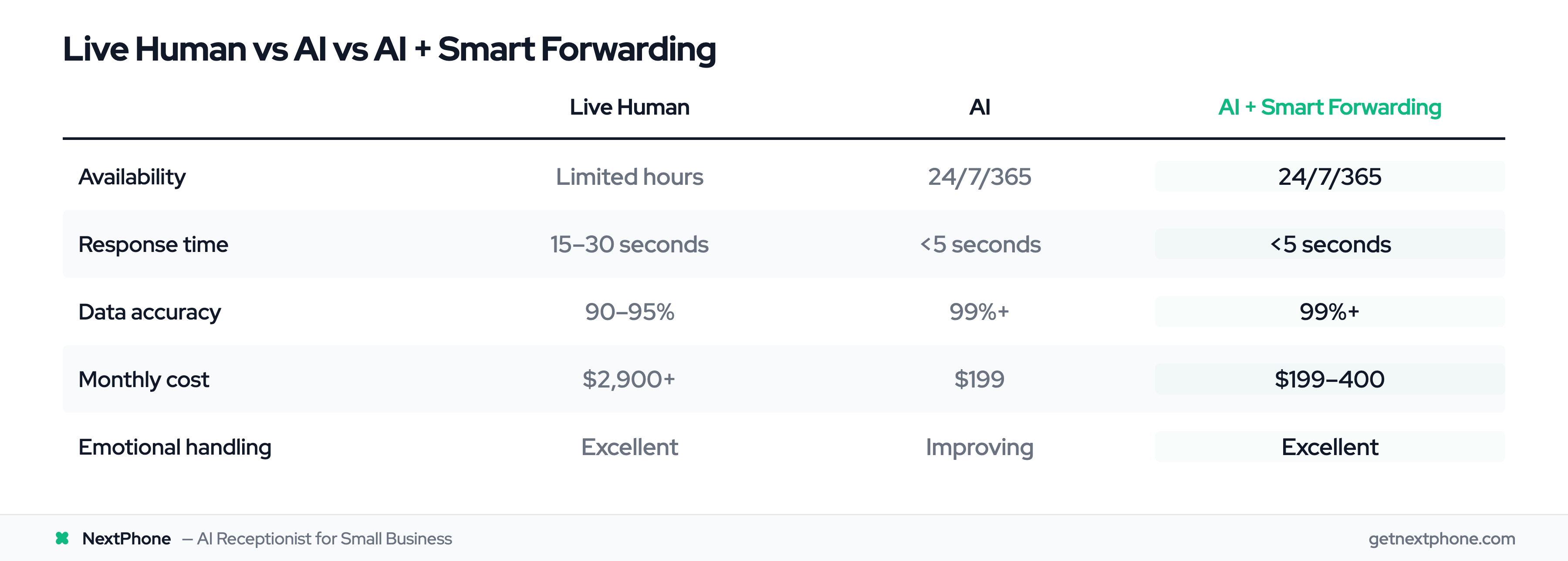
Most successful firms don't choose exclusively between human and AI. They use both:
- AI handles: After-hours calls, routine inquiries, data collection, scheduling confirmations, overflow during busy periods
- Humans handle: Distressed callers who need empathy, complex situations requiring judgment, VIP clients, escalated matters
The key is seamless transfer capability. When AI recognizes a caller needs human assistance—detecting distress, confusion, or explicit requests—it transfers to a live person without making the caller repeat everything.
This AI-first approach with smart forwarding captures the efficiency and consistency of AI while preserving access to you for the cases that need it.
| Factor | Live Human | AI | AI + Smart Forwarding |
|---|---|---|---|
| Availability | Limited hours | 24/7/365 | 24/7/365 |
| Response time | 15-30 seconds | <5 seconds | <5 seconds |
| Data accuracy | 90-95% | 99%+ | 99%+ |
| Cost | $35K+/year | $199/month | $199-400/month |
| Emotional handling | Excellent | Improving | Excellent |
| Scalability | Limited | Unlimited | Unlimited |
How Legal Intake Services Integrate with Clio, MyCase, and Other Legal CRMs
Capturing intake information is only valuable if it reaches your attorneys and case management system. Integration is what makes intake actionable.
Why CRM Integration Matters
Without integration, someone has to manually transfer information from the answering service into your system. That creates:
- Duplicate data entry (wasted time)
- Transcription errors (wrong phone numbers, misspelled names)
- Delays (attorney doesn't see the lead until someone enters it)
- Lost leads (the sticky note falls off the desk)
With proper integration, intake information flows directly into your CRM within seconds of the call ending. The attorney sees complete case details before making a callback. No manual entry required.
How Integration Works
Modern legal intake services integrate with CRMs through several methods:
- Native integration: Services like Answering Legal connect directly to Clio Grow, syncing data automatically
- API connections: Custom integrations push data directly to your platform
- Webhook automation: Services send structured data that triggers CRM actions
- Zapier/Make: For platforms without native integration, automation tools bridge the gap
The workflow looks like this: Intake call completes → Data automatically syncs → New contact created in CRM → Matter assigned to practice area → Task created for follow-up → Attorney notified via email/SMS.
Key Platforms
Clio Grow: The most popular legal CRM. Many answering services offer native Clio integration. One firm reported their no-show rate dropped from 20-25% to less than 5% after implementing Clio Grow with integrated intake.
MyCase: Strong intake forms and client portal. Integrations available through API and automation tools.
PracticePanther: Popular with small and solo firms. Supports most common integrations.
Lawmatics: Combines CRM with marketing automation—good for firms doing significant digital advertising.
For platforms without native integration, services like Zapier connect to 5,000+ applications, ensuring your intake data reaches wherever it needs to go.
What Poor Legal Intake Is Costing Your Firm
The numbers on missed legal calls are staggering—and they represent real revenue walking into your competitors' offices.
The $109 Billion Problem
According to a nationwide study of law firm responsiveness:
- Law firms across the US receive 557 million calls annually
- 35% of those calls (195 million) go unanswered during business hours
- Only 7% of new calls convert to paying clients
- That means 13.6 million lost client opportunities every year
- With average client value of $8,000, the total lost revenue reaches $109 billion annually
And that's just during business hours. After hours, miss rates climb to 90%. When your competitors have intake systems that answer 24/7, they're capturing the calls you don't even know you're missing.
Calculating Your Firm's Losses
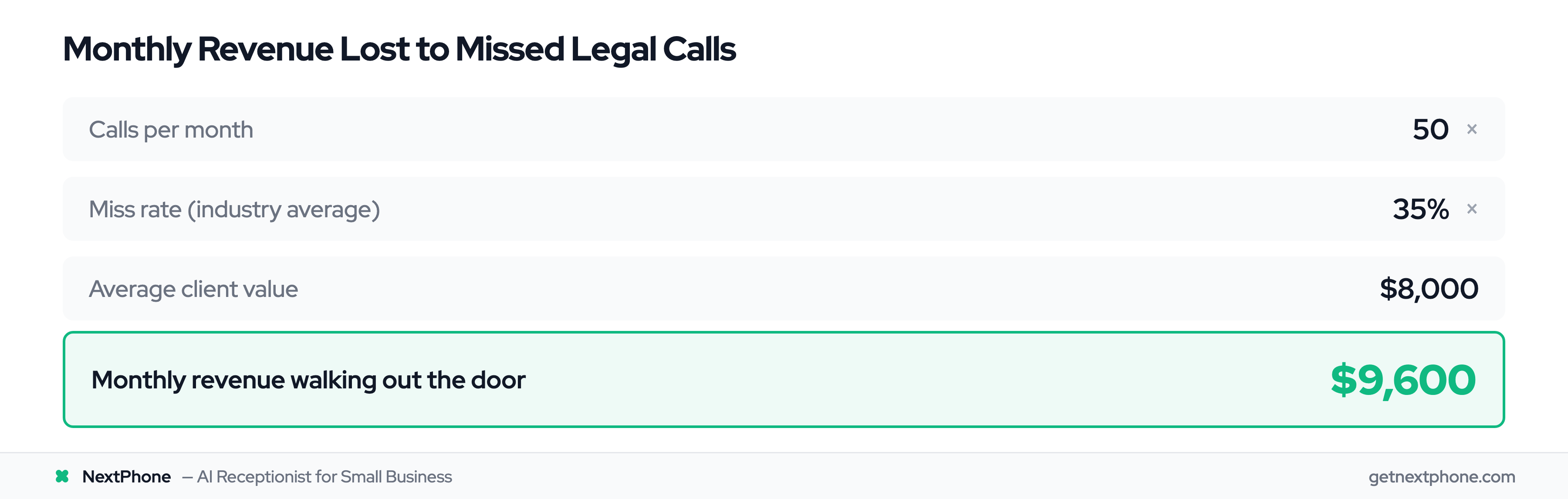
Here's the math for a firm receiving 50 calls per month:
- 35% miss rate = 17-18 missed calls
- 7% of those would have converted = ~1.2 clients lost monthly
- At $8,000 average client value = $9,600/month in lost revenue
- Annual total: $115,200 walking out your door
For personal injury firms with higher average case values ($15,000-$50,000), those numbers multiply quickly. Missing just two viable PI cases per month at $25,000 each costs $600,000 annually.
The True Cost Comparison
What does it cost to solve this problem?
- Full-time receptionist: $35,000-$50,000/year in salary, plus benefits, training, management time, and coverage for sick days and vacations
- Live answering service: $300-$800/month for limited hours and call volume
- AI answering service: $199/month for unlimited 24/7 coverage
The ROI math is simple: Even a mid-sized firm capturing just one additional client per month more than covers the cost of any intake solution. For most firms, the return is 10x to 50x the investment.
How NextPhone Solves Legal Intake for Law Firms
NextPhone is AI-first with smart forwarding, designed specifically for businesses that can't afford to miss calls—including law firms handling high-value cases.
AI-First with Smart Forwarding
NextPhone's AI answers every call in under five seconds, 24/7/365. There's no voicemail, no hold time, no "our office is currently closed."
For routine intake—gathering contact information, determining case type, assessing urgency, collecting basic case details—the AI handles everything professionally and accurately. Data capture accuracy exceeds 99%, eliminating the typos and forgotten questions that plague manual intake.
But when a situation requires human judgment—a distressed caller, a complex matter, or an explicit request to speak with an attorney—NextPhone transfers the call immediately. You control the rules: urgent criminal matters go directly to the on-call attorney, high-value PI leads get immediate transfer, routine estate planning inquiries get scheduled callbacks.
Key Capabilities for Law Firms
- Custom intake questions: Configure practice-area specific questions once, and the AI asks them consistently on every call
- Conflict check workflow: AI gathers opposing party information for attorney review before engagement
- CRM integration: Data syncs to Clio, MyCase, and other platforms via webhooks and Zapier
- SMS follow-up: Automatically send consultation confirmations and firm information to callers
- Email notifications: Attorneys receive complete intake summaries within minutes of each call
- Call recording and transcription: Review any intake call to ensure quality
Getting Started
NextPhone runs $199/month with unlimited calls—no per-minute charges, no surprise fees during busy months. Setup takes under an hour. The website analyzer reads your firm's site and auto-configures the AI with your practice areas, services, and common questions.
A 7-day free trial lets you test with real calls before committing. Most firms see the value within the first few days, when they review the call log and realize how many after-hours and missed calls the AI captured.
Sample Law Firm Intake Scripts: Templates by Case Type
Generic "thank you for calling" scripts are why 14%-firms stay stuck at 14%. The firms converting 40%+ use structured, empathy-first scripts that match the case type in front of them. Below are practical templates you can adapt — the opening, the qualifying questions, and the close.
The Opening Script (Works for Every Practice Area)
The first 15 seconds decide whether the caller stays on the line or hangs up and dials the next firm. Keep it warm, named, and forward-moving:
"Thank you for calling [Firm Name]. This is [Intake Name] — I help new clients get connected with the right attorney. I'm sorry you're dealing with this. Before I ask a few questions so we can get you the right help, is it okay if I take about 5 minutes with you?"
Why this works: it names the firm, names the person, acknowledges the situation without making legal statements, sets a time expectation, and gets explicit consent to proceed. No jargon, no "please hold."
In our call data, 99.0% of callers express positive or neutral sentiment — they want to talk. The opening's only job is to avoid breaking that.
Personal Injury Qualifying Questions
PI intake has to establish liability, damages, and timing in under three minutes. Ask in this order:
- "First — are you or anyone else hurt right now, and have you been seen by a doctor?"
- "When and where did the accident happen?"
- "What type of accident was it — auto, slip and fall, workplace, something else?"
- "Was a police report filed? Do you have a copy or report number?"
- "Do you have the other party's insurance information?"
- "Have you spoken with any insurance adjusters yet — theirs or yours?"
- "Have you signed anything or given a recorded statement?"
- "Have you contacted any other attorneys about this case?"
The last three questions are often skipped — and they're the most important. A caller who already gave a recorded statement to the opposing insurer has a materially different case than one who hasn't.
Family Law Qualifying Questions
Family matters need safety screening before fact-gathering:
- "Before anything else — are you and any children safe right now? Is there any immediate danger?"
- "Is there a protective order, restraining order, or open DCF/CPS case involved?"
- "What type of matter is this — divorce, custody, modification, support?"
- "Are there minor children, and what are their ages?"
- "Is there currently a court case open? If so, do you know the case number?"
- "Is the other party represented by an attorney?"
- "Are there any upcoming hearings or deadlines?"
If the answer to question 1 is "no, I'm not safe," the script ends and the call routes to an attorney or a domestic violence hotline immediately. No further intake questions.
Criminal Defense Qualifying Questions
Criminal intake is time-critical. Run it in this exact order:
- "Is the person currently in custody right now, or have they been released?"
- "What are the charges — or the suspected charges?"
- "Has there been an arraignment? Is there a court date already scheduled?"
- "Has the person been interviewed by police or given any statement?"
- "Is bail set? Has it been posted?"
- "Is there a public defender already appointed?"
- "Who is calling — the defendant, a family member, or someone else?"
Question 1 determines everything. "In custody right now" means transfer to an on-call attorney immediately, regardless of the hour.
Estate Planning Qualifying Questions
Estate intake is lower urgency but higher average matter value. Focus on scope and life events:
- "What's prompting the call today — are you updating an existing plan, starting fresh, or handling something for a family member?"
- "Are we dealing with a will, a trust, powers of attorney, or all of the above?"
- "Is there a specific timeline — a health concern, upcoming travel, a recent life event?"
- "Do you currently have any estate documents in place?"
- "Roughly, what's the size of the estate — real estate, investments, business interests?"
- "Are there any blended-family or minor-beneficiary considerations?"
The "what's prompting the call" question often surfaces urgency the caller won't volunteer — a terminal diagnosis, an imminent travel plan, a relative's death.
Bankruptcy Qualifying Questions
- "Is there a specific action you're trying to stop — a foreclosure, a wage garnishment, a lawsuit, a repossession?"
- "Have you filed for bankruptcy before? If so, when and what chapter?"
- "Are you dealing mostly with credit card debt, tax debt, personal loans, or something else?"
- "Do you own a home? Are you behind on the mortgage?"
- "Are you currently employed?"
- "Have you been served with any lawsuits?"
Question 1 is the urgency trigger. A foreclosure sale date in 10 days is a different call from "I'm thinking about my options."
Immigration Qualifying Questions
- "What's your current immigration status?"
- "What are you trying to accomplish — a green card, citizenship, work authorization, family petition, removal defense?"
- "Are you currently in removal proceedings? Have you received a Notice to Appear?"
- "Is there a hearing date scheduled?"
- "What country are you from?"
- "Have you ever had any criminal charges, even minor ones?"
- "Do you have any family members who are US citizens or permanent residents?"
Removal proceedings with a hearing date is the urgency flag here. Everything else can wait for a scheduled consultation.
The Closing Script
Every intake call should end with the same three things: a confirmed next step, a written record, and an expectation about what happens next.
"Thank you for walking through all of that with me. Based on what you've shared, I'm going to [schedule a consultation with Attorney Name for Tuesday at 2pm / have our attorney call you back within 2 hours / transfer you right now]. I'm sending you a text message in the next minute with the [booking confirmation / intake link / callback details]. You'll also get an email copy. Is the number you're calling from the best one to reach you?"
The SMS-during-the-call is the hinge. We cover why below.
Intake KPIs: What to Track and What "Good" Looks Like
If you don't measure it, you won't improve it. These are the KPIs firms converting 40%+ track on a weekly dashboard:
| KPI | What It Measures | Good Benchmark |
|---|---|---|
| Answer rate | % of calls picked up in under 5 seconds | 95%+ |
| Abandonment rate | % of callers who hang up before intake starts | Under 5% |
| Qualified lead rate | % of calls that match your practice areas and aren't conflicts | 50-70% |
| Consultation set rate | % of qualified leads who book a consultation | 60-80% |
| Show rate | % of booked consultations who actually show up | 70-90% |
| Signed retainer rate | % of consultations that become paying clients | 30-50% |
| Time-to-first-response | Time from call to attorney callback (for non-live calls) | Under 15 minutes |
| Overall conversion | % of total calls that become paying clients | 15-35% |
The firms at the top of these ranges aren't staffed better — they just have a scripted, measured process. A firm running no script typically sits at the bottom of every row.
Three stats from our call data make the KPI case concrete:
- 51.2% of inbound calls are real leads — meaning every missed call has a roughly 50/50 chance of being actual revenue.
- 51.5% of conversations express urgency — callers aren't comparison shopping, they're looking for someone to help today.
- 28.5% of calls arrive outside business hours — if your KPIs only track 9-5, you're measuring less than three-quarters of your pipeline.
In-Call Conversion: What Turns a Lead Into a Booked Consultation
Scripts tell you what to say. This section covers what actually happens during the call that converts — the micro-decisions that separate the 14% firms from the 45% firms.
The First 30 Seconds Decide the Call
The caller has already decided whether to stay on the line by the time you finish your second sentence. Three things they're judging:
- Did a real human (or a competent AI) answer in under 5 seconds? 80% of callers who hit voicemail hang up without leaving a message.
- Does the person on the line sound like they know what to do? Fumbling or transferring immediately signals "call the next firm."
- Am I being heard, or am I being processed? A two-sentence acknowledgment of the situation — "I'm sorry you're dealing with this, we help people in exactly this situation every day" — buys you the rest of the call.
Get those three right and the caller stays for the qualifying questions. Get any of them wrong and you've lost the lead before you've asked a single question.
Qualifying Without Interrogating
The biggest mistake in legal intake is running through the qualifying list like a form. Callers shut down. The fix is framing — every question is prefaced with why you're asking it:
- Instead of "When did the accident occur?" — "I want to make sure we're still inside the time limits to take action, so when did this happen?"
- Instead of "Have you contacted other attorneys?" — "So I don't repeat questions you've already answered, have you talked with anyone else about this?"
- Instead of "Has bail been set?" — "So I know how quickly we need to move, has bail been set yet?"
The why-first framing turns interrogation into help. Callers who feel helped book consultations. Callers who feel processed call the next firm.
One more thing: 47% of calls in our dataset involve 7 or more exchanges. Legal calls aren't quick — they're conversations. Budget 5-8 minutes for intake, not 90 seconds.
The Booking Moment: Send the Link During the Call
This is the single biggest conversion lever most firms miss. When a caller agrees to a consultation, do not say "someone will call you to schedule." Do this instead:
"Great. I'm sending you a link right now to my phone — it has three time slots available this week. Go ahead and pick the one that works. I'll stay on the line until you've got it confirmed."
Send a Clio Grow booking link, a Calendly link, or whatever your firm uses — via SMS, while the caller is still on the phone. Watch for the confirmation. Only hang up after the booking is locked in.
Why this matters: 28.6% of callers in our data explicitly request a callback rather than an immediate appointment. Every callback is a leak point — the caller's urgency fades, they talk to another firm, they forget. Booking the consultation during the live call closes the leak.
For firms using AI intake, the AI can trigger the SMS automatically at the booking-intent detection point. No human required.
Warm Transfer vs Callback: The Decision Logic
Not every call should be a "we'll call you back." Not every call should be a live transfer to an attorney. Use this decision logic:
Transfer live, right now, if:
- Someone is currently in custody
- A hearing or filing deadline is in the next 48 hours
- A TRO/restraining order or safety concern is active
- The caller is in visible emotional distress and asks for an attorney
- A high-value PI case with a represented opposing party wants to move today
Book a consultation on the spot (SMS link during call) if:
- The matter is qualified but not an emergency
- Urgency is moderate (weeks, not hours)
- The caller has selected your firm and is ready to commit
Schedule a callback within 15 minutes if:
- Intake is complete but all attorneys are currently in court or on other calls
- The caller prefers a phone conversation over an online booking link
- The matter needs attorney evaluation before a consultation is offered
Schedule a next-day callback only if:
- The caller explicitly prefers a scheduled future time
- The matter is low urgency and scope is undefined
The cost of getting this wrong is measurable. In our call data, 36.9% of conversations contain explicit buying intent — pricing questions, scheduling requests, "how soon can someone see me." Those calls need to convert in the same session. A "we'll call you tomorrow" to a buying-intent caller is a handoff to your competitor.
After-Hours Conversion: The Biggest Unused Lever
28.5% of calls arrive outside business hours. Here's the part most firms miss: after-hours callers are not lower-intent — they're higher-intent. They've been thinking about the problem all day and finally made the call when everything else quieted down. 51.5% of conversations across the dataset express urgency.
If your only after-hours plan is "leave a message and we'll call you tomorrow," you're handing a disproportionate share of your highest-intent leads to whichever firm answers. A 24/7 intake system — live, AI, or hybrid — that can run the qualifying script and book the consultation at 11pm is the single highest-ROI change a firm can make.
Frequently Asked Questions
How much does a legal intake answering service cost?
Pricing varies by service type. Live receptionist services typically run $300-$800 per month, often with limited call volumes or per-minute charges. AI-powered services range from $99-$400 per month, usually with unlimited calls. NextPhone charges $199/month flat rate with no per-call fees. Compare any of these to a full-time receptionist at $35,000-$50,000 annually plus benefits—intake services deliver the same coverage at a fraction of the cost.
Can AI really handle sensitive legal conversations?
Modern AI handles 70-85% of routine intake effectively—gathering contact information, determining case type, and collecting basic details. For emotionally sensitive situations—distressed divorce clients, injury victims in pain, family members dealing with a loved one's arrest—the best approach combines AI efficiency with human empathy. Look for services offering instant transfer to live agents when callers need that human connection.
How do legal intake services check for conflicts?
During intake, the service asks about all parties involved: opposing parties, witnesses, and anyone else connected to the matter. These names get checked against your existing client database. Potential conflicts are flagged for attorney review before any engagement proceeds. Some services integrate directly with conflict-check software, while others provide the information for manual review.
What happens if someone calls after hours?
With AI-powered services, calls are answered 24/7—no voicemail, no "call back during business hours." Urgent matters (someone in custody, imminent deadlines) can transfer immediately to on-call attorneys. Non-urgent calls get full intake processing: all information captured, attorney notified, follow-up scheduled for the next business day. After-hours callers are often the highest-intent leads, actively searching for help rather than casually browsing.
Do I need to change my phone number?
No. Most firms simply forward their existing number to the intake service. Calls ring to your regular number and seamlessly route to the answering service. Alternatively, you can get a dedicated intake number for advertising while keeping your main number for direct client communications. Porting your number to a new provider is also an option if you prefer that setup.
How do legal intake services integrate with Clio?
Many services offer native Clio Grow integration—after each call, contact information and intake details sync automatically to your Leads section. Intake fields can be mapped to match your existing Clio configuration. For services without native integration, tools like Zapier connect intake data to Clio and hundreds of other platforms. Either way, the goal is eliminating manual data entry so attorneys see complete information before making callbacks.
Capture Every Potential Client with Professional Legal Intake
Legal intake is the first—and often only—chance to convert a potential client into a paying case. With 35% of law firm calls going unanswered and 87% of clients hiring the first attorney who responds, the math is clear: firms with professional intake systems win cases their competitors never even compete for.
Whether you choose live human intake or AI-first with smart forwarding, the key is ensuring every call gets answered, every lead gets captured, and every piece of information reaches your CRM without manual intervention.
The firms converting 40%+ of leads aren't better lawyers. They're firms that answer every call, ask the right questions, and follow up faster than anyone else.