Key Takeaways
- 78% of customers hire the first business to respond - speed is your competitive advantage, not price or quality
- Responding within 5 minutes makes you 100x more likely to connect with a lead vs. waiting 30 minutes
- Urgent inquiries rank among the top reasons people call - those callers need an immediate response and will hire whoever answers first
- Industry benchmark: Phone inquiries should be answered within 20 seconds; callbacks should happen within 30 minutes for urgent requests
- AI answering technology can reduce inquiry response time to zero seconds - every call answered instantly, 24/7, for a fraction of hiring staff
Introduction
When a potential customer calls your business, the clock starts ticking. In the time it takes you to call them back, 78% will have already hired whoever answered first.
This is the customer inquiry response time challenge that silently drains revenue from small businesses every day. Most business owners don't realize they're losing customers not because of price, quality, or reputation - but simply because someone else picked up the phone faster.
This guide covers everything you need to know about customer inquiry response time: what the research says, what benchmarks to aim for, and why urgent inquiries need immediate attention. More importantly, we'll show you how to achieve instant response even when you're busy working on a job.
What Is Customer Inquiry Response Time (And Why It Matters)
Defining Inquiry Response Time
Customer inquiry response time is the duration between when a customer reaches out to your business and when they receive their first response. This applies to phone calls, voicemails, contact form submissions, and text messages.
For service businesses - contractors, home services, professional services - phone calls remain the most time-sensitive channel. A customer calling about a plumbing emergency or an HVAC breakdown isn't browsing email. They're picking up the phone and calling until someone answers.
Why Every Second Counts
Customer expectations have fundamentally shifted. Research shows 90% of customers rate immediate response as critical, with 60% defining "immediate" as less than 10 minutes. "Immediate" doesn't mean within a day. It means within minutes.
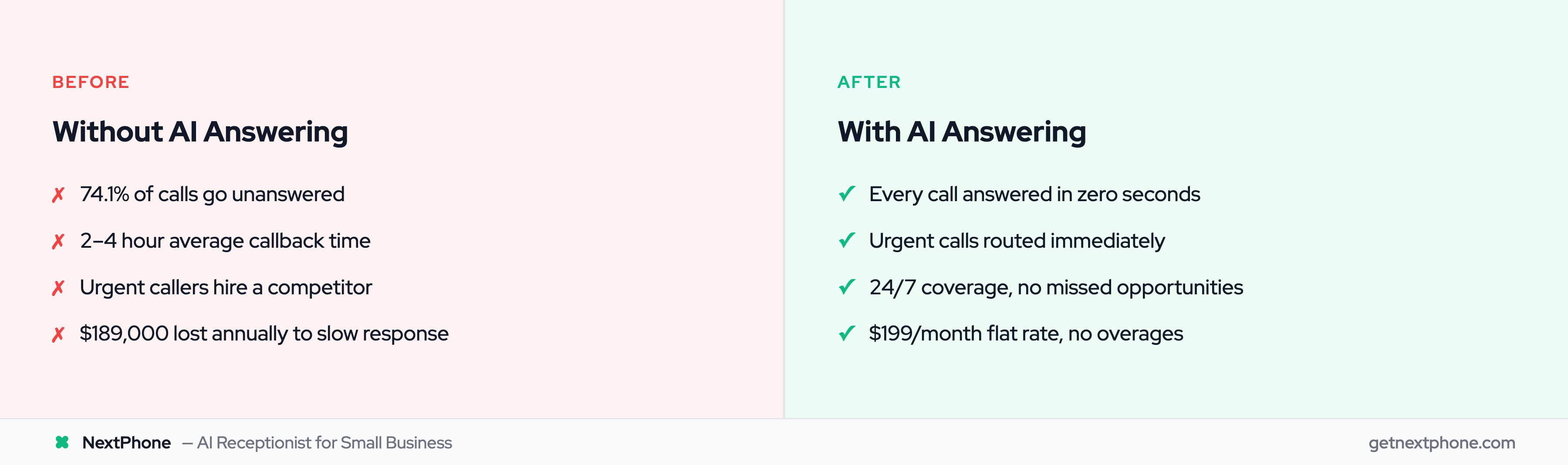
The uncomfortable reality? Industry data shows 74.1% of small business calls go unanswered. While you're finishing a job, your phone is ringing - and most of those callers aren't leaving voicemails. They're calling your competitor.
Your competitor isn't necessarily better at what they do. They're just faster at picking up the phone.
The Research: Speed-to-Lead Statistics You Need to Know

The 5-Minute Rule
The MIT Lead Response Management Study identified a critical threshold: responding within 5 minutes makes you 100x more likely to connect with a potential customer compared to waiting 30 minutes.
Not 2x more likely. Not 10x. One hundred times.
This isn't a marginal improvement. It's the difference between converting leads and watching them disappear.
What Happens When You Wait
The data on delayed response is sobering:
- After 5 minutes: Lead qualification drops by 400%
- After 30 minutes: You're 21x less likely to qualify the lead
- After 1 hour: Harvard Business Review research shows you're 7x less likely to have a meaningful conversation
Every minute of delay compounds the problem. The lead gets colder. The customer gets frustrated. Your competitor answers.
The Harvard Business Review Finding
The landmark Harvard Business Review study on lead response found that companies contacting potential customers within an hour were nearly 7 times as likely to qualify the lead compared to those waiting even one hour longer. The study also found the average response time across 2,241 US firms audited was 42 hours.
Consider what this means for a typical small business. If you're on a job site and can't call back for 2-3 hours, you've already lost the speed-to-lead advantage that turns inquiries into customers.
The gap between customer expectation (5 minutes) and small business reality (2-4 hours) is where business goes to competitors. In real estate, the average agent takes 917 minutes (over 15 hours) to respond.
Industry Benchmarks for Inquiry Response Time
Phone Inquiry Benchmarks
The industry standard for phone inquiries is clear: answer within 20 seconds - about 4 rings. After 6 rings, 75% of callers hang up. After reaching voicemail, 80% hang up without leaving a message.
For most service businesses, an unanswered phone call isn't a voicemail waiting to be returned. It's a lost opportunity that called someone else. In healthcare, missed and delayed inquiries can reduce annual revenue by 15-24%.
Callback Time Standards
When you do miss a call, callback speed matters enormously:
- Urgent inquiries: Within 30 minutes
- Standard inquiries: Within 4 hours
- Informational requests: Within 24 hours
Research shows 82% of customers expect a response within 10 minutes for sales-related inquiries. The Healthcare Contact Center Survey confirms similar expectations across industries.
What "Good" Looks Like for Small Businesses
Here's the benchmark framework for small service businesses:
| Inquiry Type | Target Response Time |
|---|---|
| Phone call | Answer within 20 seconds |
| Urgent callback | Within 30 minutes |
| Standard callback | Within 4 hours |
| Quote request | Within 2 hours |
| After-hours inquiry | First thing next morning |
The reality? Most contractors without phone answering help are responding in 2-4 hours during jobs, next business day for after-hours calls, and sometimes not at all for weekend inquiries. A study of the top 74 brokerages found 41% didn't respond at all.
You don't have to be perfect. You just have to be faster than everyone else your customer is calling.
The Urgency Factor: Which Inquiries Need Immediate Response
The Discovery: Urgency Language Is Everywhere
Not all customer inquiries are equal. Our analysis of the 1,446,980+ business calls we've answered revealed a critical finding: urgent calls rank among the top reasons people call, with language indicating the caller needs immediate help.
That pattern shows up across every trade we serve.
These aren't casual "I'd like a quote for next month" calls. These are "my water heater burst" and "my AC died in 95-degree heat" calls. Customers ready to hire whoever answers first.
What Urgency Sounds Like
Urgency language includes phrases like:
- "Emergency," "urgent," "ASAP"
- "Need someone today," "right away," "immediately"
- "Flooding," "no heat," "no AC," "burst pipe"
- "Can't wait," "as soon as possible"
True emergencies are a recurring reason people call - situations requiring immediate professional response. These often carry the highest job values, averaging $1,200 or more per emergency job.
Why Urgent Callers Have Zero Patience
When a homeowner's basement is flooding, they're not leaving a voicemail and waiting patiently. They're calling 2-3 businesses in the first 10 minutes and hiring whoever answers.
Urgent callers have the highest conversion potential because they've already decided to hire someone. The only question is who. They also have zero tolerance for voicemail - the moment they hear your recording, they're already dialing the next number.
A large share of your callers is ready to hire right now. If you don't answer, they'll hire someone else in the next 10 minutes. The urgency factor means speed isn't just good service - it's the difference between capturing high-value jobs and losing them.
First Responder Wins: The 78% Advantage
The 78% First Responder Reality
Here's the most important customer inquiry statistic you'll read: 78% of customers hire the first business to respond to their inquiry.
Not the best business. Not the cheapest business. Not the business with the best reviews. The first business to respond.
This single data point explains why some businesses thrive while others struggle despite similar quality and pricing. Research confirms 78% of homebuyers work with the first agent to respond, and similar patterns apply across service industries. Speed isn't just a customer service metric. It's a revenue multiplier.
Why Speed Beats Everything Else
When a customer reaches out with a need, speed sends signals that matter:
- Fast response signals: Competence, availability, professionalism, that you want their business
- Slow response signals: Disorganization, being too busy, not prioritizing their needs
Customers interpret response speed as a preview of what working with you will be like. If you can't return a call promptly, how will you handle their project?
What This Means for Your Business
Let's do the math. If you're getting 40 calls per month and 74.1% go unanswered, that's roughly 30 missed opportunities. If 78% of those callers hire the first responder (your competitor who answered), you're losing 23+ potential customers every month.
At an average job value of $500, that's $11,500 in monthly lost revenue. Over a year, industry calculations suggest contractors lose approximately $189,000 in revenue to response time failures.
Your competitors aren't winning because they do better work. They're winning because they answered the phone when you couldn't.