Why People Look for a Goodcall Alternative
Goodcall shows up in a lot of "best AI answering service" lists. And at first glance, it looks like a solid pick. Affordable entry point. Unlimited minutes. AI that handles scheduling and FAQs.
But here's what happens in practice: your business grows, call volume picks up, and suddenly you're hitting customer caps, paying overage fees, and realizing the AI can't detect when someone calls about a burst pipe at 2 AM.
This is the pattern we see constantly. Industry research from Invoca shows 74.1% of calls to home services businesses go completely unanswered. And according to industry research, 85% of those callers won't call back. They'll call your competitor instead.
So if your current AI answering service can't keep up with your call volume, detect emergencies, or speak your customers' language, you're still losing those calls. Just with extra steps.
Want to see how NextPhone handles your calls differently? Try it free.
Goodcall: What You Need to Know
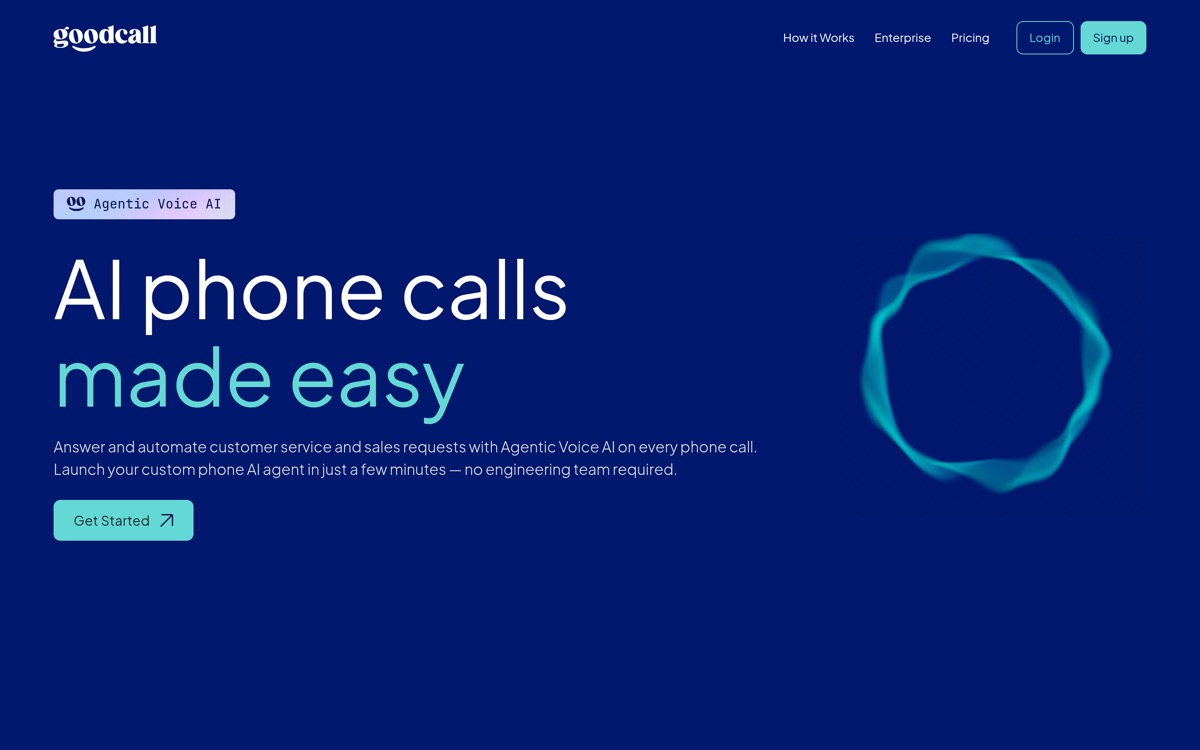
Goodcall started as a Google-backed project in 2017 and has evolved into an AI phone agent targeting small businesses. It handles inbound calls with AI, scheduling appointments, capturing leads, and answering common questions.
The platform offers six voice options and uses a "teachable moments" system where the AI flags questions it couldn't answer so you can train it over time. It connects to external tools through Zapier and provides an analytics dashboard showing call patterns and automation rates.
Goodcall positions itself primarily toward home services, healthcare intake, and small service businesses. It's a legitimate product that works for its intended use case: answering basic calls for businesses with low-to-moderate call volume and simple workflows.
The question isn't whether Goodcall works. It's whether it works well enough for your business as it grows.
Goodcall Pricing: How the Model Works
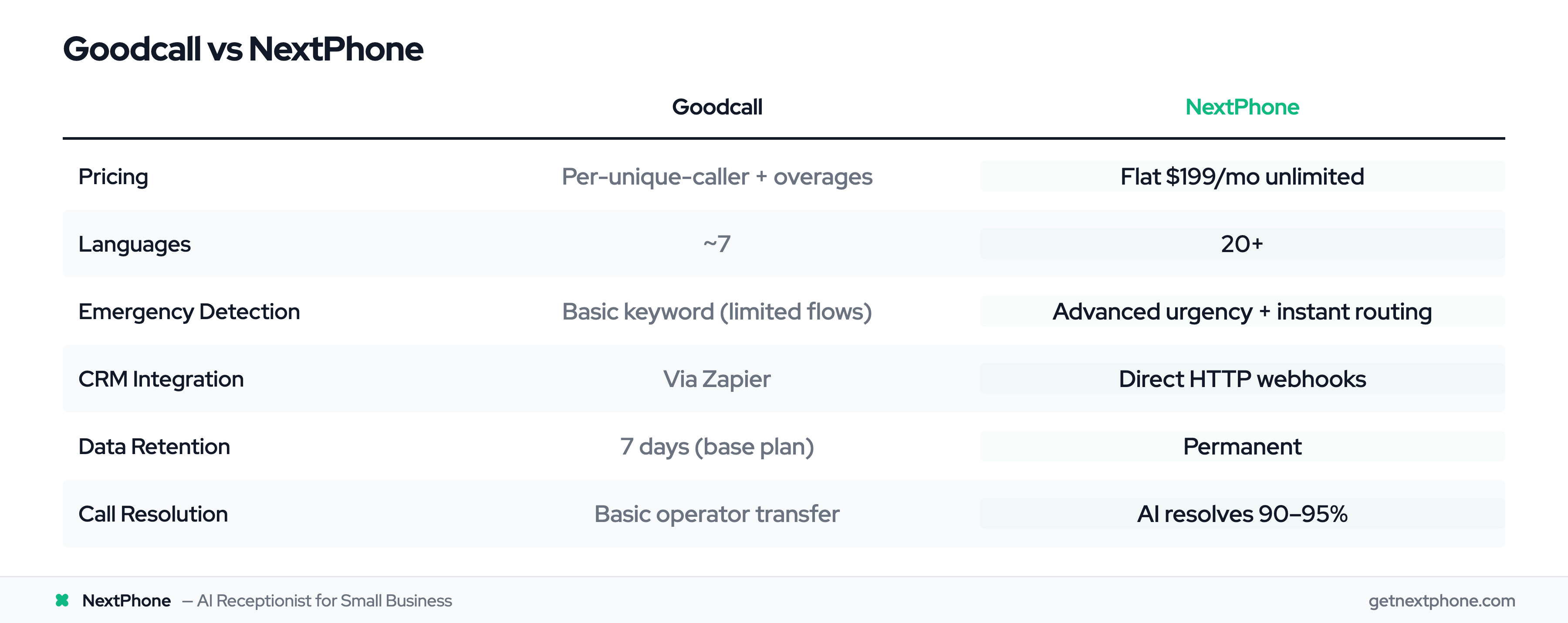
Goodcall uses a per-unique-customer pricing model. That means you're not paying per minute or per call. You're paying based on how many distinct callers contact your business each month.
Each tier includes a customer cap. Once you exceed that cap, overage fees kick in for every additional unique caller. The base tier caps at 100 unique customers per month. Mid-tier goes to 250. Top tier allows 500.
Here's where it gets tricky for seasonal businesses. A roofing company that gets 60 unique callers in January might get 200 after a spring storm. Suddenly you've blown past your cap and owe overage fees you didn't budget for.
The "unlimited minutes" claim is technically true, but it's limited by the number of people who can actually call you. Think of it this way: you have unlimited gas, but you're only allowed to drive to 100 destinations.
Lower tiers also restrict you to fewer logic flows, fewer forms, and shorter data retention. The base plan deletes your call history after just 7 days.
What Goodcall Does Well
Let's be fair. Goodcall has genuine strengths:
- Quick setup: Most users report getting started in about 15 minutes
- Clean audio: Call quality is consistently clear, which matters for customer-facing conversations
- Simple scheduling: The calendar integration handles basic appointment booking reliably
- Parallel calls: No busy signals, even during high-volume periods
- Low barrier to entry: The per-customer model works fine if you're a solo operator with under 100 callers per month
- Zapier connectivity: Access to 1,000+ tools through their Zapier integration
For a solopreneur testing AI phone answering for the first time, Goodcall offers a reasonable starting point with minimal commitment.
Where Goodcall Falls Short
Limited Language Support
Goodcall supports approximately 7 languages. If you're serving a diverse community, Spanish, Portuguese, Mandarin, Vietnamese, Korean, or Arabic-speaking customers will hit a wall. For businesses in multilingual markets, this single limitation can cost real revenue.
Per-Customer Caps Create Overage Anxiety
The pricing model means you're always watching your unique caller count. Seasonal spikes, marketing campaigns, or storm-season rushes can push you past your cap without warning. "Unlimited minutes" means nothing when you're paying extra for every new person who picks up the phone.
Shallow Integration Depth
Goodcall routes integrations through Zapier. That works, but it adds a layer between your AI and your CRM. Extra latency. Another subscription to manage. Another point of failure. If Zapier goes down, your lead capture breaks.
There's no native way to send structured data directly to HubSpot, Salesforce, or Pipedrive through custom HTTP webhooks. Everything runs through the Zapier middleman.
7-Day Data Retention
On the base plan, Goodcall deletes call and customer details after 7 days. That means if a customer calls Monday and you want to reference that conversation the following Monday, it's gone. For businesses that need call records for disputes, training, or pattern analysis, this is a deal-breaker.
Emergency Detection Gaps
Goodcall does have basic keyword detection, but lower-tier plans restrict logic flows to just one. When a customer calls about a flooded basement or an electrical fire, you need the AI to immediately recognize urgency language and route that call to your phone. Basic keyword matching on a restricted flow isn't enough for emergency call routing in high-stakes trades.
Support Limitations
Lower-tier users get email-only support. No live chat. No SLAs. No dedicated success manager. Multiple reviewers report slow response times, especially during initial setup when questions are most critical.
NextPhone: The Professional Upgrade

NextPhone takes a different approach. Flat $199/month. Unlimited calls. No per-customer caps. No overage fees. No surprises on your bill.
The AI answers every call in under 5 seconds and supports 20+ languages out of the box. Whether your customer speaks English, Spanish, Mandarin, Portuguese, or Arabic, the conversation flows naturally without switching systems.
But the real difference shows up in how NextPhone handles the calls that matter most.
Across the 1,446,980+ business calls we've answered, calls containing urgency language like "emergency," "urgent," or "ASAP" rank among the top reasons people call. True emergencies are a recurring reason people call too: burst pipes, no power, AC failures in extreme heat. Those emergency calls average $4,200 in revenue, significantly higher than routine work.
NextPhone's emergency keyword detection identifies these calls in real time and routes them to your phone instantly through smart forwarding. The AI resolves 90-95% of calls on its own. The remaining 5-10% reach you directly, with full context about what the caller needs.
Integrations work through direct HTTP webhooks. No Zapier middleman. Your lead data goes straight into HubSpot, Salesforce, Pipedrive, Zoho, or any system with an API. Built-in SMS and email notifications mean you know about every call the moment it happens.
Ready for unlimited calls without per-customer caps? See NextPhone in action.
Try NextPhone free for 7 days
AI answering service that answers, qualifies, and books — 24/7.