
Voice AI isn't a future technology you need to wait for. Right now, AI systems are answering phones, booking appointments, detecting emergencies, and routing calls for thousands of businesses. What's changing in 2025 is who can access it.
The market is exploding: The voice AI market is projected to grow from $3.14 billion to $47.5 billion by 2034, a 34.8% CAGR. The virtual receptionist market is projected to grow from $3.85 billion to $9 billion by 2033.
Until recently, sophisticated voice AI required enterprise budgets. A small plumbing company or local law firm couldn't justify the cost or complexity. That barrier is disappearing fast.
Here's why this matters: industry research shows 74.1% of calls to home services contractors go unanswered. That's not a typo. Nearly three-quarters of incoming calls - potential customers, emergency requests, booking opportunities - went to voicemail or rang out. Those missed calls translate to an estimated $189,068 in lost revenue annually per contractor.
Voice AI automation solves this problem for $199/month. And 2025 is the year this becomes obvious to every business owner.
This article covers what's actually happening with voice AI - the real trends, honest predictions, and practical implications for businesses that can't afford another year of missed calls.
The State of Voice AI Entering 2025
Before diving into predictions, let's establish where voice AI technology actually stands. The gap between hype and reality has narrowed significantly.
Where Voice AI Technology Stands Today
Modern voice AI systems have crossed critical thresholds that make them genuinely useful for business:
Natural language processing now exceeds 95% accuracy for common business scenarios. The AI understands context, handles variations in phrasing, and responds appropriately. "I need someone to fix my AC" and "My air conditioning stopped working" trigger the same correct response.
Real-time processing enables natural conversation flow. The lag that made early voice AI frustrating has essentially disappeared. Best-in-class voice AI systems achieve 510ms latency, faster than human reaction time. Conversations feel natural because they happen at natural speed.
Integration with business tools is now standard. Voice AI connects directly to CRMs, calendars, and communication platforms. When a customer books an appointment by phone, it appears in your calendar automatically.
Emergency detection and routing works reliably. AI identifies urgency language and true emergencies, routing critical calls immediately rather than burying them in voicemail.
Current Adoption Rates
The numbers tell a clear story of accelerating adoption:
- Gartner projects 85% of customer service leaders will explore conversational GenAI by 2025
- McKinsey's State of AI 2024 reports 78% of organizations now use AI in at least one business function
- OpenAI's State of Enterprise AI 2025 report shows 82% of enterprises now use generative AI weekly
- Customer service is the #1 AI use case across industries
- SMB adoption is growing 23% year-over-year according to Grand View Research
- Gartner predicts agentic AI will autonomously resolve 80% of common customer service issues by 2029
The enterprise wave has already happened. The SMB wave is happening now. 91% of customer service leaders are under executive pressure to implement AI, and 80% of organizations expect to reduce agent headcount in the next 18 months. Gartner predicts 30% of Fortune 500 companies will offer service through a single AI-enabled channel by 2028.
The Problem Voice AI Solves
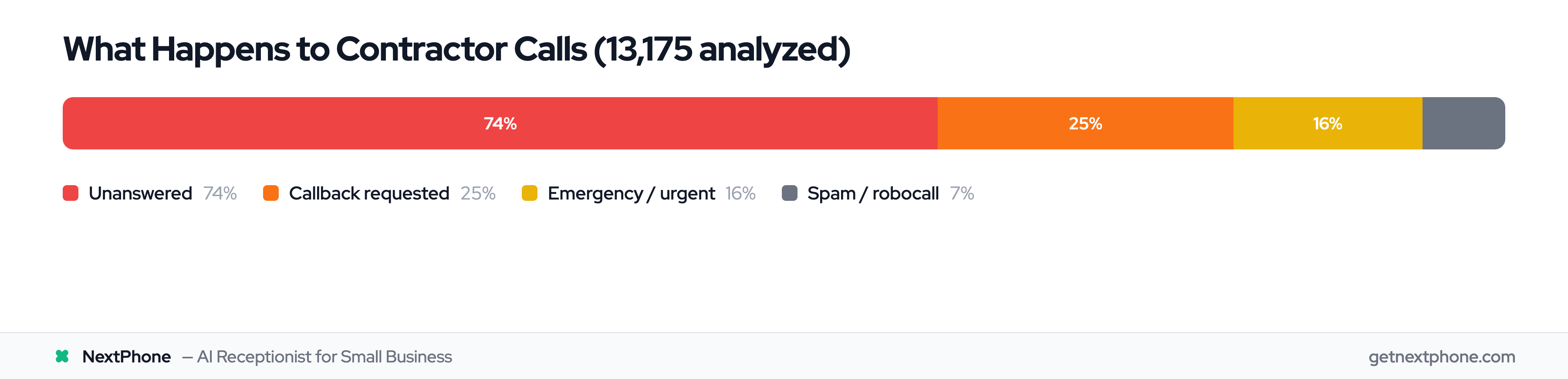
Abstract market statistics matter less than concrete business problems. Here's what we actually see in the data on calls to contractors:
- Industry research shows 74.1% of calls go unanswered - busy with jobs, after hours, or simply overwhelmed
- A significant share of callers explicitly request callbacks - many never receive them
- Emergencies are a recurring reason people call - burst pipes, no heat in winter, no AC in summer
- Urgent calls rank among the top reasons people call - needed help soon, even if not emergency
- Spam and robocalls are filtered out before they ever ring you - no wasted time, no cluttered logs
The average contractor loses an estimated $189,068 annually from missed calls. Voice AI addresses this with 24/7 automated answering - every call answered, every lead captured, every emergency routed.
Voice AI Automation Trends for 2025
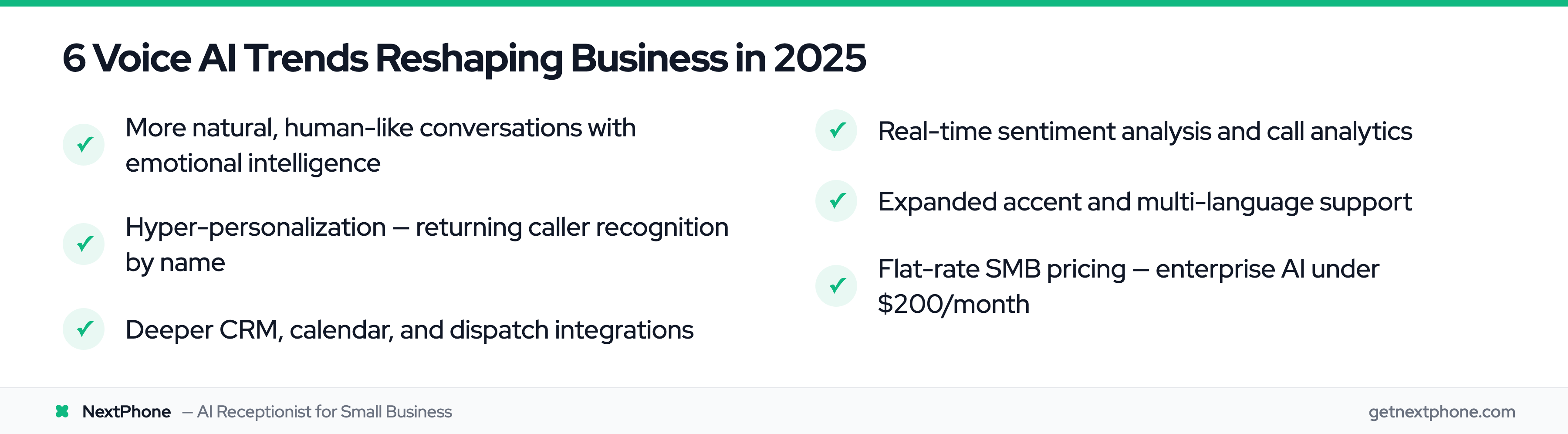
These are the trends that will actually impact businesses this year: capabilities arriving now.
Trend 1: More Natural, Human-Like Conversations
The "robotic AI" stereotype is dying. 2025 voice AI handles conversations in ways that increasingly mirror human interaction:
-
Better interruption handling - Callers can cut in with corrections or additional information without confusing the system. The AI adapts rather than forcing callers through rigid scripts.
-
Emotional intelligence - AI detects caller frustration, urgency, or confusion and adjusts responses accordingly. A stressed caller gets a different tone than a casual inquiry.
-
Natural filler handling - "Um," "uh," and pauses don't break the conversation. The AI understands that humans don't speak in perfect sentences.
-
Context memory within calls - The AI remembers what was discussed earlier in the conversation and references it naturally. No more repeating information.
The practical implication: Callers increasingly can't tell they're talking to AI - and when they can, they don't mind because the interaction works. Research shows 85% of customer interactions will be handled without human agents by 2025.
Trend 2: Hyper-Personalization Through Data
Voice AI is moving beyond generic responses to personalized interactions:
-
Returning caller recognition - AI identifies repeat callers and greets them by name with relevant context. "Hi Sarah, calling about your HVAC maintenance we scheduled?"
-
History-informed responses - Previous interactions inform current ones. The AI knows this customer always requests morning appointments or prefers text confirmations.
-
CRM integration during calls - Customer data surfaces in real-time, enabling personalized service without manual lookup.
-
Predictive service - AI anticipates needs based on patterns. Customers who call every six months for maintenance might get proactive outreach.
For businesses, this means higher conversion rates and better customer experience without additional staff time. Twilio's research surveying 457 leaders and 4,800 consumers confirms that personalization drives customer satisfaction with AI interactions.
Trend 3: Deeper Business Tool Integration
2025 voice AI connects to your entire business workflow:
-
Direct calendar booking - Appointments schedule into Google Calendar, Calendly, or industry-specific systems without manual entry.
-
Real-time CRM updates - Call summaries, customer information, and follow-up tasks populate automatically during and after calls.
-
Triggered automation - Call outcomes trigger follow-up sequences. A quote request automatically sends relevant information and schedules follow-up.
-
Dispatch integration - For service businesses, AI can check technician availability and schedule jobs directly into dispatch systems.
The evolution: AI handles the entire customer journey from first call to booked appointment, not just the answering part. Y Combinator reports a 70% rise in vertical voice AI startups, signaling intense investment in these integration capabilities.
Trend 4: Real-Time Analytics and Insights
Every call becomes data that improves your business:
-
Sentiment analysis - Understand how callers feel during interactions. Identify frustration points or successful approaches.
-
Pattern identification - Spot trends across calls. Are customers asking about a specific service more? Is there a common complaint?
-
Predictive insights - AI identifies busy periods before they happen, common issues by season, or emerging customer needs.
-
Automatic reporting - Dashboards show call volume, outcomes, and trends without manual compilation.
This transforms phone calls from isolated events into business intelligence. Industry voice-AI research highlights analytics capabilities as a key differentiator for businesses adopting voice AI.
Trend 5: Expanding Language and Accent Support
Voice AI is becoming genuinely accessible to diverse customer bases:
-
Regional accent improvements - Southern, Northeastern, Midwestern, and international accents handled with significantly better accuracy.
-
Multi-language handling - Seamless switching between languages within a single call as needed.
-
Industry terminology - AI trained on specific vertical vocabularies. An HVAC company's AI knows "condenser" and "refrigerant line."
-
Cultural context - Understanding regional communication patterns and expectations.
For businesses serving diverse communities, this removes a significant adoption barrier.
Trend 6: Pricing Accessibility for SMBs
This might be the most important trend for small business owners:
-
Enterprise capabilities at SMB prices - Features that cost thousands monthly two years ago now available under $200/month.
-
Flat-rate unlimited models - No more anxiety about per-minute charges. NextPhone at $199/month unlimited means your busiest month costs the same as your slowest.
-
No setup fees - Barrier to trying voice AI essentially eliminated.
-
Month-to-month flexibility - No long contracts required. Try it, cancel if it doesn't work.
The technology barrier is gone. The price barrier is gone. Adoption is now purely a decision. Wharton's 2025 AI Adoption Report shows SMBs are now the fastest-growing segment for AI adoption.
Industry-Specific Voice AI Predictions
General trends matter less than specific impact on your industry. Here's what to expect.
Home Services and Contractors
Contractors have the most to gain from voice AI - and the data proves it. That 74.1% missed call rate? That's home services.
-
Emergency routing becomes table stakes - Emergencies are a recurring reason people call, so AI that detects "my basement is flooding" and routes immediately isn't optional.
-
After-hours differentiation - Homeowners with emergencies call at night and on weekends. The contractor who answers at 11 PM wins the job.
-
Dispatch integration - Voice AI that checks technician availability and books jobs directly saves hours of back-and-forth.
-
Spam filtering value - Junk calls never ring you at all, which saves significant time weekly.
Prediction: 60% or more of contractors will use voice AI by end of 2025. The ROI is too clear and the cost is too low to ignore. Gartner predicts $80 billion in contact center labor cost reductions by 2026, savings that apply to businesses of all sizes.
Healthcare and Medical Practices
Healthcare faces unique challenges that voice AI addresses:
-
Compliant automation - Appointment scheduling, prescription refill requests, and basic triage without compliance risk.
-
Administrative burden reduction - Staff spend less time on routine calls, more on patient care.
-
After-hours handling - Patient calls at 2 AM get appropriate response without waking staff for non-emergencies.
-
Urgency routing - Genuine emergencies reach on-call providers; routine matters wait for office hours.
Prediction: Voice AI handles 70% of routine medical office calls by late 2025, freeing staff for patient-facing work. McKinsey's analysis of customer care in 2024 shows healthcare leading AI adoption in customer-facing roles.
Legal Services
Legal intake is perfectly suited for voice AI:
-
Qualification automation - AI asks screening questions, captures case details, and qualifies potential clients.
-
Urgency detection - Time-sensitive matters (court deadlines, arrest situations) route immediately.
-
24/7 availability - Potential clients with legal emergencies don't wait until morning.
-
Conflict checking integration - AI can preliminarily check for conflicts before involving attorneys.
Prediction: Firms using AI intake will see 40%+ improvement in lead capture versus voicemail-dependent competitors. However, Gartner predicts 50% of organizations will abandon customer service workforce reduction plans by 2027. AI augments human workers rather than replacing them entirely.
Professional Services
Accountants, consultants, and similar professionals face seasonal and capacity challenges:
-
Seasonal capacity management - Tax season, audit periods, and deadline rushes handled without temporary staff.
-
Appointment efficiency - Scheduling happens automatically, eliminating phone tag.
-
Communication logging - Every client interaction documented without manual effort.
-
After-hours coverage - Clients with deadline pressure appreciate 24/7 responsiveness.
Prediction: Voice AI becomes standard for professional services firms with 5+ employees by end of 2025. Accenture's Technology Vision 2025 predicts unprecedented AI autonomy in professional services.