
Introduction
Here's a number that should make every business owner uncomfortable: 74.1%.
That's the percentage of customer calls to home services contractors that go unanswered, according to industry research. Nearly three out of four callers never reach a human. They get voicemail, endless ringing, or nothing at all.
And here's the kicker: only about one in four of those missed callers ever try again. The rest? They call your competitor.
This is the problem autonomous AI agents are built to solve. Not by replacing your team, but by making sure every call gets answered, every question gets addressed, and every potential customer gets the attention they deserve - even at 2am on a Sunday.
This article breaks down what autonomous AI agents actually are, how they're transforming customer service, and whether they make sense for your business. No hype, no jargon - just practical information you can use.
What Are Autonomous AI Agents?
The Basic Definition
Autonomous AI agents are software systems that can perceive their environment, make decisions, and take action - all without human intervention. Think of them as AI that doesn't just answer questions, but actually solves problems.
When a customer calls about scheduling an appointment, an autonomous agent doesn't just provide information. It checks your calendar, offers available times, books the appointment, and sends confirmation. It handles the entire interaction from start to finish.
The "autonomous" part is what separates these systems from everything that came before. They don't need someone pushing buttons behind the scenes. They don't follow rigid decision trees. They actually reason through situations, much like a skilled employee would.
How They Differ from Traditional Automation
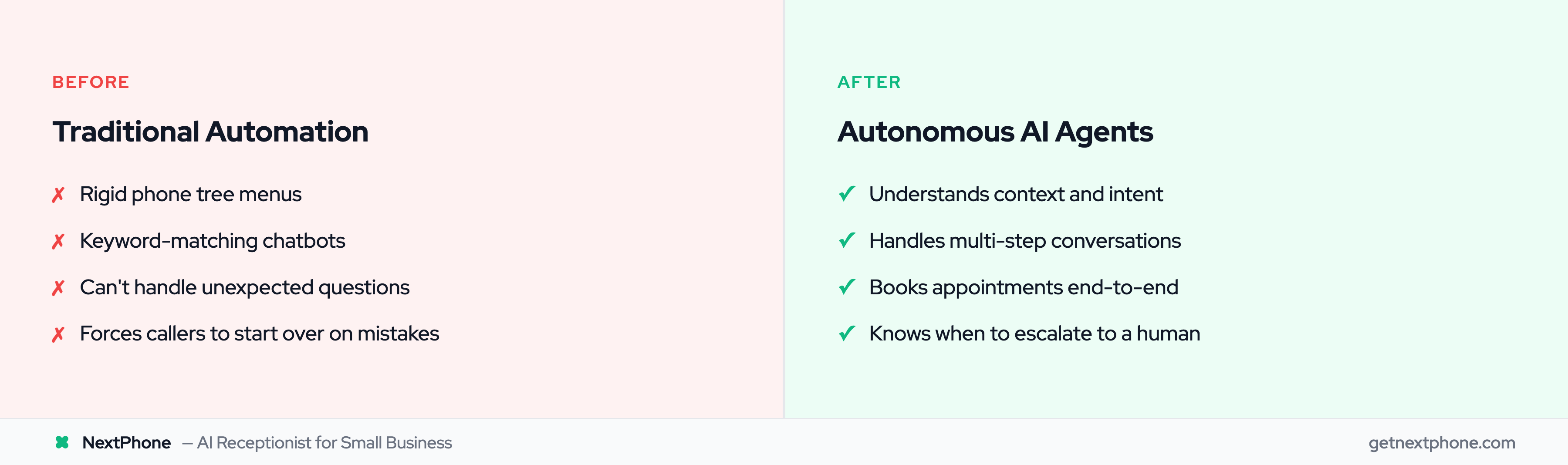
The difference between an autonomous AI agent and a basic chatbot is like the difference between a GPS navigation system and a paper map.
Both can help you get somewhere. But the GPS understands traffic, recalculates when you miss a turn, and adapts to changing conditions. The paper map just sits there.
Traditional IVR systems (press 1 for sales, press 2 for support) force customers through predetermined paths. Miss an option? Start over.
First-generation chatbots match keywords to pre-written responses. They work fine for simple FAQs but fall apart when questions get complicated or unexpected.
Autonomous AI agents understand context, intent, and nuance. They can handle multi-step conversations, ask clarifying questions, and make judgment calls about what to do next. When something falls outside their capabilities, they know when to escalate to a human.
The Evolution from Chatbots to Autonomous Agents
Where We Started
Customer service automation has a rough history.
Those "your call is important to us" recordings? People hate them. Phone trees with seventeen menu options? Universally despised. Early chatbots that couldn't understand anything beyond exact keyword matches? A frustration machine.
These systems were built around technology limitations, not customer needs. They saved businesses money but made customers miserable.
The AI Breakthrough
The past few years changed everything.
Large language models - the technology behind tools like ChatGPT - gave AI systems the ability to actually understand language, not just pattern-match against it. The Stanford AI Index 2025 Report tracks how rapidly these capabilities have advanced. They can follow complex conversations, remember context, and generate natural responses.
This wasn't a small improvement. It was a fundamental shift.
Today's autonomous agents can understand a caller who says "I need someone to look at my AC, it's making a weird noise and my kid's birthday party is Saturday." They get that there's urgency, that it's an HVAC issue, and that weekend availability matters - all without the caller explicitly stating any of that.
What used to require enterprise-level budgets and dedicated IT teams is now accessible to businesses of every size. As McKinsey's State of AI research documents, the technology matured, costs came down, and implementation got simpler.
How Autonomous Agents Transform Customer Service
24/7 Availability Without 24/7 Staff
Here's the math that keeps small business owners up at night: customers call when they call. It might be during business hours. It might be 9pm when they finally have time to deal with that leaky faucet. It might be Sunday morning when they notice their air conditioning died.
Hiring staff to cover every possible calling hour is financially impossible for most small businesses. A single full-time receptionist costs $35,000-$45,000 annually, and that only covers 40 hours of the 168 hours in a week.
The result? Our data shows that only about a quarter of people who reach voicemail ever call back. The rest find someone else to do the job.
Autonomous AI agents solve this without blowing up your payroll. They answer every call, every time, whether it's noon on Tuesday or midnight on Christmas. No overtime, no sick days, no coverage gaps.
Handling Complex, Multi-Step Interactions
Modern autonomous agents do far more than take messages.
Consider a typical call to a plumbing contractor: A homeowner calls about a clogged drain. The autonomous agent determines the severity (is there flooding?), asks about the location (kitchen, bathroom, main line?), checks technician availability, offers appointment times, books the slot, and sends confirmation - all in a natural conversation that takes maybe three minutes.
That's not a single transaction. That's lead qualification, scheduling, and customer communication handled in one interaction.
The agent can also recognize when situations require human attention. If a caller mentions water flooding their basement, the system understands that's an emergency and routes accordingly. Emergencies are a recurring reason people call - exactly the situations that need immediate human handling.
The Phone Advantage
Here's something most AI customer service content gets wrong: they focus almost entirely on chat and text.
That's a mistake for service businesses. Research consistently shows that 60-70% of customers still prefer phone calls for complex or urgent issues. When someone's furnace stops working in January, they're not going to wait around for an email response.
Voice-based autonomous agents meet customers where they actually are. They handle the natural back-and-forth of conversation, pick up on tone and urgency, and provide immediate resolution.
Text-based solutions have their place. But for service businesses where phone calls drive revenue, autonomous voice agents are where the real opportunity lives.
The Real Cost of Missing Customer Calls
What Our Data Reveals

We've answered more than 1,446,980 business calls for contractors and other service businesses. The findings paint a clear picture of how much businesses lose when phones go unanswered.
74.1% of calls go unanswered, industry research shows. Not transferred to voicemail eventually - completely missed. Callers get no response at all.
Low callback rate. Only about one in four people who couldn't get through tried calling again. The rest moved on.
Urgent calls rank among the top reasons people call. Words and phrases like "emergency," "urgent," "as soon as possible," or "need someone today." These aren't casual inquiries - they're motivated buyers ready to hire someone.
Emergencies are a recurring reason people call. Flooding, gas leaks, electrical hazards. Situations where every minute matters.
The Financial Impact
Model the revenue impact and the number is staggering: $189,068 in lost revenue per contractor, per year.
That's an estimate rather than something we measured. It's built from typical call volumes, industry average job values, and close rates, and it assumes not every call becomes a job - but a significant percentage does, if someone answers.
Think about what $189,068 represents. That's enough to hire multiple employees. Enough to fund serious marketing campaigns. Enough to completely transform a small business.
And it's being lost, phone call by phone call, to competitors who simply pick up.
Why Traditional Solutions Fail
If the problem is obvious, why hasn't it been solved?
Voicemail doesn't work. People don't leave messages like they used to. They'll call someone else before leaving a message for you to maybe return someday.
Traditional answering services are hit or miss. They're expensive (often $1-2 per call or more), the quality varies wildly, and the human operators don't know your business. They can take a message, but they can't qualify leads or book appointments.
Hiring more staff is cost-prohibitive. Adding headcount to cover phones is rarely economical, especially for after-hours coverage.
This gap - between what businesses need and what traditional solutions provide - is exactly where autonomous AI agents fit.
Benefits Beyond Just Answering Calls
Intelligent Spam and Robocall Filtering
Spam calls aren't just annoying; they're expensive. Every spam call your staff answers is time they're not spending on actual customers.
Our data shows spam and robocalls are a steady presence in the call mix at contractors. For a business receiving 50 calls a day, that's wasted interactions every single day - unless spam is filtered out before it ever rings you.
Autonomous AI agents learn to recognize spam patterns. They can screen calls, identify obvious robocalls, and filter them out before they ever reach you. Your time stays focused on real customers.
Lead Qualification and Routing
Not all calls deserve equal attention. An emergency call from a repeat customer requires immediate action. A price-shopping call from someone who's called five competitors needs a different approach.
Autonomous agents can assess callers, determine urgency, and route appropriately. Remember that emergencies are a recurring reason people call? An intelligent system identifies those and ensures they get priority handling.
It can also identify high-value opportunities - larger projects, commercial work, repeat customers - and flag them for personal attention.
Consistent Brand Experience
Human staff have good days and bad days. They get frustrated. They rush when they're busy. They're inconsistent.
Autonomous AI agents deliver the same professional experience on every call. Your 4pm Friday caller gets the same attention as your 9am Monday caller. Your brand shows up consistently, every time.
For businesses building a reputation, this consistency matters. Customers remember how they're treated, and they tell others.
Data and Insights
Every call becomes data. Autonomous systems track patterns: when calls come in, what customers ask about, which services generate the most inquiries, where customers are located.
This information helps you make better decisions about marketing, staffing, service offerings, and more. Instead of guessing what customers want, you'll know.