
Introduction
Your front desk phone rings. Again. Your receptionist is checking in a patient, verifying insurance for another, and trying to calm down a third who's running late. The call goes to voicemail.
The person on the other end? A new patient with a toothache who found you on Google. They don't leave a message. Instead, they scroll down to the next practice and dial that number. You just lost a patient you didn't even know you had.
This scenario plays out in dental practices across the country every single day. And it's not a staffing problem or a training problem—it's a communication problem that costs practices six figures annually.
Here's what you'll learn in this guide: exactly how much missed calls and no-shows are costing your practice, why traditional phone handling can't keep up with patient expectations, and how a dental answering service can turn those communication gaps into filled appointment slots.
The True Cost of Missed Calls in Your Dental Practice
Let's start with a number that might make you uncomfortable: dental practices miss 35% of incoming calls on average. Some practices hit rates as high as 68%.
That's roughly one in three patients who can't reach you when they call.
You might think, "They'll leave a voicemail and we'll call them back." But here's the problem: only 14% of new patients actually leave a voicemail-statistics) when their call isn't answered. The other 86% hang up and move on.
And "move on" means exactly what you think it does. 75% of callers who don't reach you will never call back. They find another dentist who picks up the phone.
Here's what makes this particularly painful: nearly 80% of those missed calls are about appointment scheduling. These aren't wrong numbers or sales calls. They're patients trying to give you their business.
What Every Missed Call Really Costs You
The math on missed calls gets ugly fast.
Each new patient represents $850-$1,300 in first-year revenue. Over their lifetime as a patient? That value climbs to $4,500-$22,000 depending on the treatments they need.
Let's run some quick numbers. Say your practice misses 10 new patient calls per month (a conservative estimate given that 35% miss rate). At $850 per patient in first-year value alone:
- Monthly lost revenue: $8,500
- Annual lost revenue: $102,000
Factor in lifetime value, and that number could be several hundred thousand dollars walking out your door—or rather, never walking in at all.
Research from Dental Economics confirms this range: the average dental practice loses $100,000-$150,000 annually from missed calls alone.
| Metric | Impact |
|---|---|
| Average missed call rate | 35% of all calls |
| Callers who leave voicemail | 14% |
| Callers who never call back | 75% |
| First-year patient value | $850-$1,300 |
| Lifetime patient value | $4,500-$22,000 |
| Annual revenue loss | $100,000-$150,000 |
Why Your Front Desk Can't Keep Up
Before blaming your front desk staff, consider what they're actually dealing with.
According to the American Dental Association, dental practices can receive up to 50 calls per day. Your front desk team spends roughly 21 hours per week on phone-related tasks—that's more than half their working hours just handling calls.
Meanwhile, they're also checking in patients, verifying insurance, processing payments, answering questions from people standing right in front of them, and managing the general chaos of a busy practice.
Something has to give. Usually, it's the phone.
The Staffing Crisis Hitting Dental Practices
"A lot of phone calls are not being answered. That's the number one issue we're seeing right now. And it's because there's just not enough manpower," says Malika Azargoon, dental consultant and founder of Zar Dental Consulting.
One practice manager pulled her call reports and discovered that 29% of calls on a single day went straight to voicemail—simply because there weren't enough people to answer them.
This isn't an isolated case. The dental industry is facing a genuine staffing crisis. A 2024 DentalPost Salary Report found that more than 50% of dental professionals are actively or passively looking for new jobs. Front desk burnout is a major driver.
When your staff is overwhelmed, phones go unanswered. When phones go unanswered, patients go elsewhere.
The Result: Patients Who Can't Reach You
During peak hours—typically 10 AM to noon and 2 PM to 4 PM—one in three calls to dental offices goes unanswered. These are the exact hours when patients are most likely to call, and the exact hours when your staff is most stretched.
The patients who can't get through don't wait. 48% immediately start searching for another provider if they can't reach you on the first try.
The After-Hours Gap That's Costing You Patients
Here's a statistic that might surprise you: 43% of patients search for dentists after regular office hours, according to Becker's Hospital Review.
Think about that. Nearly half of your potential patients are looking for a dentist when you're closed. If all they get is your voicemail, what happens next?
We already know the answer: 80% won't leave a message, and 75% won't call back.
What Happens When Patients Call After 5 PM
28% of appointment requests come outside standard business hours. That's more than a quarter of your potential bookings happening when nobody's at the front desk.
And it gets more urgent than routine appointments. 63% of dental emergencies happen after hours—patients with sudden tooth pain, broken crowns, or knocked-out teeth. Emergency call volume peaks between 6 PM and 10 PM on weekdays and 10 AM to 4 PM on weekends.
These patients aren't going to wait until Monday morning. They're going to call every dentist in town until someone answers.
The Patients You're Losing to Competitors
Single-location practices lose an average of 8-12 new patient opportunities monthly from after-hours communication gaps alone. That translates to $15,000-$25,000 in annual revenue lost—just from the hours between closing time and opening the next day.
The patients calling after hours aren't casual browsers. They're often the highest-intent prospects:
- Working professionals who can only call during their own off-hours
- Parents researching dentists for their kids after bedtime
- People in actual pain who need help now
These are exactly the patients you want. And right now, they're going to your competitors who answer the phone.
How No-Shows and Cancellations Drain Your Production Time
Missed calls aren't the only empty-chair problem. No-shows and last-minute cancellations create their own financial drain.
Industry data shows no-show rates in dental practices range from 10-30%, with the average hovering around 11-15%. According to the American Dental Association, no-shows and late cancellations are the number one reason dental practice schedules aren't full. A staggering 81% of practices report struggling with this issue.
The good news? Top-performing practices have cracked the code, achieving no-show rates as low as 1%. The difference comes down to systems, not luck.
The Real Cost of Empty Chairs
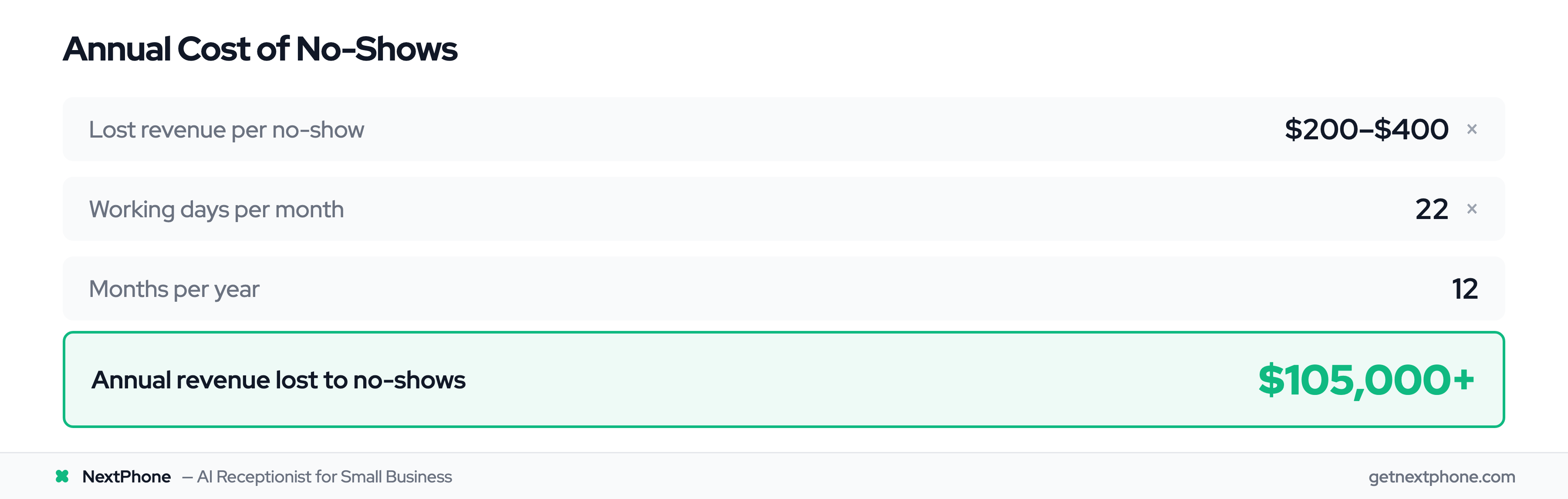
Each no-show appointment represents $200-$400 in lost production. For a practice scheduling 36 appointments per day, even a modest no-show rate creates significant revenue leakage.
Here's the math:
- One no-show per day = $200-$400 lost
- Multiply by 22 working days = $4,400-$8,800 per month
- Annual cost: $52,800-$105,600
Research from dental industry sources confirms that dental practices lose an average of $105,000+ annually from no-shows alone. Combined with missed call losses, we're talking about potentially $200,000+ in preventable revenue loss.
Why Patients No-Show (And How to Fix It)
Understanding why patients miss appointments is the first step to fixing the problem. Studies show the primary causes break down like this:
| Reason | Percentage |
|---|---|
| Forgetfulness | 36% |
| Personal/health issues | 30.7% |
| Distance to clinic | 17.2% |
| Inflexible work schedule | 14.7% |
| Transportation | 12.3% |
| Dental anxiety | 6.7% |
The biggest culprit—forgetfulness at 36%—is also the most fixable. Automated reminder systems reduce no-show rates by 22.95% compared to manual methods. SMS text reminders are particularly effective, achieving no-show rates as low as 1.90% thanks to 98% open rates.
One study found that combining automated reminders with a personal phone call reduced no-shows from 23% to 13%—a 41% improvement.
What Today's Dental Patients Actually Expect
Patient expectations have shifted dramatically in recent years. Your grandmother might have accepted calling during business hours and waiting for a callback. Today's patients? Not so much.
72% of patients expect a response within one hour when they reach out to a dental practice. 73% say that 24/7 appointment scheduling is "very important" when choosing a new provider.
And here's the kicker: over 70% of new patients choose their dental practice based on that initial phone contact experience. If their first impression is voicemail, they're already moving on.
The Expectation Gap
Most dental practices operate Monday through Friday, 8 AM to 5 PM. Patient expectations, however, run 24/7/365.
This mismatch creates a competitive disadvantage. The practice that answers the phone—or at least captures the inquiry and responds quickly—wins the patient. The practice that doesn't gets voicemail silence and an empty appointment slot.
Why First Impressions Matter More Than Ever
The MIT/InsideSales.com Lead Response Management Study found that responding to an inquiry within 5 minutes makes you 100 times more likely to make contact and 21 times more likely to qualify the lead compared to waiting 30 minutes.
78% of customers buy from whichever company responds first—not the cheapest, not the best reviewed, but the first one to pick up the phone.
After just 30 minutes, your contact success rate drops by 10x. Every minute your patient waits is a minute they could be talking to your competitor.
How a Dental Answering Service Actually Works
Modern dental answering services have evolved far beyond the old-school message-taking operations. Today's solutions can actually run your patient communication workflow—answering calls, scheduling appointments, sending reminders, and routing emergencies—without requiring you or your staff to pick up the phone.
There are two main categories: human answering services (live operators who answer on your behalf) and AI-powered receptionists (automated systems that handle calls conversationally). Both have their place, depending on your practice's needs and budget.
Key Features to Look For
Not all answering services are created equal. When evaluating options for your dental practice, prioritize these capabilities:
24/7 availability: After-hours coverage alone won't cut it. You need a solution that handles peak daytime hours when your staff is overwhelmed, plus evenings and weekends when patients can't reach you.
Appointment scheduling: The service should book appointments directly into your practice management system—not just take messages for your staff to process later.
Emergency call routing: Dental emergencies need immediate attention. Your service should identify urgent situations and route those calls directly to your cell phone or on-call dentist.
SMS/text follow-up: Automated confirmations and reminders are essential for reducing no-shows.
Data security: Verify how the service stores call data, controls access, and handles deletion requests — and make sure those practices fit your obligations as a dental practice.
Practice management integration: The best services connect with software like OpenDental, Dentrix, and Eaglesoft to schedule appointments in real-time.
The Workflow: From Ring to Booked Appointment
Here's how a modern dental answering service handles a typical call:
- Call comes in (any time, day or night)
- Service answers immediately (under 5 seconds for AI, 15-30 seconds for human)
- Caller's needs assessed (new patient, existing patient, emergency, question)
- Appointment scheduled directly in your PMS or caller's information captured
- Confirmation sent via SMS to the patient
- Reminder automated for the appointment date
- Practice notified of the new booking or message
Practices using professional answering services report a 27% reduction in missed calls and a 32% increase in appointment bookings. Patient satisfaction scores increase by an average of 38% when calls are answered promptly and professionally.
AI vs. Human Dental Answering Services: Which Is Right for You?
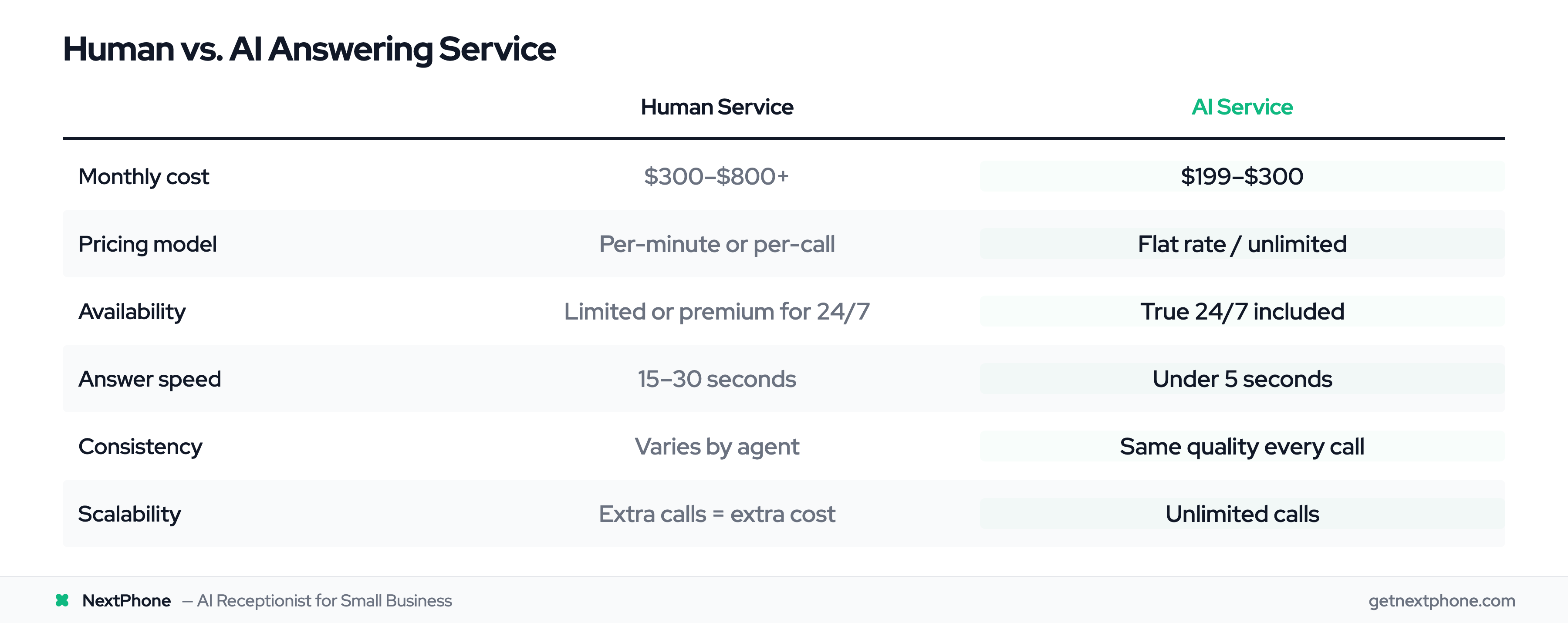
The dental answering service market now includes both traditional human-operated services and newer AI-powered solutions. Each approach has strengths and trade-offs.
| Feature | Human Answering Service | AI Answering Service |
|---|---|---|
| Monthly cost | $300-800+ | $199-300 |
| Pricing model | Per-minute or per-call | Usually flat rate/unlimited |
| Availability | Limited hours or premium for 24/7 | True 24/7 included |
| Answer speed | 15-30 seconds | Under 5 seconds |
| Consistency | Varies by agent | Same quality every call |
| Scalability | Extra calls = extra cost | Unlimited calls |
| Integration | Limited | Full PMS, CRM, SMS |
When Human Services Make Sense
Human answering services excel when calls require genuine empathy or complex decision-making. If your practice handles a high volume of anxious patients who need personal reassurance, or if you serve a demographic that strongly prefers human interaction, a live operator may be worth the premium.
Concierge-style practices that charge premium fees often match that with premium service, including human-answered calls.
Why AI Is Taking Over
The numbers favor AI for most practices. According to Gartner and Salesforce research, 60-70% of customers are now comfortable interacting with AI for simple tasks like scheduling appointments. In fact, 40-50% actually prefer AI for quick transactions because there's no hold time and no small talk.
Modern AI receptionists sound natural and conversational—most patients don't realize they're talking to AI until the end of the call, if at all. And the key feature that satisfies everyone? The ability to transfer to a human when needed. Over 80% of patients are happy with AI as long as they have the option to speak with a person if the situation requires it.
For dental practices, AI excels at exactly the tasks that drive the most revenue: answering calls instantly, booking appointments efficiently, sending follow-up reminders, and ensuring no caller falls through the cracks.
How NextPhone Helps Dental Practices Fill More Chairs
NextPhone was built for exactly the challenges dental practices face: high call volume, limited staff, after-hours gaps, and the need to capture every patient opportunity. See how our dental answering service for dentists works in practice.
At $199/month for unlimited calls, NextPhone costs a fraction of traditional answering services that charge $300-800+ for limited minutes. There are no per-call fees, no per-minute charges, and no surprises on your bill.
Features That Matter for Dental Practices
24/7 coverage with under 5-second answer time: Every call answered before the patient gets frustrated and hangs up—whether it's 10 AM on a Tuesday or 9 PM on a Saturday.
Appointment scheduling and confirmation: NextPhone doesn't just take messages. It books appointments and sends SMS confirmations automatically.
Automated reminders: Reduce no-shows with text and voice reminders that go out automatically before each appointment.
Emergency detection and routing: The AI recognizes urgency language and routes emergency calls directly to your cell phone so you can triage real dental emergencies.
Call transfer when needed: If a patient needs to speak with you directly, NextPhone transfers the call instantly without dropping the connection.
CRM integration: Every call is logged, every lead is captured, and nothing falls through the cracks.
The Numbers That Count
Our internal analysis of thousands of calls across service businesses over seven months found that 74.1% of calls went unanswered without proper coverage. For dental practices averaging 50 calls per day, that's potentially 37 missed opportunities daily.
We also found that 15.9% of calls contain urgency language—"emergency," "urgent," "ASAP"—and require immediate response. These are often the highest-value appointments.
Another 25.4% of callers explicitly request callbacks. Without a system to track and complete those callbacks, most never happen.
How to Get Started with a Dental Answering Service
Making the switch to an answering service doesn't require a complete practice overhaul. Here's a simple path to implementation.
Step 1: Audit Your Current Call Performance
Start with data. Pull your phone system's call reports and answer these questions:
- How many calls are you receiving daily?
- What percentage goes to voicemail?
- When do most calls come in (peak hours)?
- How many calls come after hours?
If you don't have call tracking, this is a good reason to get it. You can't improve what you don't measure.
Step 2: Identify Your Biggest Gaps
Based on your audit, pinpoint where you're losing the most patients:
- Daytime overflow: Calls during peak hours when staff is busy
- After-hours gap: Evenings and weekends when nobody's available
- Emergency response: Urgent calls that need immediate routing
- No-show problem: Appointments that aren't being confirmed or reminded
Step 3: Choose the Right Service
Compare your options based on:
- Pricing model: Flat rate vs. per-minute (unlimited is usually better for busy practices)
- Features: Make sure they offer appointment scheduling, not just message-taking
- Integration: Check compatibility with your practice management software
- Data security: Verify the provider's data storage, access controls, and deletion policies
Step 4: Set Up and Train
Most modern services can be configured in hours, not weeks. You'll need to:
- Record or approve your greeting
- Set up call flows (new patient vs. existing vs. emergency)
- Define emergency protocols (which calls get routed to your cell)
- Connect to your scheduling system
- Run test calls before going live
Frequently Asked Questions About Dental Answering Services
How much does a dental answering service cost?
Traditional human-operated services typically charge $300-800+ per month, depending on call volume and hours. Many use per-minute pricing that can lead to unpredictable bills during busy periods. AI-powered services like NextPhone offer flat-rate pricing—$199/month for unlimited calls with 24/7 coverage.
Will patients know they're talking to an AI?
Modern AI receptionists use natural conversation patterns, appropriate pauses, and context-aware responses. Most patients don't realize they're speaking with AI, and many appreciate the immediate response and efficient scheduling. Services like NextPhone can also transfer to a human whenever needed.
Can an answering service actually book appointments?
Yes. Modern services integrate directly with practice management software like OpenDental, Dentrix, and Eaglesoft. They can check availability, schedule appointments in real-time, send confirmations, and automate follow-up reminders.
What happens with emergency calls?
Quality answering services have emergency protocols built in. They can identify urgent situations based on keywords and caller tone, then immediately route those calls to your cell phone or on-call dentist. Routine calls get scheduled appointments; emergencies reach you within seconds.
How quickly do answering services answer calls?
Human services typically answer within 15-30 seconds. AI services like NextPhone answer in under 5 seconds—well within the optimal window before callers hang up. Research shows that answer speed within the first few rings significantly impacts whether callers stay on the line or move to your competitor.
Will this replace my front desk staff?
No—and it shouldn't. An answering service handles overflow during peak hours, after-hours calls, and weekends so your front desk staff can focus on the patients standing in front of them. Think of it as extending your team's capacity, not replacing it.
Stop Losing Patients to Empty Chairs
Let's recap the numbers:
- 35% of calls missed on average
- 75% of missed callers never call back
- $100,000-$150,000 lost annually from missed calls
- $105,000+ lost annually from no-shows
- 28% of appointment requests happen after hours
Empty chairs in your practice aren't a patient demand problem. They're a patient access problem. When people can't reach you—whether because your front desk is overwhelmed, it's after hours, or they forgot their appointment—they become someone else's patient.
A dental answering service closes these gaps. Every call answered. Every lead captured. Every appointment confirmed. Every chair filled.
The practice that picks up the phone wins the patient. It really is that simple.