
Why Medical Clinics Can't Afford to Miss Patient Calls
Your front desk phone rings. Again. But Sarah at reception is checking in a patient, verifying insurance on line two, and a mother with a sick toddler just walked through the door. The call rolls to voicemail. The caller -- a new patient referral from your best physician partner -- hangs up and calls the clinic down the street.
This happens dozens of times a week in clinics across the country. And most practice managers have no idea how much it's costing them.
The Front Desk Bottleneck
Medical clinic front desks are the most overloaded reception points in any industry. Staff simultaneously handle patient check-ins, insurance verifications, prescription call-ins, scheduling changes, and incoming new patient calls. During peak hours (typically 10am-12pm and 2pm-4pm), call volume spikes at the exact moment your waiting room is fullest.
The result? Calls go unanswered. According to industry research, 85% of callers who can't reach someone won't call back. They'll call another clinic, book online elsewhere, or simply put off care -- which creates a cascade of downstream problems.
What Missed Calls Cost Your Clinic
The math is straightforward. A typical primary care clinic receives 40-50 calls per day. If even 30% go unanswered during peak and after-hours periods, that's 12-15 missed calls daily. Not all of those are new patients, but even 3-4 new patient opportunities missed per day adds up fast.
A new patient's lifetime value to a primary care practice ranges from $800 to $1,500 annually. Lose three new patients per week to missed calls, and you're looking at $125,000-$234,000 in annual revenue walking out the door -- or rather, never walking in.
The No-Show Connection
Here's what most clinic managers don't connect: missed calls and no-shows are the same problem from different angles. MGMA's 2025 data shows no-shows cost US healthcare $150 billion annually, with average rates between 15-30% depending on specialty.
A significant chunk of no-shows happen because patients couldn't get through to reschedule. They called, got voicemail, meant to call back, and never did. The appointment slot sat empty. A clinic answering service that picks up every call -- including reschedule requests at 8pm on a Tuesday -- directly reduces this problem.
What a Clinic Answering Service Actually Handles
A clinic answering service sits between your patients and your staff, catching every call that would otherwise go unanswered. But what does that actually look like in practice?
Inbound Call Handling
When a patient calls your clinic and the front desk can't pick up (or it's after hours), the answering service takes over. It answers the call, identifies the patient's need, and handles it appropriately. This includes:
- Greeting patients by clinic name with a professional message
- Collecting caller information (name, date of birth, reason for calling)
- Answering common questions (hours, location, accepted insurance plans)
- Taking detailed messages for clinical staff
- Routing urgent calls to the appropriate provider
Patient Message-Taking and Relay
For non-urgent calls, the service captures everything your staff needs to follow up: patient name, contact info, preferred callback time, and detailed notes about their concern. Messages get delivered to your team via email, SMS, or directly into your practice management system -- depending on your setup.
This isn't the old-fashioned pink message pad approach. Modern clinic answering services capture structured data: what the call was about, how urgent it is, and what action is needed. Your morning team gets a clean list of overnight calls ranked by priority, not a stack of scribbled notes.
After-Hours and Overflow Coverage
The real value shows up in two scenarios. First, after-hours coverage: evenings, weekends, and holidays when your office is closed but patients still need help. Industry research shows 30-35% of calls come outside standard business hours -- and after-hours callers often have higher intent because they're dealing with active symptoms or concerns.
Second, overflow during peak hours. Rather than letting calls ring endlessly during your busiest mornings, the answering service picks up the overflow. Your front desk handles in-person patients while the service handles the phone queue. No more choosing between the patient in front of you and the one on the line.
How 24/7 Appointment Scheduling Works
Scheduling is the number-one reason patients call clinics. In our analysis of thousands of calls across home services businesses, 7.7% were explicitly scheduling requests -- and in medical settings, that percentage runs even higher. A clinic answering service that can actually book appointments (not just take messages about them) solves a massive friction point.
Real-Time Booking During the Call
The most direct approach: the answering service accesses your calendar in real time and books the appointment while the patient is on the phone. The patient calls, says "I need to see Dr. Martinez about my knee," and the service checks availability, confirms a date and time, and books it right there.
This works through calendar integrations -- Google Calendar, Calendly, or direct EHR scheduling system connections. The patient hangs up with a confirmed appointment. No phone tag, no callbacks needed, no missed slots.
Sending Booking Links via SMS
For patients who want more control over their schedule (or who call at 11pm when they can't think straight about next week's availability), there's a second approach: the answering service sends an SMS with a booking link during or right after the call.
The patient gets a text with a direct link to your scheduling page. They can browse available times, pick what works, and confirm -- all on their phone, at their convenience. Industry data shows a 30% year-over-year surge in patient self-scheduling adoption, so this matches how many patients already prefer to book.
Reducing No-Shows Through Accessibility
Here's the connection that matters: patients who can easily schedule, reschedule, or cancel are far less likely to simply not show up. Research shows that appointment lead times of 28-30 days carry a 22% no-show rate, compared to just 8% for appointments booked within 0-3 days.
When your answering service can schedule same-week appointments at midnight on a Sunday, patients get shorter lead times. Shorter lead times = fewer no-shows. It's that direct.
How Urgent Call Triage Protects Your Patients
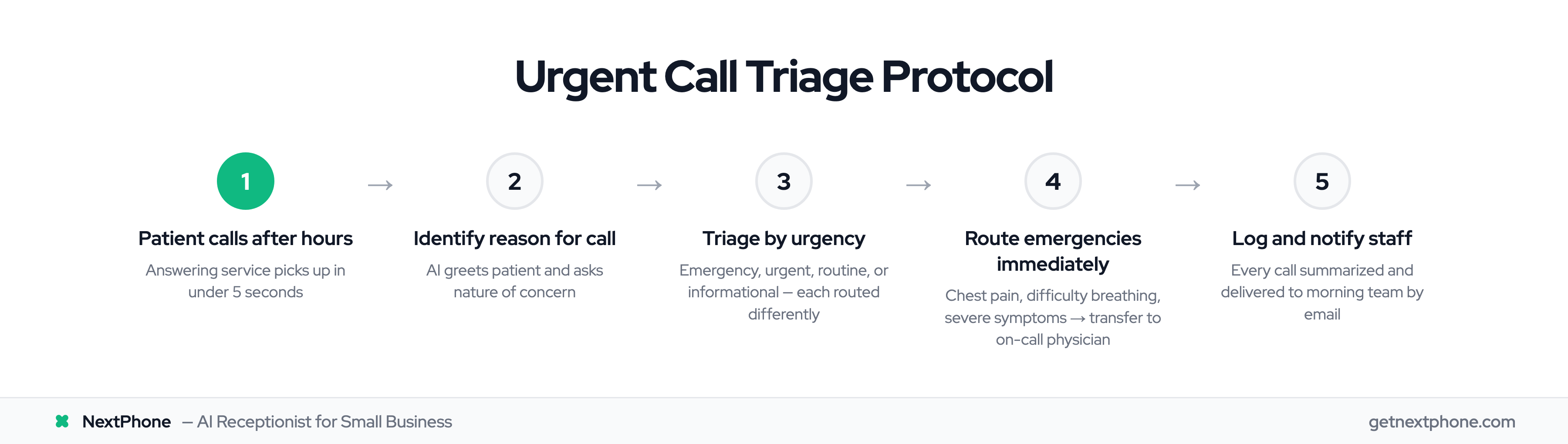
Not every after-hours call is routine. Some are genuine emergencies. The difference between a good clinic answering service and a dangerous one is how well it triages urgent calls -- and how fast it routes them to someone who can help.
Identifying Urgent vs Routine Calls
In our study of thousands of calls from home services businesses, 15.9% contained urgency language -- words like "emergency," "urgent," or "ASAP." For medical clinics specifically, that number skews higher because patients call with symptoms that genuinely can't wait.
A clinic answering service needs to distinguish between four categories:
- Emergency: Chest pain, difficulty breathing, severe bleeding, allergic reactions, suicidal thoughts. These need immediate physician contact or 911 direction.
- Urgent: High fever in a child, new concerning symptoms, medication reactions, post-surgical complications. These need same-day callback from clinical staff.
- Routine: Appointment scheduling, prescription refill requests, referral inquiries. These can wait for next business day.
- Informational: Office hours, directions, insurance acceptance questions. These can be answered immediately.
The Triage Decision Tree
Good triage isn't about guessing. It follows a structured protocol:
- Patient calls after hours
- Answering service greets patient, asks reason for call
- If emergency keywords detected → immediate transfer to on-call physician
- If urgent keywords detected → mark as urgent, attempt physician contact, or instruct patient on next steps
- If routine → take message, schedule callback for next business day
- If informational → answer directly from knowledge base
AI-powered services excel here because they detect urgency keywords consistently. A human operator at 3am might miss subtle cues. An AI trained on medical urgency language picks up "I can't breathe well" or "the pain is getting worse" every single time.
Routing to On-Call Physicians
When a call is genuinely urgent, speed matters. The answering service triggers a call transfer to the on-call physician's personal line. The physician gets context before the transfer -- patient name, symptoms described, and any relevant history the patient shared.
This happens in seconds, not minutes. With AI answering, the initial pickup happens in under 5 seconds, triage assessment takes another 30-60 seconds, and transfer initiates immediately. Compare that to a traditional answering service where hold times of 30+ seconds are common before an operator even picks up.
Data Handling for Patient Calls
Every call to your clinic contains sensitive information -- patient names, symptoms, insurance details, medication questions. How your answering service stores and controls that data matters.
What to Ask Before Choosing a Service
Before handing patient calls to any provider, ask:
- Encryption: Is call data encrypted in transit and at rest?
- Access controls: Who can view recordings, transcripts, and call logs?
- Audit trails: Is there a log of who accessed what, and when?
- Retention and deletion: Where is data stored, for how long, and can you delete it on request?
- Incident response: What's the process if there's a security issue?
Services differ widely on these practices. Some are purpose-built for regulated healthcare; others are general business tools. Verify the provider's practices match your practice's obligations before sharing any patient data.
AI and Data Security
AI answering services that encrypt call data, limit access controls, and maintain audit logs can offer strong data security. In some ways, AI services reduce risk because they don't have human operators who might accidentally share information, leave notes visible, or discuss patient calls with unauthorized colleagues.
Traditional Answering Services vs AI: Which Fits Your Clinic?
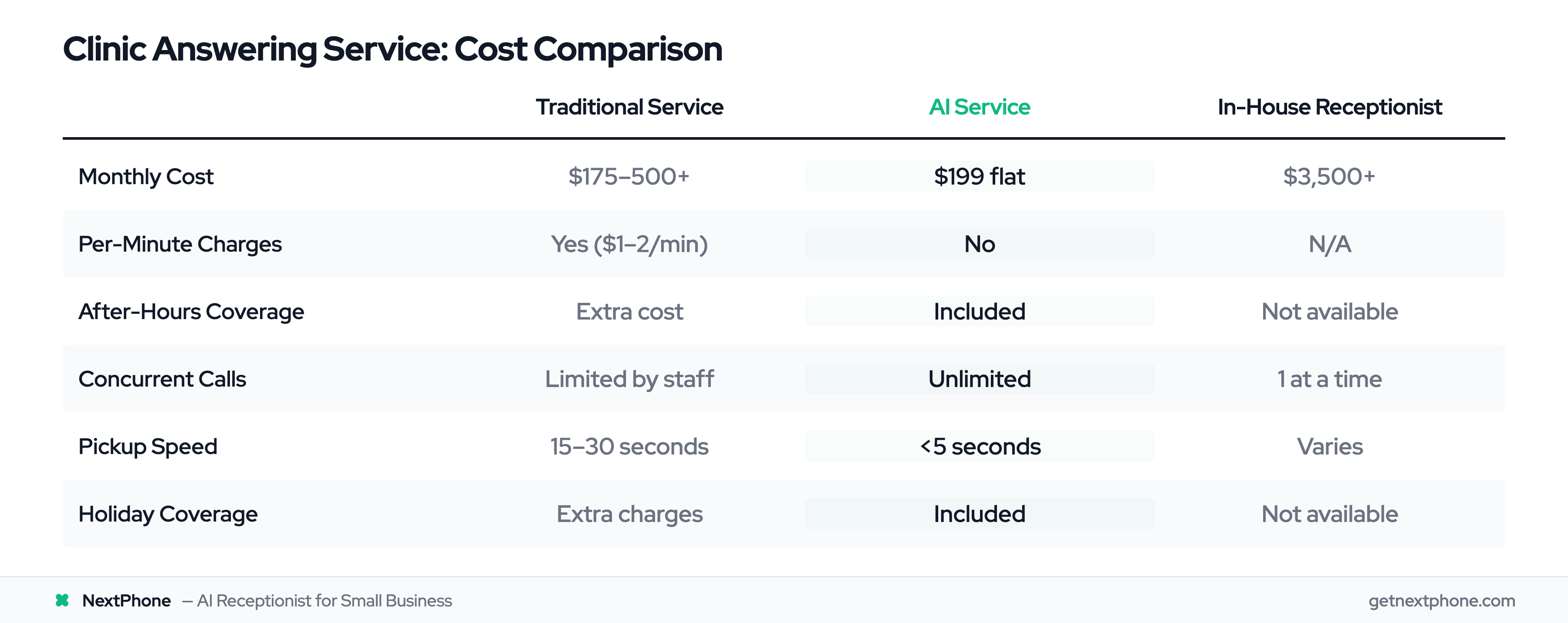
Clinic managers evaluating answering services face a choice that didn't exist five years ago: traditional live operators or AI-powered systems with smart forwarding. Here's an honest comparison.
Traditional Live Answering Services
Traditional medical answering services employ human operators who answer calls using customized scripts for your practice.
Strengths:
- Human empathy for sensitive or emotional calls
- Can handle complex, multi-step conversations
- Patients who prefer speaking with a person feel comfortable
- Established track record in healthcare (some services have operated for decades)
Limitations:
- Per-minute billing means costs spike during busy periods
- Operator quality varies (especially overnight shifts)
- Limited scalability during call surges (flu season, post-holiday)
- Script-based responses can feel robotic despite being human
- Average pickup time: 15-30+ seconds
AI-Powered Answering
AI answering services use conversational AI to handle patient calls without human operators for routine interactions.
Strengths:
- Answers in under 5 seconds, every time
- Unlimited concurrent calls (no hold times ever)
- Consistent quality regardless of time or call volume
- Direct integration with scheduling systems
- Flat monthly pricing (no per-minute surprises)
- 99%+ data capture accuracy
Limitations:
- May feel less personal for highly emotional situations
- Complex medical discussions may need smart forwarding to staff
- Some older patients may initially feel uncomfortable
AI-First with Smart Forwarding
The best solution for most clinics is AI-first with smart forwarding: AI handles the 80% of calls that are routine (scheduling, refills, insurance questions, hours), and smart forwarding routes the 20% that truly need your staff (complex symptoms, emotional patients, physician requests).
Gartner predicts that AI will autonomously resolve 80% of common customer service issues by 2029. For clinics, that threshold is already reachable for scheduling, triage routing, and FAQ handling.
Cost Comparison
| Factor | Traditional Service | AI Service | In-House Receptionist |
|---|---|---|---|
| Monthly Cost | $175-500+ | $199 flat | $3,500+ (salary + benefits) |
| Per-Minute Charges | Yes ($1-2/min overage) | No | N/A |
| After-Hours | Extra cost | Included | Not available |
| Concurrent Calls | Limited by staff | Unlimited | 1 at a time |
| Pickup Speed | 15-30 seconds | <5 seconds | Varies |
| Holiday Coverage | Extra charges | Included | Not available |
For a clinic receiving 40 calls per day, a traditional service with per-minute billing can easily hit $400-600/month during busy periods. An AI service stays at $199/month regardless of volume.
How NextPhone Handles Clinic Calls
NextPhone is AI-first with smart forwarding, built for medical practices. The AI receptionist answers every call in under 5 seconds -- during office hours, after hours, on weekends, and on holidays.
For routine calls, it handles everything independently. A patient calling to schedule an appointment gets booked right on the call or receives an SMS with your booking link. Someone asking about accepted insurance plans gets an immediate answer from your practice's knowledge base. A prescription refill request gets documented and flagged for your clinical team.
For urgent calls, NextPhone detects urgency cues and transfers immediately to your on-call physician. The transfer includes context -- patient name, symptoms described, and relevant details -- so your doctor picks up informed and ready to help.
Every call generates a summary sent to your team via email and push notification. Morning staff see exactly what happened overnight: which patients called, what they needed, and what actions were taken. No more mystery voicemails or missed messages.
The service runs on a flat $199/month with unlimited calls. No per-minute charges during flu season spikes. No overtime fees for holiday coverage. No surprise bills when your phones blow up after a community health alert.
Your patients get answered every time. Your staff gets freed from phone overwhelm. And your practice stops bleeding revenue from calls that never got picked up.
Frequently Asked Questions
How much does a clinic answering service cost?
Traditional live answering services for medical practices typically cost $175-500 per month, with per-minute overage charges of $1-2/minute. AI-powered services like NextPhone charge a flat $199/month with unlimited calls. A full-time in-house receptionist costs $35,000-45,000 annually when you factor in salary, benefits, and training -- and they still only cover 40 hours per week.
Can an answering service schedule appointments in my EHR?
It depends on the service and your EHR system. AI answering services integrate with common scheduling tools like Google Calendar and Calendly for real-time booking. For EHR-specific scheduling (Epic, Cerner, Athenahealth), many services use the SMS booking link approach -- sending patients a direct link to your patient portal scheduling page. This keeps appointment data in your EHR while still providing 24/7 booking access.
What happens if a patient has a medical emergency?
A properly configured clinic answering service follows emergency triage protocols. When a patient describes emergency symptoms (chest pain, difficulty breathing, severe injury), the service immediately connects them with your on-call physician via call transfer. For life-threatening situations, the service directs patients to call 911 while simultaneously alerting your on-call team. This happens in seconds with AI-powered triage, which detects emergency keywords faster than human operators can assess.
Will patients know they're talking to AI?
Modern conversational AI sounds natural and professional. Transparency is recommended -- the AI can introduce itself as your clinic's virtual assistant. Research shows that 60-70% of people are comfortable interacting with AI for routine tasks like scheduling and information requests. The key is providing an easy path to reach a human when needed, which builds trust rather than eroding it.
How quickly can I set up a clinic answering service?
AI-powered services like NextPhone can be operational within hours. You provide your clinic's information (hours, services, providers, insurance accepted, scheduling preferences), configure your triage rules, and forward your phone line. Traditional live services typically require 1-2 weeks for script development, operator training, and testing. Either way, the setup process for after-hours handling is straightforward once you've defined your protocols.
Stop Losing Patients to Missed Calls
Every unanswered call is a patient who needed help and didn't get it. Some will call back. Most won't. And the ones who don't show up to appointments they couldn't reschedule cost your practice twice -- once in the missed visit, and again in the wasted slot.
A clinic answering service fixes this at the source. Patients get answered, appointments get booked, emergencies get routed, and your front desk stops drowning. Whether you choose traditional operators or AI-powered coverage, the goal is the same: every patient call gets handled, every time.
For clinics looking for the most coverage at the lowest cost, AI answering services deliver 24/7 support, instant pickup, and unlimited calls -- all without the per-minute billing that makes traditional services expensive during your busiest periods.