
You're installing an AC unit in Logan Square. It's 94 degrees, the homeowner is anxious, and you're elbow-deep in refrigerant lines when your phone buzzes in your pocket. You can't answer. The call goes to voicemail.
That caller? Someone in Lakeview whose air conditioning just died. They have a toddler at home and need help today. They wait 30 seconds, hang up, and call the next contractor on Google. A $4,200 emergency job just walked out the door.
This scenario plays out hundreds of times daily across Chicagoland. Whether you're a plumber under a house in Hyde Park, an electrician in a Wicker Park crawl space, or a roofer working a job in Cicero, missed calls mean missed revenue. And in a metro area with nearly 10 million people, missing calls means handing business to your competitors.
This guide covers how Chicago businesses can get a local answering service with a 312, 773, or 872 number, what it actually costs, and why capturing every call matters more than ever in today's Chicagoland market.
Why Chicago Businesses Can't Afford to Miss Calls
The Chicago Market Reality
Chicago's metropolitan area spans 12 counties and 9.4 million residents, making it the third-largest metro area in the United States. That's a massive customer base for home services contractors, medical offices, legal practices, and every other business that depends on phone calls to generate revenue.
But the market is getting tougher. According to the 2025 Chicagoland Small Business Outlook from UIC Business and the Chicagoland Chamber of Commerce, less than half of surveyed small business owners feel optimistic about the next 12 months. Rising labor costs, inflation, and uncertain consumer demand are squeezing margins. Most business owners expect staffing levels to stay flat because hiring has become too expensive and too difficult.
When you can't hire more help, every lead you capture becomes more valuable. And every lead you miss hurts more.
What Happens When You Miss Calls

Industry research on calls to home services businesses found that 74.1% of calls go completely unanswered. For a typical contractor receiving 42 calls per month, that's 31 missed calls every single month.
The downstream effect is brutal. According to industry research, 85% of callers who don't reach someone won't call back. They don't leave a message. They don't wait. They call your competitor.
Research consistently shows that 78% of customers hire whoever responds first. Not the cheapest option. Not the highest-rated. The first one to pick up the phone.
Let's do the math. If you're getting 42 calls per month and 74.1% go unanswered, that's 31 missed calls. If just 20% of those would have converted at an average project value of $3,500, you're losing $21,700 per month. That's $260,400 per year in missed revenue.
Chicago-Specific Challenges
Chicago businesses face unique pressures that make phone coverage even more important.
Weather extremes create call surges. When it's 95 degrees in July, AC failures spike. When the polar vortex hits in January, heating emergencies explode. These aren't calls that can wait until tomorrow - customers need help now, and they'll call whoever answers.
Large service areas mean longer drive times. Chicagoland covers over 10,000 square miles. When you're driving from a job in Evanston to an estimate in Oak Park, you might miss calls for an hour or more. Those calls don't wait.
Established competitors have the infrastructure. Companies like Four Seasons and Cahill have been serving Chicago for 50+ years. They have staff to answer phones. If you're a solo contractor or small crew competing against them, you need to match their responsiveness - without their overhead.
City requirements keep you busy on-site. Between Chicago inspection requirements, condo board rules, and complex building stock (from steam-boiler two-flats to high-rise RTUs), contractors spend significant time on-site where answering calls isn't possible.
The solution isn't hiring a full-time receptionist at $35,000+ per year. It's getting an answering service that handles calls when you can't - and does it with a local Chicago number that customers actually trust.
Why a 312, 773, or 872 Number Matters
Chicago's Three Area Codes
Chicago has three primary area codes, each with its own character:
312 was established in 1947 as one of the original area codes in North America. It covers downtown Chicago, the Loop, and the central business district. A 312 number signals an established, professional presence in the heart of the city. It's the most prestigious Chicago area code.
773 was created in 1996 when the original 312 area code ran out of numbers. It covers the outer Chicago neighborhoods that give the city its character: Logan Square, Lakeview, Lincoln Park, Wicker Park, Hyde Park, Englewood, Jefferson Park, and Brighton Park. A 773 number says "neighborhood business."
872 is an overlay area code that went into service in 2009. It covers the same geographic area as both 312 and 773, providing additional number availability as demand grew.
All three area codes are unmistakably Chicago. When a Chicagoan sees any of these area codes on their caller ID, they know it's local.
Local Numbers Build Trust
Here's what the research shows about how customers respond to different phone numbers:
According to a Software Advice survey, consumers are 4x more likely to answer calls from local area codes compared to unknown toll-free numbers. When people see a familiar area code, they're more likely to pick up.
The numbers tell the story:
- 80% of respondents said they were "extremely unlikely" to answer unknown toll-free calls
- Only 53% said they were "extremely unlikely" to answer unknown local calls
- 72% of consumers prefer calling businesses with local phone numbers when searching for local services
- 90% say local numbers feel more personal
Psychologists call this the "mere exposure effect" - humans naturally prefer things they recognize. A 312 or 773 area code triggers instant familiarity for Chicago residents. A toll-free 800 number? That looks like a telemarketer.
Real-World Impact
A Boston boutique tested this by switching from an 800 toll-free number to a local 617 number. Within weeks, appointment calls rose by 25%. Same business, same services, same marketing - just a different area code.
For small business owners in Chicago, this means your choice of phone number directly affects how many customers you can reach. When you call a customer back from a 312 number, they're more likely to answer. When they see your 773 number on your Google listing, they're more likely to call in the first place.
Answering Service Options for Chicago Businesses
Traditional Live Answering Services
Traditional answering services use human receptionists to answer your calls. They've been around for decades, and they work. But they come with limitations - especially for busy Chicago contractors.
Ruby starts at $250 per month for just 50 minutes of call time. Their Grow plan runs $385 per month for 100 minutes. Here's the catch: Ruby bills per-minute and rounds up to the nearest 30 seconds. One chatty caller can blow through your monthly allotment fast. They also charge for sales calls and wrong numbers unless you specifically opt into filtering.
Smith.ai starts at $300 per month for 30 calls with their virtual receptionist service. for 30 calls, but you lose the human touch. Smith.ai has a testimonial from a Chicago business owner (CMIT Solutions of Downtown Chicago) who said "Having a trained and personable voice has transformed our ability to answer the phone and convert callers to clients."
The problem with both? Limited capacity at high cost. During a Chicago heat wave when AC calls are flooding in, you might burn through your monthly minutes in a week. Then you're either paying steep overage fees or back to missing calls.
AI-Powered Answering Services
AI answering services use conversational AI to handle calls around the clock. The technology has improved dramatically - modern AI achieves 70-85% resolution rates for routine calls without any human involvement.
NextPhone charges $199 per month for unlimited calls. No per-minute billing, no per-call fees, no overage charges. Whether you get 10 calls or 1,000 calls, the price stays the same. The AI answers in under 5 seconds - faster than most human receptionists can pick up - and it works 24/7/365.
For Chicago businesses, that means handling summer AC surges and winter heating emergencies without worrying about your bill spiking.
Cost Comparison
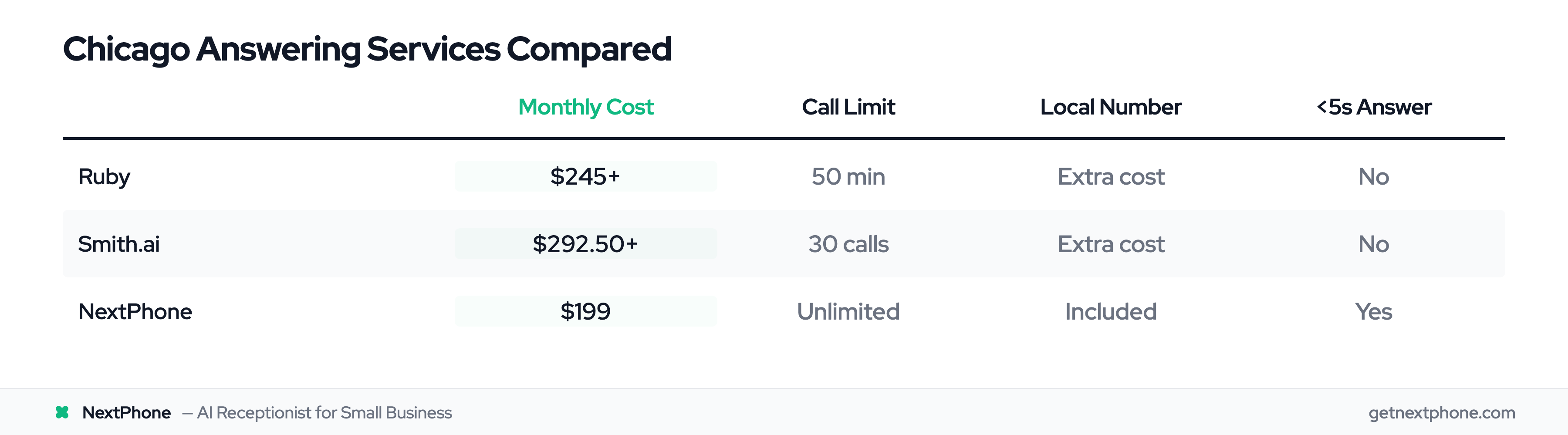
| Feature | Ruby | Smith.ai | NextPhone |
|---|---|---|---|
| Monthly Cost | $250+ | $300+ | $199 |
| Call/Time Limit | 50 minutes | 30 calls | Unlimited |
| 24/7 Coverage | Limited | Limited | Yes |
| Local Chicago Number | Extra cost | Extra cost | Included |
| Answer Speed | 15-30 seconds | 15-30 seconds | <5 seconds |
| Spam Filtering | Optional | Included | Included |
| Per-Call Overages | Yes | Yes | No |
The math is straightforward. At $199/month with unlimited calls, NextPhone costs 60-85% less than traditional services for most Chicago businesses. And you never have to worry about overage fees during busy seasons.
The Hybrid Approach
The best setup combines AI speed with human judgment. AI handles the routine calls that make up 60-80% of your volume: business hours, directions, basic pricing questions, appointment scheduling. These calls don't need a human - they need fast, accurate responses.
Emergencies get routed immediately to your phone. When someone calls at 2 AM saying their basement is flooding, the AI recognizes the urgency and calls you directly. For more details on how this works, see our guide to emergency call routing.
Complex situations transfer to you when you're available. If a caller has questions the AI can't answer, they get connected to you or a team member - but only after the AI has collected their information and assessed their needs.
This approach gives you the best of both worlds: AI handles the volume, and you handle the conversations that actually need you.
How AI Answering Services Handle Chicago Calls
Instant Call Pickup
The industry standard for professional call handling is the "80/20 rule" - 80% of calls answered within 20 seconds. Most human receptionists take 15-30 seconds to pick up after the first ring.
AI changes that equation. NextPhone answers in under 5 seconds, every time. No hold music. No "please wait while I transfer you." Just an immediate greeting and engagement.
For Chicago businesses, this speed matters. When 85% of unanswered callers won't call back, shaving 10-20 seconds off your answer time can be the difference between capturing a lead and losing them to competition.
And the AI works 24/7/365 - including Chicago's brutal winter holidays when your family wants you at dinner, not answering work calls.
Smart Call Handling
The 1,446,980+ business calls we've answered show what customers actually want when they call:
Quote and estimate requests (among the top reasons people call): Customers want to know if you can help and roughly what it might cost. The AI collects project details, timeline, budget range, and contact information - everything you need to prepare an accurate quote.
Scheduling requests (the single most common reason people call): Customers ready to book need available time slots. AI can check your calendar, offer options, and confirm appointments with text or email reminders.
Emergency calls (a recurring reason people call): When someone says "pipe burst," "no heat," or "no power," the AI recognizes the urgency language and routes the call immediately to your cell phone. You decide if it's a true emergency worth leaving the job site.
Callback requests (approximately one in four callers): When callers need to speak with you specifically, the AI captures their information and reason for calling, then tracks the callback to make sure it actually happens.
Basic questions: Business hours, service area, whether you work on their type of equipment. These make up a significant portion of call volume, and AI handles them instantly.
Chicago-Specific Scenarios
Summer heat wave: It's mid-July and temperatures hit 95 degrees for the third straight day. AC failures spike across the city. Your phone is ringing constantly, but you're on a job in Naperville. The AI captures every lead, routes true emergencies to your cell, and schedules routine maintenance calls for the following week when the rush dies down. Nothing falls through the cracks.
Winter polar vortex: It's 3 AM in January, wind chill is -20, and someone's furnace just died. The AI answers immediately, assesses the situation (elderly resident? Pipes at risk of freezing?), and decides whether to wake you. True emergencies get through. Someone asking about a maintenance appointment for next month doesn't interrupt your sleep.
Storm damage season: A spring hailstorm hits the northwest suburbs. Your phone blows up with roofing calls. A human receptionist would be overwhelmed. The AI handles unlimited concurrent calls - whether it's 5 at once or 50 - giving every caller immediate attention and capturing every lead.
After-Call Actions
The call is just the beginning. After every call, the AI:
- Sends text confirmation to the customer with your business name, contact info, and appointment details if applicable
- Emails you a call summary with transcript, caller information, and reason for calling
- Pushes lead data to your CRM automatically (works with ServiceTitan, Housecall Pro, Jobber, and others)
- Tracks callback requests so you can see exactly who needs a return call and why
This automation closes the loop on every call. No more sticky notes lost on the dashboard. No more forgetting to call someone back. Every lead is captured, organized, and actionable.