
Introduction
Your gut feeling about missed calls? It's probably right - and likely worse than you think.
When we analyzed 130,175 calls from 45 contractors over seven months, the numbers stopped us cold: 74.1% of calls went unanswered—and 62% of calls to home services businesses go completely unanswered. That's not a typo. Nearly three out of every four calls rang out or hit voicemail.
If you're searching for the best answering service, you already know something's broken. Maybe you're returning calls hours late and losing bids. Maybe your staff is drowning in phone duties instead of doing their actual jobs. Or maybe you've watched competitors scoop up customers who couldn't reach you.
The good news: the answering service market has more solid options than ever, including AI-powered services that didn't exist five years ago. The bad news: sorting through them all takes time you don't have.
That's why we built this guide. No affiliate-driven fluff, no ranked-by-whoever-pays-us lists. Just data-backed recommendations based on what actually happens when businesses miss calls - and which services actually solve the problem.
What Missed Calls Actually Cost Your Business
Before we get into which services are best, let's talk about what's at stake. Because "missed calls are bad" understates the problem by a factor of about a hundred thousand dollars.
The Numbers Behind the Problem
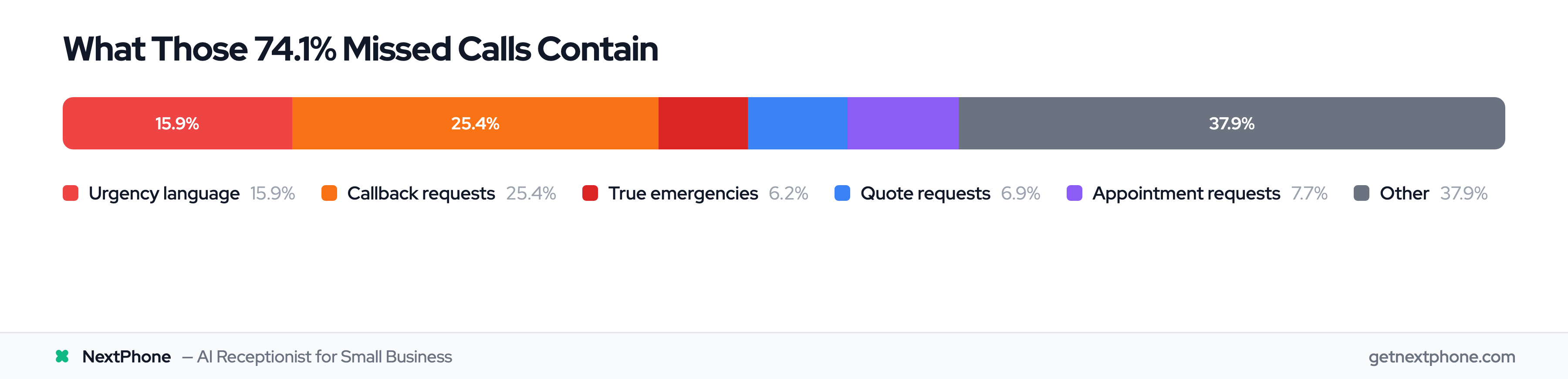
Our research team analyzed 130,175 calls across 45 contractors over seven months. Here's what we found:
74.1% of calls went unanswered. During business hours, after hours, weekends - the pattern held. Most calls simply never connected with a human.
Only 25.4% of callers left messages or called back. Here is why reducing missed calls is the single highest-ROI investment for service businesses. The "I'll call them back" strategy fails because most callers don't give you the chance. They call your competitor instead.
15.9% of calls contained urgency language. Phrases like "as soon as possible," "emergency," or "need help today." These callers aren't browsing - they're buying.
6.2% were true emergencies. Burst pipes, no heat in winter, electrical failures. Miss these calls and you're not just losing revenue - you're abandoning people who need help.
The Annual Financial Impact
When you add it all up, the average contractor in our study lost an estimated $189,068 per year to missed calls. 42% of small businesses lose $500+ per month to missed calls.
Let that sink in. That's not revenue they failed to grow into. That's money that rang their phone and went somewhere else.
Here's the math: Each missed call has a conversion probability. Each converted call has an average job value. Multiply across thousands of missed calls, and you get a number that should make every business owner uncomfortable.
The flip side? Even capturing 10% more of those calls would cover the cost of any answering service on this list - many times over. See our missed call cost calculator for your industry-specific numbers.
Types of Answering Services Explained
Not all answering services work the same way. Understanding your options helps you choose the right fit.
Traditional Live Answering Services
Human operators answer your calls 24/7, following scripts you provide. They can take messages, transfer calls, schedule appointments, and handle complex conversations.
Pricing model: Usually per-minute, ranging from $0.75 to $1.50 per minute of talk time.
Best for: Businesses where calls require judgment, empathy, or complex problem-solving. For context, the receptionist median wage is $17.90/hr ($37,230/year). Professional services, medical offices, and high-touch industries often prefer live operators.
Watch out for: Costs scale with volume. A busy month can mean a surprising bill. See our answering service cost breakdown for the full fee analysis.
AI-Powered Answering Services
85% of customer service leaders will explore or pilot conversational generative AI in 2025, and the virtual receptionist market is now worth $6.26B. Automated voice AI handles calls using natural language processing. Modern AI services can carry conversations, answer questions, capture information, and even schedule appointments.
Pricing model: Typically flat monthly rates, often $150-$250 regardless of call volume.
Best for: Businesses with high call volume, significant after-hours traffic, or a need for consistent call handling. Service businesses and contractors often benefit most.
Watch out for: AI struggles with highly complex or emotional situations. Good services offer escalation paths when AI hits its limits. Learn more about how AI receptionists actually work.
Hybrid Solutions
These services combine AI for routine calls with human operators for complex ones. AI handles simple requests and qualifies callers; humans step in when needed.
Pricing model: Varies, often combining base fees with per-minute human time.
Best for: Businesses with mixed call types - some simple, some complex. Offers AI efficiency without sacrificing human capability.
Virtual Receptionist Services
More than just answering calls, virtual receptionists provide administrative support. They might manage calendars, handle intake forms, make outbound calls, and perform follow-up tasks.
Pricing model: Higher base rates, often $300+ monthly, sometimes with additional per-task fees.
Best for: Businesses needing more than call answering - those wanting a remote extension of their office staff.
How We Evaluated These Answering Services
We looked at dozens of answering services and narrowed them down based on criteria that matter to actual businesses - not just impressive feature lists.
24/7 Availability: Our data shows 6.2% of calls are true emergencies. Services must actually answer at 2 AM, not just claim to.
Pricing Transparency: "Starting at" pricing means nothing. We looked for real costs at realistic usage levels.
Industry Expertise: Does the service understand contractors, service businesses, and trades? Generic scripts waste caller time.
Integration Capabilities: Can it connect with your CRM, scheduling software, or dispatch system? Isolated data creates extra work.
Setup Speed: How quickly can you go live? Days matter when calls are being missed.
Contract Flexibility: Month-to-month options beat annual commitments when you're not sure about fit.
Customer Reviews: Real user experiences across multiple platforms, not cherry-picked testimonials.
Scalability: Can it handle growth without breaking or repricing?
Best Answering Services for 2026: Our Top Picks
1. NextPhone - Best AI Answering Service for Contractors
NextPhone was built specifically for contractors and service businesses, using data from our analysis of 130,175 real contractor calls. It's AI-powered, providing 24/7 coverage with flat-rate pricing.
- AI trained on actual contractor call patterns
- Appointment scheduling with calendar integration
- Emergency call escalation
- CRM and dispatch software integrations
- Call transcripts and recordings
Pricing: $199/month flat rate - no per-minute fees, no overages
Pros:
- Built from real contractor data, not generic AI
- Predictable monthly cost regardless of volume
- Instant setup - go live same day
- Understands service industry terminology and urgency
Cons:
- AI-only (no human operator option)
- Newer company compared to established players
- May struggle with highly unusual requests
Best For: Contractors, HVAC companies, plumbers, electricians, and service businesses wanting consistent 24/7 coverage at a predictable price.
2. Ruby - Best Live Answering for Premium Experience
Ruby has built a reputation as the gold standard for live answering services. Their US-based receptionists receive extensive training and genuinely sound like part of your team.
Key Features:
- Live US-based receptionists
- Mobile app for managing calls
- Warm transfers
- Appointment scheduling
- Bilingual options available
Pricing: Starting around $230/month for 50 receptionist minutes, scaling with usage
Pros:
- Exceptional call quality and professionalism
- Strong training programs
- Reliable technology platform
- Excellent customer support
Cons:
- Per-minute pricing adds up quickly
- Premium pricing at all tiers
- Overages can surprise you
Best For: Law firms, professional services, and businesses where caller experience justifies premium pricing.
3. AnswerConnect - Best for 24/7 Live Coverage
AnswerConnect delivers reliable round-the-clock live answering with strong capabilities for lead capture and appointment scheduling.
Key Features:
- True 24/7/365 live coverage
- Bilingual English/Spanish
- Appointment scheduling
- Lead capture and qualification
- Custom scripting
Pricing: Custom quotes, typically $200-400/month depending on volume and features
Pros:
- Genuinely 24/7 with consistent quality
- Good software integrations
- Flexible scripts
- Experienced with service businesses
Cons:
- Pricing requires a sales conversation
- Setup takes longer than AI alternatives
- Quality can vary by operator
Best For: Businesses with significant after-hours call volume needing live operators.
4. Smith.ai - Best Hybrid Solution
Smith.ai combines AI and human operators intelligently. Their system handles simple calls automatically while routing complex ones to trained receptionists.
Key Features:
- AI for routine calls, humans for complex
- Lead screening and intake
- Appointment booking
- Outbound calling capabilities
- CRM integrations
Pricing: Starts around $255/month for 30 calls
Pros:
- Smart routing reduces costs
- High-quality human operators when needed
- Modern technology platform
- Good for businesses with mixed call types
Cons:
- Per-call pricing requires monitoring
- Learning curve for optimal setup
- Premium pricing tier
Best For: Businesses that specifically require paid human agents on every call (be prepared to pay 3-4x more).
5. VoiceNation - Best Budget Live Option
VoiceNation offers live answering at price points that work for businesses watching every dollar. They're not fancy, but they're reliable.
Key Features:
- 24/7 live answering
- US-based operators
- Message taking and call patching
- Basic appointment scheduling
Pricing: Plans starting around $70/month for limited minutes
Pros:
- Genuinely affordable
- Simple, straightforward service
- Reliable coverage
- No long-term contracts required
Cons:
- Fewer integrations than competitors
- Basic features only
- Per-minute overage can add up
Best For: Small businesses and startups needing basic live coverage on a budget.
6. Specialty Answering Service (SAS) - Best for Call Center Needs
SAS provides full call center capabilities beyond basic answering - inbound, outbound, order taking, and more.
Key Features:
- Inbound and outbound calling
- Order processing
- Appointment scheduling
- Lead generation
- Overflow handling
Pricing: Per-minute pricing, varies by services used
Pros:
- Comprehensive service options
- Scalable for growing businesses
- Experienced team
- Industry specializations available
Cons:
- Complex pricing structure
- More enterprise-focused
- Setup requires more planning
Best For: Larger businesses needing call center functionality, not just answering.
7. MAP Communications - Best for Medical and Legal
MAP Communications specializes in industries with strict compliance requirements. Their operators understand legal intake and sensitive call handling.
Key Features:
- Compliant call handling
- Legal intake expertise
- Trained industry-specific operators
- Secure message delivery
Pricing: Custom, typically $200+ monthly
Pros:
- Compliance expertise built in
- Professional scripting
- Understands industry terminology
- Reliable and established
Cons:
- Not contractor or trade-focused
- Premium pricing
- May be overkill for simple needs
Best For: Medical offices, law firms, and compliance-sensitive industries.
8. Abby Connect - Best for Personalized Service
Abby Connect assigns dedicated receptionist teams to your account. The same people answer your calls consistently, learning your business over time.
Key Features:
- Dedicated receptionist teams
- Personalized call handling
- Appointment scheduling
- Custom call flows
Pricing: Starting around $300/month
Pros:
- Consistency - callers reach the same people
- Receptionists truly learn your business
- High-quality, personalized service
- Strong attention to detail
Cons:
- Premium pricing
- Less flexibility than pooled services
- Longer onboarding process
Best For: Businesses valuing relationship and consistency over lowest price.
Answering Service Pricing Comparison
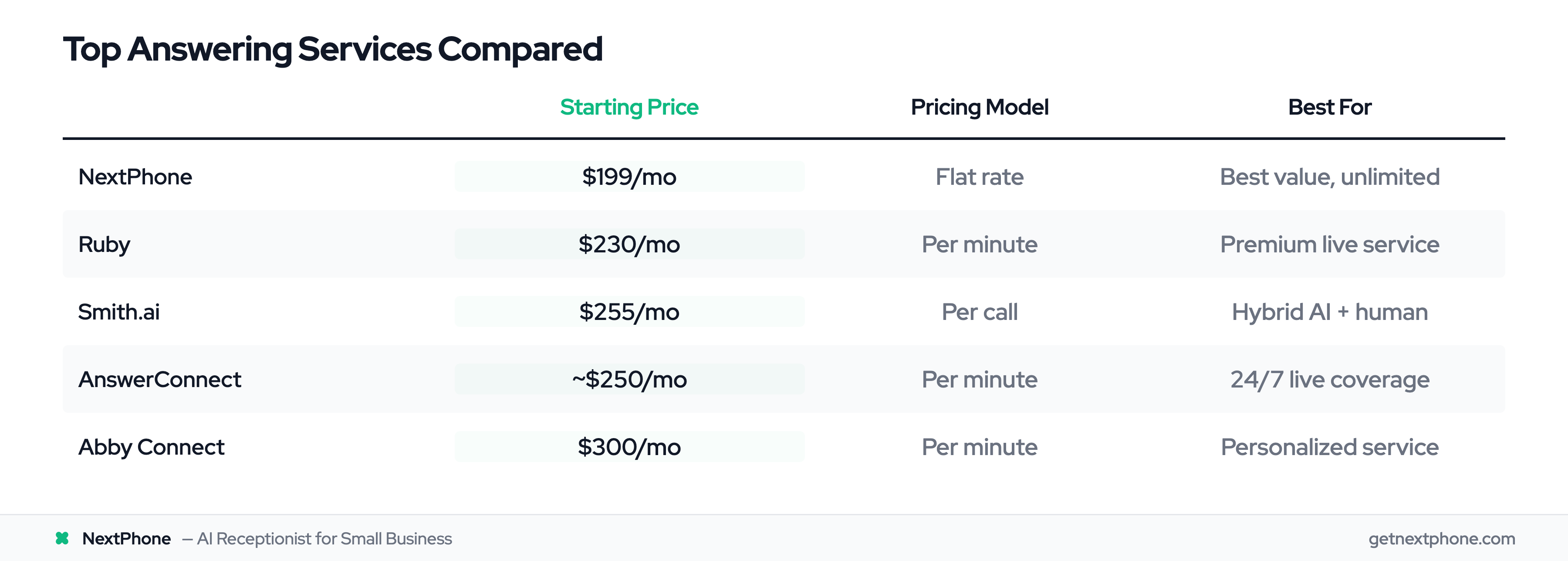
| Service | Starting Price | Pricing Model | Best For |
|---|---|---|---|
| NextPhone | $199/mo | Flat rate | Best value, unlimited |
| Ruby | $230/mo | Per minute | Premium service |
| Smith.ai | $255/mo | Per call | Hybrid needs |
| AnswerConnect | ~$250/mo | Per minute | 24/7 live |
| Abby Connect | $300/mo | Per minute | Personalized |
Understanding Pricing Models
Flat rate: You pay the same amount regardless of call volume. See flat rate vs per-minute answering service for when each model makes sense. Best for predictable budgeting and businesses with variable call patterns.
Per minute: You pay for actual talk time. Can be economical for low volume but unpredictable and expensive during busy periods.
Per call: You pay per call handled. Simpler than per-minute but still variable with volume.
Hidden costs to watch: Setup fees, holiday rates, after-hours premiums, integration charges, and overage penalties. Always ask about total cost, not just the starting price. For full cost breakdowns by provider, see our answering service cost comparison.
Answering Services by Industry
Different industries have different call patterns and requirements. Here are our dedicated guides for the most common verticals:
- Contractors -- Emergency dispatch, estimate scheduling, after-hours coverage
- Plumbers -- 24/7 emergency calls, seasonal surges, dispatch integration
- HVAC -- Seasonal volume spikes (summer/winter), maintenance scheduling
- Electricians -- High spam rate (15.5%), emergency routing critical
- Law Firms -- Client intake, conflict checking, confidential handling
- Medical Offices -- Regulatory compliance, patient scheduling, triage routing
- Dental Practices -- Appointment scheduling, insurance questions
- Real Estate -- Showing scheduling, lead capture, time-sensitive inquiries
- Roofing -- Highest quote request rate (10.6%), storm surge handling
- Landscaping -- Seasonal business, estimate scheduling
How to Choose the Right Answering Service
For Contractors and Service Businesses
Your calls often include urgency - remember, 15.9% contain urgency language and 6.2% are true emergencies. Prioritize:
- 24/7 coverage (non-negotiable)
- Fast setup
- Scheduling integration
- Understanding of trade terminology
Our recommendation: NextPhone or AnswerConnect. Both understand service businesses and offer solid 24/7 coverage. NextPhone wins on predictable pricing; AnswerConnect wins if you prefer live operators.
For Professional Services
Your callers expect polished professionalism. Prioritize:
- Quality of human interaction
- Warm transfer capability
- Professional intake processes
- Compliance if needed
Our recommendation: NextPhone for flat-rate unlimited AI answering with smart forwarding for complex calls. At $199/month with 24/7 coverage, it's more cost-effective than per-minute human services while providing better availability.
For High-Volume Businesses
Your cost-per-call matters at scale. Prioritize:
- Flat-rate or declining per-unit pricing
- Strong integrations to avoid manual data entry
- Reporting and analytics
- Scalability
Our recommendation: AI services like NextPhone handle volume best. For live options, negotiate volume discounts with larger providers.
For Budget-Conscious Startups
You need coverage without breaking the bank. Prioritize:
- Low entry price
- Month-to-month flexibility
- Basic but reliable service
Our recommendation: NextPhone at $199/month flat — unlimited calls, no contracts, no per-minute fees. Live in 1-2 days with zero setup cost.
Making the Switch: What to Expect
Switching to an answering service feels like a big step. Here's what actually happens.
Typical Setup Timeline
AI services: Same day to 48 hours. You provide business information, set up integrations, and go live. NextPhone and similar services can have you answering calls within hours.
Live services: 1-2 weeks typically. Operators need to learn your scripts, understand your business, and practice scenarios. Rush setup is sometimes available.
Information You'll Need
Before starting, gather:
- Business hours and after-hours procedures
- Common call types and appropriate responses
- Emergency escalation procedures (who to call, when)
- CRM or scheduling software credentials for integration
- Frequently asked questions and answers
Testing Your New Service
Once live:
- Call your own number from different phones
- Test after-hours handling
- Try edge cases (emergencies, complex questions)
- Review call recordings or transcripts
- Adjust scripts based on what you hear
Most services expect and welcome this testing period. Better to find issues in week one than month three.
Frequently Asked Questions
What is the best answering service for small business?
It depends on your priorities. For contractors and service businesses, AI services like NextPhone offer flat-rate pricing that's ideal for small businesses - you know exactly what you'll pay each month. If you prefer human operators, VoiceNation offers budget-friendly plans starting around $70/month. The "best" service is the one that fits your call volume, budget, and industry needs.
How much does an answering service cost per month?
Quality answering services range from $70 to $500+ monthly. AI services typically charge $150-250 flat rate regardless of volume. Live services start lower but charge per minute, often totaling $200-400/month for moderate call volume. Always calculate total expected cost based on your call patterns, not just the advertised starting price.
Are answering services worth the investment?
Almost always, yes. Our research shows contractors lose an average of $189,068 annually to missed calls. Even a $300/month service costs $3,600 per year. If that service helps you capture just two or three extra jobs, it pays for itself many times over. The math works for nearly every service business.
What's the difference between an answering service and a virtual receptionist?
Answering services handle incoming calls - taking messages, scheduling, transferring. Virtual receptionists provide broader administrative support: managing calendars, making outbound calls, handling intake paperwork, and performing follow-up tasks. Virtual receptionists cost more but do more. Choose based on whether you need call answering only or full remote admin support.
Can answering services schedule appointments?
Most can, though capabilities vary significantly. AI services like NextPhone integrate directly with calendar software, booking appointments automatically. Live services may use your scheduling software remotely, use their own system, or simply collect information for you to schedule later. If scheduling is critical, verify the specific capability before signing up.
Do I need 24/7 coverage?
For service businesses, yes. Our data shows 6.2% of calls are true emergencies and 15.9% contain urgency language. These calls often come after hours - a burst pipe at 10 PM, a no-heat call on Saturday morning. After-hours callers who reach you are often the most valuable leads. Don't miss them.
How do AI answering services compare to human operators?
AI offers consistency, true 24/7 availability, and predictable flat-rate pricing. Every call gets the same quality handling regardless of time or volume. Humans offer adaptability, emotional intelligence, and better handling of truly complex situations. For most service business calls - scheduling, information, message taking - AI handles them well. For complex emotional situations, humans still have the edge. Hybrid solutions offer both.
Conclusion
Let's bring it back to where we started: 74.1% of calls going unanswered, $189,068 in annual losses, and callers who need help moving on to your competitors.
The answering service market has evolved. AI now resolves 90-95% of calls on its own — faster, cheaper, and more consistently than human services.
Our recommendation: NextPhone. It was built from analysis of 130,175 real contractor calls, understanding the specific patterns of how service businesses get and miss calls. The $199/month flat rate means no surprises, and you can be live within hours.
But whatever you choose, choose something. The cost of inaction - nearly $190K per year - dwarfs the cost of any service on this list.
Stop losing calls. Stop losing revenue. Pick a service and go live this week. Your future customers are calling.
Ready to stop missing calls? [See how NextPhone works for contractors →]